🔎 Reverse Image Search
Image search techniques made simple: upload a photo or paste a URL and search 6 engines at once. 100% free, nothing stored.
🔒 Your image is never stored on our servers longer than 24 hours and is never shared.
A brand account posts a still from a film, adds the film’s name in the caption, and waits for the likes. Then the post disappears, or a copyright notice lands in the inbox. The question behind this guide comes from Quora, where a reader asked: “Is copyright law violated if a screenshot and quote from a movie (with references of course) shared in a commercial product account in Instagram?” Two answers were given, and both pointed the same way. This guide works through the answer properly, for movie screenshots on Instagram on a commercial account, not a personal one.
This is general information, not legal advice. Copyright rules differ between countries, and only a court can settle a fair use or fair dealing argument. What follows is what the official sources actually say, so you can judge the risk before you post.
Direct answer: Yes, in most cases. A movie screenshot is a copy of a copyrighted film, and posting it on a commercial Instagram account counts as publishing that copy, even with a credit line. Credit is not permission. The only defences are a genuine fair use case, a studio licence, or a still from a film that is in the public domain.
A related question is whether Instagram tells someone when you screenshot their post. It does not, for an ordinary post, reel or story. It only alerts the sender when you screenshot a disappearing photo or video, or a message in Vanish Mode. That is a separate question from copyright, and it does not change whether posting the still is allowed.
What counts as a movie screenshot in copyright terms?
A movie screenshot is a copy of a frame from a copyrighted film. That is the whole point, and it is the point people most often miss. A film is a creative work. Every frame in it is part of that work. Taking a screenshot does not create a new work of yours. It copies a small piece of someone else’s.
Copyright in a film starts automatically the moment the film is made. No watermark is needed, no copyright notice is needed, and no registration is needed for the work to be protected. A single frame, even one that flashes past in a split second, is still part of the protected work. The studio, or whoever holds the rights, owns that frame. Your phone took the screenshot, but the picture inside it belongs to the rights holder.
This matters because the defence people reach for first, “it is only one frame”, has no legal weight on its own. One frame is still a copy. The question is never how much of the film you took. The question is whether you had permission, a licence, or a defence that covers the use.
Is posting a movie screenshot on Instagram copyright infringement?
In most cases, yes. Taking a screenshot for your own private viewing is one thing. Saving it and posting it publicly on Instagram is another. The first is a private copy you never share. The second is publishing someone else’s work to your audience, on an account that exists to sell products.
The commercial angle makes it worse, not better. A product account uses the still to attract attention, build a following, and sell something. That is a commercial purpose, and commercial purpose weighs against you in every fair use test. The Quora answers put it bluntly. The long answer says a screenshot of someone else’s work is a copy, that whether it infringes depends on licence or permission, and that a personal use defence only covers a copy you never share. The short answer is blunter still: you cannot use someone else’s content without permission, citation does not matter, and you should buy the licensing rights from the film studio.
None of this means every film still on Instagram gets taken down. Millions of stills sit on fan accounts and meme pages. Some rights holders ignore them. A separate trend edits your own photos with movie-style subtitles and black bars to look like film stills. That uses your own photo, so no copyright question arises. One creator, Thomas Duke, prints film stills and holds them up at the real filming locations to line them up with the scene. Some studios run automated detection and remove them in bulk. The fact that other people post stills, and get away with it, is not a defence. Instagram’s own help pages say so in plain words, and we come to those next.
Why giving credit does not protect you
Credit is what you do after you have permission. It is not a substitute for permission. This is the same spine as our guide on using book images in a YouTube video, and the rule is identical: credit is not permission.
Instagram’s own copyright help page lists the things that do not stop a post from infringing, and the list is worth reading in full. It says you can infringe even if you bought or downloaded the content, recorded it onto your own device, gave credit to the copyright owner, included a disclaimer saying you did not intend to infringe, did not intend to profit, modified the work or added your own original material, found the content available on the internet, saw that others posted the same content, thought the use was fair use, or used an unauthorised streaming device or service.
That list answers nearly every excuse a brand account reaches for. “I credited the film” is on it. “I added a caption and a filter” is on it. “Everyone else posts stills” is on it. “I did not mean to infringe” is on it. None of them turns an unlicensed copy into a licensed one.
Adding your own material does not clean the copy either. Cropping the still, filtering it, adding a caption, or placing it inside a branded template still leaves the studio’s frame at the centre of the post. The US Supreme Court made this point in Warhol Foundation v. Goldsmith in 2023: using a work for the same purpose, on a commercial basis, weighs against fair use even when new expression has been added. A filter is not a new purpose.
Could fair use save the post?
Fair use is the defence most people hope will save them, and it is the defence most people misunderstand. In the United States, fair use is set out in 17 U.S.C. s.107, and the US Copyright Office explains it on its fair use page. Four factors are weighed together, case by case, and only a court can decide the outcome.
The four factors are: the purpose and character of the use, including whether it is commercial or for non-profit education; the nature of the copyrighted work; the amount and substantiality of the portion used; and the effect of the use on the potential market for, or value of, the work. A film is a creative work, which counts against fair use. A commercial product account is a commercial use, which counts against fair use. A still used to decorate a product post does not compete with the film in the market, which helps, but it does not outweigh the first two factors on its own.
There is no formula, and there is no safe percentage. The Copyright Office says so directly: there is no formula to ensure that a predetermined percentage or amount of a work is permissible. Anyone selling a rule like “one frame is always fine” or “under ten seconds is safe” is inventing it.
The narrow path that can work is genuine criticism or review. A real review of a film, where the still illustrates a specific point you are making about that film, is a much stronger case than a still posted because it looks good next to a product. Even then, the use must be limited to what the review needs, and the still must serve the criticism, not the other way round. A fan page, a meme account, or a product post with a film still as decoration rarely fits that description. Fair use is a defence you argue after you are accused, not advance permission to post.
What about the quote in the caption?
The Quora question asks about two things at once: a screenshot and a quote. They are two different things, and they need separate answers. Keep them apart.
The still is a copy of a creative visual work. The quote is text. Short phrases, titles, and names are generally not protected by copyright on their own, so a very short line of dialogue may not be a copyright problem at all. A longer passage is different. A substantial piece of dialogue, quoted at length, still needs a fair use or fair dealing analysis, and a commercial caption does not help it.
Quoting the film’s name, the director, or a line of dialogue does not licence the still. The credit line in the caption and the image in the post are separate acts. You can credit a film perfectly and still infringe by posting its frame. That is the exact trap in the Quora question: “with references of course” sounds careful, and it changes nothing about the still.
UK law draws the line even more sharply. The quotation exception under UK fair dealing does not apply to a photograph, and a film still is, for this purpose, a photographic image. So the caption quote and the still image cannot share one defence in the UK. The quote might be covered. The still is not.
What does UK law say?
UK fair dealing is not the same as US fair use, and the two should never be mixed up. The GOV.UK guidance on exceptions to copyright sets out the UK position, and it is narrower than many people assume.
Fair dealing for criticism, review, or quotation is allowed for any type of copyright work, and a sufficient acknowledgement will be required in each case. But there is no legal definition of fair dealing. The GOV.UK page says it will always be a matter of fact, degree, and impression in each case, judged on the facts. Two factors it names are that the use must not affect the market for the original work, and that the amount of the work used must be reasonable and appropriate.
Two limits matter for a brand account. First, fair dealing for research and private study is non-commercial only, and there is no fair dealing exception for commercial research. Second, as noted above, the quotation exception does not apply to a photograph. A commercial product post on Instagram, using a film still to sell something, is a long way from the criticism or review the exception was written for. A genuine review article that discusses a film and uses one still to illustrate a point it actually makes is a different matter from a product post that borrows a famous frame for attention.
If your audience is in the UK, or your business is, do not rely on US fair use arguments. The UK test is separate, it is fact specific, and it gives a commercial poster very little room.
What can Instagram actually do to your account?
Instagram enforces copyright in two ways: its own systems, and reports from rights holders. Studios use automated detection, including Meta’s Rights Manager, which scans uploaded media against reference files. A still that matches a studio’s reference can be flagged at upload or removed later. Rights holders can also file a report through Meta’s intellectual property form, and Instagram acts on it.
When a post is removed, that is usually the first step, not the last. Instagram’s repeat infringer policy says that if you repeatedly post content that infringes someone else’s intellectual property rights, your account may be disabled or your Page removed. Your ability to post photos or videos may be limited, and you could lose access to certain features on Instagram or Threads. What happens depends on the nature of the reported content and where it was posted. Instagram does not publish a fixed number of strikes, so do not believe any guide that promises you three safe chances.
There is a way back if a removal is wrong. You can appeal, or the rights owner can withdraw the report, and Instagram says restorations are taken into account under the policy. But an appeal only helps if you genuinely had a right to post the still, a licence, permission, or a real fair use case. “I credited the film” is not a ground for appeal, because it was never a defence in the first place.
For a brand account, the real cost is often not the single removed post. It is the account itself. A product account with a following, a catalogue, and paid ads behind it has far more to lose from a disabled account than a personal fan page does. That is the risk the Quora question is really asking about, and it is why a commercial account should be more careful, not less. The same care runs the other way too: protecting your own photos online matters just as much as respecting other people’s.
Worked example: testing a public domain still
There is one clean way to post a film still without asking anyone: use a still from a film that is actually in the public domain. But “old” is not the same as “public domain”, so the still has to be checked, not assumed. Here is a real check, performed for this article on 15 November 2026.
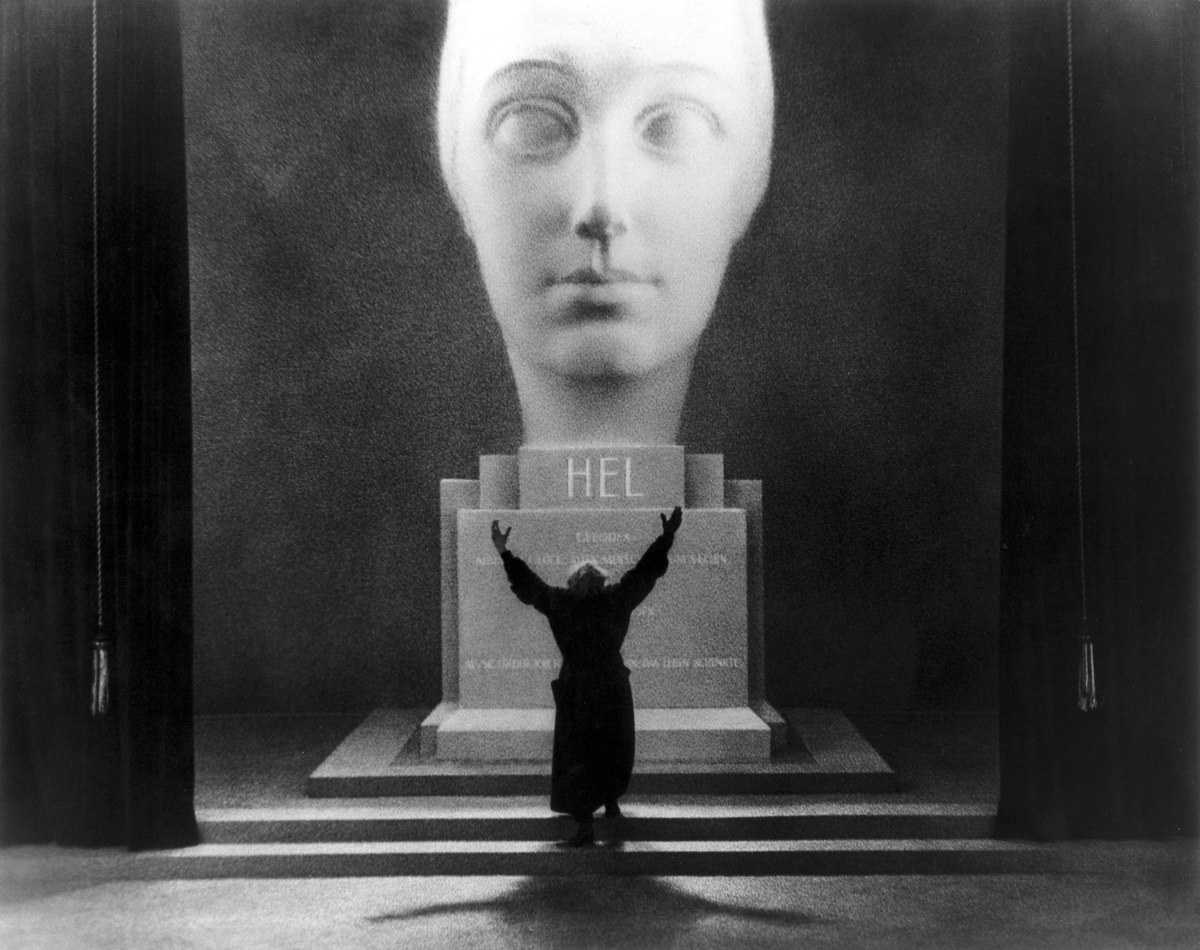
The test image is a still from Metropolis, the 1927 silent film directed by Fritz Lang. It shows Rotwang standing below a large head statue of Hel, an effect achieved with the Schufftan process, and the photograph is credited to Horst von Harbou. The file sits on Wikimedia Commons, where it is marked public domain, with the PD-old-70-expired and public domain mark tags. The film was released in 1927, which puts it before 1931, the date after which US works are generally still protected. That is the first check: the date.
The second check is a reverse image search, to see how widely the still circulates and whether anything about it contradicts the public domain claim. TinEye searched its index of 86.7 billion images and returned 47 matches. The earliest match TinEye had indexed was 14 March 2008, on amazon.com, a product image for a Metropolis DVD. Other early matches included a Spanish film blog from April 2008 and an Australian film history page from February 2010. Nothing in the results suggested a live rights claim on the image itself. The still has been circulating freely for nearly two decades.
Google Lens did not cooperate. Three fresh sessions were tried, and all three failed. The Lens page showed an empty AI Overview heading, the image thumbnail never loaded, and each session ended with “Expired visual search” or “Something went wrong, no image at the URL”. A later attempt hit Google’s unusual traffic block instead. That failure is reported here as a failure, not a clean result. A failed search proves nothing about the image.
What the test proves is narrow, and it should stay narrow. It proves this one still is public domain, widely circulated, and safe to use with a proper credit to the film and the photographer. It does not prove that any old film still is free. A film from 1960, 1980, or 2020 is almost certainly still protected. The check has to be run on the actual film, every time. Our guide to public domain photos walks through that check in full, including the UK rules, which differ from the US ones.
The film still commercial use table
Use this table as the quick test before any post goes live. If your planned use sits in a high risk row, do not post it and hope. Get a licence, or use a different image.
| Planned use | What it really is | Risk on a brand account | What to do instead |
|---|---|---|---|
| Single still on a product post, no permission | Publishing a copy of a copyrighted frame | High, removal and repeat infringer action | Licence it, or use your own photo |
| Still inside a genuine film review | Illustration for criticism or review | Lower, if the still serves the review | Keep it to one still, and make the point it illustrates |
| Still as a meme or fan edit | Decorative reuse of a copyrighted frame | High, fair use rarely covers it | Make your own graphic, or quote the film in words |
| Still with a full credit line | An unlicensed copy with a credit attached | High, credit is not permission | Get written permission first, then credit |
| Cropped or filtered still | The same copy with a new look | High, editing does not clean it | Do not rely on a filter as a defence |
| Short dialogue quote in the caption | Text, not an image copy | Low for a short line, higher for long passages | Keep quotes short, and quote accurately |
| Still from a public domain film | A copy of a work whose copyright expired | Low, once the date is verified | Check the film’s date and country rules first |
| Licensed stock still | A copy used under a licence | Low, if the licence covers Instagram | Read the licence, and keep the receipt |
| Still showing a recognisable actor | Copyright plus a likeness layer | High, two rights at once | Licence it, and check the likeness rules too |
| Still used in a paid Instagram ad | Commercial use of a copyrighted frame | Highest, ads draw the most attention | Never use an unlicensed still in an ad |
How to use film imagery legally on a brand account
There are four routes that actually work. Pick one of them, and keep a record of it, so you can show it if a post is ever questioned.
- Ask the studio or rights holder. This is the route the Quora answers recommend, and it is the only one that covers a current film still. Studios and distributors have licensing and permissions teams. Write to them, say exactly how you want to use the still, on which account, and for how long, and get the answer in writing. A verbal yes from a social media manager is not a licence.
- Buy a licensed still. Stock agencies sell licensed film stills, and some offer editorial or commercial licences that cover social media. Read the licence before you pay. A licence that covers a website may not cover Instagram, and a licence for personal use never covers a product account. Keep the invoice and the licence terms with the post.
- Use a public domain film. Films published in the United States before 1931 are generally in the public domain there, and the Metropolis test above shows how to verify one. Check the date, check the country, and check the film, not just the still. UK rules differ, so do not assume a US public domain film is free everywhere. Our public domain guide covers both sets of rules.
- Make your own image. An original graphic, an illustration, or a photo you took yourself carries none of this risk. A still from a film is attractive because the film did the work. Your own image does the same job without borrowing anyone else’s. If your post is about a film, a short written quote or a genuine review can carry the reference without the still.
Two traps to avoid. First, fan stills databases host thousands of stills, but hosting is not licensing. Downloading a still from a database gives you a file, not a right. Second, AI faces are not a shortcut around this either. Swapping a generated face onto a film still leaves the underlying frame, the set, the costumes, and the composition in place, and none of that becomes yours. Our guide to AI faces in adverts works through that problem in full.
What to do if you already posted movie screenshots
If your account already carries unlicensed stills, audit it before Instagram or a studio does it for you. Go through the grid, post by post, and ask the table’s question about each one. Delete the posts that sit in the high risk rows. Do not repost them, and do not re-upload them as stories, because stories carry the same rules as feed posts even though they disappear after 24 hours.
If a post has already been removed, read the notice carefully. It will tell you who reported it and what your options are. If you genuinely held a licence or a real fair use case, appeal with the evidence. If you did not, accept the removal, delete any similar posts, and move on. Filing a counter-notice you cannot support is worse than the removal, because a counter-notice is a formal statement made under penalty of perjury.
Going forward, set a simple rule for the account: no film still goes up without a licence, a public domain check, or a genuine review it illustrates. Write the rule down, and make sure anyone who posts for the brand knows it. One careful habit is worth more than a dozen deleted posts.
Film stills are powerful images, and that is exactly why they are protected. A commercial Instagram account borrows that power every time it posts one. Borrow it properly, with a licence or a public domain check, and the post is safe. Borrow it on a credit line and a hope, and the account pays for it sooner or later.
Can I post a movie screenshot on Instagram if I give credit?
No. A credit line tells people where the still came from, but it does not give you permission to publish it. Instagram’s help pages say you can still infringe even if you gave credit. The only thing that makes the post safe is a licence, a genuine fair use case, or a still from a film in the public domain.
Is one movie screenshot fair use on Instagram?
Not automatically. Fair use is decided case by case, and a single frame is still a copy of a copyrighted film. A still in a review, used to make a specific point about the film, has a stronger case. A still posted to promote a product rarely qualifies. Only a court can settle it, and there is no safe percentage.
Can I use a movie screenshot in a film review on Instagram?
Yes, sometimes, if the review is genuine. A still that illustrates a point you actually make about the film has a stronger fair use or fair dealing case than a still used as decoration. Keep it to one still, use only what the review needs, and add acknowledgement. A product post dressed up as a review does not count.
What happens if Instagram removes my post for copyright?
The post is deleted and you get a copyright notice. If it happens again, Instagram’s repeat infringer policy can limit your ability to post, remove features, or disable the account. You can appeal if you genuinely had a licence or a real fair use case. Credit alone is not a ground for appeal, because it was never a defence.
Are old movie screenshots free to use on Instagram?
Not just because they are old. A film still is only free when the film’s copyright has actually expired, and the date differs by country. Films published in the United States before 1931 are generally in the public domain there. Always check the film’s date and your country’s rules first, and run a reverse image search to confirm the still.
Can I use a movie still in a paid Instagram ad?
No, not without a licence. A paid ad is the most commercial use of all, and it draws the most attention from rights holders and automated detection. The fair use case is weakest here, because the still is being used to sell something. If the film matters to the campaign, licence the still or use a public domain film instead.