🔎 Reverse Image Search
Image search techniques made simple: upload a photo or paste a URL and search 6 engines at once. 100% free, nothing stored.
🔒 Your image is never stored on our servers longer than 24 hours and is never shared.
Short answer: You can identify a flag from a photo in three steps. Reverse-search the photo first, because a match names the flag for you. If that fails, describe what you see: the colours, the stripe direction, and any emblem. Then check your description against a flag database. Most flags are identified in under five minutes this way.
A flag in a photo is a small puzzle. You can see the design clearly enough to describe it, but you cannot name the country, region, or organisation it belongs to. It might be a flag you saw on holiday, one flying outside a building, or one in an old family photograph. The good news is that flags are one of the easiest things to identify from a photo. There are only around 200 national flags in the world, and each one has a fixed design. A reverse image search often names the flag in seconds. When it does not, a short description plus a flag database finishes the job.
This guide shows the method that works: reverse-search first, describe second, and check a database third. It uses a real worked example, a flag photo reverse-searched live, and a table of the lookalike flags that trip people up most. The same method works for national flags, regional flags, and historical flags, and it works whether the photo is sharp or a little worn.
How do you identify a flag from a photo?
In short: reverse-search the photo, and if that gives you nothing, describe the flag and check it against a database. That is the whole method. The three steps below are the ranking asset of this article, and every section after this one walks through one of them in detail.
Vexillology is the study of flags. You do not need to know the word to use the method, but it helps when you search: flag databases and flag forums use it, and the best of them are run by people who have studied flags for decades.
| Step | What to do | What it tells you |
|---|---|---|
| 1. Reverse-search the photo | Upload the photo to a reverse image search and look at the matches. | The flag’s name, when the same photo already exists online. |
| 2. Describe what you see | Note the colours, the stripe direction, the number of bands, and any emblem. | A short description you can match against a flag list. |
| 3. Check a flag database | Search your description in a classification tool or a flag encyclopaedia. | The shortlist of flags that fit, usually two or three. |
| 4. Confirm with context | Check where the photo was taken and what the flag is flying next to. | Which flag on the shortlist is the right one. |
Most people stop at step one, and most of the time that is enough. A clear photo of a well-known flag will match a copy of the same image, or a near copy, and the page it comes from will name the flag. The later steps matter when the photo is unusual: a flag photographed at an angle, a flag in a crowd, a regional flag, or a flag that looks almost identical to another one.
How do I reverse-search a flag photo?
In short: crop the photo so the flag fills the frame, then upload it to a reverse image search and read the matching pages. A flag is a simple shape, so the search works best when the flag is the main thing in the picture.
Follow these steps.
- Crop the photo tightly around the flag. Cut out people, sky, and buildings around it. A flag that fills most of the frame gives the search engine far more to work with than a small flag in a wide scene. If the flag is waving and folded, pick the clearest frame you have.
- Upload the cropped photo to a reverse image search. Start with our free reverse image search tool, which checks six search engines at once, or use Google Lens on its own. If you have never run one before, our guide to reverse image search walks through it step by step.
- Read the matching pages, not just the thumbnails. A match tells you where the same image appears online. Open the top two or three results and see how each page names the flag. If two unrelated pages agree, you have your answer.
- Check the source page, not the image host. Stock photo sites and wallpaper sites often label flags wrongly. A page from a flag database, a news site, or a government site is worth far more than a wallpaper caption.
One practical note from our own testing: Google Lens sometimes refuses an image sent to it as a web address, and says it found no image at that address. Uploading the photo file directly, from your phone or computer, is the reliable route. The worked example below shows exactly that happening.
Worked example: a white flag with a blue cross
In short: TinEye matched the photo to Finland’s flag in seconds, while Google Lens would not load the image from its web address at all. This is a real test, run on 16 November 2026, on a real photograph. Nothing here is staged.
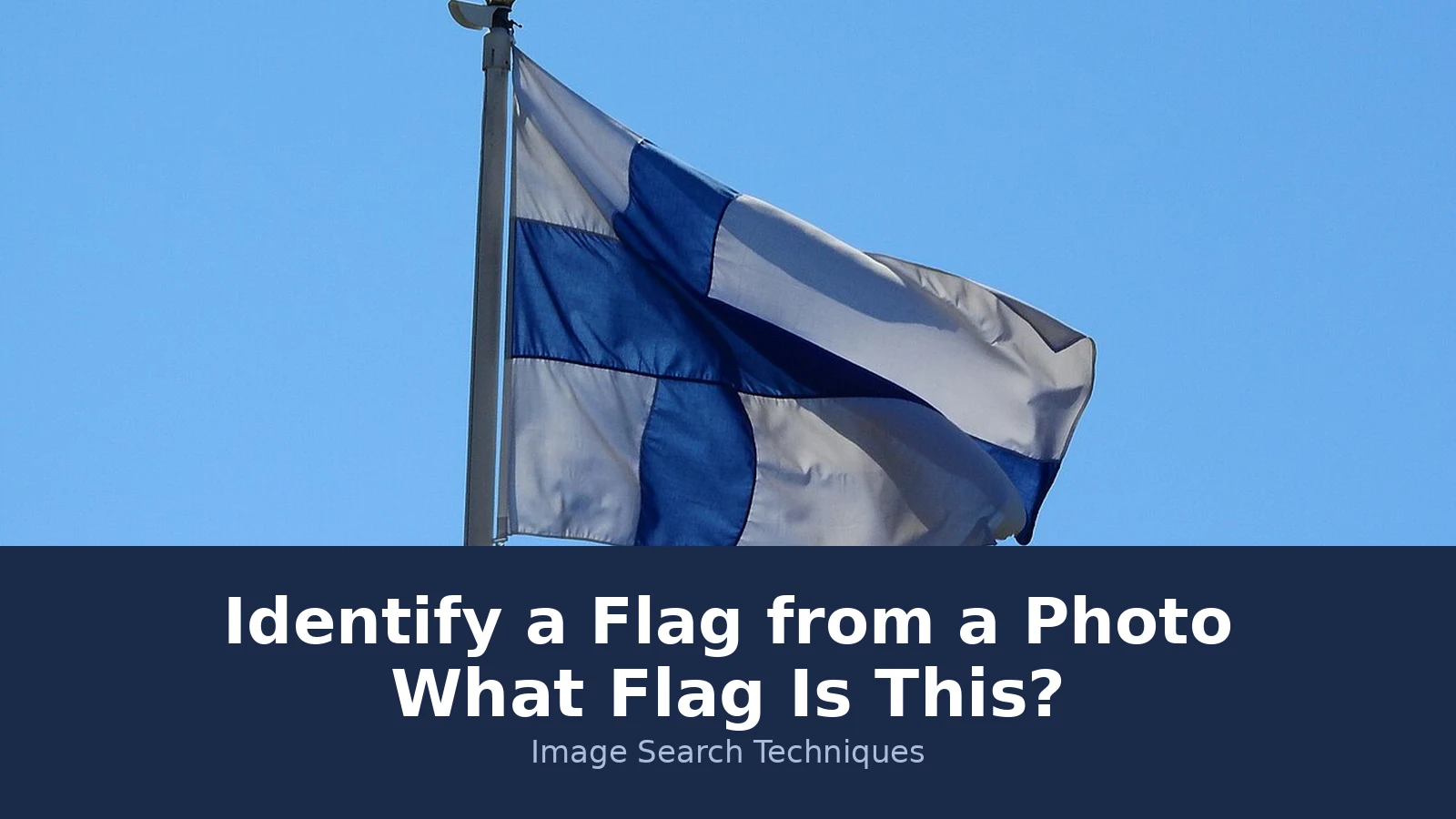
The test photo is a Wikimedia Commons photograph of a flag on a flagpole against a blue sky, taken on 15 August 2015. The flag is white with a blue cross that sits off centre, closer to the pole. If you know flags, you may already guess Finland. The point of the test is to see what the tools say when you do not guess.
| Search engine | What happened | What it named |
|---|---|---|
| TinEye | 20 results, after searching 86.7 billion images. First indexed on 14 January 2017. | Finland. The matching copies carry file names such as “finland-finnish-flag-siniristilippu-wallpaper.jpg”. |
| Google Lens | Would not load the image from its web address on two tries, and showed no matches at all. | Nothing. The page said “No image at the URL”. |
TinEye’s result is a good example of how to read a match. TinEye does not print a label saying “this is Finland’s flag”. It shows you the same image on other sites, and the file names and pages around it do the naming. The top matches here name the flag plainly: “finland”, “finnish-flag”, and “siniristilippu”, which is the Finnish name for the flag, meaning Blue Cross Flag. Several unrelated sites agree, which is what makes the answer solid.
Google Lens failing is worth reporting honestly, because it happens in real use. The same image address failed twice in a row, with no captcha and no error beyond “No image at the URL”. That is a Lens quirk with web addresses, not a verdict on the photo. Uploading the file directly is the fix, and it is what you should do when a URL upload fails.
The flag itself checks out against the official description. Finland’s flag is a sea-blue Nordic cross on a white field, adopted on 28 May 1918, and its proportions are 11:18. The cross is the Nordic cross, the off-centre cross shared by the Nordic countries, and it sits closer to the hoist, the edge by the pole. The state flag adds Finland’s coat of arms in the centre, but the plain civil flag in the photo has no arms, which matches the version flown by ordinary citizens. The photo, the TinEye matches, and the flag’s description all point the same way, so the identification is Finland.
The method in this example is the same one our find an item by image guide teaches for any object: search the photo first, read the pages behind the matches, and confirm with a second source. Statues follow the same order too, as our guide to identify a statue from a photo shows on a real Angel of the North photo. Day-flying moths follow it too: our guide to identify a day moth from a photo runs the same workflow on a real six-spot burnet photo. Mountains follow it too: our guide to identify a mountain from a photo runs the same workflow on a real Matterhorn photograph. It works for flags because flags are standardised, and it works for cars, watches, and dog breeds too, as our car identification guide shows. Paintings follow the same order too, as our guide to identify a painting from a photo explains.
What if the reverse search finds nothing?
In short: write down what the flag looks like, then search a flag database by those features. A reverse search needs a copy of your photo to exist online. A description works even when no copy exists.
Start by writing down six things about the flag in the photo.
- Stripe direction. Are the bands horizontal or vertical? France, Italy, and Ireland are vertical. The Netherlands, Germany, and Russia are horizontal.
- Number of bands. Two bands, like Poland, or three, like France? Count them carefully, because a folded flag can hide one.
- Colour order. Which colour is at the top, or at the hoist? The order is part of the design. Ireland is green, white, orange from the hoist. Flip the order and you have a different flag.
- Emblem. Is there a star, a crescent, a coat of arms, a sun, or an animal in the middle or in a corner? Note where it sits: centre, upper hoist corner, or spread across the flag.
- Cross or canton. Is there a cross, like the Nordic flags, or a small rectangle in the top corner by the pole, called a canton? The United States flag has a canton full of stars. Greece has a canton with a cross.
- Shape. Most flags are rectangles, but not all. Nepal is the famous exception: its flag is two stacked pennants, not a rectangle at all, and that shape alone identifies it.
With that description, use a classification tool. The Flag Identifier at flagid.org lets you search by colours, shapes, proportions, and symbols, using the FIAV colour standard, or upload a photo for an AI identification. The Flag Finder lets you browse and filter thousands of national, regional, provincial, and historical flag designs by colour, pattern, stripes, and symbols. FindMyFlag runs an AI reverse image search across modern, historical, and maritime flags and ranks the matches by visual similarity. All three were cited by Google’s AI Overview for this exact question, and each one approaches the problem differently, so try two of them before you settle.
For the final check, use Flags of the World, the largest flag site on the internet, with more than 91,000 pages and 219,000 images of flags. It is a reference work, not a search tool, so it works best once you have a shortlist: open the country page and compare your photo against the real design, including the notes on shades and variants. Our two external links in this article are the Flags of the World database and the Flag Identifier, because those are the two sources this method leans on most.
If you are still stuck, the flag community on Reddit, r/vexillology, answers “what flag is this” posts every day. Post the photo, say where it was taken, and list the features you noted. A clear photo with context usually gets an answer within hours.
How do you tell lookalike flags apart?
In short: lookalikes differ in one small thing, usually the shade of a colour, the proportions, or a single emblem, so compare the candidates side by side. The table below is the second ranking asset of this article, and it covers the pairs that cause the most confusion.
| The pair | What they share | How to tell them apart |
|---|---|---|
| Chad vs Romania | Vertical blue, yellow, red | Chad’s blue is a darker indigo. Chad adopted its flag in 1959; Romania’s current form dates from 1989, when the communist emblem was removed. In a photo you often cannot tell them apart, so check where the photo was taken. |
| Indonesia vs Monaco | Red over white, two bands | Indonesia is longer, 2:3, while Monaco is nearly square, 4:5. Monaco’s red is a slightly darker shade. Indonesia adopted its flag in 1945; Monaco’s dates from 1881. |
| Netherlands vs Luxembourg | Red, white, blue horizontal bands | Luxembourg’s flag is longer and its blue is a lighter shade. Side by side the difference is clear; in a lone photo, check the context. |
| Ireland vs Ivory Coast | Green, white, orange vertical bands | They are mirror images. Ireland has green at the hoist, the edge by the pole. Ivory Coast has orange at the hoist. Find the pole and you have the answer. |
| Italy vs Mexico | Green, white, red vertical bands | Mexico has its coat of arms, an eagle on a cactus, in the centre of the white band. Italy’s flag is plain. No arms means Italy. |
| Finland vs Sweden vs Norway vs Iceland | Nordic cross | Finland is white with a blue cross. Sweden is blue with a yellow cross. Norway is red with a blue cross edged in white. Iceland is blue with a red cross edged in white. |
| Senegal vs Mali | Green, yellow, red vertical bands | Senegal has a green five-pointed star in the centre. Mali’s flag is plain. The star is the whole difference. |
| Poland vs Indonesia | Two bands, red and white | They are upside-down versions of each other. Poland is white over red; Indonesia is red over white. Check which colour is on top. |
The Chad and Romania pair deserves a longer note, because it is the most famous lookalike in the world and it shows why context matters. The two flags are so close that Chad asked the United Nations to examine the issue in 2004, and Romania’s president at the time refused to change a flag he said predated Chad itself. In May 2025, a Romanian presidential candidate posted the flag of Chad on social media by mistake, thinking it was Romania’s. When two flags are that close, no tool can separate them from the photo alone. The place, the event, and the people in the photo are what settle it.
A related trap is the flag photographed upside down. A flag hung the wrong way round can look like a different country’s flag entirely, and an upside-down flag is also a traditional distress signal. Before you conclude you have found a rare flag, check whether the photo simply shows a common flag upside down.
What if the flag is not a national flag?
In short: if it is none of the national flags, widen the search to state flags, historical flags, ensigns, and organisation flags. Around 200 national flags exist, but thousands of other flags fly every day.
State and regional flags are the most common next step. US states, German states, Spanish regions, and British counties all have their own flags, and many of them appear in photos of parades, sports events, and town halls. City flags turn up too, often flown next to the national flag. If the photo shows two flags on two poles, the second one is often a regional or city flag, and the first one tells you the country.
Historical flags are the next possibility, especially in old photographs. A flag in a photo from the 1980s may belong to a country that no longer exists, or to a country that has changed its flag since. The Soviet Union, Yugoslavia, and South Africa under apartheid all had flags that are now historical. A reverse search handles these well, because old photos are often catalogued, but a database check helps when the search gives you a modern flag that does not fit the date of the photo.
Naval ensigns are a third family. Many countries have a different flag for use at sea: Britain’s Red Ensign, for example, is a red flag with the Union Jack in the canton, and it looks nothing like the Union Jack on its own. If the photo was taken on a ship or at a port, search ensigns as well as national flags.
Organisation flags round out the list: the United Nations, the European Union, the Olympic flag, and the flags of political parties, sports clubs, and companies. These are often simple designs, a logo on a plain field, and they are the hardest to identify by description alone, because a logo is hard to describe in words. For these, a reverse search is the best first step, since the logo is the part the search engine recognises.
What mistakes lead to the wrong flag?
In short: the wrong answer usually comes from trusting one match, one colour, or one cropped photo, so always confirm with a second source. These are the mistakes that cause most wrong identifications.
Trusting the first match. A reverse search ranks matches by visual similarity, and the top match is not always the right flag. A flag that looks similar, or a photo that shares the same background, can rank above the correct one. Read three matches, not one.
Trusting the colours in the photo. Sunlight, shade, and a phone camera can all shift a colour. A dark blue can look black, a light blue can look white, and a red can look orange in evening light. If the colours in your photo sit between two candidates, use the layout and the emblem to decide, not the shade.
Using a cropped or folded photo. A flag waving in the wind hides part of its design. A fold can hide a star, a coat of arms, or a whole stripe. If a key feature is hidden, say so, and treat the identification as a best guess until you find a clearer photo.
Trusting a wallpaper caption. Stock photo and wallpaper sites mislabel flags often, and a reverse search will faithfully repeat the wrong label. A match is a lead, not proof. Confirm the name against a flag database before you rely on it.
Forgetting the flag may be upside down. As the Poland and Indonesia pair shows, turning a flag over changes its identity. Check the orientation before you name it, and check whether a pole or a building in the photo tells you which way is up.
None of these mistakes is hard to avoid once you know them. Crop well, read several matches, check the colours against the layout, and confirm the name in a database. That is the whole method, and it works for almost every flag you will ever photograph.
FAQs
Can Google Lens identify a flag from a photo?
Yes, often. Google Lens is good at matching famous flags, and it usually names the country when the flag is clear in the frame. Upload the photo file directly from your phone or computer, because Lens sometimes refuses an image sent as a web address. In our own test, a URL upload failed twice, so use the file upload.
What is the best way to identify a flag if I only remember its colours?
Write down the colours in order, the stripe direction, and whether there is an emblem or a cross. Then use a classification tool such as the Flag Identifier, which lets you search by colour, shape, and symbol. It will return a shortlist of flags that fit, and you can compare them against your memory of the photo.
How can I tell the flags of Chad and Romania apart?
Chad’s blue stripe is a darker indigo, while Romania’s is a brighter cobalt blue, but the difference is small and hard to judge in a photo. Chad adopted its flag in 1959 and Romania’s current form dates from 1989. In practice, use the context: where the photo was taken, and what event it shows, usually settles it.
Can I identify a flag from a black and white photo?
Yes, but only part of the way. A black and white photo still shows the layout, the number of bands, the shape, and any emblem, which narrows the list a lot. It cannot show the colours, so you will usually end with two or three candidates. The date and place of the photo then decide which one fits.
Why does reverse image search show the wrong flag?
A reverse search ranks images by visual similarity, so a lookalike flag or a mislabelled stock photo can rank above the right one. Wallpaper sites mislabel flags often, and a waving flag can hide the emblem that would separate two candidates. Read three matches, open the source pages, and confirm the name in a flag database.
What should I do if the flag is not a national flag?
Widen the search to state and regional flags, historical flags, naval ensigns, and organisation flags. Flags of the World lists all of these, and its subject index is the best place to browse them. If the photo shows two flags together, identify the national flag first, because the second flag usually belongs to the same country or region.