🔎 Reverse Image Search
Image search techniques made simple: upload a photo or paste a URL and search 6 engines at once. 100% free, nothing stored.
🔒 Your image is never stored on our servers longer than 24 hours and is never shared.
You are standing in front of a painting, or you have a photo of one on your phone, and you want to identify a painting from a photo: the title, the artist, and maybe which museum holds it. The good news is that this is one of the easiest identification jobs on the internet, because famous paintings are some of the best indexed images in the world.
Short answer: Yes, in most cases. Take a straight, well-lit photo of the painting, crop out the frame and any glare, then upload it to Google Lens. Famous and well-documented paintings are usually named in seconds, with the artist, title and museum. If Lens finds nothing, read the signature and wall label, then check a museum database.
This guide walks through the method in order: the reverse search first, then the signature and the wall label, then the museum’s own collection page. It also covers the two traps that catch people out: a painting that exists in more than one version, and a match that names the wrong painting. The method below is the same one we use to find an item by image, applied to paintings, and it is backed by a real test we ran on a museum photograph while writing this article.
What Is the Fastest Way to Identify a Painting from a Photo?
Start with a reverse image search, not with a text search. A text search needs words you do not have yet: the title or the artist. A reverse search uses the picture itself as the question, and paintings are ideal for it. A painting has a fixed composition, fixed colours and fixed brushwork, so the search engines can match it against museum pages, Wikipedia and gallery sites that already hold the same image.
Google Lens is the best first step for paintings. It is free, it is built into the Google app on Android and iPhone, and it reads text in the image too, so a visible signature can help it. Take the photo straight on, with no flash and no glare from the glass. Stand square to the wall rather than at an angle, because a skewed photo matches badly. Crop the image so it holds only the painting, with the frame and the wall cut out, then upload it.
If Lens gives you a clear answer, do not stop there. Open the top result and check it on the source page. A match that names the painting on a museum’s own site is worth far more than a match on a print shop or a poster site. Our guide to reverse image search for artwork explains the full workflow, but the short version is: Lens first, then TinEye, then Yandex Images if the first two come back blank. Each engine indexes different corners of the web, so a painting that is invisible to one can show up in another.
In short: photograph the painting straight and glare free, crop out the frame, and run it through Google Lens first. Check the answer on a museum or gallery page before you trust it.
How Did the Test Work? A Real Photo of Sunflowers, Searched Live
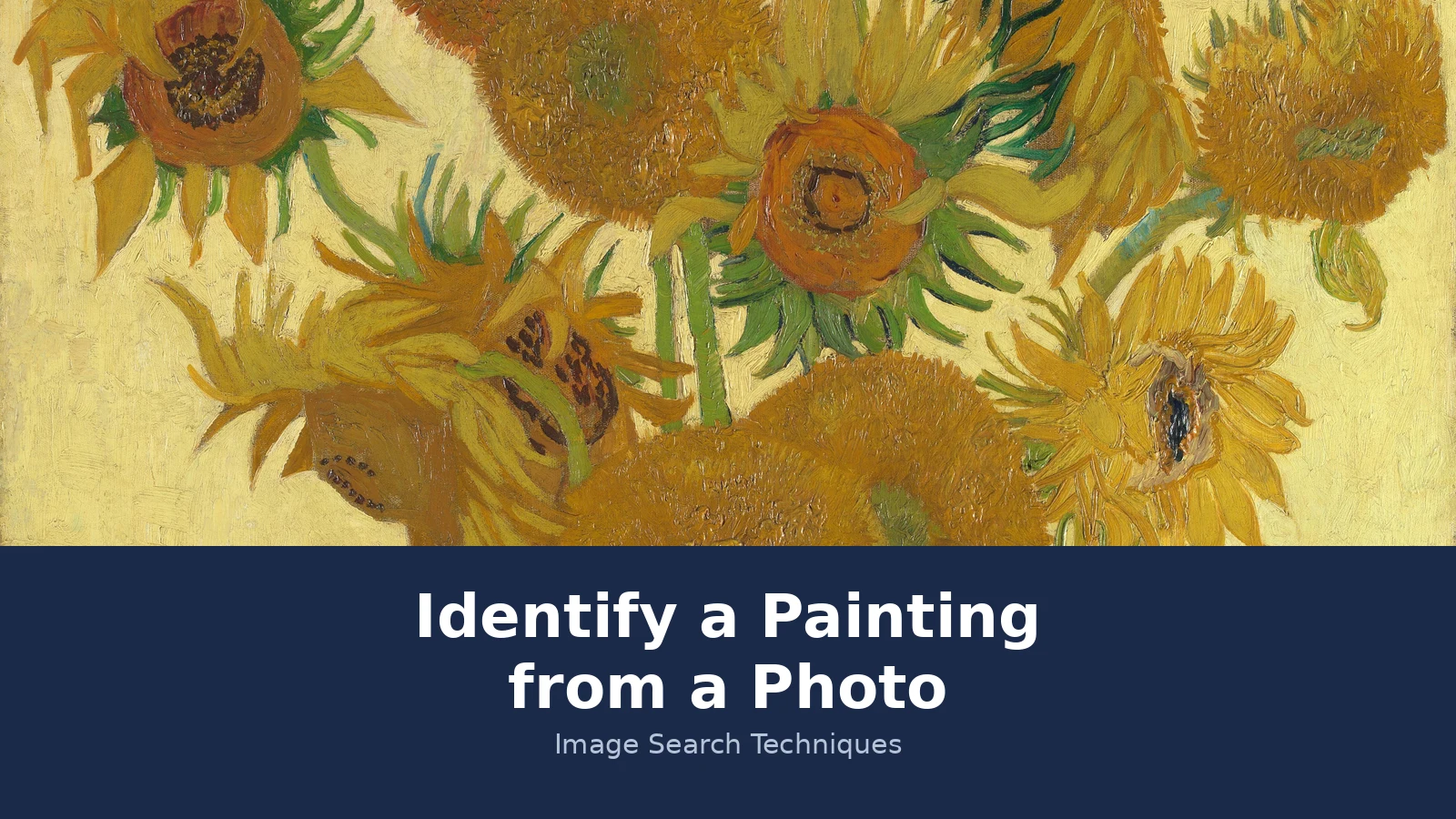
Every method in this guide was tested on a real photograph before we wrote about it. The test image is a photograph taken inside the National Gallery in London on 11 August 2014, showing Vincent van Gogh’s Sunflowers hanging on the wall in its frame. The photo comes from Wikimedia Commons, taken by photographer Diego Delso, and it is the kind of picture a visitor takes: the whole painting, the frame, the gallery wall around it. We cropped nothing and cleaned nothing up before searching, because we wanted to know what happens with an ordinary museum snapshot.
Google Lens identified it at once. Its answer named the work as Sunflowers, specifically the fourth version of the Arles series, painted in 1888 by Vincent van Gogh, and gave the key details: oil on canvas, 92.1 by 73 centimetres, held at the National Gallery in London. The visual matches list was long, headed by the Wikipedia page for the Sunflowers series and the National Gallery’s own pages, and the exact matches included the very Wikimedia Commons file we had searched with. Lens showed no total count for its visual or exact matches, so we report no count for those. The identification itself was correct in every detail.
TinEye gave a different kind of answer, and it is just as useful. It returned 10,420 results after searching 86.7 billion images, and said the image was first indexed on 5 February 2008. The top matches named the painting plainly: stock listings for “Vase with Fifteen Sunflowers, fourth version, exhibited at the National Gallery, London”, plus exact matches for the same Wikimedia Commons file, which measures 3,225 by 3,996 pixels. TinEye does not try to name the painting for you. It shows you every page that uses the image, and the names on those pages do the identifying. That is why it is the better tool when you want to know where a picture of a painting first appeared online.
We then checked the answer against the National Gallery’s own Sunflowers page. It confirms every detail Lens gave: Sunflowers, 1888, oil on canvas, 92.1 by 73 centimetres, signed, bought with the Courtauld Fund in 1924, inventory number NG3863, hanging in Room 43. That museum page is the proof step. A search result can be wrong, but when the museum that owns the painting agrees with the search result, the identification is settled.
In short: an ordinary gallery snapshot of Sunflowers was identified correctly by Google Lens in one step, and TinEye backed it up with 10,420 matching pages. The museum’s own page then confirmed the title, the size and the location.
What Do You Do When the Reverse Search Finds Nothing?
Some paintings will not match. The painting may be by a little known artist, a local scene, a family portrait, or a contemporary work that has never been published online. A blank result does not mean the painting is worthless or fake. It means the search engines have nothing to match it against, and you have to work from what is visible in the photo itself.
Start with the signature. Most signed paintings carry the name in a lower corner, sometimes as initials or a monogram rather than a full name. Crop the photo tightly around the signature and run that crop through Lens on its own. A signature crop often matches when the full painting does not, because it turns the problem into a text match. Then search the possible readings of the name in an artist dictionary such as the Getty Union List of Artist Names, and keep only the candidates whose dates, country and usual subjects fit the painting in front of you.
Next, read the wall label. In a museum or gallery, the small card beside a painting usually gives the artist, the title, the date and the medium. Photograph it as well as the painting, because it is the single most reliable piece of text in the room. At home, look at the back of the canvas instead. Gallery labels, exhibition stickers, framers’ labels, auction stencils and handwritten titles often say more than the front of the painting does, and a supplier’s stamp on the canvas can date the work within a few decades.
Two words are worth knowing here. Provenance is the recorded history of who owned a painting, from the artist to the present day. A clear provenance supports an identification; a gap in it is a warning, not proof of anything on its own. A catalogue raisonné is the complete published list of an artist’s authenticated works. If a painting is not in the catalogue raisonné, that does not make it a fake, but it means no expert has recorded it as genuine yet.
Also record the medium and the support before you guess at a name. Oil paint sits in raised, glossy strokes and often shows fine age cracks. Watercolour is transparent and lets the paper show through. A painting on hardboard cannot be an eighteenth century work, because hardboard was only introduced in the mid 1920s. These details narrow the period fast, and they stop a hopeful reading of a signature from steering the whole identification.
In short: when the search finds nothing, work from the painting itself. Crop and search the signature, photograph the wall label, read the back, and use the medium and the support to narrow the period before you name an artist. If that still leaves you stuck, the Reddit community r/WhatIsThisPainting will take a look: post a well-lit photo of the whole canvas plus a close-up of any signature, and say where the painting came from. Treat any answer as a lead to check against a museum record, not as a verdict.
Which Version Is It? When a Famous Painting Exists in More Than One Copy
Naming the painting is only half the job when a famous work exists in several versions. Van Gogh painted seven versions of Sunflowers in vases at Arles in 1888 and 1889. Five survive in museums: London, Amsterdam, Munich, Philadelphia and Tokyo. One is in a private collection and one was destroyed in Japan in 1945. A reverse search that only says “Sunflowers” has told you the series, not the painting. You still need to know which version your photo shows.
The way to tell is to read the match properly. A good result names the museum, the date and the size, not just the title. The London Sunflowers was painted in August 1888 and measures 92.1 by 73 centimetres. The Amsterdam version is a repetition Van Gogh made in January 1889, slightly larger at 95 by 73 centimetres. The Munich version has a turquoise background and fourteen flowers instead of fifteen. Those differences are small, but they are exactly what separates one version from another, and they are the reason the museum’s own collection page is the last step in every identification.
| Painting | Version A | Version B | How to tell them apart |
|---|---|---|---|
| Sunflowers, Van Gogh | National Gallery, London, August 1888, 92.1 by 73 cm | Van Gogh Museum, Amsterdam, January 1889, 95 by 73 cm | London is the August original. Amsterdam is the January repetition, slightly larger. Check the museum named in the match. |
| The Scream, Munch | National Gallery, Oslo, 1893, pastel | Munch Museum, Oslo, 1910, tempera, plus other versions | Four versions exist. The date and the medium in the match tell you which one you are looking at. |
| Water Lilies, Monet | Musée de l’Orangerie, Paris, large panels | Musée Marmottan Monet, Paris, many smaller canvases | Monet painted the theme dozens of times. A match that only says Water Lilies has not identified your painting yet. |
| Mona Lisa, Leonardo da Vinci | The Louvre, Paris, the original | Countless copies in homes, shops and hotels | If your photo shows it behind glass with a crowd in front, it is the original. A copy on a wall at home is a copy. |
The same caution applies to prints. A poster or a canvas print of Sunflowers will match the painting in a reverse search, because the image is the same. That does not make the print an original. Look for raised brushstrokes, paint running onto the edges of the canvas, and the absence of a printed dot pattern under a magnifier. A print is flat, its edges are trimmed, and a close look shows tiny regular dots. If you are trying to work out whether a painting on your wall is an original, the identification is only the first step, and it is not the same as authentication.
In short: famous paintings often exist in several versions, so check the museum, the date and the size in the match, not just the title. A print of a painting matches the same way an original does.
Can an App Identify a Painting for You?
Yes, and in a museum an app can be quicker than a general search. Smartify, often called the Shazam for art, lets you point your phone at a painting in a museum and read about it on the spot. It is built for exactly this moment: you are standing in front of the work and you want its story. Magnus works the same way but adds market information, and ArtScan identifies paintings from a photo and reads signatures. Art Identifier, an iPhone app, works the same way from a photo and gives an art-historical breakdown, including the medium, the style and the period. Google Arts and Culture, which you can open at artsandculture.google.com, lets you explore museum collections online and check a work against the museum’s own record.
None of these apps replaces the reverse search. They are a second opinion, and a useful one when the painting is in a museum whose collection the app covers. Outside a museum, or with an unknown painting, Lens and TinEye are still the stronger tools, because they search the whole web rather than one database. Use the app for the museum visit and the search engines for everything else, and let the two answers check each other.
One warning applies to every app in this field. An app’s answer is a suggestion, not a certificate. It cannot confirm that a painting is original, it cannot value it, and it cannot authenticate it. Identification is the question “what painting is this”, and authentication is a different, formal question that only a recognised expert or a catalogue raisonné committee can answer. Keep the two apart, and do not pay anyone who offers to authenticate a painting from a single phone photo.
In short: art apps such as Smartify are handy inside a museum, but they are a second opinion. Use them alongside a reverse search, and remember that no app can authenticate a painting.
How Do You Tell a Real Painting from a Print or a Copy?
Once you know what the painting is, the next question is usually whether the one in front of you is the real thing. Start with the surface. An original oil painting has raised brushstrokes you can see in raking light, uneven paint at the edges, and fine cracks in old varnish. A print is flat. Under a magnifier, a photomechanical print shows a regular pattern of tiny coloured dots. A painting never does. Look at the edges of the canvas too: an original usually has paint running onto the tacking margins, while a print is trimmed flat.
Then check the back. An original painting has a stretcher, tacks or staples, and often labels from galleries or exhibitions. A print on canvas is usually glued to a board or a thin stretcher with no labels at all. Varnished prints on canvas and textured reproductions can fool the eye at arm’s length, which is why the close look matters more than the first impression.
Be careful with copies as well. A hand painted copy of a famous painting is still a copy, and it can be well made. The signature is the giveaway more often than the brushwork is: a copy may carry the original artist’s name in a hand that does not match, or no signature at all. If the painting is meant to be valuable, none of this replaces a proper opinion. Take your identification, your photographs and your notes to an auction house specialist or a qualified appraiser, and let them examine the object itself.
In short: look for raised paint, paint on the canvas edges, and no printed dots. A flat surface with a dot pattern is a print, however good it looks from across the room.
What Should You Never Assume from a Match?
A reverse search match is a lead, not a verdict. It tells you that the same image appears on a page with a certain name attached. That page can be wrong. Print shops mislabel paintings, blogs copy titles from each other, and a stock photo listing can carry a confident title that nobody checked. Always confirm the name on a museum, university or gallery page before you repeat it. One authoritative source beats ten shops saying the same thing.
Never assume a match proves who painted a picture either. A painting can be attributed to an artist, painted by a follower, painted in the style of an artist, or simply mislabelled. The honest grades run from a firm attribution down to a probable one, then to a circle or school, and then to a period and region only. A careful answer such as “French school, about 1870” is more useful than a confident guess at a famous name.
And never assume that identifying a painting tells you what it is worth. Value depends on authorship, condition, provenance and the market, none of which a photo can settle. The same applies to a painting you found online: naming it does not make it free to use. The painting may be in the public domain, but the photograph of it may not be, so check the licence before you reuse the image anywhere.
Finally, keep two jobs apart. Identifying the painting in a photo is one job. Finding out who took the photograph is a different one, with its own method, and it is the subject of a separate guide. Mixing the two up is how people credit the photographer as the painter, or the painter as the photographer.
In short: a match is a lead to confirm, not proof. Check it on an authoritative page, grade your conclusion honestly, and never treat an identification as a valuation or an authentication.
The Painting Identification Method
Here is the whole method in one place. Work down the table in order, and stop as soon as you have an answer you can confirm on an authoritative page.
| Step | What to do | What it tells you |
|---|---|---|
| 1 | Photograph the painting straight on, with no glare, and crop out the frame | A clean image the search engines can match |
| 2 | Upload the photo to Google Lens | Title, artist and museum for famous and well documented works |
| 3 | If Lens is blank, try TinEye, then Yandex Images | Where the image first appeared online, and every page using it |
| 4 | Read the signature, the wall label and the frame, and photograph the back | Artist, title, date and provenance clues the search engines cannot see |
| 5 | Check the museum’s own collection page | Confirms which version of the painting you have, and where it hangs |
| 6 | Try an art app such as Smartify or ArtScan as a second opinion | A useful check inside a museum, and a fresh lead when the web search stalls |
The same method works across the whole identification family on this site. We use it to identify a flag from a photo, to identify a car from a photo, to identify a dog breed from a photo, and to identify a statue from a photo. The subject changes, but the order never does: reverse search first, then the visible clues, then the authoritative source that confirms the answer.
FAQs
Finding who took a photo is a different job from identifying the painting in it. Our guide to finding the photographer of a photo covers the metadata check, the reverse search, and the TinEye sort by oldest, with a worked example tracing a famous 1936 photograph back to Dorothea Lange.
Can Google Lens identify a painting from a photo?
Yes, often. Lens is good at matching famous and well documented paintings, and it usually names the title, the artist and the museum. Take the photo straight on with no glare, crop out the frame, and upload the file rather than a web address. In our test, a museum snapshot of Van Gogh’s Sunflowers was identified correctly in one step.
What should I do if the painting is not famous?
Work from what is visible in the photo. Crop and search the signature on its own, photograph the wall label in a museum, and read the back of the canvas for gallery labels and stamps. Then narrow the period from the medium and the support, and search artists in a dictionary such as the Getty Union List of Artist Names.
How do I identify a painting with no signature?
Many paintings were never signed, so identification then rests on the medium, the support, the style and any provenance. Expect a conclusion such as French school, about 1870, rather than a name, unless strong documentary evidence exists. Photograph the back as well as the front, because labels and stamps there often hold the best clues.
Can I find out how much a painting is worth from a photo?
No. A photo can identify a painting, but it cannot value it. Value depends on authorship, condition, provenance and the market, and none of those can be settled from a picture alone. Identification is also not authentication. For a painting that may be valuable, take it to an auction house specialist or a qualified appraiser for an opinion in person.
What is the best app to identify a painting?
Inside a museum, Smartify is the handiest choice, because it is built to scan the work in front of you and tell you its story. Outside a museum, Google Lens is stronger, because it searches the whole web rather than one database. Use the two together and let each answer check the other before you trust either one.
How do I identify the artist from a signature on a painting?
Crop the photo tightly around the signature and run that crop through Google Lens on its own, because a signature crop often matches when the full painting does not. Then search the possible readings of the name in an artist dictionary, and keep only the candidates whose dates, country and usual subjects fit the painting you have.