🔎 Reverse Image Search
Image search techniques made simple: upload a photo or paste a URL and search 6 engines at once. 100% free, nothing stored.
🔒 Your image is never stored on our servers longer than 24 hours and is never shared.
Quick answer: If the delivery photo is not your house, the parcel has not been delivered to you. Save the courier’s photo, photograph your front door from the same angle, and challenge the retailer in writing under section 29 of the Consumer Rights Act 2015. Your contract is with the retailer, not the courier: chasing the courier is the retailer’s job.
This guide walks through exactly how to read a proof-of-delivery photo, compare it with your own door, get the evidence each courier holds, and challenge the retailer in writing. If the photo itself looks suspicious, our guide to how to check a proof of delivery photo shows how to reverse-search it and tell whether it is a reused image. It is part of our complete guide to photo scams, and it covers buyer-side false delivery only, the case where you ordered something and the courier’s photo shows the wrong place.
First, a definition. “Proof of delivery” is the courier’s record that a parcel was left somewhere: usually a photograph, a GPS pin and a timestamp, sometimes a signature, a recipient name or a safe-place note. It is evidence of where the driver stopped. It is not, on its own, proof that the parcel reached you.
What does a delivery photo actually prove?
A delivery photo proves that a parcel was photographed at a place at a time. It does not prove that the place was your address, that the parcel was handed to you, or that the person in the photo, if anyone is in it, was you. That distinction is the whole dispute, and it is why a “delivered” scan should never end the conversation.
Many delivery photos prove very little at all. A closed door with no number, a patch of paving, a parcel balanced on a bin or a blurry porch at night tells you almost nothing about whose house it is. If the photo shows no identifying feature, no number, no recognisable door, no street context, say so plainly in your complaint: the photo cannot link the parcel to your address, because there is nothing in it that identifies your address.
The same logic applies to other photo evidence. A photo of a cheque does not mean the money has cleared, our cheque photo guide explains the “available is not cleared” trap, and a photo of a parcel does not mean it reached you. A photo is a claim about what happened, not proof of it, which is the same lesson behind fake payment screenshots: the image shows what someone wants you to believe, and the real question is what independent evidence backs it up. Council parking fines work the same way: our guide to checking your PCN photo evidence before you pay shows what the council’s photos must show before the fine is worth paying.
Two citable facts settle who is responsible. First, Citizens Advice states that if you bought something from a business to be delivered, it is the seller’s responsibility to make sure the item is delivered to you, and that if the seller used a courier, the seller should chase the courier, that is not your responsibility. Second, section 29 of the Consumer Rights Act 2015 keeps the goods at the trader’s risk until they come into the physical possession of the consumer, or of a person the consumer identified to receive them. A parcel left at a house you never identified is still the retailer’s problem.
How do you compare the courier’s photo with your own door?
Do this before you contact anyone, while the evidence is fresh. The comparison is your case in miniature: if the two pictures cannot be the same place, the delivery did not happen at your address.
- Screenshot the courier’s photo immediately. Save the full tracking page too, the photo, the timestamp, the delivery address shown and any safe-place note. Delivery photos can disappear from tracking pages, and a screenshot is your permanent copy.
- Photograph your own door from the same angle. Stand where the driver stood, at the same height and distance, and take the same shot: door, step, mat, floor and anything beside it.
- Put the two pictures side by side on your phone or computer and work through the worksheet below, one row at a time.
- Write the differences down in plain sentences you can paste into your complaint. “My door is blue; the photo shows a white door” beats “that’s not my house” every time.
| What to check | In the courier’s photo | At my door | Match? |
|---|---|---|---|
| House number | |||
| Door colour and style | |||
| Porch, canopy or steps | |||
| Flooring, tiles or paving | |||
| Doormat | |||
| Brickwork or render | |||
| Bins or planters | |||
| Street or neighbours |
Look for the small things, because couriers photograph the same kinds of doorstep again and again. A different door handle, a step the courier’s photo does not show, a mat of another colour, a tiled porch where yours is concrete, any one of these is enough to say the photo is not your house. Three or four together make the case unanswerable.
One safety note: do not go hunting the streets yourself at night to find the house in the photo, and do not knock on a stranger’s door to demand a parcel. The photo may show a house streets away, and the parcel may already be gone. Your dispute is with the retailer, not with whoever lives at the address in the photo.
What evidence does each courier keep?
Every major UK courier records more than the photo. Ask the retailer for the full delivery record, not just the picture, because the GPS pin and the timestamp are often what prove the parcel went elsewhere.
| Courier | Photo | GPS pin | Timestamp | Extra record |
|---|---|---|---|---|
| Evri | Yes, where left in a safe place | Yes | Yes | Safe-place note |
| DPD | Yes | Yes | Yes | Recipient name or passcode |
| Amazon | In Your Orders, where provided | Delivery location shown | Yes | Driver note |
| Royal Mail | Where a photo was taken | Map in tracking | Yes | Signature or named neighbour |
Evri. Evri’s delivery confirmation can include a photograph showing where a parcel was left and a pin showing the delivery location. Claims go through the sender, so for an online order that means the retailer, not you. Evri pays compensation to the sender, and the retailer then owes you the refund or replacement. Evri’s published time limits are short: 28 days for UK services and 45 days for international services, counted from the date of the order. Do not wait, and check the current limit on Evri’s site when you claim.
DPD. DPD records the photo, the timestamp and the delivery location, and its customer support can usually supply a more detailed delivery log or GPS data if the retailer asks. DPD’s published claims terms require loss or damage to be notified within 14 days of despatch, check the current wording on DPD’s site before you rely on it, and only the contract holder, normally the retailer, can register the claim. Your remedy is against the retailer; the retailer then claims from DPD.
Amazon. Amazon shows a delivery photo in Your Orders where one was taken, and its own help pages say parcels may be scanned as delivered before they arrive, so Amazon tells customers to wait 48 hours before treating a parcel as missing. Contact Amazon Customer Service within 30 days of the expected delivery date, and for a marketplace order you can claim under the A-to-z Guarantee once three days have passed since the latest estimated delivery date, within 90 days of the order’s last delivery date. Screenshot the photo straight away: Amazon’s own guidance notes it may not stay visible.
Royal Mail. Royal Mail’s proof of delivery can include a photograph, a GPS map and a signature or the name of the person who signed, and it names a neighbour in the tracking message when one took the parcel. Its own guidance says an item marked as delivered today may occasionally have been affected by a rare scanning error, and it recommends allowing one additional day before reporting the parcel as missing. If the sender was a retailer, the retailer opens the investigation with Royal Mail; if you posted the parcel yourself, you claim directly.
What did a reverse image search of a real delivery photo show?
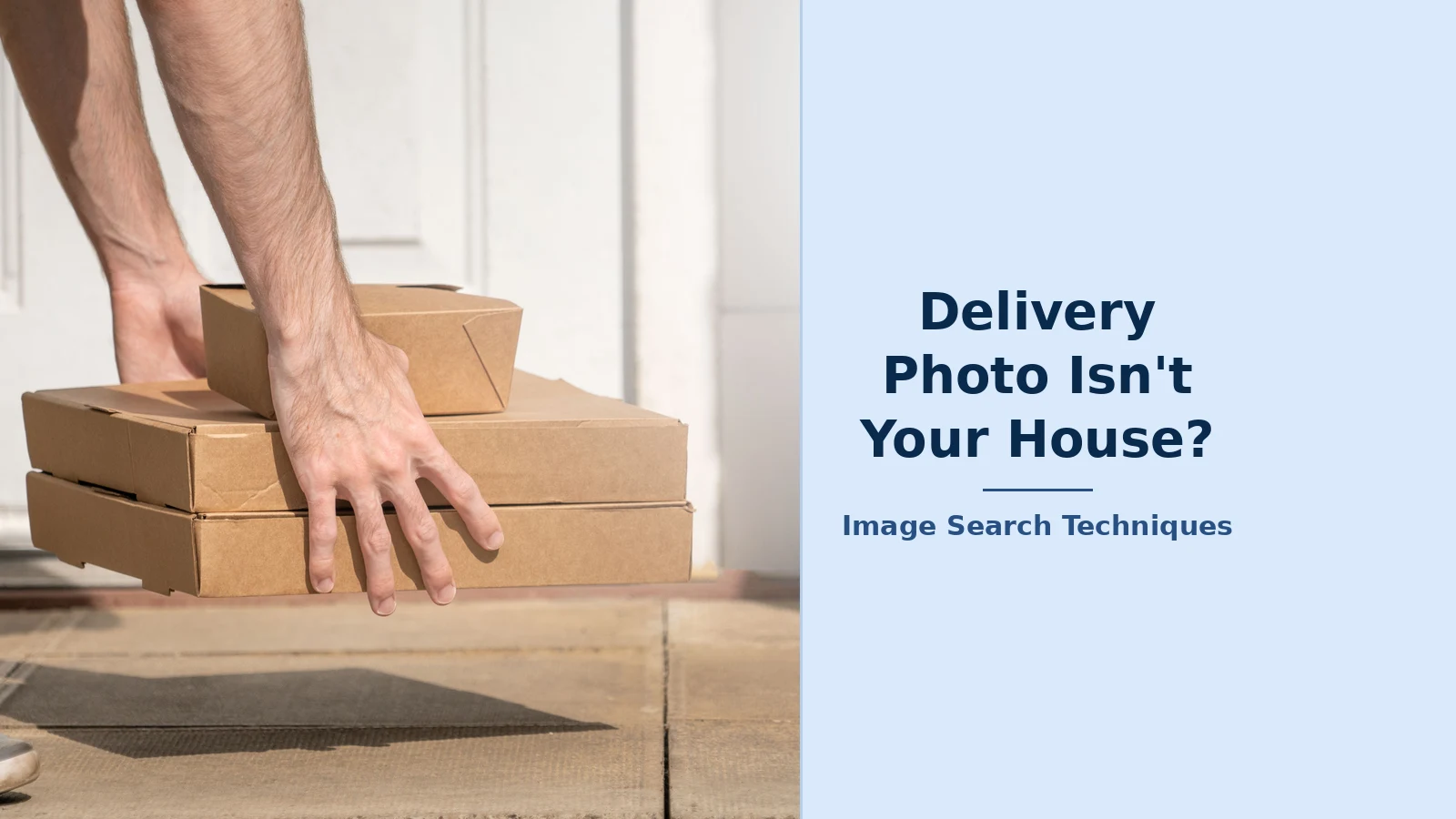
To test what a reverse image search can actually tell you about a delivery photo, I ran a real one through our free reverse image search tool on 12 November 2026: a Wikimedia Commons photograph (CC BY 2.0) of a delivery driver placing three cardboard boxes in front of a white front door. If the engines struggle with a real, properly published photo, they will struggle even more with a courier’s low-resolution doorstep snap, and that is the point.
| Engine | Result | What it found |
|---|---|---|
| Google Lens | Failed | 0 results: “No image at the URL” |
| Bing | Partial | 8,200 results; described the photo; no source found |
| Yandex | Found it | Traced the photo to its Commons file page |
| TinEye | 0 matches | Searched 86.7bn images; no match |
| Failed | Keyword search only; unrelated pins |
Only Yandex traced the photo back to its Wikimedia Commons file page, listing the exact 4000 × 2666 original and a reuse credited to the photographer. Bing did the next best: it described the photo correctly, a delivery person placing three cardboard takeout boxes onto a doorstep, returned 8,200 results and 12 similar-image thumbnails, and listed two pages using the image, but neither was the Commons source. Google Lens failed outright with “No image at the URL” on both its exact-match and visual-match tabs. TinEye searched over 86.7 billion images and found nothing, saying it had probably not yet crawled any page where the image appears. Pinterest was not a reverse search at all: the tool’s Pinterest link opens a keyword search for the image’s domain, and it returned seven unrelated pins.
Two honest lessons follow. First, a delivery photo is weak evidence on its own: if five engines cannot reliably trace a real, published photograph of a doorstep back to its source, a courier’s compressed phone photo of a parcel on paving will tell you even less, which is why the GPS pin, the timestamp and your own comparison photograph matter more than the picture itself. Second, results vary by engine and by day: Lens has worked on other photos in our earlier tests and failed on this one, so a single engine’s failure proves nothing either way. Run the photo through more than one engine, save what each returns, and build your challenge on the comparison worksheet and the delivery record, not on one search result.
Who do you challenge first: the retailer or the courier?
The retailer. Your contract is with the retailer, not the courier: the retailer chose the courier, paid the courier and is the courier’s customer. Section 29 of the Consumer Rights Act 2015, quoted above, is the reason the retailer cannot simply point at a “delivered” scan and close your case. The retailer’s job is to investigate with the courier, and to redeliver or refund you if delivery to you cannot be established.
Contacting the courier is still useful, but for evidence, not for a refund. Ask the courier for the full delivery record, the photo at full size, the GPS pin, the timestamp and any recipient name, and pass it to the retailer. Do not let the retailer bounce you to the courier and the courier bounce you back to the retailer: in writing, tell the retailer that the contract is with them and that chasing the courier is their responsibility, as Citizens Advice confirms.
There are two exceptions. If you booked the courier yourself, you bought the label, dropped the parcel off, or arranged the collection, then you are the sender, the contract is yours, and you claim with the courier directly. And if you bought from a private seller on a marketplace, start with the seller and the marketplace’s own buyer-protection route, since the Consumer Rights Act route applies to businesses.
One boundary matters. This article is about buyer-side false delivery: you ordered something and it went to the wrong house. The seller-side version, a supposed courier collecting an item you sold, then the payment never arriving, is a different scam with different steps, covered in our fake courier collection guide. Do not mix the two: the evidence, the claim route and the warning signs are all different.
Delivery photo not my house, what should you do?
Work through these steps in order. Most wrong-photo cases are settled at step five, because a retailer faced with a written, evidence-backed challenge and a section 29 quote will usually redeliver or refund rather than argue about a photograph.
- Screenshot everything now. The tracking page, the delivery photo, the timestamp, the delivery address shown and your order confirmation. Save the courier’s photo as a file, not just a screenshot, if the tracking page lets you open it full-size.
- Check the obvious places. Your safe place, neighbours, household members, reception or mailroom, bins, shed and porch. Parcels left with a neighbour or in a safe place often turn up within a day or two: but do this after step one, so the evidence is saved first.
- Allow the courier’s own waiting window. One extra day for Royal Mail, 48 hours for Amazon. For Evri and DPD, report to the retailer the same day, their claim windows are short, and waiting only weakens the retailer’s claim.
- Photograph your own door from the same angle as the courier’s photo and fill in the comparison worksheet above.
- Check the address on your order confirmation. A wrong flat number, house number or postcode means the courier delivered where it was told, and the retailer may fairly say the error was yours. If the address on the order is right, the error is theirs.
- Write to the retailer. Email or chat, not phone only, so there is a written record. Use the copy-paste message in the last section. State the order number, the tracking number, the delivered time, and the differences between the photo and your door. Ask for a redelivery or a full refund, and quote section 29.
- Ask for the full delivery evidence. The photo at full size, the GPS pin, the timestamp and any recipient name. If the retailer says “the courier confirmed delivery”, ask what evidence supports that, a scan is not proof of receipt.
- Set a deadline and keep every reply. Give the retailer 7 to 14 days to resolve it, and keep copies of every message. If it is not resolved, you will need that paper trail for the escalation routes below.
What are the claim deadlines for each courier?
Deadlines are the reason to act on day one. The courier’s window is the retailer’s problem, not yours, your contract is with the retailer, but a retailer whose own claim has expired is slower, less helpful and more likely to argue. Report the problem in writing the same day you spot it, whatever the courier.
| Courier | Your deadline | Who claims | If you miss it |
|---|---|---|---|
| Evri | 28 days UK, 45 days international, from order date | Sender (retailer) | Claim refused as out of time |
| DPD | 14 days from despatch to notify | Sender (retailer) | Claim weakened or refused |
| Amazon | 30 days from expected delivery; A-to-z within 90 days | You, in Your Orders | Investigation or guarantee refused |
| Royal Mail | Allow 1 extra day, then report; windows vary by service | Sender (retailer) | Late claims can be refused |
Check the courier’s current terms on the day you claim, these windows change, and the figures above are the published limits as of November 2026. Missing a courier’s window does not end your rights against the retailer, but it weakens the retailer’s own claim, which is why the practical advice never changes: screenshot it today, write to the retailer today.
What if the retailer refuses to help?
First, copy, adapt and send this message. It contains everything the retailer needs and nothing it can argue with:
Subject: Order [number], parcel marked delivered, delivery photo is not my property
Hello, my order [number], tracking [number], is marked delivered at [time] on [date]. The delivery photo does not show my property: [list two or three differences, for example “my door is blue; the photo shows a white door with no number”]. I have not received the parcel. Under section 29 of the Consumer Rights Act 2015 the goods remain at your risk until they reach me. Please arrange a redelivery or a full refund. I have saved the tracking page and the delivery photo. [Your name, address and phone number]
If the retailer still refuses, escalate in this order. Raise a formal complaint with the retailer and give it a deadline, many retailers have a separate complaints team with more authority than front-line support. Ask your bank for a chargeback, which card schemes usually allow within 120 days of the transaction. If you paid by credit card and the item cost between £100 and £30,000, Section 75 of the Consumer Credit Act 1974 makes the card provider jointly liable with the retailer, so you can claim from the card provider directly. Citizens Advice can explain your next step, including the RetailADR route after eight weeks unresolved and the small-claims route as a last resort.
This guide is general information about your consumer rights, not legal advice. If the amount is large, the retailer is threatening debt collection, or the situation involves a private seller who has disappeared, get advice from Citizens Advice or a solicitor before you act.
Can a retailer refuse a refund because the courier’s photo shows a delivery?
No, not on the photo alone. A delivery photo shows a parcel somewhere at a time; it does not prove it reached you or the right address. Under section 29 of the Consumer Rights Act 2015, the goods stay at the retailer’s risk until they reach you or someone you named. Ask for the evidence and a redelivery or refund.
How long should I wait before reporting a delivery photo that isn’t my house?
Screenshot the photo and tracking page the same day, so the evidence cannot disappear. Then allow the courier’s own window: one extra day for Royal Mail and 48 hours for Amazon, whose scans can run early. For Evri and DPD, report to the retailer the same day, their claim windows are short, and waiting only weakens the case.
What if the delivery photo shows my house but the parcel is gone?
That is a different problem: the parcel may have been left where you did not agree, or taken after delivery. Check whether you agreed a safe place; if not, the retailer is still responsible. Photograph the empty spot, note the time, and report it the same way, the photo proves where it was left, not that it stayed there.
Can I go to the house in the delivery photo and ask for my parcel?
Do not go alone, knock on a stranger’s door late, or accuse anyone, you do not know whose house it is, and the parcel may already be gone. Ask the retailer to investigate; it can ask the courier for the GPS pin. A local community group or your postie may recognise the door, which is safer than going yourself.