🔎 Reverse Image Search
Image search techniques made simple: upload a photo or paste a URL and search 6 engines at once. 100% free, nothing stored.
🔒 Your image is never stored on our servers longer than 24 hours and is never shared.
A book cover can look perfect and still be made by a machine. If you want to know how to tell if a book cover is AI-generated, you do not need a special tool to start. The cover itself, the credits, and the listing usually give you enough to work with, if you know where to look.
The short answer: check the disclosure and the credits first, then look at the image, then run one detector test and one reverse image search. A named cover designer points to human work. A publisher note that says the cover was generated using AI settles it. Visual tells and detector scores are only clues, so combine at least three checks.
This guide walks through the whole investigation on two real covers. One is a forthcoming novel whose publisher states plainly that the cover was generated using AI. The other is a traditionally published bestseller with a named cover designer on its copyright page. You will see the same checklist applied to both, and the same detector and reverse search run on both, so you can judge what each step is actually worth.
How to tell if a book cover is AI-generated from the image alone
Start with your eyes. AI image tools are good at the overall look of a cover and weak at the small details. That gap is where most tells live.
Hands are the classic problem. Count the fingers. Look at how a hand holds a cup, a sword, or a steering wheel. Extra fingers, missing fingers, and fingers that melt into each other are common on AI covers. Faces come next. A face can be smooth to the point of looking airbrushed, with eyes that do not quite line up or a gaze that points nowhere. Ears and teeth often look wrong on a close look, even when the face seems fine at a glance.
Text is the fastest check of all. AI tools still garble words on covers. Read the title letter by letter. Look for a misspelt word, an extra letter, a missing letter, or a word that is almost right but not quite. Check the author name the same way. A human designer does not ship a cover with the title spelt wrong. If the title on the cover does not match the title on the listing, stop and treat that as a strong lead.
Then step back and look at the whole picture. AI covers often have a polished, almost glossy sameness to them. Faces repeat. Poses repeat. The lighting on a person does not match the lighting on the background. Shadows fall in two different directions. A scene can look right in pieces and wrong as a whole, like a collage of parts that were never in the same room.
None of this proves anything on its own. A human cover can have a stylised face or odd lighting because the designer chose it that way. A clean AI cover can have no visible flaw at all. Visual tells are leads, not verdicts. They tell you where to look next, and that is all. The same checks work beyond books: our guide to how to tell if a logo is AI-generated runs the same six checks on a very different kind of artwork. The answer capsule for this section is simple: a visual oddity is a reason to investigate, never a finding.
Where do you look first: the disclosure and the credits?
Before you zoom into pixels, read the words around the cover. Two places settle more cases than any detector ever will: the disclosure and the credits.
Many self-published books now carry a note about AI use. It may sit in the book description, in a note from the publisher, or on the copyright page. The wording varies. Some say “the cover was generated using AI”. Some say “AI tools were used to assist with final proofreading”, which is a different thing. Read the sentence as written. A note about proofreading does not mean the cover is AI-made, and a note about the cover does not mean the text is.
The credits are the other half. Open the copyright page, usually one of the first pages of the book. A traditionally published book almost always names the people behind the cover: “Cover design by” followed by a name, or “Cover illustration by” followed by a name. A named designer with a real portfolio is strong evidence of human work. The absence of a credit proves nothing by itself, since some books simply do not list one, but a named credit is the single most useful piece of evidence you can find in under a minute.
Check the author as well. Look at the author’s other covers. A human designer usually leaves a recognisable style across a backlist: similar typography, similar composition, similar colour choices. An author whose covers swing wildly between styles, with no designer named anywhere, is worth a closer look. None of this is proof. It is pattern, and pattern is what a good investigation is built from.
The answer capsule here is that the words around the cover often answer the question before the image does. Read them first.
How does the Amazon KDP disclosure rule actually work?
If the book is self-published through Amazon KDP, there is a rule that does some of the work for you. Amazon KDP requires authors to inform Amazon when a book contains AI-generated content, and that expressly includes cover images. The rule sits in KDP’s own Content Guidelines, under the section on artificial intelligence content.
The rule draws a line that matters. “AI-generated” means content created by an AI-based tool, including the cover and interior images. If an author used an AI tool to create the actual cover, even if they then edited it heavily, KDP counts it as AI-generated and it must be disclosed to Amazon. “AI-assisted” is different. That is content the author created themselves and used AI tools only to edit, refine, error-check, or improve, or to brainstorm ideas while creating the work themselves. AI-assisted content does not need to be disclosed.
Two limits are worth knowing. First, the disclosure goes to Amazon, not necessarily to you. KDP’s own help page does not say the disclosure appears on the book detail page or in the copyright page, and in our research we could not verify any reader-facing KDP label. A book can be properly disclosed to Amazon and still show you nothing on its listing. Second, the author stays responsible for checking that AI-generated content follows KDP’s content rules, including intellectual property rights. A disclosure is not a clean bill of health for the image. It only tells you the author followed the reporting rule. The ownership question behind that rule is a separate one: see who owns AI pictures for how copyright treats AI-made artwork.
So the KDP rule helps you in two ways. When a publisher or author volunteers the disclosure in the book description or a publisher note, you have your answer straight from the source. And when there is no disclosure at all, you know the KDP rule exists but cannot assume it was followed, so you keep investigating. The answer capsule: KDP requires authors to tell Amazon about AI-generated covers, but that disclosure may never reach the reader, so its absence proves nothing.
What is the difference between AI-generated and AI-assisted?
People use these two phrases as if they mean the same thing. They do not, and the difference decides what a disclosure actually tells you.
AI-generated means the AI tool made the thing. The author typed a prompt and the tool produced the cover image, the text, or the translation. Editing the result afterwards does not change the label. Under KDP’s rule, that is AI-generated even after substantial edits.
AI-assisted means a person made the thing and used an AI tool as a helper. A designer draws a cover and asks an AI tool to clean up the background. An author writes a chapter and asks an AI tool to check the spelling. The human did the creating; the tool did the tidying. Under KDP’s rule, that needs no disclosure.
Why does this matter for your check? Because a note that says “AI tools were used to assist with proofreading” tells you about the text, not the cover. And a note that says “the cover was generated using AI” tells you the cover is AI-made, full stop. Read the exact words. Do not let a vague “AI was involved” stand in for a precise claim about the cover itself.
The worked test: one disclosed AI cover and one human cover
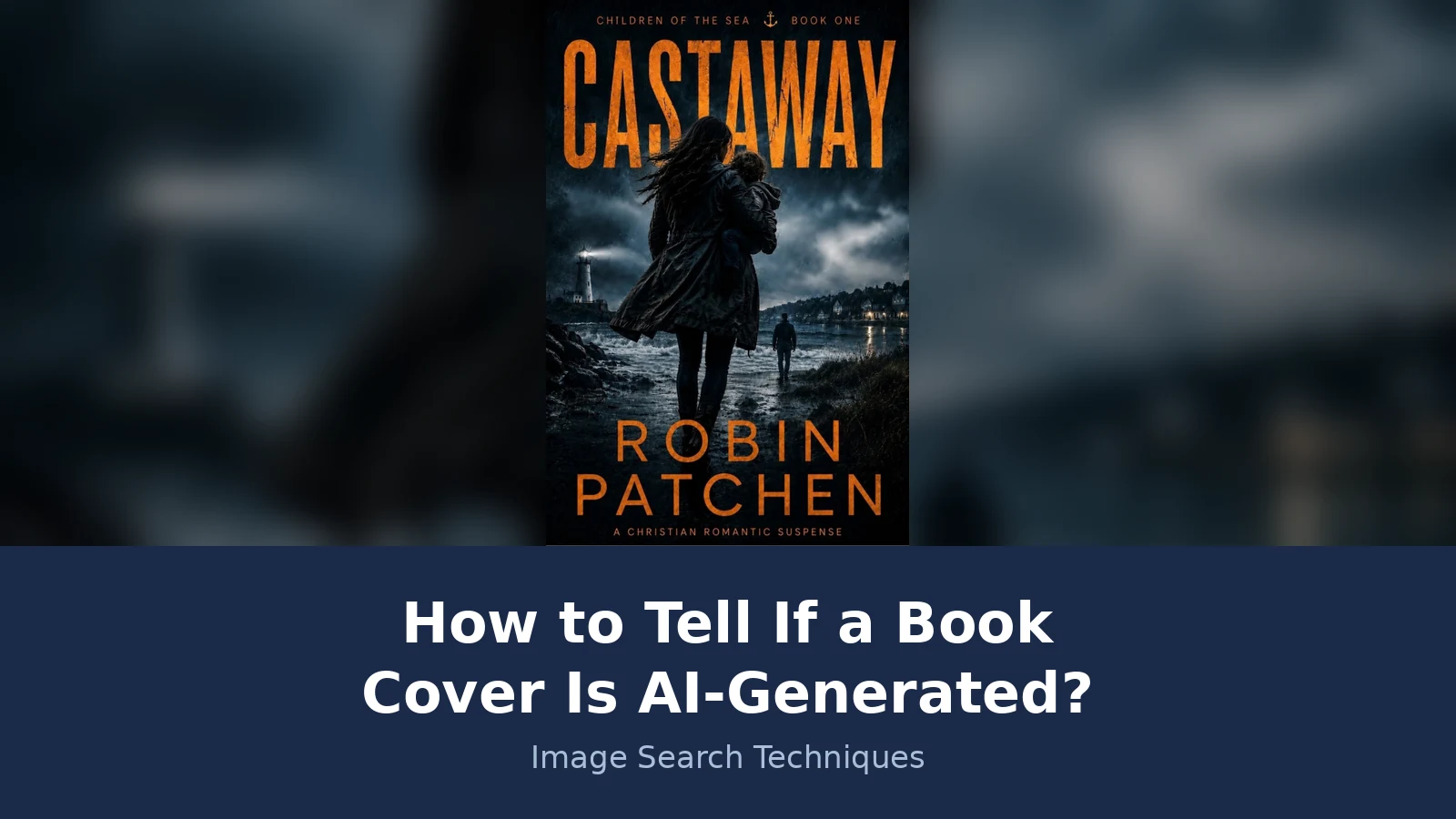
Here is the same checklist run on two real covers, on 21 November 2026. The first is Castaway by Robin Patchen, a novel from JDO Publishing, first in the Children of the Sea series. Its publisher states in a note on the book’s NetGalley catalog page: “AI tools were used to assist with final proofreading and continuity check following human editing. The book cover was generated using AI.” The book is due out on 5 January 2027, so its Amazon listing is a pre-order. The second is Diary of a Wimpy Kid by Jeff Kinney, published by Puffin Books. Its copyright page says: “Book design by Jeff Kinney” and “Cover design by Chad W. Beckerman and Jeff Kinney.”
Look at the Castaway cover first. It shows a woman with long dark hair, seen from behind, holding a small child on a stormy shore, with a lighthouse on the left and a lone man in the distance. The title and the author name are set in large orange capitals. The faces are turned away, so there are no eyes or hands to check, which is itself worth noting: AI covers often hide the parts the tools get wrong. The image has the smooth, painterly finish that AI tools favour, and the light on the woman does not quite match the light on the sea behind her. None of that proves anything. What proves it is the publisher’s own sentence.
The Wimpy Kid cover needs no such argument. It is a hand-drawn cartoon of Greg Heffley on a sheet of lined paper, taped onto a red cover, with a hand-lettered title. The drawing style is Kinney’s own, consistent across the whole series, and the cover credit names the designer. A detector could not add much to that, but we ran one anyway, because the point of the test is to see what each step is worth.
The detector was Hive Deploy Detect. On the Castaway cover it returned 99.9 percent likely AI-generated, 0 percent deepfake, and listed likely generation sources with gptimage2 at 85.4 percent. On the Wimpy Kid cover it returned 0 percent likely AI-generated and 0 percent deepfake. Those two scores line up exactly with the paper evidence: the disclosed AI cover scores 99.9, the credited human cover scores 0. That is a clean result, and it is also one test on one image each. A different detector, or a different cover, could disagree.
The reverse searches tell a different kind of story. Google Lens found 41 exact matches for the Castaway cover, topped by the author’s own site, robinpatchen.com, and its AI Overview correctly named it as Castaway by Robin Patchen. TinEye found 0 matches out of 86.8 billion images, which is a genuine zero and makes sense: the book is not out yet, so the cover has barely circulated. Yandex found 0 exact matches and mislabelled the image as a film still. For the Wimpy Kid cover, Lens listed 398 exact matches, TinEye found 4,814 results with the first indexed on 6 February 2008, and Yandex showed more than 50 sites carrying the exact cover, while wrongly labelling it as the Rodrick Rules film. Two lessons fall out of that. First, a zero on TinEye can mean a new cover, not a fake one. Second, an engine’s own label can be wrong even when its matches are right, so read the matches, not the label. A reverse search on a cover can do more than check for AI: if you only have the artwork and no title, it can identify a book from its cover outright.
Neither cover file carries a C2PA provenance signal. We checked both files for one and found nothing, which is normal: most covers published today carry no content credential at all. Its absence proves nothing either way.
The cover-investigation checklist, filled in for both covers
| Check | Castaway (Robin Patchen) | Diary of a Wimpy Kid (Jeff Kinney) |
|---|---|---|
| Disclosure on the listing or publisher page | Yes. Publisher note: the book cover was generated using AI. | None needed. No AI disclosure anywhere. |
| Contributor credits on the copyright page | No cover designer named. | Yes. Cover design by Chad W. Beckerman and Jeff Kinney. |
| KDP metadata match: title, author, series on cover vs listing | Matches. Cover reads Children of the Sea Book One, Castaway, Robin Patchen; listing agrees. | Matches. Cover title and author agree with the listing. |
| C2PA or provenance signal in the file | None found. | None found. |
| Detector score (Hive Deploy, one test) | 99.9% likely AI-generated. | 0% likely AI-generated. |
| Reverse image search | Lens 41 exact matches; TinEye 0; Yandex 0 exact. | Lens 398 exact matches; TinEye 4,814; Yandex 50+ sites. |
| Verdict | Verified AI-generated. The disclosure settles it; the detector agrees. | Human-made. Named designer, consistent series style, detector 0%. |
The answer capsule for this section is that the paper trail beats the pixels. A disclosure or a named credit answers the question. The detector and the reverse search only confirm what the words already said.
What does a detector score actually tell you?
A detector gives you a number. That number feels certain. It is not.
Detector tools are trained on known AI images and known human images, and they guess which side a new image falls on. They are right often enough to be useful and wrong often enough to be dangerous. A high score on a real AI cover is expected. A high score on a human cover happens too, especially on illustrations, heavily edited photos, and images with the smooth look that AI tools favour. A low score on a real AI cover also happens, especially when the cover has been edited, compressed, or rebuilt by a human designer after generation.
Vendor accuracy claims need the same caution. A detector that claims 99 percent accuracy is quoting its own test set, not your cover. Treat every score as one test on one image, reported honestly and labelled as such. Never present a score as proof that a named author or publisher used AI. A score is a reason to ask for the design trail and the source files, not a finding.
Run the test properly if you run it at all. Use the cover image itself, not a screenshot of a listing page, which adds compression and cropping that can change the result. Run the same image through the same detector once, and record the exact figure. If you run it twice and get two different figures, say so. For the wider method behind this test, our guide on how to tell if an image is AI-generated covers detectors, metadata and reverse search in detail. The answer capsule: a detector score is a clue with a number attached, and a clue is all it will ever be.
What should you do with what you find?
End every investigation with a decision, not a suspicion. The evidence falls into four rough levels, and each one points to a different action.
Verified means you have a disclosure or a provenance signal: the publisher says the cover was generated using AI, or the copyright page names the designer, or the file carries a content credential that traces it to a human tool. Act on it. You can say the cover is AI-generated, or human-made, and cite the source.
Strong means several independent clues point the same way: no credit anywhere, a garbled title, distorted hands, and a high detector score, all on the same cover. You can say the cover looks AI-generated and explain the clues. You cannot state it as a fact.
Weak means one clue and nothing else: a single visual oddity, or a detector score with no other support. Treat it as a lead. Look for more evidence before you say anything to anyone.
Circumstantial means a feeling and nothing more: the cover looks “too perfect”, or the style seems generic. That is not evidence. Say nothing. A suspicion is a reason to investigate, not a reason to accuse.
Never accuse a named author or publisher of using AI on visual suspicion alone. If you need certainty, ask. Authors and publishers can usually answer the question in one sentence, and many will show you the design files. If a listing is genuinely misleading, report it through the platform’s own reporting route rather than posting an accusation. And if the cover is AI-made and you are tempted to reuse the artwork yourself, stop: the rules on using someone else’s AI-generated art are a separate question, and the answer is usually no. The answer capsule for the whole article is this: prove it with a disclosure, a credit, or a provenance signal, or say only what the evidence supports.
FAQs
How can I tell if a book cover is AI-generated?
Check the disclosure and the credits first. A publisher note that says the cover was generated using AI settles it, and a named cover designer points to human work. Then look for garbled text, odd hands and mismatched light, and finish with one detector test and one reverse image search. No single check proves it, so combine at least three.
Does Amazon KDP require authors to disclose AI-generated covers?
Yes. Amazon KDP requires authors to inform Amazon when a book contains AI-generated content, and that includes cover images. AI-assisted content, where the author created the work and used AI tools only to edit or improve it, does not need to be disclosed. KDP does not describe any reader-facing label, so the disclosure may never appear on the book listing.
Can a detector prove a book cover is AI-generated?
No. A detector score is one test on one image, and scores can mislead. A high score on a human cover happens, and a low score on a real AI cover happens after editing or compression. Treat the score as a clue, and never accuse a named author or publisher on a score alone. Ask for the design trail instead.
What does a zero on TinEye mean for a book cover?
It means TinEye has not crawled any page carrying that image, not that the cover is fake or genuine. A new cover on a book that is not out yet will often score zero, because the image has barely circulated. Compare it with the other engines: a cover with many Lens matches and a TinEye zero is a new cover.
Is it legal to use an AI-generated book cover?
That depends on the platform rules and the copyright position, and this is general information, not legal advice. KDP requires disclosure of AI-generated covers to Amazon, and the author stays responsible for checking the image follows the content rules. Copyright ownership of AI-made artwork is still unsettled in several countries, so check the rules before using any AI cover commercially.
What should I do if a listing hides AI-generated cover art?
Gather the evidence first: the disclosure or its absence, the credits, the detector score and the reverse search results. Ask the author or publisher directly, since most can answer in one sentence. If the listing is genuinely misleading, report it through the platform reporting route. Do not post a public accusation on visual suspicion alone.