🔎 Reverse Image Search
Image search techniques made simple: upload a photo or paste a URL and search 6 engines at once. 100% free, nothing stored.
🔒 Your image is never stored on our servers longer than 24 hours and is never shared.
You are standing in front of your own front door with a broken lock, a locksmith on the phone asking what type it is, and no idea what to call it. A photo can settle that in a minute, but only if you photograph the right parts. The edge of the door matters more than the handle, the shape of the cylinder matters more than the brand, and the key should never be in the picture at all.
To identify a door lock from a photo, photograph the door edge and the cylinder, then read three things. A tall faceplate with a latch and a bolt means a mortice lock. A small plate with a latch only means a tubular latch. An oblong cylinder means a euro cylinder. Check the table below, confirm it with a reverse search.
This guide works for your own home only. It covers identifying a lock so you can buy the right replacement or describe it to a locksmith. It does not teach picking, bypassing or opening a lock, and it never will. If you are locked out, call a locksmith. Do not try to get in yourself.
What can a photo of a lock actually tell you?
A photo can tell you the lock type, and the lock type is what a locksmith or a shop needs to hear. It cannot tell you the exact model, the key code, or whether the lock is any good. Two locks that look alike from the front can have different backsets, different cylinder lengths and different standards, so the photo is the start of the identification, not the whole of it.
The answer capsule for this section is simple. A photo names the family of the lock. Measurements name the exact replacement.
Start with the three questions that matter. First, where does the lock live: in a pocket cut into the edge of the door, through a hole bored through the face, or in a box screwed to the inside face? Second, what does the edge plate look like: tall with two bolts, or small with one? Third, what shape is the cylinder the key goes into: oblong, round, or a separate round plug in a square plate?
Those three answers place almost every UK front door lock into one of five families: mortice, euro cylinder with a multi-point mechanism, tubular latch, rim night latch, or rim cylinder with a separate deadlock. The rest of this guide works through each one, with real photos and a real reverse search, so you can match your own door to the right row.
One warning before you pick up the phone. Never photograph a key, and never post a photo that shows one. A clear photo of a key can be copied, and a copied key opens the lock it belongs to. If your key is in the lock while you photograph it, take it out first. If a key is lying next to the lock, move it out of frame or cover it. Every example photo in this guide follows that rule: no key appears in any of them.
How do you photograph a lock so it can be identified?
Take two photos, not one. The first shows the face of the lock: the cylinder, the handle or knob, and the plate around them, straight on and in focus. The second shows the edge of the door with the door open: the faceplate, the bolts, and any screws, again straight on. The edge photo does most of the work. Most people only take the face photo, and the face photo on its own often cannot separate a mortice lock from a cylinder lock.
The answer capsule for this section is simple. Face photo plus edge photo, both straight on, both in focus, no key in either.
Photograph both faces of the door, outside and inside, and include any logo or label on the trim or the faceplate. The inside face also shows whether the cylinder is a double, a single or a thumb turn. Leave the lock fitted while you photograph it, and never take hardware off a fire door. If the head of the key carries a code such as SC1 or KW1, read it with your eyes and tell the locksmith the code. Do not photograph the key itself, and never show the cut blade. When you send the photo, say what you want: a like-for-like replacement, a rekey, or a smart lock that fits the same door.
Use daylight or a bright room light, and wipe the plate first. A greasy fingerprint or a smear across the faceplate can hide the one marking that settles the identification, such as the words 5 LEVER or a British Standard number. Hold the phone steady and fill the frame with the lock. A photo taken from across the room, with the lock a small patch in the middle of a door, is no use to anyone.
Put something in the edge photo for scale. A coin or a tape measure beside the faceplate lets the reader judge whether the plate is tall or small, which is the single most useful measurement in this guide. A tall plate is roughly the length of your hand. A small plate is roughly the width of two fingers.
If the lock has a brand name or a number stamped on the faceplate, photograph that too, close enough to read. The brand does not identify the lock type, but it helps a locksmith match the replacement, and a standard mark such as BS 3621 tells you the lock meets the British Standard for thief resistant locks. Photograph markings, not keys.
Finally, take the photos on your own door, for your own home. Do not photograph a neighbour’s lock, a lock on a door that is not yours, or a lock you found on the street. The method in this guide is for replacement and repair on your own property, and that is the only use it is written for.
What does the door edge tell you? The faceplate test
Open the door and look at its edge, the narrow strip that faces the frame when the door is shut. The metal plate screwed to that edge is the faceplate, and it is the fastest way to name the lock. Read it before you read anything else.
The answer capsule for this section is simple. Tall plate with two bolts means a mortice lock. Small plate with one bolt means a tubular latch.
A mortice lock sits in a pocket cut into the edge of the door, so the whole mechanism is hidden inside the wood and only the faceplate shows. The plate is tall, usually three to five inches, and it shows two separate openings: one for the spring latch, the angled bolt that catches automatically when the door closes, and one for the deadbolt, the solid bolt that only moves when you turn the key. A US locksmith guide we checked against, West Broadway Locksmith, uses exactly this test and gives the same measurements, but it covers only the mortice and the cylindrical knob lock, and it never mentions euro cylinders or rim night latches at all. That is the gap this guide fills.
A tubular latch, sometimes called a cylindrical latch, is the opposite. It is a small unit that passes through a hole bored through the door, and its edge plate is small, usually an inch to an inch and a half, with a single opening for the latch only. If there is a deadbolt as well, it sits on a separate small plate of its own, not on the same plate as the latch.
Use the table below as the working tool for the whole guide. Read your edge photo against it, row by row, and note which row matches.
| What you see in the photo | Lock type | What it means |
|---|---|---|
| Tall faceplate on the door edge, with a latch and a bolt in the same plate | Mortice sash lock | One unit holds the latch and the deadbolt. Common on timber doors. Check for 5 LEVER and BS 3621 on the plate. |
| Tall faceplate on the door edge, with a bolt only and no latch | Mortice deadlock | Key only, no handle latch. Often fitted as a second lock halfway up a timber door. |
| Small faceplate on the door edge, with a latch only | Tubular latch | The latch is a separate unit. Any deadbolt sits on its own plate. Common on internal doors and some front doors. |
| Oblong cylinder, round on top and flat sided below, in the door face | Euro cylinder | The most common UK front door cylinder. It usually drives a multi-point mechanism on uPVC and composite doors. |
| Round cylinder in a square or round plate on the door face | Rim cylinder | The cylinder is mounted on the surface. It usually works a night latch or a rim deadlock on the inside face. |
| A box screwed to the inside face of the door, with a snib or button | Rim night latch | The familiar Yale type latch. It locks automatically when the door closes, and opens from inside without a key. |
| A long strip on the door edge with several bolts or hooks | Multi-point lock | Lifting the handle throws bolts at several points along the frame. Always paired with a euro cylinder. |
| Key shape, seen by eye and never photographed | Supporting clue only | A flat key with cuts along one edge suits most cylinders. A key with dimples suits a dimple cylinder. Never include a key in a photo. |
Worked example one shows this test on a real photo. The picture is a composite of two parts of a mortice lock, photographed by Heron2 in 2008 and held on Wikimedia Commons under a CC BY-SA 3.0 licence. On the left is the faceplate on the door edge: a tall brass plate, stamped Chubb, 5 LEVER, with the British Standard Kitemark and the words BS 3621:2001 and a licence number. The latch bolt is visible near the top of the plate and the deadbolt below it. On the right is the strike plate, the matching keep screwed to the frame, with two rectangular openings for the two bolts.
That photo is a textbook mortice sash lock, and the markings settle it. Five levers means five internal levers must line up before the key turns, and BS 3621 is the British Standard for thief resistant locks on timber doors. UK police home security guidance, published on the ProtectUK site, recommends a BS 3621:2017 five lever mortice deadlock or sash lock fitted halfway up the leading edge of a timber door, with the door at least 44 millimetres thick to take it. Our worked example matches that description exactly, down to the standard number stamped on the plate.
How do you read the cylinder?
The cylinder is the round or oblong plug the key goes into. Its shape is the second read, and on a modern UK front door it is usually the read that matters most, because the cylinder is the part you replace when you change the lock.
The answer capsule for this section is simple. Oblong means euro cylinder. Round in a square plate usually means rim cylinder.
A euro cylinder has a shape you cannot mistake once you have seen it: round at the top, with a flat sided body below, like a keyhole shape turned on its side. It is the standard cylinder on uPVC and composite doors, and on many timber doors fitted in the last twenty years. It comes in three common forms: double cylinder, with a keyhole on both sides; single cylinder, with a keyhole outside and a blank or a fixed rose inside; and thumb turn, with a keyhole outside and a small knob inside so you can lock the door without a key from the inside.
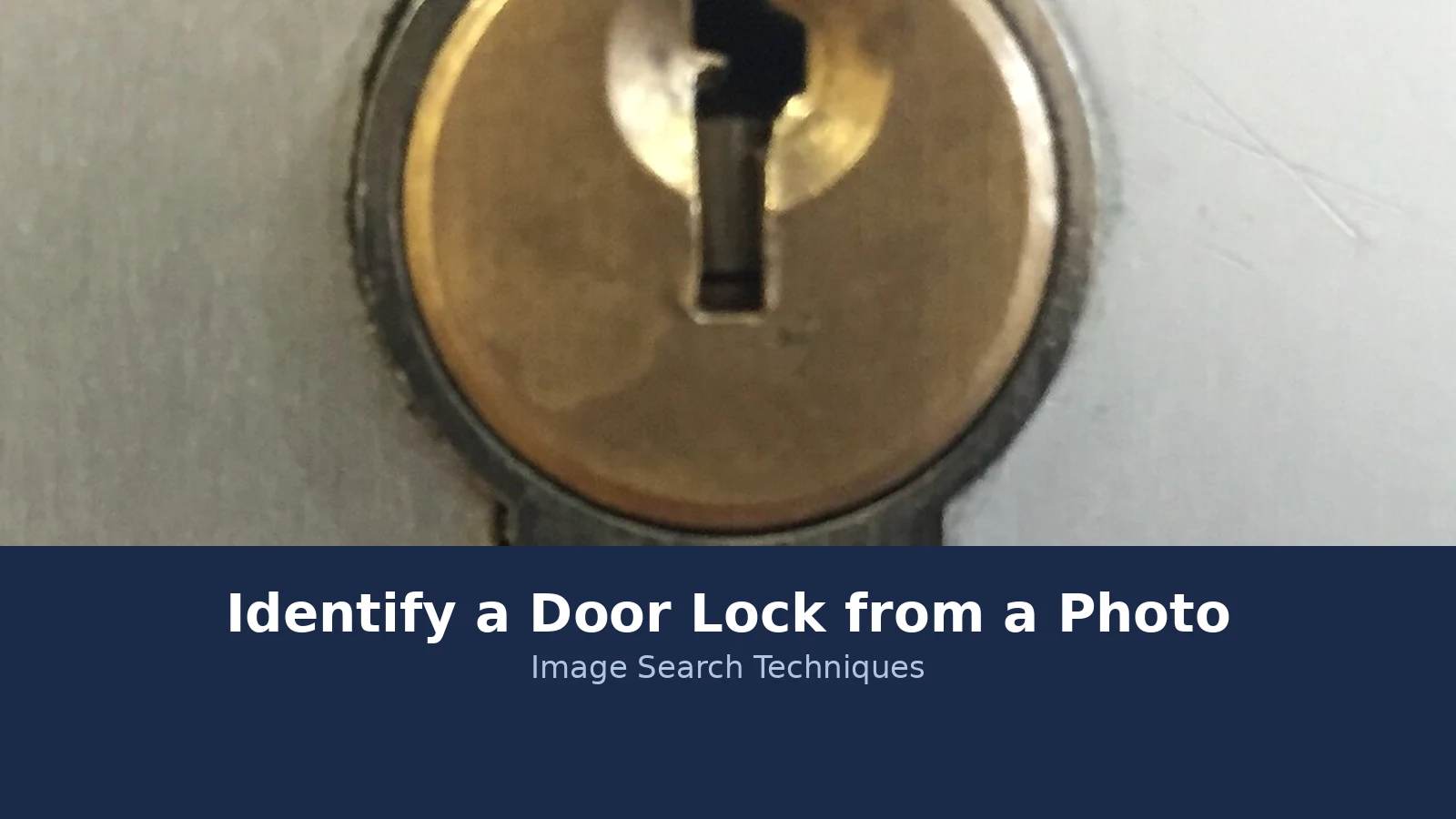
Worked example two shows a euro cylinder close up. The photo, taken by Willh26 in 2020 and held on Wikimedia Commons under a CC BY-SA 4.0 licence, shows an unbranded pin tumbler euro cylinder set into a grey door. The brass plug is round, the black body below it is the flat sided oblong of the euro profile, and there is no key in the picture. The shape alone names it. You do not need the brand, because the profile is the identification.
A rim cylinder is different. It is round, and it sits in a round or square plate on the outside face of the door, with the lock body screwed to the inside face. If you see a round cylinder and a box on the inside of the door, you are looking at a rim cylinder working a night latch or a rim deadlock, not a euro cylinder.
A US style cylindrical lock, the type the West Broadway guide compares against the mortice lock, has its mechanism inside the knob or lever itself, with the cylinder in the centre of the knob. You will see it on older American doors and in some UK commercial buildings, but it is not a common UK front door lock. If your photo shows a knob with a keyhole in the middle and a small edge plate with a latch only, that is what you have.
Note the key shape while you are looking, but keep it out of the photo. A flat key with cuts along one edge is the usual key for a pin tumbler cylinder. A key covered in small round dimples belongs to a dimple cylinder. A long key with a patterned shaft belongs to a lever lock. The shape is a supporting clue, never the identification on its own, and it is never worth the risk of photographing a key.
What about a night latch, a rim lock or a multi-point lock?
Three more families turn up on UK doors, and each one is easy to recognise once you know where to look. They all live on the face of the door rather than inside its edge, which is why the face photo matters for them.
The answer capsule for this section is simple. A box on the inside face means a rim lock. A long strip with hooks means multi-point.
A rim night latch is the latch most British readers will know as a Yale lock, after the brand that made the type famous. It is a box screwed to the inside face of the door, with a spring latch that shoots out and locks automatically when the door closes. From outside you see a round rim cylinder. From inside you see the box, often with a small snib button that holds the latch back. It is a latch, not a deadlock: it keeps the door shut, but it is not the lock an insurer means when they ask for a five lever mortice deadlock.
A rim deadlock is the same idea without the automatic latch. It is a box on the inside face with a solid bolt, worked by a key from outside and a turn from inside. It is often fitted as a second lock on a timber door, above or below the main lock.
A multi-point lock is the standard fitting on a modern uPVC or composite door, and it is the one people most often fail to photograph properly. The giveaway is the long strip on the edge of the door, with hooks, bolts or rollers at several points along its length. Lifting the handle throws all of them into the frame at once. The cylinder in the middle of the strip is a euro cylinder, and the cylinder is the part you replace. If your door needs the handle lifted before the key will turn, and the edge shows a long strip rather than a single plate, you have a multi-point lock, and you should tell the locksmith that before anything else, because the mechanism and the cylinder are different parts with different prices.
A mortice lock can also hide inside a door that looks modern. A composite door with a timber core can carry a mortice sash lock, and a uPVC door with a euro cylinder can carry a separate mortice deadlock as a second lock. Photograph the edge before you decide. The edge never lies about which family you have.
Can a reverse image search identify a door lock from a photo?
Yes, partly. A reverse image search is good at naming the family of a lock and finding the page the photo came from. It is bad at reading the small print on the faceplate and it cannot measure anything. Use it as a second opinion after the faceplate test, not as a replacement for it.
The answer capsule for this section is simple. The search names the family. Your eyes read the markings. The tape measure settles the replacement.
We ran both worked example photos through a reverse image search on 20 November 2026, and we report the results exactly as they came back. Google Lens could not be checked that day: every Lens request returned Google’s unusual traffic page instead of results, so there is no Lens count to report, and a missing count is not a zero. TinEye could not be checked either: it showed a human verification wall that did not clear. Yandex Images worked for both photos, so the worked example below is a Yandex test, reported honestly.
Photo one was the euro cylinder. Yandex showed the brass cylinder under its Smart Camera view and listed five tags in Russian, which translate as lock with keys, lock cylinder, cylindrical lock, lock armour plate, and padlocks. The lock cylinder tags are right in substance, but Yandex never used the English phrase euro cylinder, and one tag, padlocks, is simply wrong. Its search tab listed 23 similar image links, with the top one the Wikipedia page for pin tumbler locks, which is the exact source page of the photo. Its sites tab listed five sites, again led by the same Wikipedia page. The fuller similar images list ran to 55 links, but it was noisy, mixing lock cylinders with locksmith videos and unrelated pictures. The search found the family and the source. It did not name the euro profile.
Photo two was the mortice faceplate. Yandex did better here. Its tags included the Russian for mortice locks and door lock, along with lock body, strike plate and door tenon, so it named the family outright. Its search tab listed 32 similar image links, with 26 thumbnails loaded, and the top one was again the exact source page, the Wikipedia article on mortice locks. Its sites tab listed 13 sites, led by the same Wikipedia page, the Commons file page and the Alchetron mirror. The fuller similar images list ran to 71 links and was mostly on topic: mortice locks, plates and lock cases. One miss is worth noting. Yandex has a text in image box, and it read nothing from this photo, even though the words Chubb, 5 LEVER and BS 3621:2001 are clearly visible on the plate. A search engine sees shapes. It does not read your lock for you.
To run the same test on your own lock photo, upload the face photo and the edge photo separately to a reverse image search, and read the results the same way. Start with the search tab or its equivalent, and look at the top matches and the named tags, not the long list of similar images, which is always noisier. If the top match is a manufacturer page or a lock guide, follow it and compare the photos. If the search names only a broad family, such as cylinder lock, that is still useful: it confirms the family, and the faceplate test fills in the rest. And if the search returns nothing at all, that is not proof your lock does not exist. It usually means the exact photo has never been published online, which is normal for a photo you took yourself this morning.
Our own guide to the method covers the steps in full, and the identification hub gathers the whole family of identify from a photo guides in one place.
What do you do once you know the lock type?
Knowing the type is only half the job. The other half is the measurements, because a replacement that is the right type but the wrong size will not fit, and a mortice lock that does not match its pocket is a carpentry job, not a swap.
The answer capsule for this section is simple. Type first, then three measurements, then buy like for like.
Measure three things. First, the backset: the distance from the centre of the cylinder or keyhole to the edge of the door. Second, the cylinder length, if it is a euro cylinder: measure from the centre fixing screw to each end, because cylinders are sold by their two halves, such as 35 by 35 millimetres, and the two sides are often different lengths. Third, the door thickness and the faceplate size, so the replacement plate covers the old screw holes. A tape measure and a screwdriver are all you need, and the screwdriver only comes out to remove the single retaining screw that holds a euro cylinder in place. If the tool in your drawer is unmarked and you are not sure what it is, our guide to identifying a tool from a photo will name it for you. If you are unsure which screwdriver fits the small screws on a faceplate, our guide to identifying a screw or a bolt from a photo will help you match the head before you buy a set.
Buy like for like. A mortice sash lock replaces a mortice sash lock, and a mortice deadlock replaces a mortice deadlock. A euro cylinder replaces a euro cylinder of the same length. A multi-point mechanism is a bigger job than a cylinder swap, and if the hooks or bolts are sticking, that is a mechanism fault, not a cylinder fault, so say so when you ring the locksmith. For a timber front door, look for the BS 3621 Kitemark on the faceplate of the replacement. For a euro cylinder on a uPVC or composite door, look for a TS007 three star rating, which is the standard for cylinders built to resist snapping. Both standards are named in UK police home security guidance, and both are worth asking for by name in the shop.
When you ring a locksmith, give them the type, the three measurements, the door material and any standard marks you found. That is enough for them to bring the right part. If you would rather find a vetted locksmith than pick one from a search page, the Master Locksmiths Association keeps a list of approved locksmiths. A good locksmith will also tell you if the lock you have is fine and only needs servicing, which is a cheaper answer than a replacement.
If you are locked out, none of this applies. Do not try the methods in this guide to get back in, and do not follow any video that shows you how to open a lock. Ring a locksmith, prove the home is yours, and let them open it. Identification is for replacement and repair on your own door, and that boundary is the whole point of this guide.
FAQs
Can I identify a door lock from one photo?
Not reliably. Take two photos: one of the face, showing the cylinder and handle, and one of the door edge, showing the faceplate and bolts. The edge photo does most of the work: a tall plate with two bolts means a mortice lock, and a small plate with one bolt means a tubular latch.
What is the fastest way to tell a mortice lock from a euro cylinder?
Look at the door edge first, then the cylinder. A mortice lock has a tall faceplate on the edge with a latch and a deadbolt in the same plate. A euro cylinder has an oblong profile, round on top and flat sided below, set into the door face, and it usually drives a multi-point strip on uPVC and composite doors.
Can Google Lens identify my door lock?
It can suggest the family and find similar images, but it cannot read the markings on the faceplate or measure the plate, so use it with the faceplate test rather than instead of it. In our test, Yandex named the mortice lock outright and called the euro cylinder a lock cylinder, while Lens could not be checked that day.
Is it safe to post a photo of my lock online?
Only if no key is visible in the photo. A photo of a key can be copied, and a copied key opens the lock it belongs to, so take the key out and move it out of frame. A photo of the lock alone shows only the lock type, so search it privately rather than posting it with your address.
What measurements does a locksmith need?
Three measurements cover most replacements: the backset, from the centre of the cylinder to the door edge; the cylinder length, measured from the centre screw to each end; and the door thickness with the faceplate size. Add the lock type, the door material and any standard marks such as BS 3621, and the locksmith can bring the right part.
My door needs the handle lifted before the key turns. What lock is it?
That is a multi-point lock, the standard fitting on uPVC and composite doors. Lifting the handle throws hooks or bolts into the frame at several points, and the key then turns the euro cylinder in the middle. Tell the locksmith it is a multi-point lock, because the mechanism and the cylinder are different parts.