🔎 Reverse Image Search
Image search techniques made simple: upload a photo or paste a URL and search 6 engines at once. 100% free, nothing stored.
🔒 Your image is never stored on our servers longer than 24 hours and is never shared.
Short answer: yes, you can identify a key from a photo, but only to the level of its blank. A photo shows the keyway grooves, the shoulder shape and stamped code, which is enough to name the blank and order a replacement. It does not prove which lock it opens, and it must never be used to read cuts.
A key blank is an uncut key with the right keyway profile and head shape for one lock family, before any cuts are made. Identifying a key means finding which blank it is. That is the whole job here. If a guide promises to tell you what a key opens from a photo alone, it is overselling. The blank narrows the field to one lock family, and the lock itself, the latch plate or the paperwork tells you the rest. If the lock itself is the unknown part, our guide to identify a door lock from a photo reads the faceplate and the cylinder the same way.
What does identifying a key actually mean?
Answer capsule: it means naming the blank, not the lock, and the blank is what you can order.
Every key you hold is a blank that has been cut. The blank is defined by three things: the shape of the grooves running along the blade, which locksmiths call the keyway or milling; the shape of the shoulder where the blade meets the head; and the code stamped on the bow, the part you hold. Those three things are visible in a photo. The cuts along the edge are visible too, and this guide deliberately ignores them. Reading cuts from a photo is a different activity, and it is the one this guide will not teach.
That boundary matters because the two jobs look alike from the outside. Both start with a photo of a key. One ends with a blank number you can hand to a hardware shop. The other ends with a working copy of somebody else’s key. This article does the first job only. If you need a copy of a key you own, take the key itself to a locksmith or a hardware shop. A photo is a starting point for identification, not a substitute for the key.
Most keys people want to identify fall into a small set of families. In the United States the common house keys are Kwikset KW1 and Schlage SC1. In the UK, Yale and ERA profiles are common, along with a long tail of padlock and cabinet blanks. The method below works for all of them, because it starts from the shape of the key rather than from a brand name you may not have. It is the same photo first method our what is this picture guide uses for any unknown object, and the same approach works when you identify a screw or bolt from a photo, identify a tool from a photo or identify a light bulb from a photo , or identify a remote control from a photo.
How do you photograph a key for identification?
Answer capsule: flat, both sides, in plain light, with the stamp readable, and never posted publicly in full.
A key photo fails for boring reasons. The photo is taken at an angle, so the grooves look different from how they really are. The light comes from one side, so one groove disappears into shadow. The key sits on a patterned surface, so the outline of the blade is hard to trace. Fix those three things and most keys become identifiable.
Take the photo like this:
- Lay the key flat on a plain, light background, a sheet of white paper works well.
- Photograph it straight from above, not at an angle, with the whole key in the frame.
- Use plain daylight or a room light from above, not a flash from the side.
- Take both sides. The grooves on the front and the back are different, and both matter.
- Take one close photo of the bow, the part you hold, so any stamped code is readable.
- Put a coin next to the key for scale, then take it away for the close shots.
Do not photograph a key you do not own, and do not post a photo of your own key on a public page, a forum or a social feed. A clear flat photo of a cut key can be read by someone who knows how, and once it is public you cannot take it back. That is the single most important safety rule in this guide, so here it is plainly: never post a full, clear photo of a cut key publicly, because the cuts can be read from an image. The test photo used in the worked example below is a different case. It is a photograph that has already been published on Wikimedia Commons, of a pile of old keys, and it is used here to show the method, not as an example of how to share your own key.
If you need help from a locksmith by message, send the photo privately, to that one person, and ask them to confirm the blank. Do not put it in a group chat or a public post. The same caution applies to apps that ask you to upload key photos. Check what the app stores, and whether it identifies blanks only, before you upload anything.
What should you read first: the stamp on the bow?
Answer capsule: the stamp is the fastest clue, and it is usually printed on the bow or the shoulder.
Start with the bow. Many keys carry a code stamped into the metal there, and that code is often the blank number itself. A Kwikset house key is usually stamped KW1. A Schlage house key is usually stamped SC1. Yale keys often carry a Y1 or similar code. If you can read the stamp, you are most of the way there, and the rest of this guide is a check that the stamp is telling the truth.
Look on both sides of the bow, and look at the shoulder too, the flat step where the blade meets the bow. Some makers stamp the code there instead. The letters may be small and worn, so use the close photo from the step above, and turn the key under the light until the stamp catches it. A magnifying glass app on your phone helps here, and it costs nothing.
A stamp can also mislead. Decorative keys, souvenir keys and cheap copies sometimes carry a brand name that does not match the keyway. A key that says Kwikset on the head may still be a copy made to a different profile. That is why the stamp is step one and not the whole answer. If the stamp says KW1 and the grooves match the KW1 profile, you have a match. If the stamp and the grooves disagree, trust the grooves, and ask a locksmith to confirm it in person.
Some keys have no stamp at all. Old keys, worn keys and unbranded copies are often blank in every sense. That is normal, and it is where the rest of the method earns its keep. An unmarked key is not unidentifiable. It just needs the next two steps.
How do keyway profile and shoulder shape narrow it down?
Answer capsule: the grooves decide the family, the shoulder confirms it, and the head shape is the weakest clue of all.
The keyway is the set of grooves milled into the sides of the blade. It is what lets a key slide into one lock and not into another. Two keys can look the same from across the room and have different keyways, and two keys with different heads can share one keyway. So the grooves come first, and the head comes last.
Look at the blade face on, in your straight-down photo. On a Kwikset KW1, the front face shows two grooves running the full length of the blade. The main narrow groove sits slightly off centre to the right and runs flat to the edge, and to its left is a wider groove that runs all the way to the left edge. Turn the key over and the pattern changes: the narrow groove is now on the left, with a flat section in the middle and a wider groove on the right. On a Schlage SC1, the front face also shows two grooves, but the narrow groove sits slightly off centre with a wider groove to its left, and the back shows a single narrow groove. These groove maps are described in detail in a KW1 versus SC1 comparison, and the comparison below gives the short version for the two commonest house keys.
| Feature | Kwikset KW1 | Schlage SC1 |
|---|---|---|
| Stamp on the bow | KW1, sometimes 66 | SC1, sometimes 68 |
| Front face grooves | Two grooves, narrow one off centre right | Two grooves, narrow one slightly off centre |
| Back face grooves | Narrow groove left, flat middle, wide groove right | Single narrow groove |
| Head shape, standard key | Five sided head, several cutouts | Wider diamond shaped head, one keyring hole |
| Ilco blank number | 1176 | 1145 |
| Fits | Kwikset locks and Weiser locks that use the KW1 keyway | Schlage locks, not interchangeable with KW1 |
Next, look at the shoulder. The shoulder is the step at the base of the blade, and its shape and position are part of the blank. Some blanks have a square shoulder, some have a stepped one, and the distance from the shoulder to the tip tells you the blade length family. Compare it against the catalogue silhouette, not against your memory of what your front door key looks like. Memory is a poor ruler.
Then, and only then, look at the head. The head is the least reliable clue, because makers put the same keyway into many head shapes: plain, decorative, coloured plastic, oversized, novelty. The worked example below shows this clearly. Several keys in one photo share a single blank, and their heads are all different. A guide that starts from head shape will send you in circles. Start from the grooves, confirm with the shoulder, and let the head be a hint at most.
Finally, note the key type. A flat blade with cuts on one edge is a standard house or padlock key. A round hollow shaft with notches around the end is a tubular key, used on vending machines, bike locks and some cabinets. A flat blade with small round dimples on both faces is a dimple key, used on higher security locks. A long thin key with a simple bit at the end is a skeleton key for old warded locks. Each type has its own catalogue section, so naming the type first saves a lot of searching.
How do you match a key to a blank catalogue?
Answer capsule: find the keyway in the catalogue index, then compare your photo against the full size silhouette.
Locksmiths use blank catalogues the way birdwatchers use field guides. The standard reference is the Ilco Key Blank Directory, published by Kaba Ilco. It lists blanks by number, with full size drawings of each blank and its milling profile, organised by section: vehicles, North American cylinder, international cylinder, and a cross reference that maps other makers’ numbers to Ilco numbers. The full text of an edition is held on archive.org, and the KW1 entry sits in the North American cylinder section, listed at pages 2-23, 2-39 and 2-49 of the index, with Ilco number 1176.
Use it like this:
- Work out the key type first: flat house key, tubular, dimple, car, padlock or skeleton.
- If the key is stamped, look the code up in the directory index. KW1, SC1 and Y1 are all listed there.
- If it is not stamped, go to the section for its type and compare the groove pattern in your photo with the milling drawings, one by one.
- When a drawing looks close, check the shoulder shape and the blade length against your photo at the same scale.
- Confirm the match in the cross reference. A KW1 should cross to Ilco 1176, a Schlage SC1 to Ilco 1145, and other makers’ numbers should point to the same Ilco number.
The directory is a reference book, not a shopping site, and it is written for locksmiths. Its drawings are technical, and its index is long. That is fine. You only need one page of it, the page for your key. If the catalogue route feels heavy, a simpler path is a keyway comparison guide that shows KW1 and SC1 side by side with photos of both faces, which is enough for the two commonest house keys. For anything unusual, the catalogue is the authority, and a locksmith will have a copy behind the counter.
Reverse image search can help at this stage, and it can also waste your time. Searching a photo of a common house key usually returns shopping listings for blanks, which is useful, because the listings name the blank. It can also return lookalikes, because many keys share a head shape. Use reverse search as a second opinion, not as the verdict. The worked example below shows what it actually returns for a real key photo, and where it falls short. Our guide to reverse image search explains the engines and their limits in detail.
Worked example: three Kwikset heads, one blank
Answer capsule: different heads, one keyway, and the stamp plus the grooves agree on KW1.
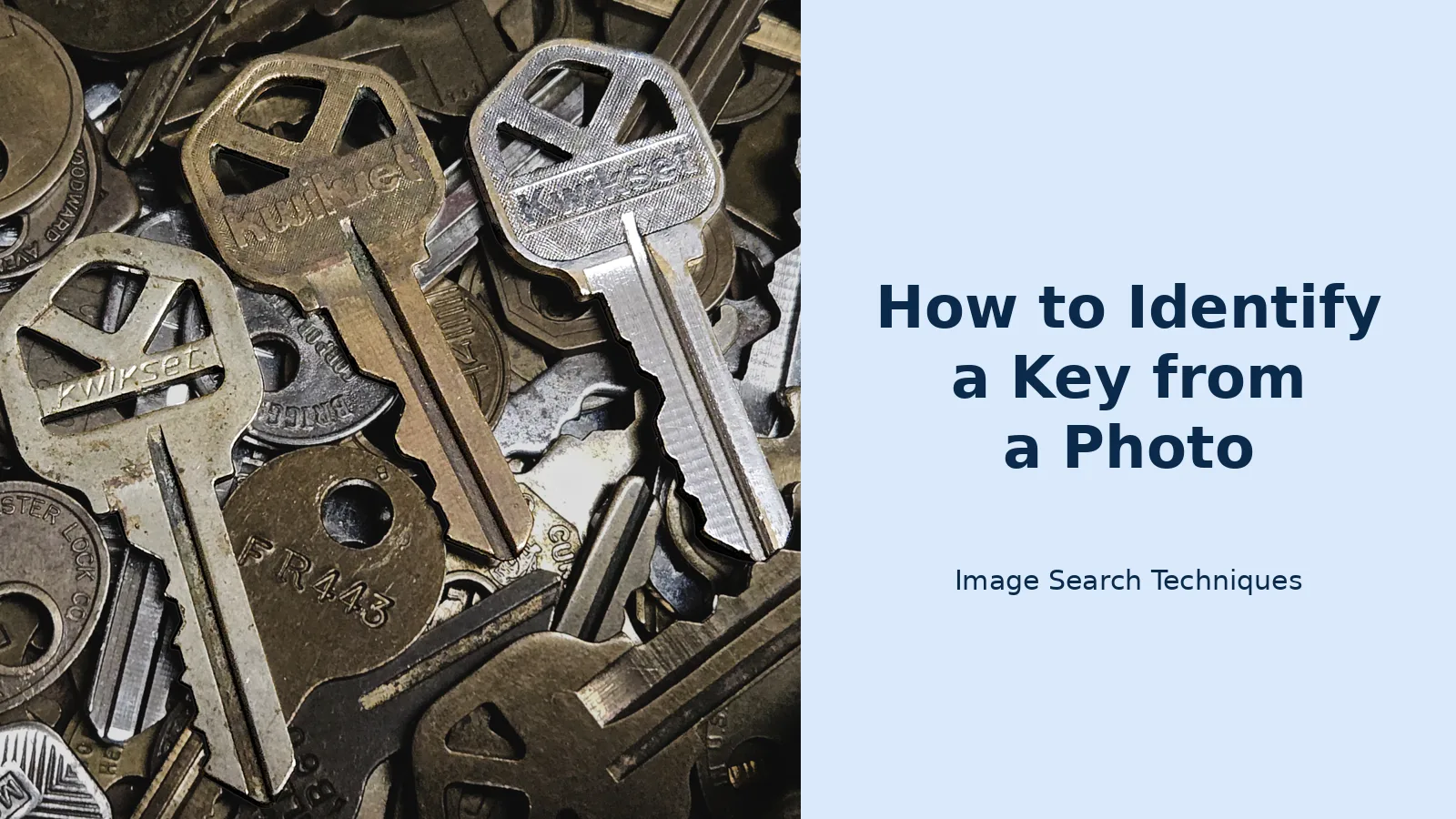
The test photo is a Wikimedia Commons photograph by WillisMoon, dated 28 February 2026, titled “Kwikset KW1 key head variations”. It shows a pile of old keys, with three Kwikset keys on top in different finishes: one brass, one silver, one worn steel. All three carry the Kwikset name on the bow. Their heads are different shapes, and their blades are cut differently, because they belong to different locks. The question is whether the photo is enough to name the blank, and the answer is yes, because the blank is the same for all three.
Step one, the stamp. The silver key on the right shows the Kwikset name clearly across its bow, and the brass key in the middle shows the same name. The worn key on the left shows it too, though fainter. None of the three shows a KW1 stamp legibly at this distance, which is normal for a pile photo, so the stamp alone does not settle it.
Step two, the grooves. The silver key on the right shows the KW1 front face pattern: two grooves running the full length of the blade, the narrow one off centre to the right. The brass key in the middle shows the same pair of grooves from a different angle. The pattern matches the KW1 milling drawing in the Ilco directory, and it does not match the SC1 pattern, which has a different back face.
Step three, the catalogue. KW1 is listed in the Ilco Key Blank Directory index at pages 2-23, 2-39 and 2-49, with Ilco number 1176, in the North American cylinder section. The cross reference maps the Kwikset KW1 to Ilco 1176, and the same number appears on hardware listings for KW1 blanks. Three different heads, one blank number.
Step four, reverse image search. The same photo was run through the reverse search engines on this site on 13 November 2026, and the results are in the table below.
| Engine | Result on 13 November 2026 | Found the Commons file page? |
|---|---|---|
| Google Lens | Failed. The Lens page showed “Expired visual search” and “No image at the URL”, 0 exact matches, even after one retry with a fresh paste URL link. | No |
| TinEye | 1 result from 86.7 billion images searched. First indexed 11 April 2026. The only result was the Commons file page, 1800 x 1350, 2.6 MB. | Yes |
| Bing | “1 Page with this image”, but the page was the Kwikset Wikipedia article showing a different 250 x 187 image from 2011, not this 2026 file. Visual matches were similar piles of keys. | No |
| Yandex | Recognised the image, but the top site was an Etsy listing for bulk cut keys. No exact match count shown, and no result was the Commons file page. | No |
| Did not search the image. The tool button opens a Pinterest keyword search for the image host domain, and its 31 pins included nothing of the keys photo. | No |
What the test shows is worth stating plainly. Only TinEye found the photo itself, which confirms the photo is the Commons image it claims to be, but even TinEye did not name the blank. No engine reads a keyway. The blank came from the stamp, the grooves and the catalogue, in that order. Reverse search is a check on the photo, not a check on the key. It tells you where a photo has appeared before, which is useful when a key photo arrives in a message from a stranger, and it tells you nothing about the grooves. Lens failing outright on a public image is also a useful reminder: one engine failing says nothing about the photo, so run more than one.
That last point is the honest limit of this whole method. A photo can name a blank. It cannot prove which lock the key opens, and it cannot prove the key is yours. If you need a working copy, the locksmith needs the key in hand, or the lock, or the code card that came with it. The photo gets you to the right counter with the right words. It does not replace the visit.
When do key identification apps help, and when do they get it wrong?
Answer capsule: blank matching apps can help, but apps that read cuts from a photo are outside this guide and should not be used.
Two kinds of key app exist, and they are easy to confuse. The first kind matches a photo of a key to a blank, the same job this guide teaches by hand. IdeniKey, from CLK Supplies, is one example. You photograph both sides of the key, and it returns up to five blank matches from its database, which you can then order through the app. It launched in the summer of 2024, and its Play Store listing was updated in July 2026. Reviews are mixed: some locksmiths say it identifies common blanks well, others report wrong matches on less common keys, and several note that it moved to a subscription. Treat any app result the way you would treat a catalogue guess, as a lead to check against the grooves, not as a verdict.
The second kind of app is different, and this guide will not recommend it, link to it or explain how to use it. Key decoding apps estimate the cut depths of a key from a photo, using a reference card for scale. That is the bitting reading this guide refuses to teach, and an app does not make it safe. A clear photo plus a decoding app can produce a working copy of a key, which is exactly why you should not post clear key photos publicly, and why you should not run a decoding app on a key that is not yours. If an app asks for a photo of a cut key and promises a cut code, close it. The blank is all you need from a photo, and the blank is all this guide will help you find.
The competitor guide on this topic lists Keyscan Mobile and the Ilco Key Web Reference as tools, without testing either against a real key. That is the gap this article fills. The Ilco directory is a real reference, and its KW1 entry is quoted above with its index pages. A photo matching app is a convenience, not an authority. The authority is the catalogue silhouette, the groove pattern and the stamp, checked against each other.
What are the common mistakes when identifying a key from a photo?
Answer capsule: trusting the head, trusting one photo, and trusting a shopping listing are the three usual errors.
The first mistake is starting from the head. Head shapes are fashion. Makers change them, souvenir makers copy them, and the same keyway appears under a dozen heads. The worked example above has three different heads on one blank. If you match by head, you will either miss the match or match the wrong key.
The second mistake is using one photo. A single front view hides the back face grooves, and the back face is often what separates two close blanks. KW1 and SC1 look similar from the front to an untrained eye, and the difference is clearer when both faces are compared. Always photograph both sides.
The third mistake is trusting a shopping result. Search a key photo and you will find listings that name a blank. Some are right. Some are listings for a lookalike blank with a similar head. A listing is a seller’s claim, not a catalogue entry. Check it against the Ilco cross reference before you order.
The fourth mistake is ignoring the shoulder. Two blanks can share a groove pattern and differ at the shoulder, and the shoulder decides whether the blank seats correctly in the lock. If the grooves match and the shoulder does not, keep looking.
The fifth mistake is the serious one: posting the photo publicly to ask for help. A forum post with a clear flat photo of your front door key is a copy of your front door key, offered to anyone who reads the thread. Ask privately, send the photo to one locksmith, and delete the message thread when you have your answer. The same warning applies to photos sent to a seller or a stranger who offered to identify a key for you. If you would not hand them the key, do not hand them the photo.
What should you ask a locksmith or hardware shop?
Answer capsule: bring the key, name the blank if you know it, and say what the key is for.
Once you have a blank in mind, the conversation is short. Tell the shop the blank number, the lock brand if you know it, and what the key opens: front door, back door, padlock, cabinet. Bring the key itself, and bring the lock brand from the latch plate if the key is lost. A locksmith can then confirm the blank in seconds against a gauge, and tell you whether a copy needs the original or can be made from a code.
If the key is for a restricted or patented keyway, expect the shop to ask for proof that you are entitled to a copy. That is normal, and it is a good sign. High security keys are designed so that a photo and a blank number are not enough. If a shop offers to cut a restricted key from a photo with no questions, walk away.
If you have no key at all, only a photo, say so at the start. A locksmith can sometimes identify the blank from a good photo and then make a key by picking the lock or by its code, but that is their work, in person, with the lock in front of them. Do not expect a photo alone to produce a working key by post. And do not send a photo of a cut key to a stranger online who offers to cut one for you. That is the same risk as posting it publicly, with a stranger attached.
One last check before you order a blank online: confirm the return policy. Blanks are cheap, and a wrong blank is a small loss, but a blank ordered from a listing that named the wrong keyway is a wasted trip. Order from a listing that names the Ilco number as well as the brand code, KW1 with Ilco 1176, SC1 with Ilco 1145, and compare the silhouette in the listing photo with your own key before you buy.
Frequently asked questions
Can you identify a key from a photo?
Yes, to the level of its blank. A clear photo of both sides shows the keyway grooves, the shoulder shape and any stamped code, which is usually enough to name the blank, such as KW1 or SC1. It cannot prove which lock the key opens, and it should never be used to read the cuts.
What is a key blank number?
A key blank number names the uncut key that fits one lock family, before any cuts are made. KW1 is the Kwikset house key blank, Ilco number 1176, and SC1 is the Schlage house key blank, Ilco number 1145. The number is what you order or ask a locksmith for.
How do I tell a KW1 key from an SC1 key?
Check the stamp on the bow first, KW1 or 66 for Kwikset, SC1 or 68 for Schlage. Then compare the grooves on both faces of the blade against a catalogue drawing, because the two blanks differ on the back face. The head shape alone is not a reliable test.
Can I post a photo of my key online to ask what it is?
No, not a clear flat photo of a cut key. The cuts can be read from an image, so a public post is effectively a public copy of your key. Ask a locksmith privately instead, send the photo to that one person, and delete it once you have your answer.
What is the Ilco Key Blank Directory?
It is the standard locksmith reference for key blanks, published by Kaba Ilco, with full size drawings of each blank and its milling profile. KW1 is listed in the North American cylinder section, Ilco number 1176. An edition is held in full text on archive.org.
Can reverse image search identify a key?
It can find where a photo of a key has appeared before, and shopping listings in the results often name the blank. But no search engine reads a keyway, so reverse search cannot name the blank by itself. Use it as a second opinion beside the stamp, the grooves and the catalogue.