🔎 Reverse Image Search
Image search techniques made simple: upload a photo or paste a URL and search 6 engines at once. 100% free, nothing stored.
🔒 Your image is never stored on our servers longer than 24 hours and is never shared.
This guide answers a question readers keep asking on Quora about photographing people in public: are you allowed to film a movie, a sitcom or a show in Canada, anywhere in public, with members of the public in the background, without their permission and without paying them? It is a fair question, and the answer splits in two. Taking the photo is one question. Using it is another. This guide covers the photographer side. If you are on the other side of the lens, our companion guide covers what you can do when a stranger is photographing your family.
The short answer: In the UK and Canada you can photograph people in a public place without asking first, and an ordinary photo needs no permit. The line is crossed by what you do next. Using a recognisable person to sell something needs their consent, a planned shoot often needs a permit, and some places and some kinds of behaviour stay off limits.
What counts as a public place? For this guide, a public place means somewhere the public can freely go: a street, a pavement, a park, a beach. A shopping centre or a restaurant looks public, but it is private land with its own rules, and that changes the answer. The same goes for a station concourse, a sports ground and a concert venue. You can stand on the pavement outside and photograph the building. Once you step inside, the owner sets the terms.
This article is general information, not legal advice. The rules below come from police guidance, the criminal law of the UK and Canada, and the publicity rules that govern advertising. Laws differ by country and by province or state, and if you are planning a commercial shoot, a local solicitor or lawyer is the right call before you spend money on it.
Can you photograph people in public without permission?
In the UK, yes, in most cases. There is no law in England and Wales that stops you photographing people in a public place, and no permit is needed for an ordinary photo. That is the starting point, and it is confirmed by police guidance rather than by a single statute. Avon and Somerset Police put it plainly: there is no law preventing people from taking photographs or a video in public, and that includes taking photos of other people’s children. The Metropolitan Police’s own published guidance says the same, and the policing.uk guide updated in October 2026 confirms there is no general law in England and Wales prohibiting photography in public places, including photographs of people.
The legal footing is freedom of expression. Article 10 of the European Convention on Human Rights, brought into UK law by the Human Rights Act 1998, protects photography as a form of expression. The police guidance that forces still cite goes further: there are no powers prohibiting the taking of photographs in a public place, members of the public and the press should not be prevented from doing so, and once an image has been recorded the police have no power to delete or confiscate it without a court order.
That does not mean anything goes. The law limits behaviour, not photography, and four limits matter most. First, harassment. Persistently following or targeting one person who has made it clear they object can become an offence under the Protection from Harassment Act 1997. One photo of a stranger on a street is not harassment. Following the same person down three streets after they asked you to stop is a different matter. Second, voyeurism. Section 67 of the Sexual Offences Act 2003 makes it a crime to observe or record someone doing a private act without consent for sexual gratification, and upskirting became a specific offence under the Voyeurism (Offences) Act 2019. Third, security law. Section 43 of the Terrorism Act 2000 lets an officer stop and search someone they reasonably suspect of being a terrorist, and Section 58A covers publishing information about police or armed forces personnel that is likely to be useful to a terrorist. Taking a photo cannot by itself be reasonable suspicion, but the power exists and officers can ask questions. Fourth, courtrooms. Section 41 of the Criminal Justice Act 1925 bans photography inside courts, and that ban is enforced.
There was a useful test of all this in the summer of 2026. A Home Office leaflet given to asylum seekers told them not to photograph or film people in public and warned they could be arrested. That advice is wrong as a statement of the law, and it was challenged at once. The National Union of Journalists responded on 25 August 2026 and the Royal Photographic Society on 26 August 2026, and a written question in the House of Lords, HL3503, tabled on 14 September 2026, asked the Government to withdraw it. The Home Office answered on 12 October 2026 that it had no plan to withdraw the leaflet. The leaflet is aimed at one group of people, not at photographers generally, but it shows why the question keeps coming up: official-looking paper can say the opposite of what the law says, and the police guidance is the better source.
The AI Overview that Google shows for this question agrees with the police position, and it is worth noting what it covers, because it is the answer most searchers will see first. It says photographing people in public is generally legal in the UK if legal and ethical boundaries are followed, no permit or permission is needed in streets, parks or open public places, police cannot stop filming in public, and no one, including police, can make you delete legally taken photos without a court order. It also flags the limits: do not trespass on private land, private businesses such as shopping centres can ask you to stop, places where people expect privacy must not be photographed without consent, and consistently targeting one person against their will breaches the Protection from Harassment Act 1997. It says non-commercial use, such as art, social media or editorial work, does not need a model release, and it points readers to the Metropolitan Police photography advice and the Avon and Somerset Police page on taking photographs in public places. Where it stops is the interesting part. It says nothing about Canada, nothing about the United States, and nothing about permits for a planned shoot. That is where this guide goes further.
What did the Quora question actually ask?
The Quora question behind this guide is specific, and it is worth reading it exactly as it was asked: “Are you allowed to film a movie, sitcom or show in Canada anywhere in public without the Public’s permission ie: having them in the background without paying them?” The person asking is not a street photographer. They are thinking about a film or a television production, with a crew, where people who never agreed to be in it might appear in the background of a shot.
The page itself carries only one direct answer, which is worth saying plainly, because the question file for this round described two substantial answers and that is not what the page shows. Quora’s own filter shows one direct answer and 31 answers to related questions. The one direct answer, by Mike Az, gets the shape of the problem right. His point is that the filming itself is not necessarily the problem. What you do afterwards is. For a major project, he says, talk to city hall, because permits may be required. For a minor project, aim for a clean background with no people in it. And deliberately filming unsuspecting people as extras without even informing them, let alone without permission, waivers or payment, is, in his word, “cruddy”. He cites no Canadian statute, makes no province-by-province distinction, and gives no rule on when background people must be paid. Those gaps are what the rest of this guide fills.
One of the related answers is worth quoting for its attitude, if not its detail. Scott B, answering the related question “Do you need permission to film a movie in a public place?”, says to always assume yes, because you are going to draw attention and you want the authorities on your side. That is practical advice rather than law, but for a planned shoot it is the right starting point, and the permits section below explains why.
Can you film people in Canada without their permission?
In Canada, as in the UK, filming people in a genuinely public place is generally legal. Streets, parks and malls are places where people expect to be seen, so filming there is lawful in most situations. Washrooms, change rooms and bedrooms are the opposite. Recording someone there without consent will almost always raise criminal issues, and the spaces in between need care.
The criminal law sets the hard edges. Section 162 of the Criminal Code makes voyeurism a crime: secretly observing or recording a person where they have a reasonable expectation of privacy, in circumstances such as where they can be expected to be naked, where they are in fact naked, or where the recording is made for a sexual purpose. It carries a maximum penalty of five years in prison, and you can read the section itself on the Government of Canada’s Justice Laws site. Section 162.1 makes it a crime to publish or otherwise make available an intimate image without consent. Section 184 covers private communications: Canada has a one-party consent rule for audio, which means one participant in a conversation can consent to recording it, but you cannot secretly record a conversation between other people that you are not part of.
The Supreme Court of Canada has said the expectation of privacy is not switched off just because someone is outside. In R v Jarvis, 2019 SCC 10, the Court held that finding a reasonable expectation of privacy is highly contextual and depends on a number of factors. Courts have held that there is a reasonable expectation of privacy at a public beach, and that zooming in on women sunbathing is voyeurism, even though the beach is a public place. The lesson for a photographer is simple: a public setting helps you, but it does not protect a shot that zeroes in on someone’s body or follows one person.
Civil law adds a second layer, and it varies by province. In British Columbia, the Privacy Act makes it a tort to use a person’s name or portrait for advertising or promotion without consent. In Quebec, the Civil Code protects the right to one’s image and privacy, and the Supreme Court applied it to a photo taken in public in Aubry v. Editions Vice-Versa inc., [1998] 1 S.C.R. 591. In that case a photograph of a young woman sitting on the steps of a public building, taken without her knowledge and published in a magazine, was held to be an invasion of her privacy. Quebec is stricter than the rest of Canada on this point, and a production filming in Montreal needs to know that before it shoots, not after. In Ontario, the courts recognise a claim for misappropriation of personality when someone’s name or likeness is used for commercial gain without consent, going back to Krouse v. Chrysler Canada Ltd. in 1973.
For a film shoot, the practical rules sit on top of the law. Parks Canada asks small-scale travel media shoots to register each shoot well in advance, at least 20 business days before the intended shoot, and to ask politely before filming or photographing anyone. Municipal film offices work the same way. A crew with lights, a tripod and a blocked pavement is not an ordinary photographer, and the city will want to know about it.
What about the United States?
The United States is the most permissive of the three countries for taking a photo, and the least uniform for using one. The First Amendment protects photographing anything in plain view from a public place, including people, buildings and police officers. There is no general federal law against photographing strangers in public, and no permit is needed to take a photo on a public street.
The complications start with the states, and they split in two directions. On privacy, most states follow the same broad line as the UK: no reasonable expectation of privacy in a public place. On publicity, the states diverge sharply. The right of publicity, the right of a person to control the commercial use of their identity, is state law, and the details change from state to state. New York requires written consent before a living person’s name, portrait or picture is used for advertising or trade, under Civil Rights Law sections 50 and 51. California protects name, voice, signature, photograph and likeness under Civil Code section 3344, and a parallel common law right. Other states have their own versions, and some have almost none. A photo that is lawful to take in all fifty states can still be unlawful to use in an advert in some of them.
Audio is the other split. Some states are one-party consent, like Ohio, where at least one party to the conversation must consent. Others are all-party consent, where everyone being recorded must agree. A film crew recording dialogue on a public street needs to know which kind of state it is standing in, because the video may be fine and the audio may not be. The safe habit is to treat sound separately from picture, and to check the state rule before the shoot rather than after.
When do you need a permit to film in public?
An ordinary photo needs no permit in the UK, Canada or the United States. A planned shoot often does, and the line is drawn by what you bring and what you block, not by the camera itself. A person with a phone is a photographer. A crew with a tripod, lights, a generator, a dolly track or a closed-off stretch of pavement is a production, and productions are managed.
In practice, ask for a permit when any of these apply. You are closing or narrowing a pavement, a road or a park path. You are bringing vehicles, generators or lighting rigs. You are filming for more than a short period in one spot. You are using a drone. You are filming inside a place the public can enter but a private owner controls, such as a shopping centre, a station or a stadium. You are filming somewhere a film office manages, such as a national park or a heritage site. Parks Canada, for example, asks for registration at least 20 business days ahead, and longer for northern and remote locations.
For a city shoot, the route is usually the municipal film office or city hall, which is exactly what the Quora answer advised. They will want the dates, the location, the size of the crew and what you plan to block. The permit does not buy you the people in the background. It buys you the space and the right to manage it. The people are a separate question, and it is answered by the consent rules in the next section.
Private property open to the public deserves its own warning, because it catches photographers out. A shopping centre, a restaurant, a museum and a railway station are all private land. The owner can set rules for the premises, including a ban on filming, and can ask you to stop or leave. If you are asked to leave and you refuse, you can face trespassing charges. The same applies in Canada and the UK. Photographing the building from the public street outside is a different matter, and is generally lawful, because you are standing where you are allowed to be.
When does a recognisable person need to give consent?
This is the question that decides most disputes, and the answer turns on the use, not the shoot. A release is a written agreement in which a person gives permission for photos of them to be used in certain ways. You need one when a recognisable person appears in a photo that will be used commercially: to advertise, promote, endorse or sell something, or licensed as commercial stock. For editorial uses, such as news, commentary, documentary work and education, you usually do not need one in the US or the UK. Some countries are stricter, and Quebec, France and Germany all give people a stronger right to their own image than the UK does.
Two permissions are often needed, and they are easy to confuse. One is copyright, which usually belongs to the photographer. The other is the permission of the person shown, which is what a release provides. Owning the file does not give you the right to put a stranger’s face on an advert. That is the mistake the Quora question is really about: the film-maker owns the footage, but the people in the background still own their own faces for commercial purposes.
Recognisable is broader than a visible face. A person can be identified by distinctive tattoos, a birthmark, unique clothing, equipment, a location, or a caption with a name. Stock agencies apply the same test. Getty Images says a release is needed for recognisable people whether they are the main subject of the shoot or in the background, and Shutterstock requires permission from every recognisable person for commercial content, with a separate release for each person. Adobe Stock tells contributors that a release may be required even when a person’s face is not visible, and accepts back views and crowds without one only when nobody can be picked out.
Three rules of thumb cover most situations. First, if the photo will sell or promote something, get a signed release from every recognisable person in it, at the time of the shoot, when it is easiest to ask. Second, if the photo is news, documentary or commentary, you usually do not need one, as long as the use is truthful and does not mislead or defame. Third, if a child is recognisable, a parent or legal guardian signs, and if you are unsure, ask anyway. A release costs nothing and takes two minutes on set. A dispute over an unauthorised image can cost a campaign, a reprint and a lawyer.
Social media does not change the test. A post on a company’s social media account is easy to mistake for something casual, but if it sells or promotes, it is commercial use, and the same release rule applies. That is why a brand account that posts a movie still or a street photo with a recognisable stranger in it is taking a different risk from a personal account posting the same image. Our guides on AI faces in adverts and movie screenshots on Instagram cover the advert side in more detail, and both make the same point: the platform will not save you from the person in the picture. For the wider picture, including how to find photos of yourself online and what to do about them, see our face search and photo privacy guide.
The permission table: taking the photo vs using it
This table is the heart of the guide. Each row is a situation a photographer will actually meet. Read it left to right: whether you can take the photo, whether you can use it, and what to do before you publish.
| Situation | Taking the photo | Using it | What to do first |
|---|---|---|---|
| Background strangers on a public street, for your own portfolio or social media | Yes, in the UK, Canada and the US | Yes, for personal or editorial use | Nothing required, but ask or nod if you make eye contact |
| The same street photo in a news story or documentary | Yes | Yes, editorial use needs no release | Keep the caption truthful and do not imply the person endorses anything |
| A recognisable stranger in an advert, a product listing or a sponsored post | Yes, taking it is lawful | No, not without their consent | Get a signed model release from every recognisable person before the campaign runs |
| A planned film shoot on a public street, with crew and equipment | Yes, with a permit where the city requires one | Yes, for the film, but background people are not extras | Apply to the film office or city hall, and tell people nearby what you are filming |
| Photos inside a shopping centre, restaurant or station | Only with the owner’s permission | Only as the owner allows | Ask the manager first, and leave if you are asked to |
| A child in a park, recognisable, for a stock library | Yes, taking it is lawful in the UK | No, not without a release | Get a parent or legal guardian to sign, and think twice before you shoot at all |
| Background people in a film shot in Quebec | Yes, in a public place | Risky, Quebec protects the right to one’s image | Take legal advice for the province, and get releases for anyone recognisable |
| A photo of a stranger used to sell a product on a marketplace listing | Yes, taking it is lawful | No, commercial use needs consent | Use a model, a licensed stock photo, or a photo with a signed release |
Notice what the table does not say. It never says a photo is safe because nobody complained yet, and it never says a clean reverse image search proves you are free to use a photo. A search tells you where a photo has appeared. It tells you nothing about who owns the rights in it or who the people in it are.
Taking the photo lawfully is only half the story. What you do with it afterwards matters just as much. Publishing an innocent street photo with a false caption, or in a context that suggests the person committed a crime or is linked to a scandal they have nothing to do with, can be defamation, even though the photo itself was taken legally. The law looks at what the publication implies about a real person, not only at whether the shutter click was lawful.
Worked example: one Amsterdam street photo, run through the table
The photo below is a real street scene, and it is the worked example for this guide. It shows the Utrechtsestraat in Amsterdam on 12 October 2021, photographed by Fons Heijnsbroek and released under a CC0 licence, which means the photographer has waived his own rights in it. People are walking and talking on the pavement, a cyclist crosses the junction, and the faces in the frame are small and mostly turned away. I ran the photo through a reverse image search on 15 November 2026 to see what the search could and could not tell me about it.
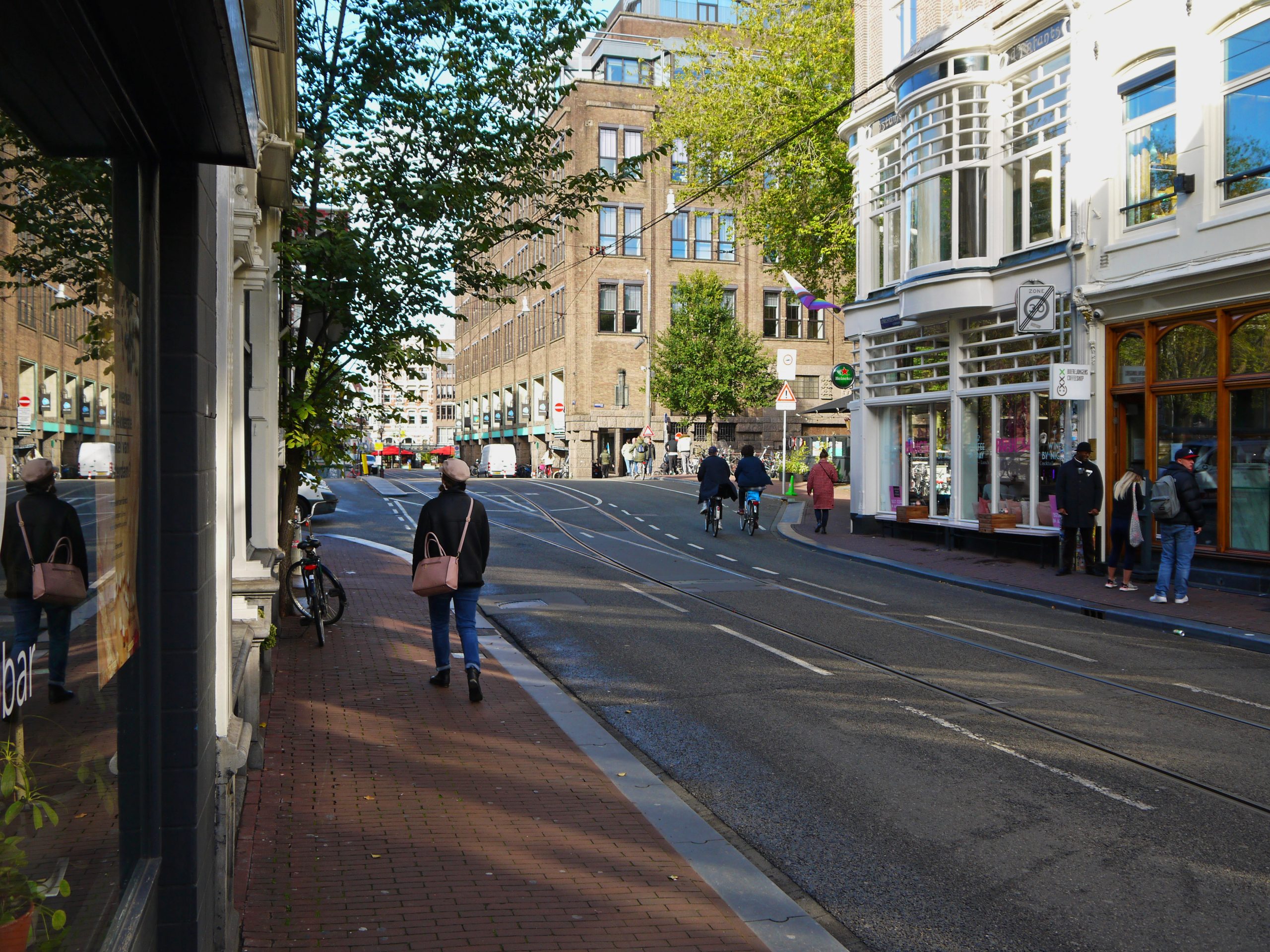
I ran the photo through a reverse image search on 15 November 2026, using the copy uploaded to this site. TinEye searched its index of 86.7 billion images and found 4 matches. The earliest was the original Unsplash copy, first indexed on 3 May 2023, and the other matches were the same photo reused on other sites, including a packfits.com page from October 2026. Google Lens returned exact matches too, including the Unsplash original from 13 October 2021 and the Wikimedia Commons file page, and it identified the location as the Utrechtsestraat in Amsterdam. Lens shows no numeric count, so I am not giving one. Neither service listed the copy on this site, which is expected: it was uploaded minutes before the search, and neither index had crawled it yet. That is the point. A search finds copies that already exist. It says nothing about permission.
Now run the photo through the table, row by row. Taking it: the photographer was standing on a public street, and the people in it are background figures in a public place. Under UK, Canadian and US rules, taking this photo needed no permission. Using it on a personal blog or a social media account: fine, it is personal and editorial use, and nobody in it is recognisable enough to be identified from the frame. Using it in an advert: that would be a different decision. The woman in the pink coat on the left is the most visible figure, and if she were large in the frame and recognisable, an advert would need her consent. In this frame she is small, seen from behind, and not identifiable, which is why the photo works as an example and not as an advert. Using it as stock: the CC0 licence covers the photographer’s rights, but a stock agency would still ask whether anyone in it is recognisable, because the licence in the photo and the permission of the people in it are two different things.
The reverse search adds one more lesson. A photo can be free to use and still carry people in it, and a photo can be impossible to find online and still belong to someone. The search tells you about copies. The table tells you about permission. Do not confuse the two.
What if someone objects, or the police stop you?
Someone objecting does not end the discussion, but it should change how you handle the next minute. If a person asks you not to photograph them, you are usually within your rights to keep shooting in a public place in the UK, but the wiser move is to lower the camera, explain briefly what you are doing, and move on. The law gives you room. It does not give you a reason to make a stranger’s day worse. If you keep photographing the same person after they have objected, you cross the line the Protection from Harassment Act draws, and that is a criminal matter, not a photography debate.
If the police stop you, stay calm and stay polite. Officers cannot stop you photographing in a public place, and they cannot make you delete images. Deletion needs a court order. They can ask questions, and near sensitive infrastructure they can stop and search under Section 43 of the Terrorism Act 2000 if they reasonably suspect you of being a terrorist. Simply having a camera is not reasonable suspicion. If an officer asks you to delete a photo, you can politely decline, and you can ask what power they are relying on. Keep your hands visible, do not obstruct them, and if you think your rights were breached, note the time, the place and the officer’s number and complain afterwards rather than arguing on the street.
On private premises the answer is simpler and less favourable to the photographer. If the manager of a shopping centre, a restaurant or a venue asks you to stop, stop. If they ask you to leave, leave. You are on their land, and their rules apply. The same applies to a film shoot that has closed a street: the permit gives the production control of the space, and you cannot walk through the shot because the pavement is public.
If you are on the other side of this, and it is your photo being taken, the position is different, and our companion guide sets it out. It covers what to do when a stranger is photographing your family, including the restaurant and private premises lever, which is the strongest card a person being photographed usually holds. The deletion question also has its own guide: if a photographer refuses to delete a photo of you, the photographer refuses to delete guide explains what rights you do and do not have, and why nobody can be forced to delete a lawfully taken photo without a court order.
Children, vulnerable people and private places
Children attract the most worry in this area, and the law is narrower than most people expect. There is no law in England and Wales that bans photographing children in a public place as such. Avon and Somerset Police say so explicitly. What the law does ban is photographing children for a sexual purpose, and that is a police matter at once. The gap between those two statements is where judgement lives. A child playing in a park is a lawful subject. A child photographed repeatedly, followed, or shot in a way that singles them out is not a photography question any more, and it should be reported.
The same judgement applies to people who are homeless, distressed or unwell. The law may allow the photo, but taking it is a choice, and the decent choice is usually not to take it, or to ask first. The AI Overview for this question makes the same point in its own way, advising photographers to ask or smile and nod on eye contact even though permission is not legally required, and to take extra care with children, homeless and distressed people. That is ethics, not law, and it is the part of the guide that matters most once you leave the statute books behind.
Private places are the hard line. A public toilet, a changing room, a bedroom and the inside of someone’s home or garden are all places where a person can reasonably expect privacy, and photographing there without consent is unlawful. In the UK that is voyeurism under Section 67 of the Sexual Offences Act 2003. In Canada it is voyeurism under Section 162 of the Criminal Code, which you can read in full on the Justice Laws site. A long lens does not change the answer. Photographing into a private garden from a public street is still photographing a place where privacy is expected, and the police guidance says so plainly.
Finally, remember what a reverse image search can and cannot do for you here. If you are worried a photo of you has been used somewhere, our guide to reverse image search walks through the checks step by step, and if a photo of you keeps appearing where it should not, our guide to stopping your photos appearing in reverse image search covers what actually works and what does not. The search finds copies. Permission decides whether those copies should exist at all.
FAQs
Can I photograph strangers in public in the UK?
Yes, in most cases. There is no law in England and Wales that stops you photographing people in a public place, and no permit is needed for an ordinary photo. The limits are harassment, voyeurism, courtrooms and security law, and what you do with the photo afterwards matters more than taking it.
Do I need a permit to film a short video on a public street?
No, not for an ordinary photo or a short video taken by one person with a phone or a camera. You usually need a permit when you bring a crew, block a pavement or a road, use lights or a generator, fly a drone, or film inside a place a private owner controls.
Can I use a photo of a stranger in an advert?
No, not without their consent. Taking the photo in a public place is usually lawful, but using a recognisable person to advertise, promote or sell something needs a signed model release. Editorial use, such as news or documentary work, usually does not need one.
Can I film people in the background of a movie in Canada?
Filming in a genuinely public place in Canada is generally legal, and background people in a crowd shot are usually fine. A planned shoot may still need a city permit, and Quebec is stricter than other provinces about the right to one’s image. Get releases for anyone recognisable.
Can the police make me delete photos I took in public?
No. In the UK, neither the police nor the person you photographed can make you delete a lawfully taken photo. Deletion needs a court order. Officers can ask questions, and near sensitive sites they can stop and search under the Terrorism Act, but having a camera is not reasonable suspicion.
Do I need permission to photograph children in a public place?
No, there is no UK law that bans photographing children in a public place as such, and Avon and Somerset Police say so explicitly. Photographing children for a sexual purpose is a crime, and repeatedly targeting one child should be reported. In practice, ask first and think twice before you shoot.