🔎 Reverse Image Search
Image search techniques made simple: upload a photo or paste a URL and search 6 engines at once. 100% free, nothing stored.
🔒 Your image is never stored on our servers longer than 24 hours and is never shared.
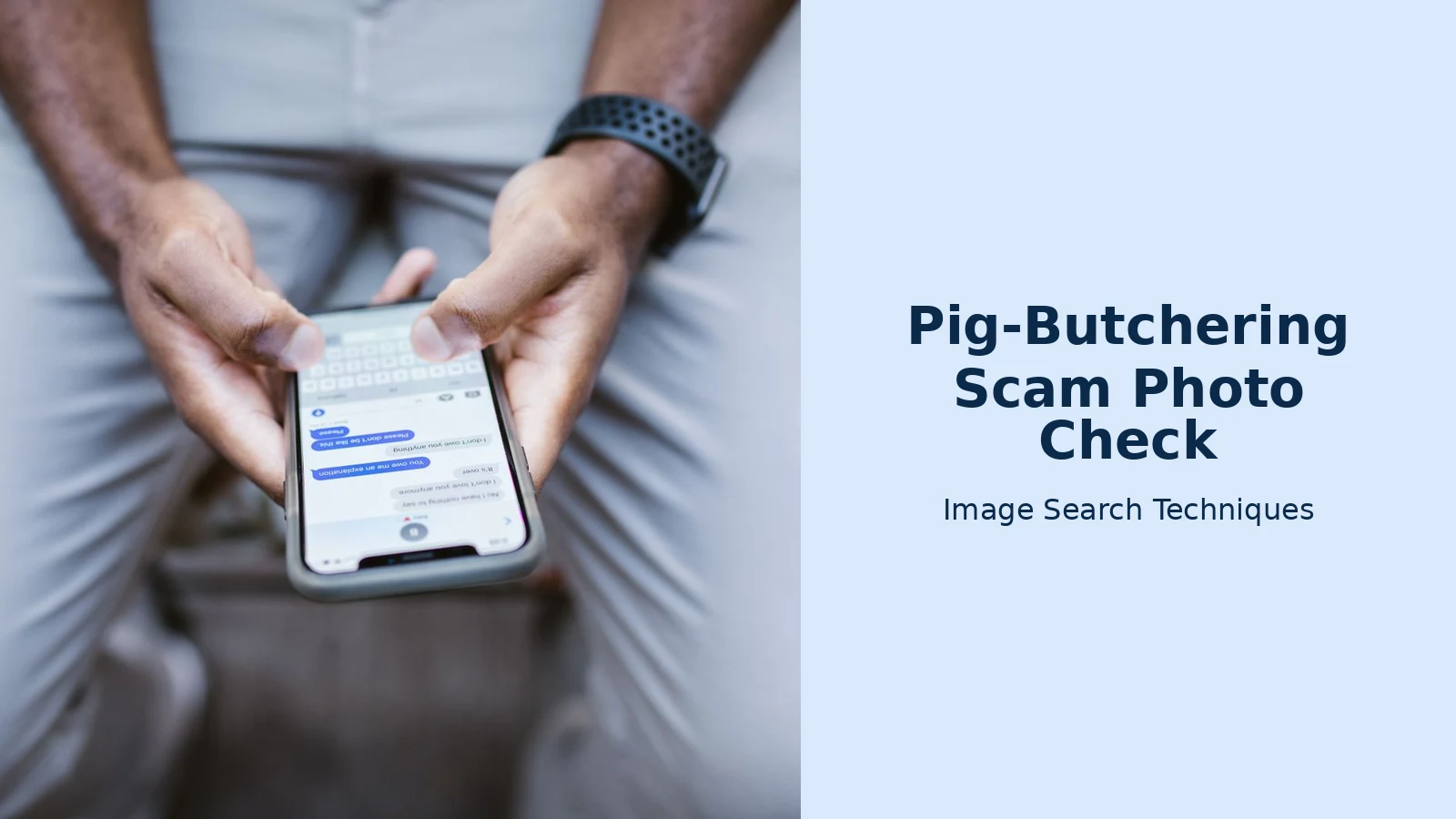
A stranger messages you out of the blue, a wrong number on WhatsApp, a friendly hello on Telegram, and within weeks they are showing you how much money they make from crypto trading. Before you believe a word of it, run a pig butchering scam photo check: save their profile photo, reverse-search it on Google Lens, TinEye and Bing, and see whether the same face appears online under a different name. When the grooming happens inside a group instead of a one-to-one chat, the profit screenshots do the persuading: our WhatsApp investment group scam check reverse-searches those screenshots and shows the staging behind them.
Direct answer: A pig-butchering scam is a long con: a stranger builds a friendly or romantic relationship over weeks, then steers you into a fake crypto investment platform. Check their photos first, save the profile photo, run it through Google Lens, TinEye and Bing, and look for the same face under a different name. A match means the identity is stolen.
What “pig butchering” means. Pig butchering, from the Chinese term sha zhu pan, “pig-butchering plate”, is a fraud in which scammers “fatten” a victim with weeks of friendly attention before “slaughtering” them financially, usually through a fake cryptocurrency trading platform they control.
The scale is enormous. The US Financial Crimes Enforcement Network (FinCEN) said in September 2026 that banks had filed 33,904 reports of suspected scams of this type between September 2023 and December 2025, tied to about $12.7 billion. The FBI’s Internet Crime Complaint Center (IC3) 2024 Annual Report put total reported US cybercrime losses for 2024 at $16.6 billion, with investment fraud accounting for $6.57 billion of that. In the UK, City of London Police reported 25,843 investment fraud cases in 2024 with total losses of £649 million, and cryptocurrency was the most common asset involved, featuring in 66 per cent of reports. These are reported figures only, most victims never report, so the true totals are higher.
This guide covers the photo check only: the messaging-channel contact and the money lure. It does not re-teach the dating-app method, that is covered in our guide to spotting a fake dating profile, and the wider patterns are in our complete guide to photo scams.
How does a pig-butchering scam start?
It almost never starts with money. FinCEN’s alert on this scam (FIN-2023-Alert005, 8 September 2023) describes four stages, and the first is simply contact: a text or social media message that pretends to reach a wrong number or to reconnect with an old friend. The most common opener in 2026 is the “wrong number” text on WhatsApp or Telegram, something like “Hey Jason, are we still on for dinner Saturday?” When you reply that they have the wrong number, they apologise, say you seem friendly, and keep talking.
Stage two is grooming. The stranger messages daily, asks about your life, shares photos of holidays, meals and a comfortable lifestyle, and slowly becomes a confidant or a romantic interest. Stage three is the pitch: they mention, almost in passing, how well their crypto trading is going, and offer to show you. Stage four is the platform: a professional-looking trading site or app where a small first deposit appears to grow fast. A small test withdrawal may even work. Then the deposits get bigger, the “profits” climb on screen, and when you try to cash out, the platform demands tax, fees or a “verification deposit”, and every payment is met with a new demand until the scammer and the platform vanish.
The same pay-first trick appears in a fake inheritance letter, where a fee is demanded before the promised millions are released.
The photo is the one thing you can check before any of that happens. The person in the photo is almost never the person messaging you. Scammers steal photos from real people’s social media accounts, from stock libraries and from influencers, and build a whole identity around them. That is why the photo check comes first, and why it has to happen before you reply more than once or twice.
How do I run a pig butchering scam photo check?
Run this check the moment a stranger’s messages start feeling personal. It takes about ten minutes, costs nothing, and needs no account. Do it on a computer if you can, saving and uploading photos is easier there, but every step works on a phone too.
- Save the photo before it disappears. Long-press the profile photo in WhatsApp or Telegram and save it to your device. If the contact sends photos in chat, save one of those too, scammers often use a different photo in chat from the one on their profile, and each one is a separate check. Do this first: scammers delete photos and accounts once they sense suspicion, and disappearing messages can take the evidence with them.
- Search it on Google Lens. Go to lens.google.com, upload the saved photo, and open the exact-matches view. Look for the same face on other sites, under other names. A stock-photo page, another person’s social media profile, or a dating profile in a different country are all hard stops. Read our step-by-step guide to reverse image search if you have never used Lens before.
- Search it on TinEye. Upload the same photo at tineye.com and note the total match count and the oldest result. TinEye’s index is different from Google’s, so it often finds copies Lens misses, including older uploads that show how long the photo has been circulating.
- Search it on Bing Visual Search. Upload the photo at bing.com/visualsearch. Bing sometimes identifies the photo’s subject or finds pages the other two engines miss. Three engines, not one: a photo that is clean on Lens can still be exposed on TinEye or Bing.
- Check the name and the number. Search the name they gave you alongside the words “scam” and “review”. Search their phone number in quotes. Check whether the number’s country code matches the country they claim to live in. A “London trader” on a number registered in a different region is not proof of fraud on its own, but it is one more mark against them.
- Ask for a live video call, once. A real person can appear on camera and do something specific, such as holding up three fingers or turning their head. A scammer will refuse, delay, or send a pre-recorded clip. One refusal with a flimsy excuse is enough: do not keep negotiating, and do not accept a video that could have been recorded at any time.
- Check the platform they mention. If they name a trading platform, search it separately. A genuine UK firm appears on the Financial Conduct Authority register; a platform that exists only on its own website, with no regulator, no company address and no independent reviews, is not a platform at all, it is a page the scammer controls.
Keep screenshots of everything as you go: the profile, the photos, the messages, the search results. If you report the scam later, that evidence is what investigators ask for first.
What does each photo-search result actually mean?
A reverse image search returns one of three broad outcomes, and they do not all mean the same thing. This is the table to use when you are staring at your results and deciding what to do next.
| What the search found | What it actually tells you | What to do |
|---|---|---|
| Match found, the same photo appears elsewhere, under a different name or on a stock site | The identity is stolen. The person in the photo is not the person messaging you; they are usually an innocent third party whose photos were taken from social media or a stock library. | Stop replying. Block the number, report the account in the app, and report the fraud (see below). Never contact the person in the photo to warn or accuse them. |
| No match, no engine finds the photo anywhere | Almost nothing on its own. It may be a private-account photo that search engines never indexed, a photo cropped or flipped to dodge matching, or a brand-new AI-generated face that has never existed online. | Do not treat it as a pass. Run the other checks on this page, video call, number, platform, and if any of those fail, walk away anyway. |
| AI-generated face, the photo looks real but has the tells of an AI portrait: odd hands, mismatched earrings, warped text, a background that melts at the edges | The “person” does not exist. Scammers now generate profile photos wholesale, so a face with no history online is exactly what you would expect from a fake identity. | Same as a match: stop, block, report. A clean reverse search plus an AI-looking face is a failed check, not a clean bill of health. |
The rule behind the table is simple: a match proves fraud, but no match proves nothing. That asymmetry is the whole point of this check. Genuine people leave traces, old profiles, tagged photos, a workplace page. A stranger who arrived from nowhere, with photos that exist nowhere, has given you no reason to trust them and several reasons not to.
Does the worked check actually catch one?
To show what this looks like in practice, here is one worked check on a reported wrong-number opener, run on 11 November 2026 with no accounts signed in.
The opener is a documented example from the security firm Huntress’s pig-butchering guide: a victim receives a WhatsApp message reading “Hey Jason, are we still on for dinner Saturday?” They reply that it is the wrong number, a friendly conversation begins, and over three months it becomes a romantic relationship before the scammer introduces a crypto trading app. The victim’s first deposit of $500 appears to grow to $2,000 on screen, and they go on to invest $150,000 before the platform locks their account.
For the photo half of that scenario, we used a stand-in profile photo, a stock photograph of a smiling bearded man in a blue T-shirt (Pexels photo 2379004, by Italo Melo, published 31 May 2019). It is not a real scammer’s photo; no real victim’s images are reproduced here. The point is to show exactly what the three-engine check returns on a plausible profile photo, and how to read it.
Google Lens found the photo on its first attempt, with no sign-in. It gave no personal name: its overview described the image as a stock photo of a smiling man with dark hair and a beard in a blue T-shirt, photographed by Italo Melo. The exact-matches list showed no total count, but the top results were unrelated sites using the same face under different contexts, PillPals, the Plastic Surgery Center of Nashville, designer Otmar Sibilo’s site (twice), and a page by Dr George H. Landis, with the original Pexels page lower down. One face, several unrelated uses, no consistent identity.
TinEye found 530 results across 86.7 billion images searched, first indexed on 19 June 2019. The oldest results were the Pexels original from June 2019, followed by reuses on other sites from August and September 2019 onwards, a seven-year trail of the same face appearing wherever someone needed a friendly stock portrait.
Bing Visual Search showed 51 pages with this image. Its top exact-match pages included a dental practice, an academy blog and an Etsy listing, and one page that labelled the very same photo “Paul Walker”. Three engines, three different names for one face: exactly the pattern this check is designed to catch.
Verdict: if this photo had arrived as a stranger’s WhatsApp profile picture, the check would have failed it in under ten minutes, and the conversation would have ended there.
The lesson from the worked check is the same one the table above gives: a match under a different name ends the conversation immediately, and a clean result on one engine means nothing until the other engines agree. The scammer in the Huntress example groomed their victim for three months before money was mentioned, the photo check takes ten minutes, and it is the cheapest moment in the whole scam to stop it.
Why does “no match” not mean the person is real?
This is the section scammers rely on you skipping. A clean reverse image search feels reassuring, and it should not.
First, search engines only index what they can see. A photo taken from a private Instagram account, a friends-only Facebook album or a dating profile that search engines do not crawl will return no matches, and it can still be stolen. Second, scammers edit photos to dodge matching: a tight crop, a horizontal flip, a filter, or a screenshot of the photo rather than the original file can all defeat an exact-match search while leaving the face perfectly recognisable to you. Third, AI-generated faces have no history at all. A portrait made by an image generator in thirty seconds has never been uploaded anywhere before, so every engine will report no match, and the “person” is still fake.
That is why the photo check is one check among several, not a verdict on its own. Combine it with the live video call, the number check and the platform check above. A stranger who passes the photo search but cannot appear on a live video call, whose number does not match their story, and who wants you on a platform nobody has heard of has failed the test, the photo result does not rescue them.
There is also a fairness point that matters. If your search does find a match, the person in the photo is almost certainly an innocent third party, a real person whose pictures were stolen and who has no idea their face is being used to run a scam. Never message them, never accuse them, and never post their photo publicly as a “scammer”. You would be harassing a victim, and you would be handing the scammer exactly the confusion they want.
What should I do if the photo check fails?
Do four things, in this order, and do not do anything else.
- Stop replying. Do not confront the scammer, do not try to trap them, and never “play along” to gather evidence or waste their time. Engaging keeps the conversation alive, and these operations are run by organised groups who are very good at turning engagement into trust. The safest reply is no reply.
- Block and report inside the app. In WhatsApp, open the chat, tap the name, and choose Block and Report. In Telegram, open the profile and choose Block User, then Report. On a dating app, report the profile for fraud. Reporting inside the app gets the number or account flagged for the next person, even if it does not get your money back.
- Report the fraud. In the UK, report to Action Fraud, the UK’s national reporting centre for fraud and cybercrime, online or on 0300 123 2040, and ask for a crime reference number, your bank will ask for it. In the US, report to the FBI’s Internet Crime Complaint Center (IC3) at ic3.gov. Report even if you lost no money: your report helps investigators connect one number to many victims.
- Tell someone you trust. The FTC’s standing advice on romance scams is blunt: never send money or gifts to a sweetheart you have not met in person. The copied-photo trick is not limited to romance scams: a scammer can clone a friend’s Venmo profile and ask for money, so if that request ever lands, run our 60-second Venmo duplicate-account check first. If you have been talking to this person for weeks, you are emotionally invested, that is the design, not a personal failure. Tell a friend or family member what happened before you make any decision about money. A second pair of eyes breaks the spell faster than any checklist.
If the check passed and the person seems genuine, the same rules still apply to money: never invest through a platform someone you met online recommended, never send crypto to an address they gave you, and never let a stranger “help” you set up a trading account. A genuine new friend will not mind you being careful with your money. A scammer will push, guilt-trip or rush you, and that reaction is itself the answer.
What if I have already sent money?
Stop sending money immediately. Paying a “tax”, a “fee” or a “verification deposit” to unlock your funds never releases them, the FBI warns that these demands are simply the next stage of the same scam, and each payment is met with a new one. Contact your bank or exchange straight away and tell them it was fraud; if the transfer was recent, they may be able to freeze or recall it, and in the US the IC3’s Recovery Asset Team can in some cases freeze funds at an exchange when a report is filed quickly The fraud often does not end with the first loss: our crypto recovery scam screenshot check works through the recovered-funds screenshot that follows, and the fee demand that gives it away.
Preserve everything before you block: screenshots of the profile and every message, the photos they sent, wallet addresses, transaction IDs, the platform’s web address and any emails. Save them somewhere the scammer cannot delete. Then report to Action Fraud or IC3 as above, with the evidence attached.
Finally, expect a second approach. Fraudsters often re-target victims by posing as fund-recovery services, lawyers or “hackers” who promise to get the money back for an upfront fee. Legitimate authorities do not charge upfront recovery fees. Anyone who contacts you offering to recover lost crypto for a fee is running the same scam a second time. If you need support, the Global Anti-Scam Organization (GASO) offers peer support for victims, and in the UK, Victim Support can help on 08 08 16 89 111.
Related checks that use the same skills: our guide to spotting a catfish covers the dating-app version of the fake-profile test, and our proof-of-life photo check covers the related scam where criminals send an altered photo of a loved one to extort a ransom. The method is the same in every case: save the photo, search it on three engines, and believe a match over a story.
FAQs
Can a reverse image search prove a wrong-number contact is a scammer?
A match proves it: if their photo appears under a different name, on a stock site, or on someone else’s profile, the identity is stolen and you should stop replying. But no match does not prove they are real, because private photos, edited copies and AI-generated faces all return clean results. Treat the photo check as one test among several.
What is the first message in a pig-butchering scam?
It is usually a “wrong number” text on WhatsApp, Telegram or SMS, such as asking for someone named Jason or mentioning a dinner that was never arranged. The sender apologises, says you seem friendly, and keeps the conversation going. Money is never mentioned at first; the investment pitch typically arrives weeks later, after trust is built.
Should I tell the person in the photo that their picture is being used?
No. The person in the photo is usually an innocent third party whose pictures were stolen from social media or a stock library, and they have no connection to the scam. Contacting them harasses a victim and does nothing to stop the fraud. Block the scammer, report the account, and report the fraud to Action Fraud or the FBI’s IC3.
Can I get my money back after a pig-butchering scam?
Recovery is difficult and often impossible once crypto has moved, because the transfers cannot be reversed. Your best chance is speed: stop paying, contact your bank or exchange immediately, preserve every message and transaction record, and report to Action Fraud or IC3 with a crime reference number. Never pay anyone who offers to recover the funds for a fee.