🔎 Reverse Image Search
Image search techniques made simple: upload a photo or paste a URL and search 6 engines at once. 100% free, nothing stored.
🔒 Your image is never stored on our servers longer than 24 hours and is never shared.
Every blogger has done it. You find a photo on Google Images that fits your post perfectly, and you wonder whether you can just use it. The phrase that comes to mind is fair use, and it sounds like a permission slip. It is not. This guide explains what fair use images on your blog really means, how the four-factor test works in practice, and what UK bloggers need to know about fair dealing, which is a different set of rules entirely. It is general information, not legal advice, and only a court can decide whether a particular use is fair.
Short answer: Fair use does not give you a free pass to use images on your blog. It is a legal defence under US law, judged case by case, and it only helps when your use has a new purpose, such as criticism or commentary. A photo used only to decorate a post almost never qualifies. Find the source and licence first.
That last sentence is the habit this whole article is built on. Before you ask whether fair use covers an image, find out who made it and what licence it carries. In our earlier guide to using images from Google on your blog, we showed that a reverse image search often finds the photographer and the licence in under a minute. Do that first. Fair use is the question you ask when there is no licence to rely on, not the first place you look.
What is fair use, and what does it actually protect?
Short answer: Fair use is a defence you raise after someone accuses you of infringement. It is not a licence, and it never guarantees you will win.
Fair use, defined: a legal doctrine in US copyright law that permits the unlicensed use of copyrighted works in certain circumstances, such as criticism, comment, news reporting, teaching, scholarship and research. It is set out in Section 107 of the US Copyright Act, and a court decides each case on its own facts.
Section 107 lists those favoured purposes, but appearing on the list does not guarantee protection. A court still runs every use through the four-factor test, which we cover in full below. The US Copyright Office is clear on this point: there is no formula, and no set percentage or amount of a work that is automatically safe. The Copyright Office also runs a Fair Use Index of court decisions, which is the best place to see how judges have actually ruled, case by case.
Three facts about fair use catch most bloggers by surprise. First, it is a defence, not a permission slip. You raise it after a copyright owner complains, a platform takes your post down, or a claim lands. You cannot show a fair use certificate to anyone in advance, because no such thing exists. Second, it is judged case by case. Two bloggers can use the same photo in similar posts and get different results, because small facts matter: how the image was cropped, where it sat on the page, whether the post carried ads, and how much traffic it drew. Third, it is American law. If you blog from the UK, or your readers are in the UK, the rules that apply to you are different, and we deal with those in the fair dealing section below.
Fair use matters because it protects real things bloggers do every day. A film critic who embeds a still from a movie to discuss a scene, a teacher who shows a photograph to explain a technique, and a reviewer who reproduces a painting to discuss the artist are all doing the kind of work the doctrine exists for. The image is part of the point being made. What fair use does not protect is using a good photo to make a post look better. That is the line most blog disputes sit on, and it is the line this article keeps coming back to.
Screenshots are the everyday version of this. Our guide to can I use screenshots in a blog post works through a real Pexels homepage screenshot in two versions, one used to critique the page and one cropped to just the photo inside it, and shows why the first is a strong fair use argument and the second is not.
How do you find the source and licence before you claim fair use?
Short answer: Reverse search the image first. If the search finds the photographer and a licence, you do not need fair use at all.
Most fair use arguments start in the wrong place. A blogger finds an image, cannot find the owner, and decides fair use must cover it. That is backwards. The owner is usually findable, and the licence is often generous. The method is simple, and it takes about a minute.
- Save the image, then search it. Use Google Lens and TinEye, and run both, because each one finds copies the other misses. Our own tool searches six engines at once, and it is a good place to start.
- Look for the earliest match. On TinEye, sort by oldest. The earliest dated result is usually the source, or close to it. Sponsored stock results at the top of the page are adverts, not matches, so skip past them.
- Open the source page and read the licence. A Wikimedia Commons file page, a Flickr page, or a stock listing will state the licence in plain words. Note the photographer, the licence type, and any conditions, such as credit or no commercial use.
- Keep a record. Save the page address, the licence wording, and the date you checked. If anyone queries your use later, that record is worth more than a memory.
- Only then ask about fair use. If the image is all rights reserved, the owner cannot be found, or the licence does not cover your use, that is when the four-factor test becomes relevant.
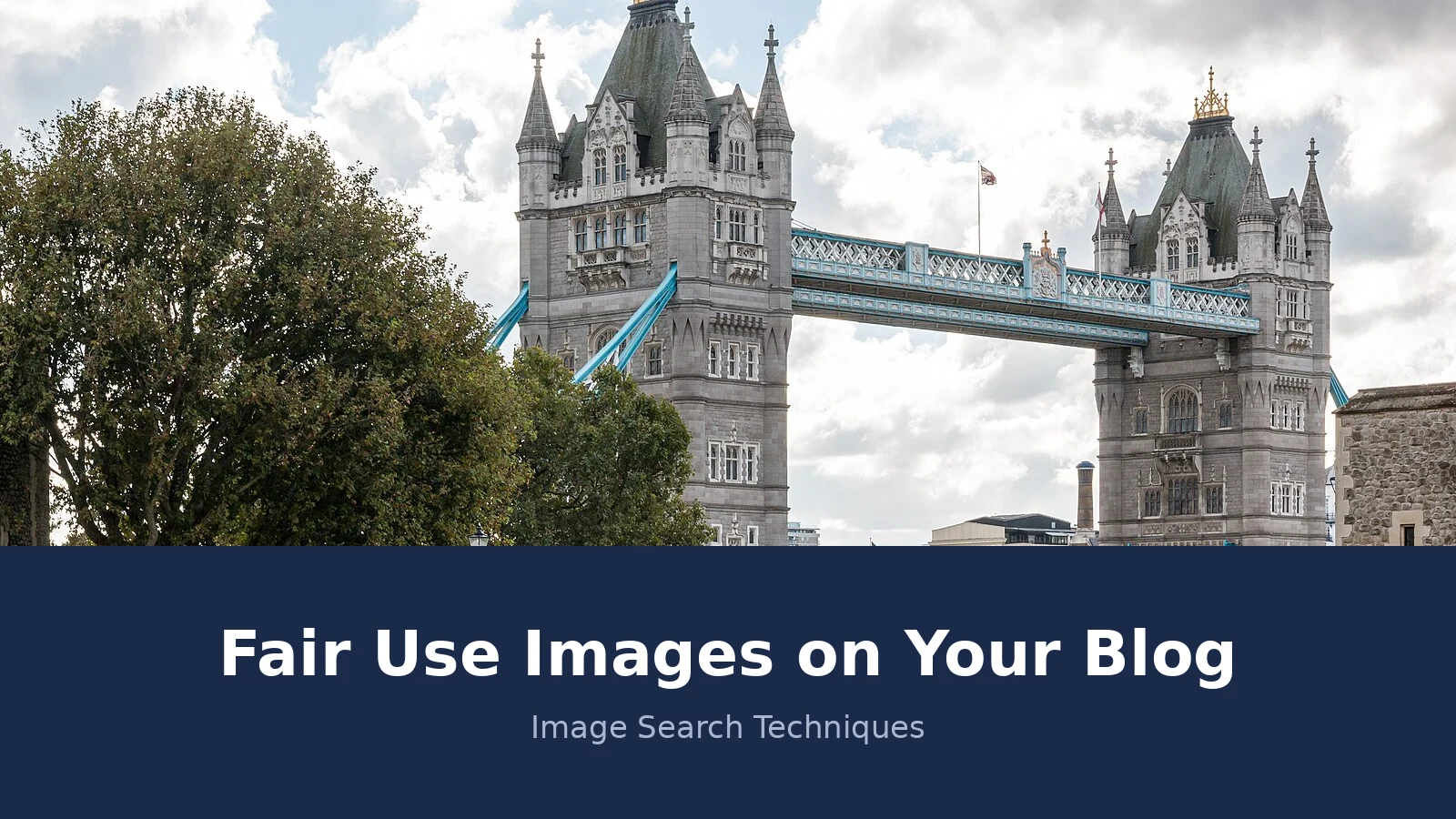
We ran this method live on a real photo to show what it looks like in practice. The photo is a shot of Tower Bridge in London, taken on 9 October 2016 by German photographer Dietmar Rabich, and hosted on Wikimedia Commons under a Creative Commons Attribution Share Alike 4.0 licence. A blogger writing about London might easily find this image through a search and wonder whether fair use covers it. Here is what the two searches actually returned on 17 November 2026.
| Search engine | What it found |
|---|---|
| TinEye | 43 results across 86.8 billion images searched. The first three results were sponsored stock listings of different Tower Bridge views, not this photo. The first exact match was the Wikimedia Commons file itself. |
| Google Lens | Identified the scene at once as Tower Bridge, London. The top exact match was the Wikimedia Commons file, 5,387 by 3,591 pixels. Lens showed no total result count, so none is reported here. |
| Where it is reused | Travel and visa pages, including an Airbnb listing, an Eltravo London itinerary, and Visa UK pages, plus the French Wikipedia article on the London Borough of Tower Hamlets. |
Two honest caveats from that test. First, TinEye showed its first indexed date as 6 September 2013, which is earlier than the photo itself, since the file is dated October 2016. That date does not line up, so treat a single date on a results page with care. It is a clue, not proof. Second, the sponsored stock results at the top of the TinEye page were different photographs of the same bridge. A sponsored result is an advert for a similar image, and mistaking one for a match is an easy error.
The important result is the licence. This photo is CC BY-SA 4.0, which means a blogger may use it, including on a commercial blog, as long as they credit Dietmar Rabich and share any adapted version under the same licence. No fair use argument is needed, because the licence already allows the use. That is the point of searching first. In our guide to how to credit a photo properly, we show how to build that credit line, including the title, author, source and licence. For this photo, the credit would name the photographer, link the Commons file page, and state the CC BY-SA 4.0 licence.
What are the four factors, and how do they apply to a blog?
Short answer: A court weighs all four factors together. No single factor decides the outcome, and a strong showing on one cannot always save a weak showing on the others.
Section 107 of the US Copyright Act names four factors. The US Copyright Office states them plainly, and every serious guide to fair use starts here. The table below applies each one to a blog, with one example that helps a fair use claim and one that hurts it. Read the table as a whole, because a court does the same.
| Factor | What the court asks | Blog example that helps | Blog example that hurts |
|---|---|---|---|
| 1. Purpose and character of the use | Did you give the image a new purpose, or just reuse it for the same job? | A review that reproduces a photo to criticise its composition, with the commentary doing the work. | The same photo as a decorative header on a travel post, where it only makes the page look good. |
| 2. Nature of the copyrighted work | How creative is the original, and was it published? | A factual diagram or a published news photo used to explain a point. | An unpublished, highly creative photograph taken from a private portfolio. |
| 3. Amount and substantiality used | How much did you take, and did you take the heart of it? | A small, low-resolution crop showing only the detail your text discusses. | The whole photo at full size, or a small crop that still shows the one famous detail. |
| 4. Effect on the market | Does your use replace a sale or a licence? | A thumbnail that sends readers to the photographer’s own page to see the full image. | A full-size photo readers can download instead of buying a print or a licence. |
Factor one carries the most weight in practice, and it is the one bloggers get wrong most often. The question is whether your use is transformative, which means it adds a new meaning or purpose rather than just repackaging the original. A review that discusses a photograph is transformative, because the photo becomes the subject of the writing. A header image is not, because the photo is still doing the job it was made for: looking good. Editing does not change this. Adding a filter, cropping the edges, or overlaying a headline changes how the image looks, but it does not change why it is being used. Courts look for a change in purpose, not a change in pixels.
Factor two matters less than the others, but it still counts. Factual and published works get less protection than creative and unpublished ones. A technical diagram or a news photograph is easier to use fairly than a fine art print, and a photo the creator has never published is harder still, because the creator has a recognised right to control the first public release of their work.
Factor three is about both quantity and quality. Using a small part of a photo helps, but only if the part you took is not the heart of the work. A tight crop of a famous portrait that keeps the face is still the portrait, for practical purposes. On the other hand, using a whole work can still be fair in some settings, such as a critic reviewing a painting, where the whole image is needed to make the point. The amount has to fit the purpose, and no more.
Factor four asks whether your use harms the market for the original, including the market for licences. This is often the deciding factor. If a photographer sells licences for blog headers, and your free use of their photo as a header means one fewer licence sold, that factor weighs against you. Courts also ask what would happen if everyone did what you did. One unlicensed header is a small loss. Ten thousand unlicensed headers is a dead licensing market.
Commercial use does not automatically defeat a fair use claim, but it makes the climb steeper, and the AI Overview for this very question says the same. A monetised blog, with ads, affiliates or sponsorships, faces more scrutiny than a personal blog with no income. That does not mean a commercial blog can never rely on fair use. It means the other factors have to work harder. A commercial news site reporting a story can still claim fair use. A commercial blog using a stock photo as decoration cannot, because the use is commercial, non-transformative, whole, and market harming all at once.
Does fair use cover this Tower Bridge photo on a blog?
Short answer: It depends entirely on how you use it, and for this particular photo the question never arises, because its CC licence already allows blog use with credit.
To make the test useful, imagine the same Tower Bridge photo carried no Creative Commons licence at all, and a blogger found it through a search with no owner attached. That is the situation most bloggers actually face. Here is how the four factors would treat two different uses of that photo.
| Use | Factor 1: purpose | Factor 3: amount | Factor 4: market | Likely outcome |
|---|---|---|---|---|
| Whole photo as the header of a London travel post | Decorative, same job the photo was made for | The whole image, full size | Replaces a licence the photographer could sell | Weak. Three factors point against fair use. |
| Small cropped version inside a post reviewing the photo itself | Commentary on the composition and light | Only the detail the text discusses | No substitute for the full image or a licence | Stronger. The use has a new purpose and takes little. |
The header use fails on the purpose that matters most. The photo is there to make the post attractive, which is the same purpose it serves on the photographer’s own portfolio page. It uses the whole work, at a size readers can enjoy without ever visiting the source. And it does the exact job a licence would be sold for, so it undercuts the market for the photo. Adding a credit line does not fix any of that. Credit is good practice, and it is required by the CC licence on this real photo, but credit is not permission, and it is not a factor in the test. Courts do not ask whether you credited the photographer. They ask about the four factors.
The review use is a different story. Here the photo is the subject of the writing, not the decoration. The text discusses the composition, the light on the bridge, and the way the trees frame the towers, and the cropped image is there so readers can see what the words describe. That is a new purpose. The amount is small and tied to the point being made. And nobody reads the review as a substitute for the photograph itself, so the market for the original is untouched. This is the kind of use Section 107 was written for, and it is the pattern behind the classic examples: criticism, comment, teaching and scholarship.
Be clear about what these verdicts are. They are reasoned guesses, not legal rulings. Only a court can decide whether a use is fair, and a court would look at facts we do not have, such as whether the blog is monetised and whether the photographer actively licenses the image. The value of the exercise is the method: run the four factors before you publish, write down your reasoning, and if the answer is not clearly in your favour, use a different image. A licensed or public domain photo is always safer than a fair use argument you have to defend later.
What did Warhol v Goldsmith change for bloggers?
Short answer: Warhol tightened factor one. A new style or a new meaning is no longer enough on its own. What matters is whether your use has a genuinely different purpose from the original.
The case is Andy Warhol Foundation for the Visual Arts v Goldsmith, decided by the US Supreme Court in May 2023 by a 7 to 2 majority. Photographer Lynn Goldsmith took a portrait of Prince in 1981. Vanity Fair commissioned Warhol to make an illustration from it in 1984. Years later, the Warhol Foundation licensed Warhol’s orange Prince image to Conde Nast for $10,000 to illustrate a magazine story about Prince. Goldsmith sued, and the Supreme Court held that the licensing shared substantially the same purpose as Goldsmith’s original photograph. Both were portraits of Prince used to depict Prince in magazine stories about Prince. Because the purpose was the same and the use was commercial, the first factor weighed against fair use.
Before Warhol, many courts treated transformative use broadly. If a secondary work changed the meaning or look of the original, that often tipped factor one in its favour, whatever the commercial context. Warhol narrowed that. The Court said that if adding new meaning were enough on its own, the fair use defence would swallow the copyright owner’s exclusive right to prepare derivative works. Commentary, criticism, and providing information about the original itself still qualify. Licensing a restyled version of someone’s photograph for the same kind of placement the photographer could have pursued does not.
For bloggers, the lesson is direct. Restyling a photo does not make it yours. A filter, a colour grade, a crop, or an AI restyle changes the look, but if the image still sits on your post doing the same job it did on the photographer’s page, Warhol says factor one is against you. The same logic applies to memes and social posts built on someone else’s photograph. A meme that mocks the photograph itself is parody, and parody gets stronger protection, because it needs to borrow from the original to make its point. A meme that uses the photograph as a backdrop for an unrelated joke is satire, and satire needs a stronger justification, because it could have made its point with any image.
Warhol did not change the other three factors, and it did not make fair use impossible. It made the first factor honest. Ask what your post does with the image that the original did not do. If the answer is nothing beyond looking good, the use is not transformative, and the rest of the test is unlikely to save it.
How is UK fair dealing different from US fair use?
Short answer: The UK has no general fair use defence. It has a short list of specific exceptions, and using a photo as blog decoration is not on it.
Fair dealing, defined: the UK system of limited exceptions to copyright under the Copyright, Designs and Patents Act 1988. Each exception covers a named purpose, such as criticism, review, quotation, or non-commercial research, and the use must be fair dealing. There is no general defence for any use that feels fair.
That difference is the single most important fact in this article for UK bloggers, and it is the point most US guides skip. Fair use is an open test: any purpose can qualify if the four factors point that way. Fair dealing is a closed list: your purpose has to fit one of the named exceptions, and then the dealing has to be fair. The Act gives no statutory definition of fair dealing. The GOV.UK guide to exceptions to copyright puts the test as a question: how would a fair-minded and honest person have dealt with the work? The courts look at whether the use affects the market for the original and whether the amount taken was reasonable and necessary.
The exceptions that matter most to bloggers are these. Fair dealing for criticism, review or quotation is allowed for any type of copyright work, and a sufficient acknowledgement is required. Fair dealing for non-commercial research and private study allows limited extracts, but copying a whole work would generally not count as fair dealing. Fair dealing for reporting current events is allowed for any type of work except a photograph, which is a trap worth remembering: a newspaper or magazine cannot reproduce a competitor’s photograph to report the news. Parody, caricature and pastiche have their own exception, but only to the extent that the dealing is fair, and only for limited amounts.
Put that next to a typical blog use and the gap is obvious. A UK blogger who takes a whole stock photo as a header is not criticising it, reviewing it, quoting it, researching with it, or parodying it. No exception fits, so the question of fairness never arises. The use needs a licence. A UK blogger who reproduces a small part of a photograph to criticise it, with a proper acknowledgement, is inside the criticism and review exception, and then the fairness of the amount and the market effect decide the outcome.
There is one more UK point that surprises people. In the UK, copyright in a photograph generally lasts for the life of the photographer plus 70 years, and a photograph is protected from the moment it is created, with no registration and no copyright notice needed. The absence of a copyright symbol on a web page means nothing. If you cannot find the owner, that does not make the photo free. It makes the risk higher, because you cannot ask permission and you cannot prove the owner agreed.
Which fair use myths should bloggers stop believing?
Short answer: Every shortcut bloggers quote to each other has been tested in court, and none of them works as a rule.
The AI Overview for this question lists three of these myths, and our competitor guides list the rest. They survive because they sound reasonable and because most infringing blog uses are never challenged. Quiet survival is not the same as safety. Here is the checklist, with the reason each one fails.
| Myth | Why it fails |
|---|---|
| Credit means permission | Attribution is good practice, not a defence. Courts ask about the four factors, not about your caption. |
| Found on Google Images means free | Search results grant no rights. Most images online are protected by copyright automatically. |
| My blog is small or makes no money | Size and income do not guarantee immunity. A non-commercial blog can still infringe, and takedowns hit small blogs first. |
| Ten percent is always safe | No court has ever applied a percentage rule. A small crop can still take the heart of a work. |
| No copyright notice means free | Copyright starts when a photo is created. No notice or registration is needed for protection. |
| Cropping or filtering makes it mine | Visual tweaks are not transformation. Only a new purpose changes the legal position. |
| Everyone else does it | Common practice is not a defence, and it does not stop a photographer from picking your blog to enforce against. |
| I will take it down if asked | Removing the image stops the ongoing harm, but it does not erase the infringement that already happened. |
The small-blog myth deserves a closer look, because it is the one bloggers repeat most. The thinking goes that a photographer will not bother with a blog that earns nothing. Sometimes that is true in practice, and it is exactly why the myth survives. But takedown notices cost a photographer nothing to send, and platforms act on them quickly. A DMCA notice can take your post down within days, and a second notice can put your whole account at risk. The fact that your blog is small also cuts the other way: you have less money to defend a claim and less reason for a photographer to settle cheaply. Before you publish an image you cannot licence, it is worth learning how to check if an image is copyrighted, so the decision is based on facts rather than hope.
What should you use instead of gambling on fair use?
Short answer: Use images you own, images with a clear licence, or images in the public domain. Fair use is a last resort, not a sourcing strategy.
Fair use is a defence you argue after the fact, and the burden of proving it falls on you, not on the photographer. When a licensed alternative exists, it is almost always smarter to use it than to gamble on a four-factor test that even federal judges apply inconsistently. Here are the options, in order of safety.
- Take your own photos. A photo you took yourself is the safest image on your blog, because you own the copyright. If someone else uses your photos without permission, our complete guide to protecting your photos online shows how to find the misuse and take it down. A phone camera and a plain background are enough for most blog images, and your own photos also make your blog look less like every other blog using the same stock search results.
- Use free stock libraries. Unsplash, Pexels and Pixabay offer photos under free licences that allow commercial blog use without credit, though checking the licence on each image is still wise. Our guide to how to tell if a photo is in the public domain explains the difference between a free licence and a photo whose copyright has expired.
- Use public domain images. In the US, works published before 1931 are in the public domain as of 2026, and works by US federal government employees are public domain too. NASA, the Library of Congress and Wikimedia Commons are reliable sources, and each image should still be checked at its source page.
- Use Creative Commons images within their terms. A CC BY licence allows any use with credit. A CC BY-NC licence forbids commercial use, which includes a monetised blog. Read the licence letters before you publish, and credit the creator properly.
- Ask the photographer. Many photographers will grant a free licence for a non-commercial or educational use if you simply ask, and a written yes by email is the strongest protection you can have. Save the permission with the post.
If you do get it wrong, the consequences are more serious than most bloggers expect. The most common outcome is a DMCA takedown notice, which asks your host or platform to remove the image. A copyright owner can also bring a claim before the Copyright Claims Board, a tribunal that has handled small claims since 2022, with total damages capped at $30,000. In federal court, statutory damages run from $750 to $30,000 per work, rising to $150,000 per work for wilful infringement, and falling to $200 per work for an innocent infringer. Registration matters too: a photographer can generally only claim statutory damages and legal costs if the work was registered before the infringement began, or within three months of first publication. None of this is meant to frighten you away from using images. It is meant to show why a minute spent checking a licence is cheaper than a month spent answering a claim.
The habit to take away from this article is a short one. Search the image first, read the licence, and keep a record. The same check works in a classroom: see whether you can use photos in a school presentation before you build the deck. If the licence covers your use, publish with confidence and credit the creator. If it does not, pick another image. And if you do decide a use is fair, run the four factors honestly, write down your reasoning, and use only as much of the image as your point needs. That is how bloggers use images without gambling their blog on a defence they may never get to argue. Album covers are a special case of fair use: see can I use album cover art on my blog, which applies the four factors to review, decoration and commercial use, with the US and UK rules side by side. Memes are another special case: see whether memes are copyrighted, which applies the same four factors to personal shares, blog posts, adverts and merchandise.
FAQs
Can I use any image on my blog if I give credit?
No. Credit is not permission, and it is not one of the four factors a court weighs. A credit line is good practice, and some licences require it, but it does not turn an infringing use into a fair one. If the licence does not cover your use, you still need permission, even with a perfect credit line.
Is it fair use if my blog makes no money?
Not automatically. A non-commercial use helps the first factor, but the other three still count. A personal blog that posts whole copyrighted photographs with short captions is not transformative, uses the entire work, and can still harm the market for the original. Size and income never guarantee immunity from a takedown.
Can I use a photo I found on Google Images?
No, not just because you found it there. Google owns none of the photos in its results, and most images online are protected by copyright from the moment they are created. Reverse search the photo to find its source, read the licence on the source page, and only use it if the licence covers your blog.
Does cropping or filtering a photo make it fair use?
No. Cropping, filtering, or overlaying text changes how an image looks, but it does not change why it is being used. Courts look for a new purpose, such as criticism or commentary, not a new look. After the Warhol ruling in 2023, a restyled photo used for the same purpose as the original weighs against fair use.
What is the difference between fair use and fair dealing?
Fair use is the US system, an open four-factor test that any purpose can pass if the factors point that way. Fair dealing is the UK system, a closed list of named exceptions under the 1988 Act, such as criticism, review, and non-commercial research. Using a photo as blog decoration fits neither system.
What happens if a photographer complains about my blog image?
The usual first step is a DMCA takedown notice, which asks your host or platform to remove the image. A photographer can also bring a small claim before the Copyright Claims Board, or file in federal court, where statutory damages run from $750 to $30,000 per work. Removing the image limits the harm, but it does not erase the infringement.