🔎 Reverse Image Search
Image search techniques made simple: upload a photo or paste a URL and search 6 engines at once. 100% free, nothing stored.
🔒 Your image is never stored on our servers longer than 24 hours and is never shared.
A letter arrives, or a photo of one lands in your inbox, and it says you have been picked for jury service. Or worse, it says you missed it, a warrant is out, and you must pay a fine today. Both versions are now arriving in American homes, and only one of them is real. The fake one is designed to look exactly like the real thing, right down to the court seal and the legal citations.
Short answer: A fake jury duty summons letter asks for money or details, or it arrives by text, email or phone. A real summons arrives by U.S. mail, names a court, a reporting date and a juror number, and never asks for payment. Photograph the letter, read it field by field, then call the court on a number you looked up yourself.
This guide shows you how to do that check with a photo. You will see what a real federal summons looks like, how to read one field by field, and what happened when we ran a real fake summons sample through Google Lens, TinEye and Yandex. The numbers in this article come from the FBI and the FTC, checked on the day of writing, and the worked examples use real court documents, not invented ones.
What does a real jury summons letter look like?
What a jury summons is. A jury summons is a court order that tells you that you have been selected as a possible juror. It names the court, the date and place you must report, and gives you a juror or participant number that identifies you to the court. It is a formal document, and ignoring a real one can lead to a fine or a court appearance. That is exactly why the fake version works: the threat inside it feels plausible.
A real federal summons arrives through the U.S. mail. That is the first and most reliable fact in this whole guide. The federal courts say so plainly on their juror scams page: most contact between a federal court and a prospective juror happens through the mail, and federal courts do not ask anyone for sensitive information in a phone call or email. The FTC said the same thing in its consumer alert of 11 June 2026: courts never demand payment over the phone, and no government agency will.
Inside the envelope you will find the summons printed on court letterhead, with the full name of the court, its address, and a phone number. It states the date and time you need to report, the courthouse address, and your juror number. Most federal summonses come with a qualification questionnaire, or instructions to complete one online through the eJuror portal, using the participant number printed on the summons. Federal law gives you 10 days from receipt to complete that questionnaire. You will also find practical details: directions, parking, and a list of items you cannot take through courthouse security.
What you will not find is any of the following: a demand for money, a threat that you will be arrested today, a request for your Social Security number, bank details or card numbers, or a link or QR code that takes you to a payment page. A real summons never asks you to pay anything to keep your freedom, because a real fine is decided by a judge in court, after you have had a chance to explain yourself, and not over the phone. One federal court puts it plainly: fines are never imposed until after a person has appeared in court. Our complete photo scams guide covers the same pattern across other fake official letters, and the shape of the trick is the same every time.
Answer capsule: A real summons arrives by mail, names a court, a date and a juror number, and asks for a questionnaire, never for money.
How do you check a fake jury duty summons letter from a photo?
Do not judge a summons by how official it looks. Scammers copy seals, letterheads and legal language with ease, and they use the names of real judges and real courts. Judge it field by field instead. The table below is the check we use in this guide, and it is the Ranking Asset for this article. Work through it in order, and write down what your letter says in each row before you decide anything.
| Field to read | What a real summons shows | What a fake usually shows |
|---|---|---|
| Court seal and letterhead | The full court name, its address, and the clerk of court’s name, printed on the court’s own letterhead | A seal copied from the internet, sometimes stretched or low resolution, with a vague office name such as Central Jury Administration Office |
| Juror or participant number | A unique number you can quote to the court, used for eJuror and for check-in | A number that looks plausible but cannot be verified, sometimes printed as an ID in the subject line of an email |
| Reporting date and time | A specific date, time and courthouse address, on a day the court is open | A date that does not match the court calendar, such as a Saturday, or no date at all, only a deadline to pay |
| eJuror portal | Instructions to go to the court’s own website yourself and click its eJuror link, never a link inside the letter | A button or link inside the message that takes you to a lookalike site, or a QR code that leads off the court’s domain |
| What it asks you to do | Complete a qualification questionnaire within 10 days, by mail or through eJuror | Pay a fine, buy gift cards, send crypto, or hand over a Social Security number within 24 to 72 hours |
| How it reached you | U.S. mail, in an envelope with the court’s return address | Email, text message or phone call, often marked urgent and confidential |
Two rows in that table settle most cases on their own. If the summons arrived by email, text or phone, it is not a real summons, whatever else it says. And if it asks for money or personal details, it is not a real summons either. The other rows are for the harder cases, such as the mailed fake postcards covered later in this guide, where the delivery method is right but the details are wrong. A similar field by field read works for other official letters too, and our fake debt collection letter check uses the same approach on a different artefact.
Answer capsule: Read the seal, the juror number, the date, the eJuror route, the ask and the delivery method, and a fake will fail on at least one of them.
Worked example: a real federal summons, read field by field
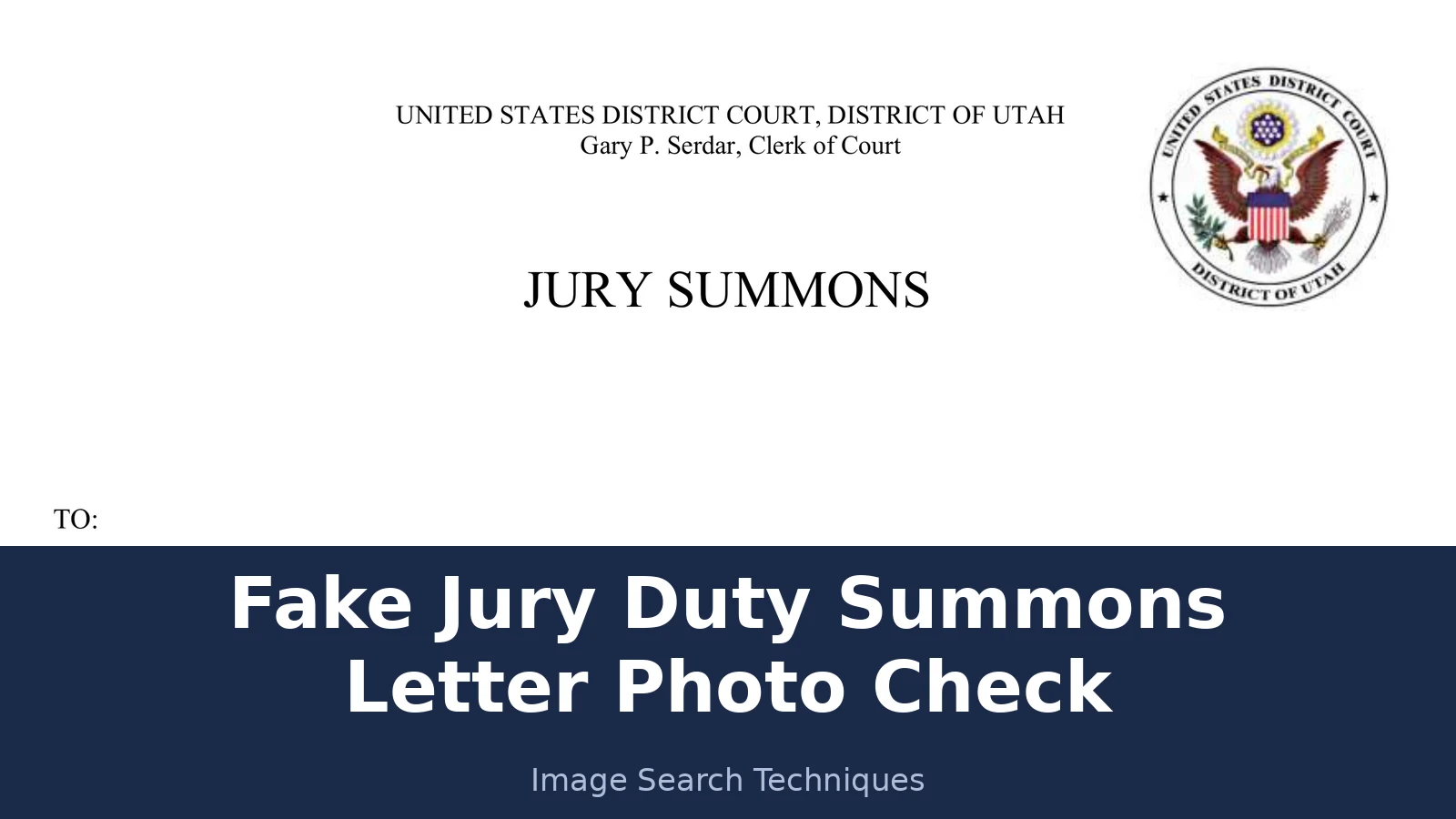
For the real side of the comparison we used a genuine federal jury summons published by the United States District Court for the District of Utah, for its Southern Region in St. George. It is a public document on the court’s own site, and it is a good example because it shows every field a real summons carries, and none of the fields a fake one adds.
The top of the page carries the court seal on the right and the words “UNITED STATES DISTRICT COURT, DISTRICT OF UTAH” with the clerk of court, Gary P. Serdar, named underneath. The heading reads “JURY SUMMONS” in large type. Below that is a “TO:” field with the juror’s name and address, then the place of service and the term: a six month on-call term, with the dates filled in. The participant number sits on the page, and in red type the summons says to fill out the eJuror Qualification Questionnaire online, by going to the court’s own website and clicking the eJuror link.
The body of the letter is calm and administrative. It explains that the reader was picked at random from the registered voters in Utah, that the term is on-call for six months, which does not mean reporting every day, and that a notice to appear will arrive by email or mail 10 to 12 days before any reporting date. It gives a deadline of 10 days to complete the questionnaire, lists the only grounds on which an excuse can be requested, and says plainly not to telephone the court or send letters asking to be excused instead of completing the questionnaire. It mentions compensation for service, plus mileage and subsistence where they apply. Federal jurors are paid 40 dollars a day in attendance fees, and that figure appears on court jury pages rather than in the summons itself.
Read that letter against the table above and it passes every row. The seal and the clerk’s name are real and checkable. The participant number is a real identifier the court can look up. The reporting arrangement is a term with a later notice, not a single panicked date. The eJuror route sends the reader to the court’s own site, typed by hand, not to a link. And the ask is a questionnaire within 10 days, not money within 72 hours. There is no threat of arrest, no fine, no request for a Social Security number, and no payment route anywhere on the page.
Answer capsule: A real summons reads like paperwork, because that is what it is, and it gives you days, not hours, to respond.
Worked example: the fake summons email, read the same way
For the fake side we used a document published by the United States District Court for the District of Columbia: its public notice of June 2025 about jury duty email, text and phone scams, which prints a full sample of a fraudulent email so the public can recognise it. The sample is watermarked “SAMPLE” across the page, and it is the exact artefact scammers were sending. We rendered page two of that notice as an image and worked through it twice: once by reading it, and once by reverse searching it.
Read field by field, the fake fails the table in five places. First, the delivery: it is an email, with the subject line “URGENT: Jury Duty Summons, Immediate Response Required, ID#50450, 4/16/2025”. Real federal summonses are not sent by email, and the D.C. court says so in the same notice. Second, the letterhead: “Central Jury Administration Office, Washington, D.C. 20001” under a bold “UNITED STATES DISTRICT COURT”. That sounds grand, but it is not how a real court names its jury office, and the D.C. court has no such office sending summonses by email. Third, the deadline: “no later than 72 hours from the time of receipt”. Real courts give you 10 days for the questionnaire. A 72 hour deadline is a pressure tactic, not a court procedure. Fourth, the ask: a “Download Jury Summons” button, with instructions to contact the Jury Office “using the contact information found in the attached PDF”. A real summons tells you to go to the court’s own website yourself. A button inside the message is the trap. Fifth, the tone: “You are legally obligated to comply”, “Failure to respond may result in legal penalties, including fines up to $1,000, imprisonment for not more than three days”, and “This communication is confidential”. The legal citations are real, sections 1861 to 1878 and section 1866(g) of Title 28 of the U.S. Code, and the $1,000 and three day figures are real penalties for ignoring a genuine summons. That is what makes the fake convincing: the law is quoted correctly and then applied to a message the court never sent. The notice even carries a “CAUTION – EXTERNAL EMAIL” banner at the bottom, the mail system’s own warning that the message came from outside the judiciary, which the scammers left in place.
Then we reverse searched the image of that sample on 19 November 2026, uploading the same file to all three engines. The results are reported exactly as they appeared, including the zeros.
| Engine | Result for the fake summons image |
|---|---|
| Google Lens | 0 exact matches. The Exact matches tab said “No exact matches found.” The closest visual matches were other jury summons documents, including a District of New Mexico jury service page, a Reddit post asking “Is this real and what do I do if it is?”, and a Scribd jury summons template. |
| TinEye | 0 matches. TinEye reported that it searched over 86.8 billion images and did not find any match for the image. |
| Yandex | No exact match and no result count shown. Yandex recognised the image as a U.S. federal district court document and returned only loosely similar court papers, mostly default judgement templates. |
None of the three engines found the D.C. court’s own notice, even though that is the page the image came from. That is an honest zero, and it teaches the main lesson of this guide: a reverse image search finds copies of a document, and a scammer’s document may have no copies online yet. A zero does not prove the letter is fake, and a match does not prove it is real. The search is useful for one thing only, which is finding out whether the same letter has already been reported as a scam, as the Reddit result above shows. The verdict comes from reading the fields and calling the court, not from the search count. If you want the method in full, our reverse image search guide walks through all three engines step by step.
One more point from the fake sample is worth naming. The scammers used the name of a real court, real statutes, and real penalties. The federal courts warn that scammers also use the names of real judges and real officers, and spoof caller ID so the call appears to come from a courthouse. A real name on the letter proves nothing. What proves something is a number you looked up yourself, on the court’s own site, that confirms your juror number. The badge and warrant version of this same trick is covered in our fake badge and warrant photo check, and the rule there is the same: the document in your hand is not the authority, the court is.
Answer capsule: The fake fails on delivery, deadline, download button and tone, and a zero from every search engine still leaves the court check as the only verdict that counts.
What do the FBI and FTC figures actually say?
The scale of this scam is not a guess, and it is worth stating plainly, because it explains why the fake letters keep arriving. On 17 September 2026 the FBI’s Internet Crime Complaint Center issued a public service announcement about criminals impersonating law enforcement and government officials. Between January 2025 and July 2026 it received nearly 61,000 complaints about these impersonation scams, with reported losses of more than 1.6 billion dollars. Of those, 6,833 complaints were about jury duty or missed court date scams specifically, with losses of nearly 36 million dollars. The FBI’s 2025 Internet Crime Report gives the same picture for a single year: 32,424 government impersonation complaints in 2025, with reported losses of almost 798 million dollars, nearly double the 17,367 complaints and 406 million dollars of 2024.
The FTC’s warning is narrower and just as blunt. Its consumer alert of 11 June 2026, titled “Ignore calls, texts, and emails threatening to arrest you for missing jury duty”, says that most of these scams start with an urgent call from someone claiming to be a U.S. Marshal or a local police officer, followed by a text or email with an official looking document that shows a warrant and an amount owed. The alert gives four checks, and they are worth memorising: real law enforcement will never text or email you an arrest warrant; a caller ID that looks like your local police department proves nothing; courts never demand payment over the phone, and no government agency will; and only scammers say you can pay only with a payment app, cryptocurrency, gift cards, or a wire transfer service such as Western Union or MoneyGram. If you get a call like this, the FTC says to tell them at ReportFraud.ftc.gov. The full alert is the first external source for this article, and the federal courts’ own juror scams page is the second: FTC consumer alert, 11 June 2026 and U.S. Courts juror scams page.
Google’s AI Overview for the exact question behind this article, “fake jury duty summons letter”, makes the same five points: real courts communicate by official U.S. mail and never demand money, gift cards or cryptocurrency; fake notices arrive by text, email or phone; they threaten immediate arrest; they ask for sensitive personal data; and their contact details will not match your local court’s official .gov domain. Its advice matches ours too: do not pay or share information, verify independently using a number you looked up yourself, and report the scam to the FTC. This article covers every one of those points, and adds what the overview does not have: a real summons and a real fake, read field by field, and a reverse search performed on the day of writing. For the wider pattern of fake official demands, our fake IRS letter check shows the same tricks on a tax letter.
Answer capsule: The FBI counted 6,833 jury duty scam complaints and nearly 36 million dollars lost in nineteen months, and the FTC’s four checks catch the scam every time.
How do you check a summons in five minutes?
Do this in order, and do not skip step four. It is the step that settles the question. The same five minutes work for any fake jury duty summons letter, whether it arrived by email, text or post.
- Photograph or screenshot the letter. Keep the whole page in frame, including the letterhead, the date, the juror number and any link or QR code. Do not click the link, do not scan the QR code, and do not reply to the message. A photo is safe. A click is not.
- Check how it reached you. If it arrived by email, text or phone call, stop: it is a scam. Real summonses arrive by U.S. mail. If it arrived by post, keep going, because the mailed fake postcards in the next section pass this test and fail the later ones.
- Read it against the table. Work through the six fields: seal and letterhead, juror number, reporting date, eJuror route, what it asks you to do, and how it reached you. Write down anything that fails. One failure is enough to treat it as fake until the court says otherwise.
- Find the court yourself and call it. For a federal summons, use the Federal Court Finder on the U.S. Courts website to find the clerk of the district court named on the letter. For a state or county summons, use your state judiciary’s official site. Call the jury office on the number listed there, never the number printed on the letter, and give the name on the summons and the juror number. The clerk can tell you in minutes whether you were ever called.
- Report it if it is fake. In the U.S., report to the FTC at ReportFraud.ftc.gov and to the FBI’s Internet Crime Complaint Center at ic3.gov, and tell the clerk of the court named on the letter, since impersonating a federal court official is a crime and the courts want to know. Tell your local police too, so the warning reaches other people in your area. If you are in the UK, the same mail-only rule applies to a genuine jury summons, and suspected fraud goes to Report Fraud.
If the letter turns out to be real, the same call tells you what to do next, and you will have lost five minutes and gained certainty. If it turns out to be fake, you will have lost nothing, and you will have stopped a scam that costs its victims an average of roughly 5,300 dollars per complaint, on the FBI’s own figures. That average comes from dividing the 36 million dollars lost by the 6,833 jury duty complaints, and it is the reason the scammers can afford to send thousands of letters: only a few need to work.
Answer capsule: Photograph it, check the delivery method, read the fields, then call the court on a number you found yourself.
What if the summons came by post, or you already paid?
Not every fake jury duty summons letter arrives by email. On 5 November 2026 the Eighth Judicial District Court in Las Vegas warned that scammers were mailing fake jury summons postcards that closely resemble the court’s own official postcards, complete with a jury ID number, a group number, and a counterfeit QR code. The court does send real summonses by postcard, which is what makes this version dangerous: the delivery method is right, so the first test in this guide does not catch it.
The tells are in the details, and the court’s own warning names them. A fake postcard may list a reporting date that does not match the court calendar, such as a Saturday, when the court is closed. It may carry an unfamiliar phone number that rings without answer or goes to a voicemail asking you to leave a message. And its QR code may lead to an unofficial website or ask for sensitive information. A real postcard from that court directs the recipient to a secure website to verify the summons, and carries the court’s real contact details. So the check is the same as before, only stricter: read the date against a calendar, check the phone number against the court’s own site, and never scan a QR code on a document you have not verified. A QR code is a link you cannot read before you open it, and that is exactly why scammers love it.
If you already paid, or already shared personal details, act now rather than waiting to see what happens. Call your bank or card provider immediately and explain that you paid a scammer, then report the payment to the FTC at ReportFraud.ftc.gov and to the FBI at ic3.gov, and tell the clerk of the court named on the letter. If you shared a Social Security number, date of birth, or bank details, treat it as identity theft as well as fraud: check your credit reports, consider a credit freeze with the three U.S. credit bureaus, and watch for new accounts you did not open. Recovery is never guaranteed, and the FTC is honest about that, but acting in the first few hours gives you the best chance, and reporting helps the next person who gets the same letter. Do not pay anyone who now offers to recover the money for a fee. That is a second scam, aimed at people the first one already caught.
Answer capsule: A mailed fake fails on the date, the phone number or the QR code, and if you already paid, call your bank first and report it second.
FAQs
How can I tell if a jury duty summons letter is fake?
Check how it arrived. A real summons comes by U.S. mail, never by email, text or phone. A real letter names the court, a reporting date and a juror number, and asks for a questionnaire within 10 days. A fake asks for money or details, sets a 24 to 72 hour deadline, or includes a payment link or QR code.
Do real courts send jury summons by email or text?
No. Federal courts say most contact with a prospective juror happens through the U.S. mail, and they do not summon jurors by email or text. State and county courts work the same way. Any summons that arrives by email, text or phone is a scam, whatever the letterhead says, so do not click its links or call its number.
Can a court demand payment over the phone for missing jury duty?
No. Courts never demand payment over the phone, and no government agency will. A real fine is decided by a judge in court, after you have had a chance to explain a missed appearance, and it is never collected by gift card, cryptocurrency, payment app or wire transfer. Anyone demanding payment that way is a scammer.
What should I do if I get a fake jury summons letter?
Do not pay, click any link, scan any QR code, or share personal details. Photograph the letter, then find the court named on it through the U.S. Courts website or your state judiciary site, and call the jury office on the number listed there. Report it to the FTC at ReportFraud.ftc.gov and to the FBI at ic3.gov.
Can a reverse image search prove a jury summons is real or fake?
No. A reverse search finds copies of a document online, and a scammer’s letter may have no copies yet. We searched a fake summons sample on Google Lens, TinEye and Yandex on 19 November 2026 and all three returned zero matches. Use the search to find scam reports, but let the read and a call to the court settle it.
What does a real jury summons ask you to do?
A real federal summons asks you to complete a qualification questionnaire within 10 days of receiving it, either by mail or online through the court’s eJuror portal, using the participant number printed on the summons. It gives a reporting date and courthouse address, and it never asks for money, a Social Security number, or bank details.