🔎 Reverse Image Search
Image search techniques made simple: upload a photo or paste a URL and search 6 engines at once. 100% free, nothing stored.
🔒 Your image is never stored on our servers longer than 24 hours and is never shared.
The message arrives out of the blue: a call, a text or an email from someone claiming to be an FBI agent, a Social Security officer or a US Marshal. There is a warrant for your arrest, your Social Security number has been suspended, or your bank account is about to be frozen. Then comes the “proof”, a photo of a badge, a credential card, or a warrant with your name on it. It looks official, and that is exactly the point.
A fake badge photo scam is a government-impersonation fraud in which the scammer sends a photograph of a badge, credential card or warrant to make a payment demand look legitimate. The photo is the whole trick: it borrows the authority of a real agency and rushes you past the one question that would expose it, why would a real agent need to prove who they are with a photograph?
No. A badge photo proves nothing. The Social Security Administration says federal law enforcement will never send photographs of credentials or badges to demand payment. Badge photos are easy to copy, and scammers reuse them, so treat any badge photo sent to demand payment as a fake badge photo scam: hang up and verify through a number you find yourself.
This guide decodes the four proof photos victims actually receive, shows what each agency says about them, walks through a real reverse image search of a badge photo, and gives you the independent call-back check that settles the question in minutes.
What does a fake badge photo scam look like?
Every version follows the same four-beat script, and the Social Security Administration’s own scam page describes it plainly: scammers pretend to be from an agency you know, say there is a problem, pressure you to act immediately, and tell you to pay in a specific way. The badge photo is inserted at the second beat, right when the threat lands, because that is when you are least likely to question it.
The contact usually starts with an unsolicited call, text, email or social media message. Caller ID may show a real agency name, the FBI’s Internet Crime Complaint Center (IC3) warns that scammers spoof official numbers, including real field-office numbers, and use the real names of government employees. The caller then supplies the crisis: a warrant for missed jury duty (our fake jury duty summons letter photo check reads a real summons against the fake, field by field), a suspended Social Security number, a bank account linked to drug trafficking, or a case file opened in your name. The badge or warrant photo arrives as “proof”, often by text or email attachment, and the demand follows immediately: pay by gift card, cryptocurrency, wire transfer, prepaid debit card, or cash sent by courier, payment methods that are hard to trace and almost impossible to reverse.
The scale is not small. The FBI’s Internet Crime Complaint Center reported in its public service announcement of 17 September 2026 (alert I-091726-PSA) that it received nearly 61,000 complaints about people impersonating law enforcement or government officials between January 2025 and July 2026, with reported losses of more than $1.6 billion. The jury-duty and missed-court-date variant alone produced 6,833 complaints and nearly $36 million in losses in the same period. Those figures count only complaints filed with the IC3, so the true total is higher.
Three details mark the pattern wherever it appears. First, the contact is always unsolicited, you did not ask this agency to call you. Second, the payment method is always one a real agency never uses: gift cards, cryptocurrency, prepaid cards or a courier collecting cash. Third, secrecy is always demanded: do not tell your family, do not call your bank, stay on the line. A real investigation never needs you to keep it secret from everyone you trust.
Why does a badge photo prove the opposite?
The strongest statement in this whole area comes from the Social Security Administration itself, on its official scam-protection page: “It is illegal to reproduce federal employee credentials and federal law enforcement badges. Federal law enforcement will never send photographs of credentials or badges to demand any kind of payment, and neither will federal government employees.” Read that twice. The photo is not weak evidence of a real agent. It is positive evidence of a scammer, because a real agent would never send it.
That is the inversion the title of this article points to. Victims read the photo as proof of authority. The agencies read it as proof of fraud. The SSA lists email attachments or texted pictures of badges, credentials or official-looking documents as a standard scammer tactic, alongside spoofed phone numbers, threats of arrest, and demands to move money to a “protected” account.
There are three practical reasons a badge photo cannot verify anyone. First, badge images are public. Photographs of real badges appear on government websites, in news coverage, on Wikipedia and Wikimedia Commons, and in stock-photo libraries, anyone can download one in seconds, and scammers do. Second, the photo shows an object, not a person. Even a genuine photograph of a genuine badge says nothing about who is holding the phone that sent it. Third, a badge photo carries no checkable link to the sender: there is no way to confirm from the image alone that the badge belongs to the person messaging you, that the badge number is real, or that the person in the headshot beside it is the badge’s owner.
The same logic applies to the warrant screenshot. A warrant is a court document served in person or through formal legal channels; it is not texted to you as a photograph with a payment deadline attached. The FBI’s September 2026 alert states plainly that law enforcement and government authorities will never contact members of the public by telephone or text message to demand any form of payment. If the message demands payment, the warrant in the photo is fake, whatever it looks like.
One more thing the photo cannot do: it cannot make the caller ID true. Spoofing lets a caller display any number they choose, including the published number of a real FBI field office or a local police department. Seeing “FBI” on your screen proves as little as seeing the badge in the attachment. Both are images the scammer controls.
The proof-photo decoder: what each image claims, and what the agency says
This is the ranking asset for this article: a decoder for the four proof photos victims actually receive. For each one, read across the row, what the image claims, what the agency itself says, and the one independent step that settles it.
| Photo you receive | What it claims | What the agency says | Your independent call-back step |
|---|---|---|---|
| Badge photo | “I am a real federal agent” | The SSA states federal law enforcement will never send photographs of credentials or badges to demand payment, and reproducing them is illegal. | Hang up. Find the agency’s published number yourself and ask whether anyone there is trying to reach you. |
| Credential or ID card | “Here is my name, photo and badge number” | Real employee names are routinely reused by scammers, according to the SSA; a name on a card proves nothing about the sender. | Do not use the name or number on the card. Look up the agency’s public contact route and verify from scratch. |
| Warrant screenshot or PDF | “A court has ordered your arrest unless you pay” | The FBI states law enforcement will never phone or text the public to demand payment of any kind, including to clear a warrant. | Call your local court or police non-emergency line using a number from the court’s own website, not the document. |
| Officer headshot or video still | “This is my face, I am who I say I am” | The IC3 warns scammers now use AI-generated video and staged office backgrounds to impersonate senior officials. | A face on a screen is not identity. Verify through an official channel; never trust a video call arranged by the caller. |
Notice what every row has in common: the answer is never “examine the photo more closely”. Zooming in on a badge will not settle anything, because the photo itself is not the evidence, the behaviour around it is. The demand for payment, the secrecy, the urgency and the unsolicited contact are the evidence, and all four point the same way.
There is also a version of this scam aimed at people who have already been defrauded once. The IC3 warns that scammers pose as IC3 staff or “recovery agents” and offer to get lost money back for a fee, sometimes joining victim-support groups to find their targets. The IC3 will never contact you directly to recover funds and will never charge a fee to do so. A badge photo from a “recovery agent” is the same scam wearing a second costume.
We put a real badge photo through a reverse image search, here is what happened
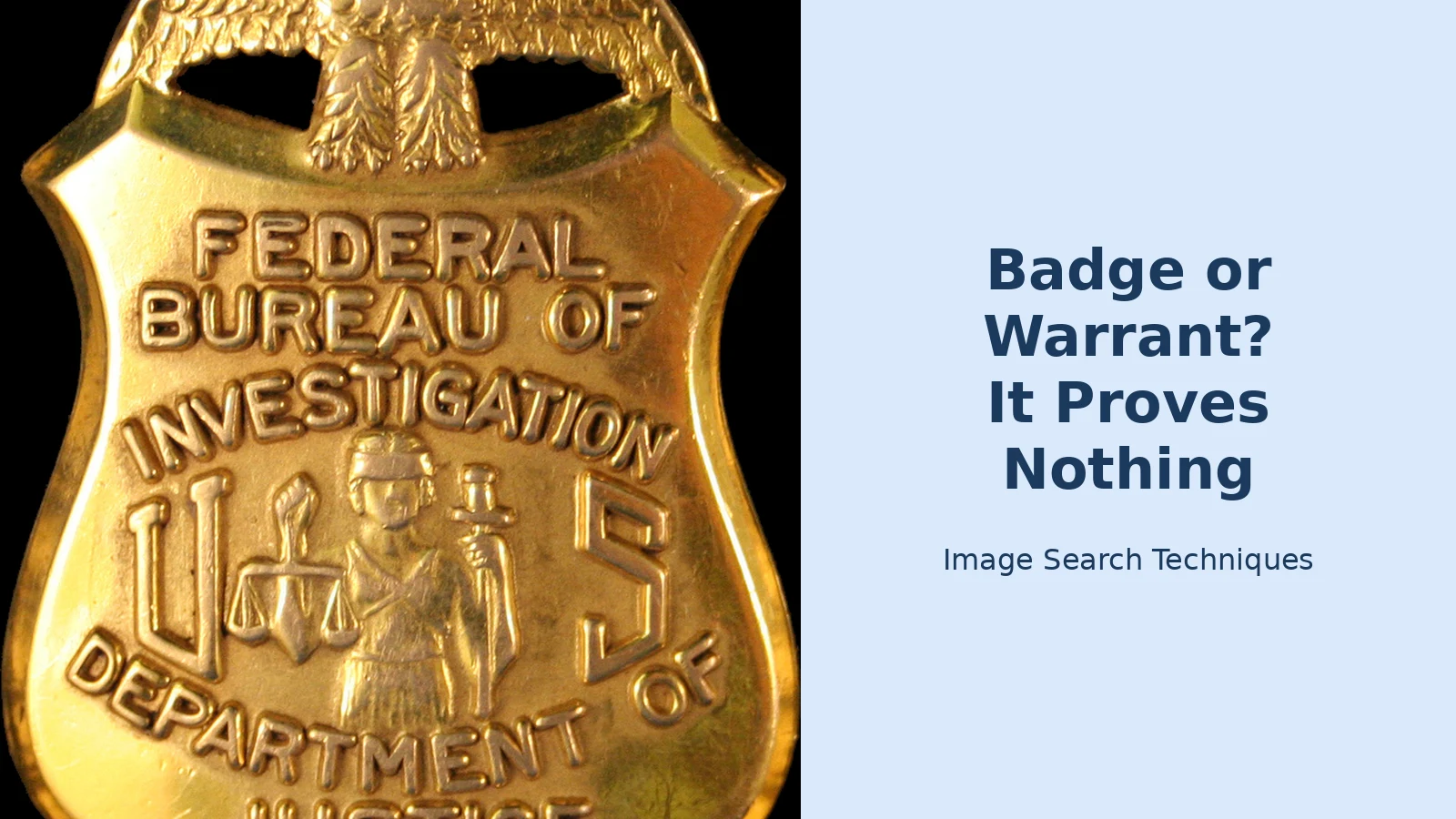
Claims are cheap; a test is better. So on 12 November 2026 I took a real photograph of a real FBI special agent’s badge, the image held on Wikimedia Commons, a 681 × 955 px photograph of the gold badge with its eagle crest and Department of Justice seal, and ran it through the reverse image search tool on this site, using the tool’s “paste URL” route. The question was simple: if a scammer texted you this exact photo, would a reverse search prove it belonged to them?
The answer was no, and the numbers were emphatic. TinEye found 192 results for the image, after searching 86.7 billion images, and reported it was first indexed on 22 May 2010. Sorted oldest first, the earliest matches included the image used as a forum avatar, then appearances on news and blog sites from 2011 onwards, and the Wikipedia file page itself in 2018. Bing Visual Search identified it correctly as the gold FBI badge worn by special agents and returned 13,300 results, including 28 pages carrying this exact image, among them news articles from 2026, while its visual-matches grid was full of near-identical badge images sold by replica makers and clipart and marketplace sites. Yandex identified it as the Federal Bureau of Investigation, tagged it “police badge”, and listed 20 sites holding information about the image, from fan wikis and wallpaper blogs to stock-photo agencies.
Two engines did not cooperate, and that is worth reporting honestly. Google Lens failed twice: both the “search all” run and a fresh individual attempt ended with “Something went wrong, No image at the URL”, with no results at all. And the tool’s Pinterest button does not perform a visual search: it opens a keyword search for the image’s domain, and the pins it returned, a homepage-design advert, the Taj Mahal, Ingrid Bergman, had nothing to do with the badge. Neither failure changes the conclusion; three independent engines agreed.
Here is what the test proves. This one badge photograph has been circulating on the public internet for at least sixteen years, on forums, news sites, blogs, clipart libraries and replica-seller pages. Anyone with an internet connection can download it in seconds and send it to you as “proof” of who they are. A reverse search can tell you the photo is public and widely copied, which is useful, because a scammer’s “personal” badge turning out to be a sixteen-year-old stock image is itself a red flag, but no search result can ever connect that photo to the person messaging you. That is the whole point: the photo is evidence about the image, never about the sender.
What should you do in the first five minutes?
Do these steps in order, and do them before you reply to anything.
- Hang up or stop replying. Do not argue, do not ask for more proof, and do not stay on the line “just to check”. Every extra minute is another minute of pressure, and scammers are trained to keep you talking until you pay.
- Do not pay anything, and do not send personal details. No gift cards, no cryptocurrency, no wire transfer, no prepaid debit card, no cash to a courier, and no photographs of your own ID, bank card or passport. A real agency will never ask for any of these by phone, text or email.
- Save the evidence. Screenshot the message, the photo, the phone number and the call log before you block anything. Note the date, the time, and exactly what was demanded. You will need this for your report, and screenshots are far more useful than your memory of the call.
- Do not click links or call numbers in the message. Links can lead to fake agency websites that harvest your details, and the “verification number” the caller gives you rings the scammers, not the agency. Any number in the message is part of the scam until proven otherwise.
- Tell someone you trust. The secrecy demand is deliberate: isolation is what makes the threat feel inescapable. A two-minute conversation with a family member or friend breaks the spell more reliably than any technical check.
If the contact came by email, do not download attachments or reply. If it came on social media, do not engage with the account, the SSA notes that scammers build fake profiles using official images, colours and jargon, and Social Security will never ask for sensitive information through social media, email or text message. Report the account through the platform, then report the scam itself through the official routes below.
How do you call back safely?
The call-back is the single check that defeats this scam, and it only works if the number comes from you, not from them. Never dial a number the caller gave you, never click a link they sent, and never use a number printed on the badge photo or warrant document. All of those lead back to the scammer.
Instead, find the agency’s number yourself. For a Social Security matter, report the scam to the Office of the Inspector General at oig.ssa.gov/report, the route the SSA itself publishes on its scam-protection page. For an FBI matter, look up your local FBI field office on the FBI’s own website and call its published number. For a local police or court matter, use the non-emergency number on your police department’s or court’s official website. For a warrant claim, the court clerk’s office can confirm in under a minute whether any warrant exists in your name, and it will not ask you to pay anything to find out.
When you get through, ask one question: “Is anyone from your office trying to contact me about this?” Give them the name and badge number the caller used if you have it, but do not hand over your Social Security number, bank details or passwords to prove who you are, a real agency will have its own way of verifying you. If the agency says there is no such case, you have your answer, and you should report the attempt through the same call.
In the UK, the shape of the scam is the same even though the agencies differ: a caller claiming to be from the police, HMRC or a court, threatening arrest or a fine, and demanding immediate payment. UK police will never phone you to demand payment, and neither will HMRC. Our guide to checking whether an HMRC message is real shows how to compare the text or email against HMRC’s own published scam examples. Report the attempt to Report Fraud at reportfraud.police.uk, and if money has already moved, call your bank immediately on the number on the back of your card.
What if you already paid or shared details?
Act fast, and do not be embarrassed into silence, the IC3’s own figures show tens of thousands of people file these complaints every year, and the scammers count on shame keeping victims quiet. Speed matters more than anything else, because some payment routes can still be stopped in the first hours.
Call your bank or card issuer immediately on the number printed on your card and tell them you were defrauded. If you paid by wire transfer, ask your bank to attempt a recall; if you bought gift cards, call the card issuer’s fraud line and ask whether the balance can be frozen; if you sent cryptocurrency, report the wallet address in your IC3 complaint, even though recovery is unlikely. If you sent cash by courier, call the courier company and the police at once.
Then report the crime in three places: file a complaint with the FBI’s Internet Crime Complaint Center at ic3.gov, report Social Security-related impersonation to the SSA Office of the Inspector General at oig.ssa.gov/report, and report the fraud to the Federal Trade Commission at ReportFraud.ftc.gov. Keep every screenshot, message and receipt, investigators use them to link cases, and the IC3 states that the complaint data is what lets it detect and size campaigns like this one.
If you shared personal information, a Social Security number, date of birth, bank details or passwords, take the identity-theft steps the SSA lists on its scam page: open or sign in to your my Social Security account so you control it before a thief does, place a fraud alert with Equifax, Experian and TransUnion, report the identity theft at identitytheft.gov for a personalised recovery plan, and change any password the scammer may have obtained. If the scammer has your photograph or ID image, our guide to spotting a pig-butchering scam from its photos explains how stolen images are reused across frauds.
Finally, never pay anyone who offers to recover the money. So-called recovery services that contact victims of this exact scam are usually the same criminals returning for a second payment. Real recovery happens through your bank, the police and the IC3, never through a fee paid to a stranger who found you.
The badge photo is one member of a family. The same trick, a photograph presented as proof, with a payment demand attached, runs through the Venmo impersonation check, where a copied profile photo makes a duplicate account look like your friend, and through the cheque-photo deposit trap, where a photographed cheque makes a fake payment look real. In each case the photograph is doing the same job: short-circuiting the question “who is actually contacting me?”
That is why the defence is the same in every case, and why it belongs in our complete guide to photo scams: verify the person, not the picture. A photograph can prove that an image exists. It can never prove who sent it, and the moment someone uses a photo to demand money, the photo itself is the warning. Learn the pattern once, unsolicited contact, a threat, a photo as proof, a demand for an untraceable payment, and you will recognise it in every costume it wears, whether the badge says FBI, SSA, police or something you have never heard of. If in doubt, the habit that saves you is always the same one: hang up, look the number up yourself, and ask the real agency.
One last check worth building into your routine: if a stranger’s photo ever feels familiar, run it through a reverse image search before you trust it. Our guide to spotting a catfish from a photo shows the method step by step, and it works on badge photos, profile pictures and warrant screenshots alike.