🔎 Reverse Image Search
Image search techniques made simple: upload a photo or paste a URL and search 6 engines at once. 100% free, nothing stored.
🔒 Your image is never stored on our servers longer than 24 hours and is never shared.
Yes, you can use government photos for free, but it depends on which government made the photo and who took it. Photos made by US federal employees as part of their job are public domain in the US. UK government photos are Crown copyright, reusable under the Open Government Licence. Photos taken by contractors or companies are a different story.
This guide shows you how to check a government photo before you use it on your blog, in a presentation, or on a business website. It covers the US rule and the UK rule separately, because they work in different ways, and it walks through three real photos to show how the check works in practice. One is a NASA photo you can use freely. One is a GOV.UK photo you can reuse under a licence. One sits on a NASA website and is not free at all. This is general information about how photo licences work, not legal advice. If a photo matters to your business, check the source page yourself or ask a lawyer.
What does free mean when the photo comes from a government?
Free is a slippery word. A photo can be free to look at, free to download, and still not free to put on your blog. The download button tells you nothing. What matters is who owns the copyright, and that depends on who pressed the shutter and under what arrangement.
There are three buckets, and every government photo falls into one of them. The first is public domain. No copyright applies, so you can use the photo without permission. That is the position for photos made by US federal employees as part of their official duties. The second is licensed. Copyright still exists, but a licence lets you reuse the photo if you follow its conditions. That is the position for most UK government photos, which sit under the Open Government Licence. The third is permission needed. Someone else owns the copyright, and the government website is only hosting the photo. That is the position for photos taken by contractors and private companies, even when the photo appears on an official site.
Public domain is not the same as a licence. A public domain photo has no copyright owner to ask. A licensed photo still has an owner, and the licence is the permission. The Open Government Licence is a licence, not public domain, so its conditions still apply even though no fee is charged.
The mistake most bloggers make is treating the website as the owner. A .gov address does not mean the government made the photo. It only means the government published it. The credit line is what tells you who made it, and the credit line is the first thing to read. If the credit names a private company, a stock agency, or a named photographer who is not a government employee, stop and check before you use it.
Answer capsule: free to view is not free to use, so check whether the photo is public domain, licensed, or owned by someone else before you publish it.
Can I use US federal government photos for free?
Usually, yes, with conditions. The rule comes from section 105 of the US Copyright Act. Copyright protection is not available for any work of the US Government. Section 101 defines a US Government work as one prepared by an officer or employee of the US Government as part of that person’s official duties. Put simply, if a federal employee took the photo as part of their job, there is no copyright in it under US law, and you can use it without permission or a fee.
NASA is the best-known example, and its own rules are worth reading. NASA says its content is generally not subject to copyright in the US and may be used for educational and informational purposes without explicit permission, as long as you credit NASA as the source. There are limits. Images marked with a third-party copyright statement may not be used. You must not imply that NASA endorses you or your product. You need permission to use a photo of an identifiable person, and NASA content must not be used for NFTs. Read the full rules on NASA’s images and media page before you use a NASA photo in a commercial setting, because the page also covers the Smithsonian images NASA hosts, which follow Smithsonian attribution rules instead.
The same federal rule covers photos from the National Archives, the Library of Congress, the Environmental Protection Agency, and the Department of Defense, among others. These are the places to look first when you want a genuinely free photo. Our guide to public domain photos and how to tell them apart explains the checks that separate a real public domain photo from one that only looks free.
Three cautions apply even to federal photos. First, a federal employee’s work outside their official duties may still be copyrighted, so the question is always what the person was doing when they took the photo. Second, a federal photo can contain pre-existing copyrighted material, such as a painting on a wall or a poster in the background, and that part keeps its own copyright. Third, the US Government can receive and own copyright that is transferred to it, for example when material is donated to the Library of Congress, so a photo in a federal collection is not automatically a federal work. Check the rights statement on the source page, not just the website it sits on.
Credit the source anyway. Public domain means you are not legally required to credit anyone, but a credit line helps your readers trust the photo, and it proves where you got it if anyone asks. A simple “Image: NASA” or “Source: Library of Congress” is enough.
Answer capsule: a photo made by a US federal employee as part of their job is public domain in the US, but check the credit line and the rights statement, because contractors, donated material, and background artwork can all change the answer.
What about UK government photos and Crown copyright?
The UK works differently, and this is where most guides go wrong. The best-known competitor guide on this topic gives the UK a single sentence, mentioning Crown copyright and moving on. That is not enough, because the UK rule is the one most British bloggers actually need.
Most UK government material is Crown copyright. That means copyright exists, and it belongs to the Crown. The reuse route is the Open Government Licence, version 3.0, published by the National Archives. The licence is worldwide, royalty-free, perpetual, and non-exclusive. It lets you copy, publish, distribute, transmit, and adapt the information, including for commercial use, provided you acknowledge the source and link to the licence where possible. You must not use the material in a misleading way, and you must not use it to suggest that the government endorses you.
The licence has exclusions, and they matter for photos. It does not cover personal data, logos, crests, the Royal Arms, military insignia, third-party rights, identity documents, or content marked with a National Archives copyright notice. So a GOV.UK photo is reusable under the licence only if none of those exclusions applies. A photo of a soldier in uniform is usually fine. A photo that is mostly a departmental logo is not.
You can see the rule in action on any GOV.UK page. The footer reads “All content is available under the Open Government Licence v3.0, except where otherwise stated”, and the page carries a “Crown copyright” notice. That footer is the licence statement, and “except where otherwise stated” is the part to watch. If the photo carries its own credit line naming an outside photographer or agency, that credit is the “otherwise stated” case, and the OGL does not cover it. Read the full terms on the Open Government Licence version 3.0 page before you reuse a GOV.UK photo commercially.
The practical difference from the US is small but real. With a US federal photo, there is no copyright to worry about, and the credit is a courtesy. With a UK government photo, the copyright exists, the licence is your permission, and the acknowledgement is a condition of that permission. Keep the credit line with the photo when you publish it, and keep a note of the source page so you can show where the licence came from.
Answer capsule: UK government photos are mostly Crown copyright, reusable under the Open Government Licence for commercial and non-commercial use, provided you acknowledge the source and none of the licence exclusions applies.
Which government photos are NOT free?
Most of the traps sit in this section. A photo can be on an official website, on a page with a government logo, and still belong to someone else. Here are the cases that catch people out.
Photos taken by contractors. A private company that takes photos for a government agency can keep the copyright. The agency gets a licence to use the photo, not ownership of it. The worked example later in this guide shows a SpaceX photo hosted on a NASA website. SpaceX is a private company, and its photographer credit is the giveaway. The same applies to press photographers, event photographers, and agencies hired for a launch or a ceremony.
State and local government photos. The US federal rule covers the federal government only. A photo from a state, county, or city website is not automatically public domain. It keeps whatever copyright the state or local law gives it, and some states claim copyright in their works. Check the rights statement on that site before you use the photo.
US Postal Service photos. USPS has its own separate rights, and its photos are not covered by the same federal rule. Do not assume a postal service image is free because it comes from a federal body.
Foreign government photos. Other countries protect their own government works. A photo from a French, German, or Japanese government site is protected under the Berne Convention, and you need permission or a licence to use it. The US rule does not travel.
Stock and licensed material inside a government work. A government report, presentation, or web page can include stock photos, commissioned illustrations, or licensed images. The government owns the report, not the photos inside it. If the credit line names a stock agency, that photo is licensed, not free.
Donated and transferred copyright. The US Government can receive copyright that is transferred to it, for example when a collection is donated to the Library of Congress. A photo in a federal archive may therefore be owned by the government as a copyright holder, which is not the same as being public domain. The rights statement on the item record is the only reliable guide.
People and logos in the photo. Copyright is only half the question. A recognisable person in a photo has privacy and publicity rights, and a government logo or seal has its own rules. NASA’s insignia, the “meatball” and the “worm” logotype, are protected under 14 CFR Part 1221. The meatball is for official NASA use, the worm is for NASA employees only, and neither may be used for other purposes without prior approval from the NASA Office of Communications. US federal seals more generally are covered by sections 701, 713, and 1017 of Title 18 of the US Code. If the photo is mainly a logo, treat it as a different question from an ordinary photo.
Our complete guide to protecting your photos online covers the same traps from the other side, what to do when someone else uses your photo without permission. The checks are the same in both directions: find the owner, read the licence, and keep the evidence.
Answer capsule: a photo on a government website is not free when a contractor, a state or local body, a foreign government, a stock agency, or a private donor owns it, and logos, seals, and recognisable people carry separate rules of their own.
We checked three real government photos. Here is what we found
Rules are easier to follow when you can see them applied. We took three real photos from government websites, read their credit lines and licence statements, and reverse-searched each one to see where else it appears. The three verdicts are different, and that is the point. The website alone tells you nothing. The credit line tells you almost everything.
Photo 1: Earthrise, Apollo 8, NASA
The first photo is Earthrise, taken on 24 December 1968 during Apollo 8. The rising Earth sits about five degrees above the lunar horizon. The crew took the photo around 10.40 a.m. Houston time, and it is widely attributed to astronaut William Anders. Its NASA record, AS08-14-2383, carries no photographer field and no outside credit. It is a NASA crew photo, so the credit is simply NASA.
The verdict is free. It is a photo made by US federal employees as part of their official duties, so section 105 applies and there is no copyright in it under US law. You can use it on a blog or a business website without permission, and a credit line reading “Image: NASA” is good practice.
A reverse image search backs up the verdict rather than contradicting it. Google Lens identified the photo as Earthrise, photographed by William Anders on 24 December 1968 during Apollo 8, and loaded hundreds of exact matches, including NASA Science, Wikipedia, the New York Times, and the National Archives. Lens does not show a total count, so that is a loaded list, not a figure. TinEye found 7,793 results after searching 86.8 billion images, first indexed on 5 February 2008, with the Wikipedia file page among the top results. Yandex recognised it as “earthrise apollo” and “earth from the moon”, listed 18 sizes, and showed about 40 similar images from four sites. A famous public domain photo is everywhere, including on stock sites that sell prints of it. The stock listings do not change its status. They sell a print, not the copyright.
Photo 2: Royal Navy photography, GOV.UK
The second photo comes from a Ministry of Defence news page on GOV.UK, published 12 July 2013, titled “Best of Royal Navy photography awarded”. It is a prize-winning image from the Peregrine Trophy competition, taken by Petty Officer Sean Clee. The caption on the page reads “[Picture: Petty Officer Sean Clee, Crown copyright]”. The page footer carries the standard GOV.UK wording: all content is available under the Open Government Licence v3.0, except where otherwise stated, and the page is marked Crown copyright.
The verdict is reusable, not public domain. Petty Officer Clee is a member of the Royal Navy, so the photo is a Crown copyright work, and the OGL is the permission to reuse it, including commercially, provided you acknowledge the source. The credit line to use is the one on the page, naming the photographer and Crown copyright.
The reverse search shows how widely a GOV.UK photo can travel. Google Lens found seven exact matches: GOV.UK itself, The Independent twice, The Telegraph, Shutterstock, and Prima Zoom twice, plus about 80 visual matches of similar military photos. The Shutterstock listing is the interesting one. Shutterstock lists this Crown copyright photo as editorial stock. Paying Shutterstock would buy you a licence to use it in the way Shutterstock allows. It would not make you the owner, and it would not change the photo’s Crown copyright status. Yandex recognised the photo only in generic terms, with Russian tags for military and army subjects, and mislabelled a Royal Marine as American. It listed nine sizes and about 40 similar images from three sites. TinEye could not be checked for this photo: its verification challenge failed repeatedly, so there is no count. That is an unknown, not a zero, and it is reported as one.
Photo 3: SpaceX Crew-5 Dragon arrival, on a NASA website
The third photo is the trap. It shows the Crew Dragon Endurance spacecraft for NASA’s SpaceX Crew-5 mission arriving at the hangar at Kennedy Space Center’s Launch Complex 39A in Florida on 23 September 2022. It is hosted on NASA’s own image library, record KSC-20220923-PH-SPX01_0003, and it looks exactly like a NASA photo. The photographer field on the record says “SpaceX”.
The verdict is not free. SpaceX is a private company, and it holds the copyright in its own photo. NASA hosts the image under its agreement with SpaceX, and NASA’s own rule says images marked with a third-party copyright statement may not be used. The .gov address and the NASA branding change nothing. This is the photo to remember when someone tells you that anything on a government website is free to use.
Here is the three-photo check as a table, which is the quick version of the method this guide teaches. Work down the rows in order: source, who made it, then the verdict.
| Photo | Source | Who made it | Verdict |
|---|---|---|---|
| Earthrise, Apollo 8 | NASA image library, record AS08-14-2383 | Apollo 8 crew, no outside credit | Free, US public domain, credit NASA |
| Royal Navy photography | GOV.UK, Ministry of Defence, 12 July 2013 | Petty Officer Sean Clee, Crown copyright | Reusable under the Open Government Licence, acknowledge the source |
| SpaceX Crew-5 Dragon arrival | NASA image library, record KSC-20220923-PH-SPX01_0003 | SpaceX, a private company | Not free, SpaceX holds the copyright |
The reverse search results for the first two photos are worth keeping together, because they show what each engine actually reports. Lens never shows a total, so its figures are counts of loaded results. TinEye shows a total, but only when its verification check lets the search through.
| Engine | Earthrise (NASA) | Royal Navy photo (GOV.UK) |
|---|---|---|
| Google Lens | Hundreds of exact matches loaded, no total shown; identified as Earthrise, 24 Dec 1968 | 7 exact matches, about 80 visual matches loaded |
| TinEye | 7,793 results, 86.8 billion images searched, first indexed 5 Feb 2008 | Unknown, verification challenge failed, not a zero |
| Yandex Images | Recognised as Earthrise, 18 sizes, about 40 similar images, 4 sites | Generic military tags, 9 sizes, about 40 similar images, 3 sites |
A reverse search cannot tell you who owns a photo. It can tell you where the photo appears, and that is often enough to find the original source page, where the credit line and the rights statement live. Many government photos on Wikipedia come from the same NASA and GOV.UK records, and the Wikipedia file page usually repeats the credit. Our guide to using Wikipedia images on your blog shows how to read a file page and check whether the image is genuinely free before you use it.
Answer capsule: Earthrise is free, the Royal Navy photo is reusable under the Open Government Licence, and the SpaceX photo on a NASA website is not free, so the credit line, not the website, decides the verdict.
How do you check a government photo before you use it?
Use the same six steps every time, and the answer is usually clear within a few minutes. The steps work for any government photo, from any country, and they work for the three photos in this guide as well.
- Read the credit line on the source page. Who took the photo? An agency name means the agency made it. A company name means a company owns it. No credit line at all means you have not found the real source yet, so keep looking.
- Read the rights or licence statement. NASA pages, Library of Congress records, and GOV.UK pages all carry one. If the statement says public domain, it is public domain. If it names a licence, read the licence terms. If there is no statement, do not guess.
- Check who pressed the shutter. A federal employee on duty, a member of the armed forces, and a named contractor are three different answers. The SpaceX photo in this guide is the warning: the photographer field said SpaceX, and that one word changed the verdict.
- Reverse-search the photo to find the original. Upload it to Google Lens or TinEye and look for the earliest and most authoritative source, usually the agency’s own site or a library record. A stock site listing is not the original, and it is not proof the photo is free. Our guide to checking whether an image is copyrighted explains the reverse search method step by step.
- Check for people and logos. A recognisable person or a prominent logo in the frame adds rules on top of copyright. Never crop out a credit line to hide the source, and never use a photo in a way that suggests the government endorses your product.
- Save the evidence. Keep a note of the source page, the credit line, and the licence terms, with the date you checked them. If anyone questions the photo later, that note is your answer. If you want a fuller method for any photo, not just government ones, our guide to checking a photo’s licence before you use it walks through the same steps.
Answer capsule: read the credit line, read the rights statement, check who pressed the shutter, reverse-search for the original, check for people and logos, then save the evidence.
How should you credit a government photo?
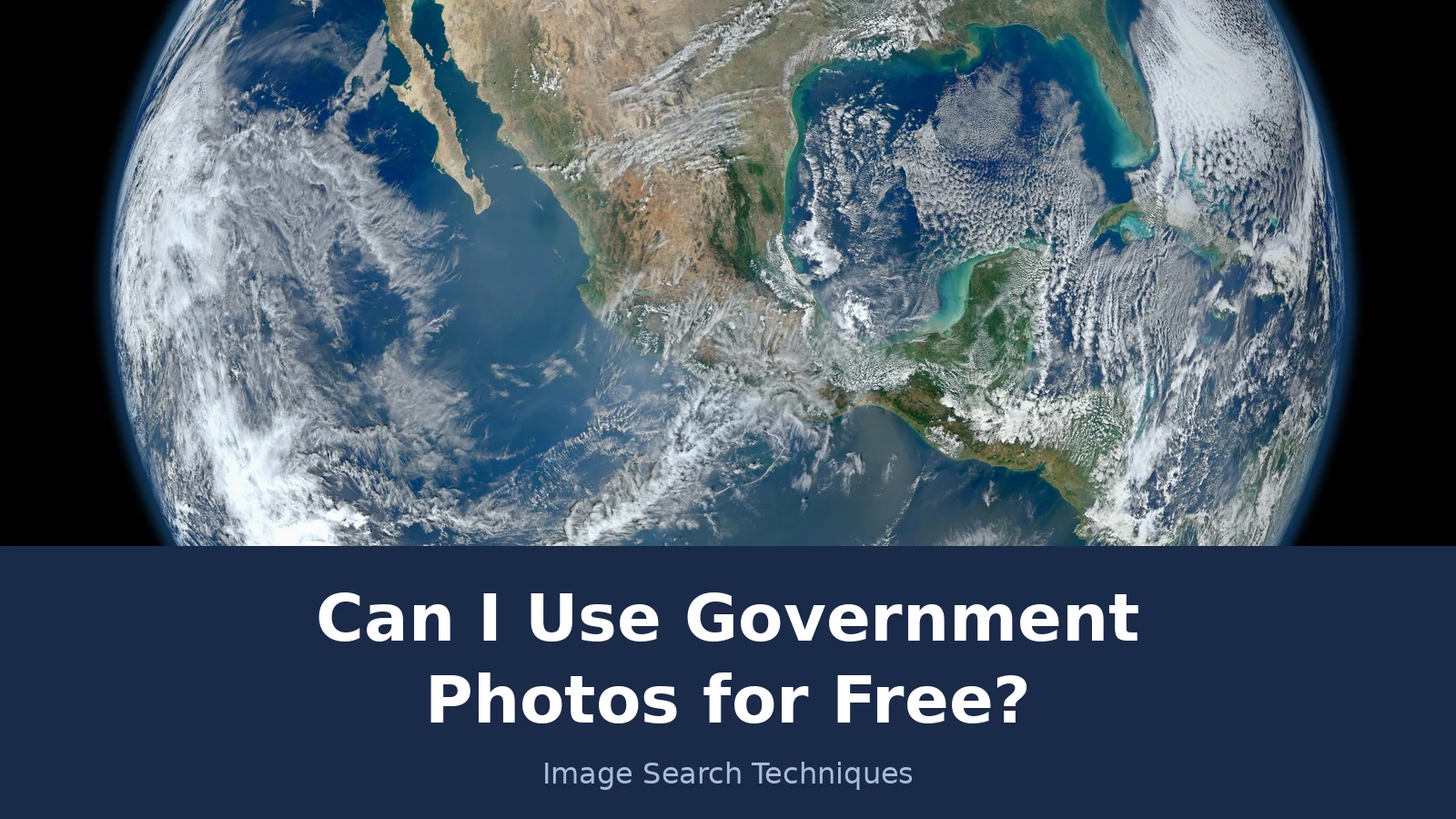
Credit is simple once you know which bucket the photo falls into. For a NASA photo, write “Image: NASA”. If the record gives a fuller credit, use it. The banner image on this article is NASA’s Blue Marble view of Earth, and its full credit is NASA, NOAA, GSFC, Suomi NPP, VIIRS, and Norman Kuring, all US government bodies, so the short credit “Image: NASA” is honest and the long credit is better.
For a UK photo under the Open Government Licence, the acknowledgement is a condition of the licence. The standard wording is “Contains public sector information licensed under the Open Government Licence v3.0”, with a link to the licence where possible. Keep the photographer’s name with it where the source page gives one, as in “Petty Officer Sean Clee, Crown copyright”.
For a US public domain photo, the credit is a courtesy, not a legal requirement, but give it anyway. It costs nothing, it helps your readers, and it proves where the photo came from. A credit line also protects you in a small way: if a photo turns out to have a third-party owner after all, a visible credit shows you acted in good faith.
Three things never to do with a credit line. Never claim a government photo is your own work. Never present it in a way that suggests the government endorses you or your product. And never remove a credit line from a photo to hide where it came from. The credit is part of the deal, and removing it is the fastest way to turn a free photo into a problem.
Answer capsule: credit NASA photos to NASA, credit UK photos with the Open Government Licence wording and the photographer’s name, and credit public domain photos anyway, because the credit is your proof of where the photo came from.
FAQs
Can I use NASA photos on my blog for free?
Yes, in most cases. NASA photos made by NASA employees are generally not subject to copyright in the US, and NASA allows educational and informational use without explicit permission. Credit NASA as the source. The exception is a photo marked with a third-party copyright statement, such as a SpaceX photo hosted on a NASA site. Check the credit line first.
Are all photos on a .gov website free to use?
No. A .gov address only tells you where a photo is published, not who owns it. Photos taken by contractors or private companies keep their copyright even on a government site, and state and local government photos are not covered by the federal rule. Read the credit line and the rights statement on the source page first.
Can I use a UK government photo on a commercial website?
Yes, if the Open Government Licence covers it. Most UK government photos are Crown copyright and reusable under the licence, including commercially, provided you acknowledge the source. Check the exclusions first: logos, Royal Arms, military insignia, personal data, and third-party rights are not covered. If the photo credits an outside photographer, the licence may not apply.
Do I need to credit a public domain government photo?
Not legally, but you should do it anyway. Public domain means there is no copyright owner to satisfy, so no credit is required by law. A credit line helps readers trust the photo and proves where you got it. For a NASA photo, write “Image: NASA”. For a UK photo, the credit is a condition of the Open Government Licence.
Can I use a government photo that shows a recognisable person?
It depends on how you use it. Copyright is only half the question. A recognisable person has privacy and publicity rights, and NASA asks for permission before you use a photo of an identifiable person. A crowd shot at a public event is fine. A portrait used to sell a product is not. Get permission or choose a different image.
Can I sell a product with a government photo on it?
Check twice before you sell. A US public domain photo can be used commercially, and a UK photo under the Open Government Licence can too, if you follow the licence terms. What you cannot do is put a government logo, seal, or insignia on a product, or use a photo that suggests the government endorses you. Logos need separate approval.