


🔎 Reverse Image Search
Image search techniques made simple: upload a photo or paste a URL and search 6 engines at once. 100% free, nothing stored.
🔒 Your image is never stored on our servers longer than 24 hours and is never shared.
You can identify a hamster breed from a photo by checking size first, then colour, then the dorsal stripe. A Syrian is much larger than any dwarf species, a Roborovski is tiny with white eyebrow patches, and a dark stripe down the back narrows the choice to the two Russian dwarfs. A photo suggests a species, it never proves pedigree.
That short answer works because pet hamsters come from only five species, and the five look different enough in a good photo to tell apart. The trouble starts when the photo is poor, when the animal is a hybrid, or when two species share the same size and colour. This guide works through the photo routine, the five-species table, the one confusion that catches almost everyone, and a real reverse image search test on a Roborovski hamster photo.
What does hamster breed mean in a photo?
In short: pet shops say breed, but the right word is species, and there are only five of them to choose from.
Species, not breed. A breed is a variety of one species shaped by selective breeding, like the many breeds of dog. Pet hamsters are different. The five animals sold as pet hamsters are five separate species, each with its own wild origin, size range and markings. A Syrian hamster and a Roborovski hamster are not two breeds of the same animal. They are two species, as different as a cat and a lynx are different, only smaller.
The five are the Syrian (also called golden), the Campbell’s dwarf, the Winter White dwarf (also called Djungarian), the Chinese hamster and the Roborovski. Pet shops often label them loosely, and the labels “Russian dwarf” and “Djungarian” get used for both Russian dwarf species and for their hybrids. That loose labelling is the first reason a photo check matters. The second is that colour alone misleads. Several species come in grey-brown, and several have a stripe. Size, colour and stripe together are what narrow the field.
How do you identify a hamster breed from a photo?
In short: one whole-animal side view in daylight, with something in frame for scale, beats five close-ups.
A reverse image search and a trait check both need the same thing, a clear photo of the whole animal. Work through these steps before you search or compare.
- Wait until the hamster is still and on open ground, not curled in a nest or pressed against cage bars.
- Take the photo from the side, at the hamster’s own height, so the full body, the tail and the back are all visible.
- Put something of known size in the frame, a coin or a matchbox, so the photo shows scale. Size is the first clue, and a photo with no scale hides it.
- Use daylight or a bright room. Avoid flash, which washes out the coat colour and turns the stripe into a shadow.
- Take a second photo of the face from the front, for the ears, the muzzle shape and the eyebrow patches.
- Note where and when the photo was taken, and whether the animal is yours, a pet shop animal or a wild one. A wild hamster is a different question from a pet species check.
Do not pick the animal up to get the shot. An unfamiliar hamster can bite, and a startled hamster in your hands is at risk of a fall. Photograph from outside the enclosure, use the zoom on your phone, and ask the owner first if you need a closer view. The same whole-animal side view is the starting point when you identify a cat breed from a photo, and it works the same way here.
What ruins a photo for identification? A top-down shot hides the body length. A close-up of the face hides the size and the stripe. Wet fur, food stuffed in the cheek pouches and bedding stuck to the coat all change the shape a trait check reads. If the only photo you have is a head shot, read the ears and face, then say so plainly and treat the answer as a guess, not a finding.
Which five species can a pet hamster be?
In short: Syrian, Campbell’s dwarf, Winter White dwarf, Chinese and Roborovski, and size alone separates three of the five.
The National Hamster Council lists five species commonly kept as pets, and its size figures are the anchor for this guide. A Syrian commonly grows between 10 and 16 cm long. Campbell’s and Winter White dwarfs grow up to 10 cm. The Chinese hamster grows up to 12 cm and is longer and thinner than the Russian dwarfs. The Roborovski rarely exceeds 7 cm from nose to tail. Other guides give slightly wider ranges, and individual animals vary, so treat every figure as a range, not a rule carved in stone.
| Species | Adult size | Colour | Dorsal stripe | Tail | Ears and face |
|---|---|---|---|---|---|
| Syrian (golden) | 10 to 16 cm, the largest pet species | Golden yellow or reddish brown, white belly; many colours in captivity | None | Short, about 1.5 cm | Rounded upright ears, soft thick coat, short or long hair |
| Campbell’s dwarf | Up to 10 cm | Brown-gold, grey-brown; many colours in captivity | Narrow dark stripe | Very short, 4 to 10 mm | Round head, short muzzle, smaller ears |
| Winter White dwarf (Djungarian) | Up to 10 cm | Light grey with white spots; coat can turn white in winter | Wide black stripe | Very short, 4 to 10 mm | Pointed muzzle, Roman nose, oval body shape |
| Chinese | Up to 12 cm, long and thin | Dark brown back, cream belly, grey ears | Dark stripe on the back | Long for a hamster, 1.5 to 2 cm | Pointed nose, mouse-like look |
| Roborovski | 4 to 5 cm, rarely over 7 cm, the smallest pet species | Sandy or pink-fawn back, white belly and legs | None | Practically absent | White patches above the eyes, snub nose, rather large ears |
Read the table in order. Size first: a hamster clearly longer than your palm is a Syrian or a Chinese, never a dwarf. A hamster the length of your thumb is a Roborovski. Colour second: the sandy back with a white belly and white eyebrow patches belongs to the Roborovski alone. Stripe third: a dark stripe down the back means a Russian dwarf or a Chinese, and the tail length then separates the Chinese, with its longer tail, from the two Russian dwarfs, with their stub tails.
The Syrian is also the only one of the five that must live alone. The National Hamster Council states the rule plainly, one Syrian per cage, because Syrians are solitary and will fight. That matters for identification too. If a shop keeps several large golden hamsters together in one tank, ask what species they really are, because a group of large hamsters is unlikely to be Syrian.
The same size-first routine works for other small pets. Our guide to identify a rabbit breed from a photo starts the same way, with body size and ear shape before colour.
How do you tell a Campbell’s hamster from a Djungarian?
In short: the stripe and the head shape decide it, because size cannot, and the winter coat confirms it.
This is the routine confusion in hamster identification, and it is the one our top competitor fails on. The AnimalsPeace guide gives both species the same size range, 7.5 to 10 cm, and then moves on. Size cannot separate them. Colour barely helps either, since both come in grey-brown. The two need a head-to-head check, and the table below is that check.
| Clue | Campbell’s dwarf | Winter White dwarf (Djungarian) |
|---|---|---|
| Dorsal stripe | Narrow dark stripe down the back | Wide black stripe down the back |
| Head shape | Round head, short muzzle | Pointed muzzle, Roman nose, oval body |
| Ears | Smaller ears | Small ears, soles densely furred |
| Winter coat | Stays the same colour | Can turn pure white in winter |
| Size | Up to 10 cm | Up to 10 cm, slightly smaller on average |
The tell, in one line: a wide black stripe plus a Roman nose means Winter White, while a narrow stripe plus a round head means Campbell’s. If the photo shows a stripe but the head is turned away, say so and call it a Russian dwarf, not a species. Guessing between the two on a blurry photo is how wrong labels spread.
There is one more honest complication. Most dwarf hamsters sold as Djungarian or Campbell’s in pet shops are hybrids of the two species, and the National Hamster Council strongly discourages breeding them, because hybrids can carry genetic and health problems and are disqualified from shows. A hybrid can show a wide stripe with a round head, or a narrow stripe with a Roman nose. When the clues disagree with each other, the honest answer is “a Russian dwarf, most likely a hybrid”, not a forced species name.
What did a reverse image search say about our test photo?
In short: all three engines found the photo, Lens named it correctly, and Yandex got the first tag wrong, which is exactly why you check more than one engine.
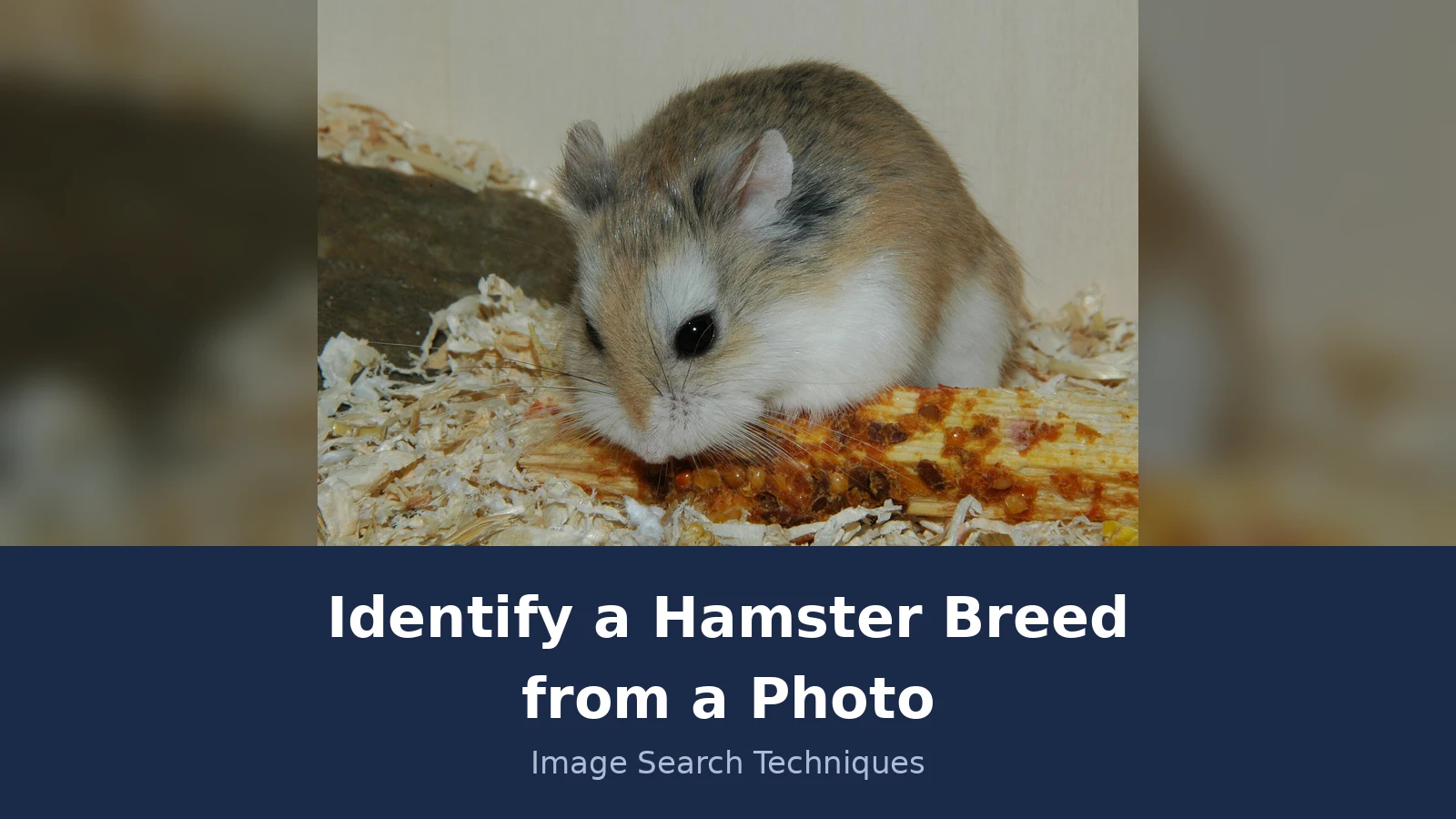
The test photo is a Wikimedia Commons file, “Phodopus roborovskii side.jpg”, a male Roborovski hamster eleven months old, photographed in side view on 23 May 2007 by Wikimedia user Bullet and released under a CC BY-SA 3.0 licence. It is a good test because it shows every trait the table uses: the sandy back, the white belly, the white eyebrow patches, the small round ears, and no dorsal stripe. The general method for this kind of check is in our find item by image guide. Here is what happened when the photo was run through the three engines live on 21 November 2026.
Google Lens named the animal a Roborovski dwarf hamster, Phodopus roborovskii, and its AI Overview described it in these terms: a sandy-brown back, a white belly, and distinct white eyebrow markings above the eyes. It added that Roborovski hamsters are the smallest hamster species, about 2 to 3 inches long, native to desert regions of Central Asia, known for fast movement and burrowing, and generally better suited to observation or gentle interaction than frequent handling. Lens showed no numeric total for exact matches, only a long list of more than 100 entries, and the first exact match was the source file itself on Wikimedia Commons, followed by copies on Wiktionary, Natural Atlas, Wikispecies and many Wikipedia language editions. The visual matches started with the same source file, then Natural Atlas, Pinterest, a Zoo Berlin photo set, Reddit, PetHelpful, The Spruce Pets and iNaturalist.
TinEye returned 19 results after searching 86.8 billion images. It first indexed the photo on 3 March 2012, on the French Wikipedia page for Phodopus, and it lists the Commons file itself at 3008 by 2000 pixels and 1.5 MB, first seen on 9 March 2013. The other results are Wikipedia pages for Phodopus and for the Roborovski hamster, plus answers.com, fanpop.com and a Czech hamster blog. Nineteen results is a small count, and it fits the subject. A hamster photo from 2007 has had years to spread across reference sites, but it is not a viral image, so a modest count with Wikipedia at the top is what a correct result looks like.
Yandex Images was the interesting one. Its tags named the photo, in Russian, as a Dzungarian hamster first, then a Roborovski hamster, then Roborovski hamsters, then a Campbell’s hamster, then a Djungarian hamster again. The first tag was wrong. The Roborovski tags were also there, and the similar images were mostly other Roborovski and dwarf hamsters, but a reader who trusted only the first tag would have walked away with the wrong species. Yandex listed 16 sizes of the same file, from 3008 by 2000 down to 200 by 200, about 78 similar thumbnails in the first batch of its Similar images tab, and 20 sites containing the image, including the English and French Wikipedia pages, the Commons file page, Animalia, hamsterlove.org and hamsterhideout.com.
| Engine | What it said | Count | Verdict |
|---|---|---|---|
| Google Lens | Roborovski dwarf hamster, Phodopus roborovskii | No total shown, more than 100 exact matches listed | Correct, and the AI Overview listed the right traits |
| TinEye | Same photo on Wikipedia and Commons | 19 results out of 86.8 billion images | Correct, first indexed 3 March 2012 |
| Yandex Images | First tag Dzungarian, Roborovski tags also given | 16 sizes, about 78 similar images, 20 sites | First tag wrong, use it as a second opinion only |
The lesson from the test is simple. Use the trait table first, then let the engines confirm or challenge it. When Lens and TinEye agree with the traits and Yandex disagrees, trust the traits and the two engines that agree. When all three engines return nothing at all, that means no indexed copy exists, not that the species is wrong. Many pet photos have never been indexed anywhere, so a zero is a statement about the engines, not about the animal.
What can a photo not tell you about a hamster?
In short: a photo can suggest a species, but it cannot prove pedigree, settle a hybrid, or tell you the age or sex with confidence.
Pedigree is the clearest limit. A photo shows the traits a species should have, but pedigree is a paper trail, not a look. A crossbred hamster can look exactly like a pedigree one, and a hybrid Russian dwarf can look like a pure Campbell’s. If you are buying a registered animal, ask for the registration certificate and check it with the breed society before you pay. The same limit applies when you identify a dog breed from a photo, where a photo match is never a substitute for papers either.
Age and sex are nearly as hard. Young Syrians are the size of adult dwarfs, so a photo of a young hamster with no scale and no date can mislead on size alone. Lens itself offered to help confirm the age or sex of our test animal, which is a reminder that the engines know their limits. If age matters, for example when judging whether a hamster is old enough to leave its mother, ask the breeder or the shop, and do not decide from a photo.
Hybrids are the third limit, and the most common one in practice. As the Campbell’s and Djungarian section explains, most pet shop Russian dwarfs are hybrids, and no photo routine can separate a hybrid from a pure animal with certainty. The honest answer in that case is the wider label, Russian dwarf, plus the traits you can see. The same hybrid problem appears with other small pets, and our guide to identify a chicken breed from a photo runs into it with mixed-breed birds.
Finally, identification is not an excuse to handle an animal that is not yours. The RSPCA hamster care pages describe hamsters as prey animals that need gentle, patient handling, and a hamster that does not know you will bite. Photograph from outside the enclosure, use zoom, and ask the owner first. A good photo taken from a step back is worth more than a close-up taken after a bite.
Work the routine in order and you will get a useful answer most of the time: size first, then colour, then the stripe, then the head and ears, then a reverse image search to confirm. When the clues disagree, say so. “Most resembles a Winter White” is a better answer than a confident wrong species, and it is the answer a careful reader can act on.
FAQs
Can a photo prove a hamster is a pedigree breed?
No. A photo shows the traits a species should have, but pedigree is a paper trail, not a look. A crossbred hamster can look exactly like a pedigree one, and a hybrid Russian dwarf can look like a pure animal. If you are buying a registered hamster, ask for the registration certificate and check it with the breed society.
What is the fastest clue in a hamster photo?
Size. A hamster longer than your palm is a Syrian or a Chinese, never a dwarf. A hamster the length of your thumb is a Roborovski. Once size has narrowed the field to two or three species, check the colour and the dorsal stripe. Size first, colour second, stripe third, and the answer usually falls out in that order.
How do I tell a Campbell dwarf from a Djungarian?
Check the stripe and the head shape, because size cannot separate them. A Winter White has a wide black stripe and a pointed muzzle with a Roman nose. A Campbell dwarf has a narrow stripe and a round head with a short muzzle. A Winter White coat can turn white in winter. When the clues disagree, say Russian dwarf.
Why did Yandex call my Roborovski a Djungarian?
Engine tags are guesses from visual similarity, not identifications. Yandex gave Dzungarian as its first tag for our test photo, then listed Roborovski tags as well, while Lens named it correctly and TinEye found the exact file. Never trust a single top tag. Use the trait table first, then let two or three engines confirm or challenge it.
Can I identify a hamster breed from a head shot only?
Only partly. A head shot shows the ears, the muzzle shape and the eyebrow patches, which are strong clues, but it hides the body size, the coat pattern and the tail. Take a whole-animal side view as well, with a coin or a matchbox in frame for scale. One good full-body photo is worth more than five close-ups.
Is it safe to pick up a hamster to photograph it?
Do not handle a hamster that is not yours. An unfamiliar hamster can bite, and a fall can hurt it. Photograph from outside the enclosure, use the zoom on your phone, and ask the owner first if you need a closer shot. A good photo from a step back is worth more than a close-up taken after a bite.