🔎 Reverse Image Search
Image search techniques made simple: upload a photo or paste a URL and search 6 engines at once. 100% free, nothing stored.
🔒 Your image is never stored on our servers longer than 24 hours and is never shared.
You adopted a rabbit from a rescue, or a friend handed you one with no paperwork, and now you want to know what breed it is. A photo is the fastest way to start. It will not give you a pedigree, and it will not settle the question the way a dog DNA test can, but a clear photo plus a reverse image search will usually narrow the answer to one likely breed or a short list of mixes.
Short answer: To identify a rabbit breed from a photo, photograph the rabbit side-on in daylight, then compare its ears, fur and body shape against known breeds, and run the photo through Google Lens, TinEye and Yandex. The result is a likely breed or mix, never proof of pedigree, because most pet rabbits are mixed breeds.
This guide shows you the whole method. You will learn which three traits do the narrowing, how to photograph a rabbit so the tools have a fair chance, how to run the reverse searches, and what a real test looks like. We ran one ourselves on a known Holland Lop photo, and the results are reported exactly as they appeared, including the places where the engines disagreed.
What can a photo actually tell you about a rabbit’s breed?
A photo can tell you what a rabbit looks like. A breed is, in large part, a set of visible traits: ear shape, fur type, body shape, size and colour. A tool that compares those traits against a database of breeds can make a good guess. That is all it is. A camera cannot see a family history, and no photo result is a pedigree.
What “breed” means here. A pedigree rabbit has registration papers from a recognised breeder, and that paperwork is what makes it a Holland Lop rather than a rabbit that looks like one. Most pet rabbits have no such papers. The American Rabbit Breeders Association currently recognises 49 rabbit breeds, and most pet rabbits are mixes of two or more of them, or of no recognised breed at all. So the honest answer to “what breed is my rabbit?” is usually “it most resembles X”, and that is a useful answer as long as you read it that way.
Three limits shape everything in this guide. First, mixed breeds blend traits freely, so a rabbit can have lop ears from one parent and a Rex coat from another, and no single label fits. Second, young rabbits change as they grow: ear carriage, proportions and size all shift until the rabbit reaches full maturity at around six to eight months for small breeds and eight to twelve months for larger ones. Third, colour alone misleads. Many colours appear across many breeds, so a black rabbit could be one of a dozen breeds, and a colour that looks distinctive often is not. Google’s AI Overview for this exact question makes the same point: coat colour alone can mislead, and the photo needs to show ears, fur texture and body shape together.
Answer capsule: A photo gives you a resemblance, not a pedigree, and the resemblance is only worth trusting when ears, fur and body shape all point the same way.
How do you take a photo that gives every tool a fair chance?
Every method below reads the same thing, pixels, so the photo is the whole game. A rabbit photographed from above, in dim light, half hidden behind a food bowl, will get a bad answer from a good tool. Take a deliberate photo instead.
- Photograph the whole rabbit, side-on. Stand at the rabbit’s level, not above it, and frame the animal from nose to tail with a little space around it. A side profile shows the body shape, the ear set and the proportions that a front-on portrait hides.
- Use daylight, and avoid flash. Flash flattens coats and blows out pale fur. Skip heavy filters too. A filter changes fur colour and markings, and those are the very traits the tools read, so the photo you upload should look like the rabbit, not like an edit. A shaded spot outdoors on a bright day is ideal. If the rabbit is moving, wait for a still moment rather than firing off a blurry burst.
- Add a head shot as a second photo. Breed descriptions talk about the head from the front and the side, so one clear head shot helps. But a face close-up should never be the only photo: it hides the body, and the body carries most of the evidence.
- Keep the background plain and the rabbit unobstructed. Grass, a fence or a plain wall all work. Avoid other rabbits, people, leads and bowls in the frame. The tool should have one subject to judge.
- Weigh the rabbit and note its age. Adult weight is one of the strongest clues, and Google’s AI Overview for this question says to share the rabbit’s age, weight and size alongside the photo for a more accurate match. Small breeds mature under four pounds, medium breeds fall between six and ten, and large to giant breeds exceed ten. If the rabbit is still growing, say so, and revisit the breed guess once it is fully grown.
- Take two or three shots, not one. One side view, one three-quarter view, and one head shot. If two photos give different answers, that disagreement is information, not a fault. Compare like with like and treat a change as a clue rather than proof.
Answer capsule: A sharp, side-on, full-body photo in daylight, plus the rabbit’s weight and age, is worth more than any app on its own.
Which three traits narrow the breed down?
Breed identification works by checking traits together, never one at a time. A lop ear on its own could belong to five breeds. A lop ear on a small, compact rabbit with rollback fur points at one. The three traits that do most of the work are body type, ear shape and fur type. Colour comes last, as a tie-breaker, because it is the least reliable of the four.
Body type. The American Rabbit Breeders Association groups breeds into five body types: semi-arch, compact, commercial, cylindrical and full arch. A compact rabbit carries a short, rounded body close to the table. A commercial type shows a longer midsection with good depth. Semi-arch and full-arch rabbits show a visible curve along the spine from shoulder to hip, with full-arch breeds showing the most dramatic rise. Only one breed, the Himalayan, is cylindrical, straight and tubular with no arch. Learning to recognise these shapes narrows your identification considerably before you look at anything else.
Ear shape. Ears divide rabbits into two broad groups at once. Lop-eared rabbits carry their ears hanging down alongside the head. The lop breeds are the Mini Lop, American Fuzzy Lop, Holland Lop, English Lop and French Lop, and size and ear length help separate them: the English Lop has the largest ears of all the breeds, while the Holland Lop is a small, compact lop. Upright-eared rabbits make up the majority of breeds, and here you look at ear length relative to body size, and whether the ears are carried close together or spread apart. The Netherland Dwarf and Britannia Petite have the smallest ears, and both are also the smallest breeds at 2.5 pounds.
Fur type. Run your hand along the coat. Normal fur lies smooth against the body and springs back when stroked against the grain. Rex fur feels like velvet, dense, plush and upright rather than laying flat. Satin fur has a glassy sheen from a translucent hair shaft. Wool breeds, like the Angoras, Jersey Wooly and Lionhead, carry long fibre that keeps growing and needs regular grooming. Fur also has a direction test: stroke it backwards from tail to head. Flyback fur returns to position almost at once, as in the Dutch, Himalayan, English Lop, Polish and New Zealand breeds. Rollback fur returns more slowly, as in the Dwarf Hotot, Holland Lop, Flemish Giant and Mini Lop. The Silver Fox has standing fur, which stays upright until brushed back. Each fur type belongs to a small group of breeds, so it eliminates most other possibilities in one stroke.
Use the checklist below as the Ranking Asset for this guide. Work through it row by row against your rabbit before you open any tool, and write down what you observe. A tool result that contradicts your own checklist deserves a second look.
| Trait to check | What to look for in the photo | What it rules in or out |
|---|---|---|
| Body type | Side profile: compact and round, long and deep, or arched from shoulder to hip | Compact points to Dutch, Netherland Dwarf or Holland Lop; commercial points to Californian, New Zealand or Rex; full arch points to Belgian Hare or Checkered Giant |
| Ear shape | Ears hanging down beside the head, or upright; ear length against body size | Lop ears narrow it to five breeds; very long ears point to English Lop; very short ears point to Netherland Dwarf or Britannia Petite |
| Fur type | Smooth and flat, velvet and upright, glassy sheen, or long and woolly; stroke test, flyback or rollback | Velvet fur points to Rex or Mini Rex; sheen points to Satin, Mini Satin or Satin Angora; wool points to Angora, Jersey Wooly, Lionhead or American Fuzzy Lop |
| Adult weight | Weigh the rabbit; note its age if it is still growing | Under 4 pounds points to dwarf breeds; 4 to 6 pounds to small breeds; 6 to 10 to medium breeds; over 10 to large and giant breeds |
| Colour and pattern | Coat colour, markings, eye rings, nose markings | Useful only as a tie-breaker; a butterfly nose marking points to English Spot, dark points to Himalayan-marked rabbits, but colour alone never settles a breed |
For a fuller walkthrough of each trait, Lafeber’s guide to rabbit breed identification works through size, fur, ears, body shape and markings with the same five body types, and the American Rabbit Breeders Association publishes the breed standards the traits come from. Both are worth reading before you trust any single tool result.
Answer capsule: Body type, ear shape and fur type together narrow the field to a handful of breeds, and colour only breaks ties.
How do you run a reverse image search on a rabbit photo?
Once you have a good photo and your own trait notes, run the photo through reverse image search. This is the step the traits guides skip, and it is the one that shows its working: you can see the photos it matched and judge for yourself whether the match is convincing. Use three engines, not one, because they index different parts of the web and they disagree in useful ways. The method is the same one our guide to finding an item by image uses for products, applied here to a living animal.
There are also dedicated AI breed identifier tools, such as AI Rabbit Breed Identifier and FastShot AI, which scan a photo and name a likely breed. They work the same way as the engines below, by matching what they can see, so treat their answer as one more photo guess. It is a suggestion, not proof of pedigree, and it is worth cross-checking against the traits in the checklist above.
- Start with Google Lens. Open lens.google.com, upload your best side-on photo, and crop tightly around the rabbit. Lens usually shows a short identification at the top, then visually similar images and links to breed pages. Open two or three of the breed pages Lens suggests and compare their photos with your rabbit, feature by feature, instead of accepting the first label.
- Cross-check with TinEye. TinEye does not guess a breed. It finds other pages hosting the exact same image, which tells you the photo’s history. If your photo is already published online, TinEye will show you where, and that source page often names the breed. If TinEye finds nothing, that is still useful: it usually means your photo is not already published, so Lens is judging the image itself rather than finding its source.
- Try Yandex Images as the third opinion. Yandex indexes different sites, including many outside the English-speaking web, and it is often the engine that catches what Lens misses. Its labels may appear in another language, so read the tags with a translator if needed. If two independent engines agree on a breed, you can trust the shortlist. If they disagree, the rabbit is probably a mix, a lookalike breed, or poorly photographed, and that disagreement is the honest answer.
- Compare like with like. Run the same photo through every engine, and write down all the answers before you decide. If the app or Lens names one breed and the other engines show five others, trust the spread. Our step-by-step guide to how to reverse image search covers the phone and desktop routes for each engine in detail.
One caution before you upload: a photo of your rabbit is not sensitive in the way a photo of a person or a document is, but uploading it still sends a copy to the search engine’s servers. Do not upload photos that also show children, documents, number plates or your home’s interior details. And if the rabbit in the photo is not yours, ask the owner first, just as you would before photographing any animal that belongs to someone else.
Answer capsule: Lens names the breed, TinEye traces the photo’s history, and Yandex gives the third opinion, and agreement between two of them is what makes a shortlist trustworthy.
Worked example: one Holland Lop photo through Lens, TinEye and Yandex
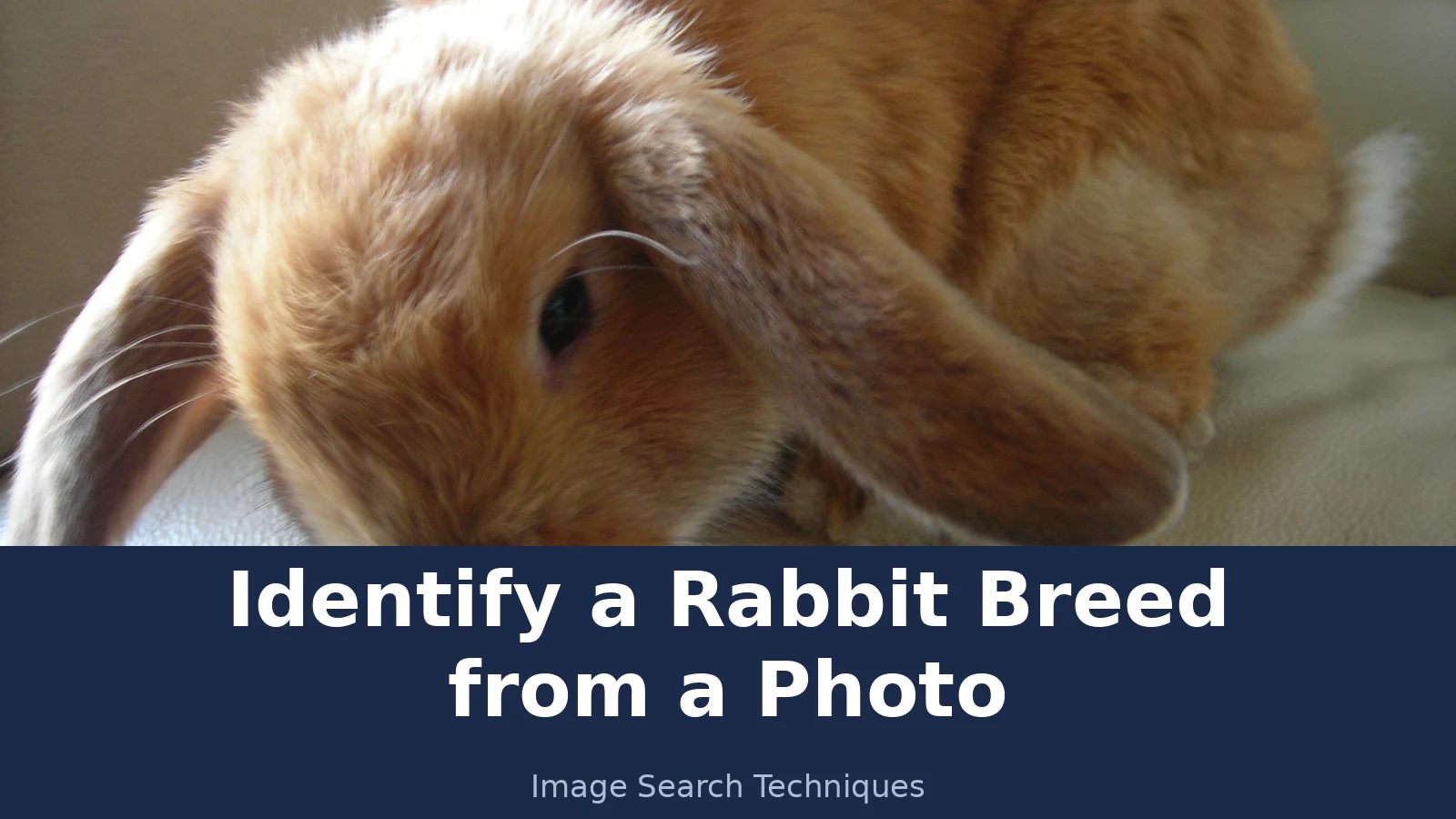
To see how the methods above behave on a real photo, we ran a test on 19 November 2026. The photo is a public-domain image from Wikimedia Commons, “Holland lop bunny.JPG”, photographed by Orlandkurtenbach on 24 January 2007 with a Nikon Coolpix L3. It shows an orange Holland Lop rabbit in a three-quarter view, with long lop ears hanging down beside its head, a dense golden-orange coat and a compact, rounded body. It is exactly the kind of photo this guide recommends, and the breed is known in advance, which is what makes it a fair test: we can check whether the engines get the right answer.
Google Lens. Lens identified the rabbit as a Holland Lop outright. Its analysis described a warm orange coat with darker shading along the floppy ears and a small white tail, and it named the key features: long hanging lop ears, a dense golden-orange coat and a compact, rounded build. The visual matches loaded 60 tiles before the “See more” button, and the exact Wikimedia file was among them. The exact matches tab loaded 62 results, the first being the Wikimedia Commons file page itself. This is Lens at its best: a clear, well-photographed pure breed, identified confidently and traced to its source.
TinEye. TinEye returned 43 results after searching 86.8 billion images, and it reported that the photo was first indexed on 19 October 2009. TinEye itself does not label a breed in its interface. It matches the exact same image, and the breed comes through indirectly: its top result was the English Wikipedia page for the Holland Lop, and the other results were copies of the same photo on sites such as imgfave.com, article.wn.com and ellf.ru. TinEye proved the photo’s provenance rather than identifying the rabbit, and that provenance pointed straight at the right breed.
Yandex Images. Yandex described the image with tags in Russian: lop-eared ram rabbit, lop-eared rabbit, dwarf lop-eared ram rabbit, rabbit, and cute rabbits. It did not use the English phrase “Holland Lop”, but “dwarf lop-eared ram rabbit” is the Russian equivalent of the same animal, so in effect Yandex named the breed too. It loaded 40 similar-image thumbnails before “Show more similar images”, listed 17 sizes of the same photo from 2592 by 1944 down to 250 by 187, and its sites tab loaded 18 entries, including the Wikipedia file page and a page titled “Holland Lop Bunnies”.
| Engine | What it said | Counts recorded |
|---|---|---|
| Google Lens | Named the breed outright: Holland Lop, with lop ears, golden-orange coat and compact build | 60 visual-match tiles loaded; 62 exact matches loaded |
| TinEye | No breed label; top result was the Wikipedia Holland Lop page, so the breed came through the source | 43 results from 86.8 billion images searched; first indexed 19 October 2009 |
| Yandex Images | Tags in Russian: dwarf lop-eared ram rabbit, the equivalent of a Holland Lop | 40 similar images loaded; 17 sizes listed; 18 site entries loaded |
That is the whole lesson in one test. All three engines found the exact photo. Lens named the breed directly. Yandex named it in another language. TinEye named it only through the source page. None of them was wrong, but only Lens gave the answer in plain English, which is why Lens is the right first engine and the other two are the cross-check. One honest caveat: this photo is a published image, so Lens had seen it before, which is why the exact matches appeared. Your own rabbit’s photo will not have that advantage. Lens will have to judge the image itself rather than find its source, and that is exactly why the breed suggestion matters more than the exact match count. If you want to see the same routine applied to other animals, our guides to identifying a dog breed from a photo and identifying a cat breed from a photo follow the same pattern, with the same cautions about mixed breeds.
Answer capsule: On a known Holland Lop photo, Lens named the breed, Yandex described it as a dwarf lop, and TinEye proved it through the source page, three different routes to the same answer.
What do you do when the tools disagree, or return nothing?
Disagreement is the most common result, and it is not a failure. It usually means one of four things, and each one has a different fix.
The rabbit is a mix. This is the most likely explanation, and it is the correct result. If Lens says Holland Lop, Yandex shows a spread of lop breeds, and TinEye finds nothing, the honest conclusion is “lop mix, most resembles a Holland Lop”. Write down the shortlist rather than forcing one label, and use the trait checklist to see which breed’s traits dominate. A mix is not a lesser rabbit. Mixed breed rabbits often benefit from greater genetic diversity, which can mean fewer inherited health problems than rabbits from tightly bred purebred lines.
The photo is the problem. A face-only crop, a dark room, or a rabbit half hidden behind a hutch will pull every engine in a different direction. Re-shoot using the steps above: side-on, full body, daylight, plain background. If you only have one old photo, say so to yourself before you start. A weak photo produces a weak answer, and no app can invent detail that is not in the image.
The breed is rare or regional. Lens is strongest on well-photographed pure breeds, because the web is full of labelled pictures of them. A rare or local breed has less to match against, so the engines fall back on the nearest common lookalike. In that case, the lookalike is a clue about the body type and fur, not a verdict on the breed. Check the result against the breed standards on the ARBA site, and ask a person who knows the breed.
Nothing matches at all. A zero result is still a result. It usually means the photo is not published anywhere online, which is good news: the engines are judging the image itself, not finding its source. It can also mean the rabbit is a young animal whose adult traits have not settled, or a breed the engines have little training data for. Try a second photo taken on a different day. If the same breed tops both runs, the guess is stronger. If the animal in the photo turns out not to be a rabbit at all, our general guide to what is in a picture explains the same routine for any object, plant or animal.
Answer capsule: When the engines disagree, the disagreement is the answer: a mix, a weak photo, or a rare breed, and each one has a different next step.
What is a breed guess actually good for?
A breed guess is worth having when it changes a practical decision. The three decisions it changes are housing, grooming and health watch, and that is where a reasonable guess about breed background actually translates into better care.
Housing size. A rabbit that carries Flemish Giant genetics will need very different housing from one with Netherland Dwarf in the mix. Large breeds need more floor space and a bigger exercise area, and planning that before the rabbit grows saves a second purchase later. If your guess says large breed, plan for the large end of the range.
Grooming. Longhaired breeds need daily grooming that shorthaired rabbits simply do not, and the difference between knowing that upfront and discovering it after mats have formed is significant. If your rabbit appears to carry Angora or Lionhead influence, prepare for regular grooming sessions. If Rex genetics seem likely, the foot fur is thinner, so softer flooring surfaces matter.
Health watch. Lop ears are more prone to moisture buildup and infection, so a lop-eared rabbit deserves closer ear checks. Understanding your rabbit’s likely breed background also helps your vet anticipate health concerns that run stronger in certain lines, which makes wellness planning more targeted. Tell your vet the guess is a guess, though. Telling a vet your rabbit is definitely a specific breed when you actually mean it looks like one can lead to care assumptions that may not apply.
Ask a person when it matters. If the breed matters for adoption paperwork, a training plan or a medical discussion, ask the people who know the rabbit, a rescue worker, a breeder or your vet, instead of relying on a visual scan. Rabbit rescue volunteers and breeders who have handled hundreds of rabbits develop an eye for breed characteristics that goes beyond what photos can teach. They notice subtleties in bone structure, fur density, ear set and body proportion that help distinguish breeds that look similar in pictures. And if you ever need certainty, only pedigree papers settle it. Genetic testing for rabbits exists, but it is far less developed than dog DNA testing: current tests can pick out some colour genes and breed markers, but the database of breed profiles is limited, so it cannot settle a breed the way a dog test can.
One thing the guess should never do is change how much you value the rabbit. A mixed breed rabbit with no identifiable pedigree deserves exactly the same quality of housing, nutrition, veterinary care and affection as a show-quality purebred. The purpose of identification is practical planning, not establishing worth.
Answer capsule: A breed guess earns its keep when it changes housing, grooming or health checks, and it should never be used to predict temperament or worth.
The same photo-first routine works for ducks too. Our guide to identifying a duck breed from a photo reads posture first, then the bill, the plumage and the wing patch, and finishes with a live reverse-search test.
The same photo-first routine works for goats too. Our guide to identifying a goat breed from a photo starts with the ears, then the face, horns and coat, and finishes with a live reverse-search test on a real Anglo-Nubian photo. The same photo routine works for other small pets: see identify a hamster breed from a photo, which uses size, colour and the dorsal stripe to separate the five pet species.
FAQs
Can you identify a rabbit breed from just one photo?
You can make a good guess, but not a certain identification. A clear side-on photo showing the ears, fur and body shape, plus the rabbit’s adult weight and age, is usually enough to narrow it to one likely breed or a short list of mixes. Only pedigree papers can prove a breed, because a photo shows looks, not ancestry.
What is the best app to identify a rabbit breed from a photo?
Google Lens is the best starting point, because it shows the photos it matched and links to breed pages, so you can judge the match yourself. Cross-check with TinEye and Yandex Images. Dedicated breed scanner apps exist for dogs and cats, but there is no equivalent rabbit scanner with a proven record, so the three-engine routine is the reliable route.
Why do different tools give different rabbit breeds for the same photo?
The tools index different parts of the web and weigh traits differently, so disagreement is normal. It usually means the rabbit is a mix, the photo is weak, or the breed is rare. Run the same photo through every engine, write down all the answers, and trust the spread rather than any single label.
Can a photo prove my rabbit is a Holland Lop?
No. A photo can show that a rabbit most resembles a Holland Lop, but that is a resemblance, not proof. Only registration papers from a recognised breeder prove it. Mixed breeds can carry lop ears from one parent and a different coat from another, so treat every photo result as a likely breed or mix.
Does coat colour identify a rabbit breed?
Colour alone almost never identifies a breed, because most colours appear across many breeds. Some markings help, such as the butterfly nose marking of the English Spot, but they are tie-breakers, not proof. Check body type, ear shape and fur first, and use colour only to choose between breeds that already match on those traits.
Is there a DNA test that tells you a rabbit’s breed?
Rabbit genetic testing exists, but it is far less developed than dog DNA testing. Current tests can identify some colour genes and breed-associated markers, but the database of breed profiles is limited, so they cannot settle a breed the way a dog test can. A photo check plus a vet or rescue worker’s opinion is the practical route.