🔎 Reverse Image Search
Image search techniques made simple: upload a photo or paste a URL and search 6 engines at once. 100% free, nothing stored.
🔒 Your image is never stored on our servers longer than 24 hours and is never shared.
Short answer: A fake visa agent scam uses stolen or staged “success” photos and doctored approval letters to look legitimate. Photos prove nothing on their own: reverse-search them, check the letter for tells, then verify the agent on the official register, CICC for Canada, the IAA for the UK, OMARA for Australia. If they are not listed, do not pay.
Agent fraud has surged as immigration rules tightened in the UK, Canada and Australia, and the “proof” is almost always visual: a smiling client at an airport, a wall of visa stamps, a screenshot of an approval letter. This guide shows you how to test every one of those photos before you hand over money, and why the only check that actually settles the question is the official register, not the pictures. A fake visa agent scam is built on borrowed trust, and the photos are the borrowing.
The same borrowed trust sits behind a fake offer letter. Our fake university admission letter photo check works through a real fake admission letter, and shows how to check the university on the official register before you pay.
What is a fake visa agent? A fake visa agent is someone who charges for immigration help they are not licensed to give, and who uses borrowed photos and documents to hide that fact.
What is a fake visa agent scam, and what are they actually selling?
A fake visa agent sells certainty. The pitch is almost always the same: a guaranteed visa, a job offer waiting for you, a study place already secured, all for a fee paid upfront, often in cash or to a personal account. What you actually buy is either nothing at all, or an application filed with documents you never saw, in a name you never checked.
There are two common shapes. The first is the “ghost consultant”: someone who works on immigration files for pay without a licence, often without ever being named on the application. Canada’s immigration department, IRCC, now targets them directly: from 28 October 2026, administrative fines of up to $1.5 million apply to anyone giving paid immigration advice without authorisation, with baseline penalties of $5,000 for unauthorised paid advice and $15,000 for knowingly giving false information, according to IRCC’s own announcement. A public online list of penalised representatives is expected in 2027. The second shape is the pure scammer: no application is ever filed, and the “visa” you paid for never existed.
Either way, the risk lands on you, not on them. An application built on a fake job letter or a doctored bank statement can be refused as misrepresentation, and under Canada’s Immigration and Refugee Protection Act, a misrepresentation finding can bar you for five years. That is why the check has to happen before the payment, not after the refusal. Our complete guide to photo scams covers the same pattern across other scams: the photo is the hook, and the payment is the catch.
Why do their “proof” photos look so convincing?
Because they are usually real photos, just not of what the agent claims. A fake visa agent scam rarely needs to fake a photograph from scratch. It needs four kinds of borrowed image, and each one is easy to get hold of.
Staged airport photos. A smiling client with luggage in an arrivals hall is the classic “success” photo. It is also the easiest to stage: anyone can pose in an airport, and the agent only needs one happy-looking traveller to reuse the image for every client. The photo proves somebody travelled somewhere once. It proves nothing about who arranged it.
Stock photos. Search any stock library for “happy traveller airport” and you will find the same images agents post as their own clients. A reverse image search finds these in seconds, which is why the test in the next section matters more than any claim in the caption.
Stolen client photos. Some agents post genuine photos of real clients, without permission, and often from years-old cases. The person in the photo may have used a completely different agent, or may have travelled on a visa the agent had nothing to do with. A real photo of a real person is still not evidence that this agent did the work.
Doctored approval letters. The most persuasive “proof” of all is a screenshot of an approval letter or a visa stamp. These are also the most frequently doctored, because a letter is just text on a page. The tells are covered in detail below, but the headline rule is simple: a screenshot of a document is not a document. Real approvals live inside an official account, not inside a WhatsApp chat.
None of this means every agent who posts photos is a fraud. Legitimate consultants post client photos too. The point is narrower and more useful: photos can only ever raise or lower suspicion. They can never confirm that an agent is licensed, because licensing is a fact recorded on a register, not a quality visible in a picture.
How do I reverse-search an agent’s success photos?
Reverse-searching a photo takes about two minutes, and it is the single most useful check you can run on an agent’s “proof”. Save the photo the agent sent you, a screenshot works, but the original file is better, and run it through these steps.
Step 1: Save the photo, do not forward it. On WhatsApp or Facebook, long-press the image and save it to your phone. Keep the agent’s message with it, including the date, so you have a record if you need to report them later.
Step 2: Run it through Google Lens. Open Google reverse image search and upload the photo, or paste its link. Lens looks for the same image, and visually similar ones, across the web. If the “success” photo turns out to be a stock image, a news photo, or a picture from another agency’s website, the agent’s story collapses on the spot. Our step-by-step guide to reverse image search covers the exact taps on phone and computer.
Step 3: Try TinEye and Yandex as well. Different engines index different corners of the web, so a photo Lens misses may turn up elsewhere. TinEye is strongest at finding exact copies; Yandex is often best at matching faces and scenes in photos from outside the English-speaking web. Run the same photo through all three before you conclude anything.
Step 4: Crop and search again. If the full photo returns nothing, crop to one detail, a face, a sign, a distinctive bag, and search that crop. Scammers often flip, crop or filter a stolen photo to dodge a first search, and a tight crop defeats most of that.
Step 5: Read the result honestly. A match to a stock site or another agent’s page means the photo is borrowed: stop there. A match to the agent’s own website only means they posted it first, it still proves nothing about the visa. And no match at all means nothing either: a photo can be genuine and the agent still unlicensed, or stolen from a source no engine has indexed. That is the lock this whole guide rests on: a clean photo result is never “agent verified”. Only the register decides that.
The table below is the Ranking Asset of this guide: the full proof-photo test battery, in the order to run it. It ends, deliberately, at the official registers, because that is where photo checking stops and real verification starts.
| Test | What to do | What a fail means |
|---|---|---|
| 1. Success photos | Reverse-search every “happy client” and airport photo through Lens, TinEye and Yandex. | A match to a stock site, news photo or another agency’s page means the photo is borrowed. Stop and do not pay. |
| 2. Office photos | Reverse-search the office, team and “our branch” photos the same way. | Matches to other businesses or stock interiors mean the office is borrowed too. A real firm photographs its own premises. |
| 3. Approval letters | Read the letter for the tells in the next section. Never accept a screenshot as proof. | Mismatched fonts, wrong letterhead or a letter sent only as a chat image means the document cannot be trusted. |
| 4. Register check | Search the agent’s full name and licence number on the official register for your country (see the table below). | Not listed, wrong name, or a suspended or expired status means they cannot legally charge you. Walk away. |
| 5. Payment check | Ask for an invoice in the firm’s registered name and a receipt for every payment. | Cash only, or payment to a personal account, means there is no paper trail, and no one to complain to. |
Worked example: a real airport photo, tested today
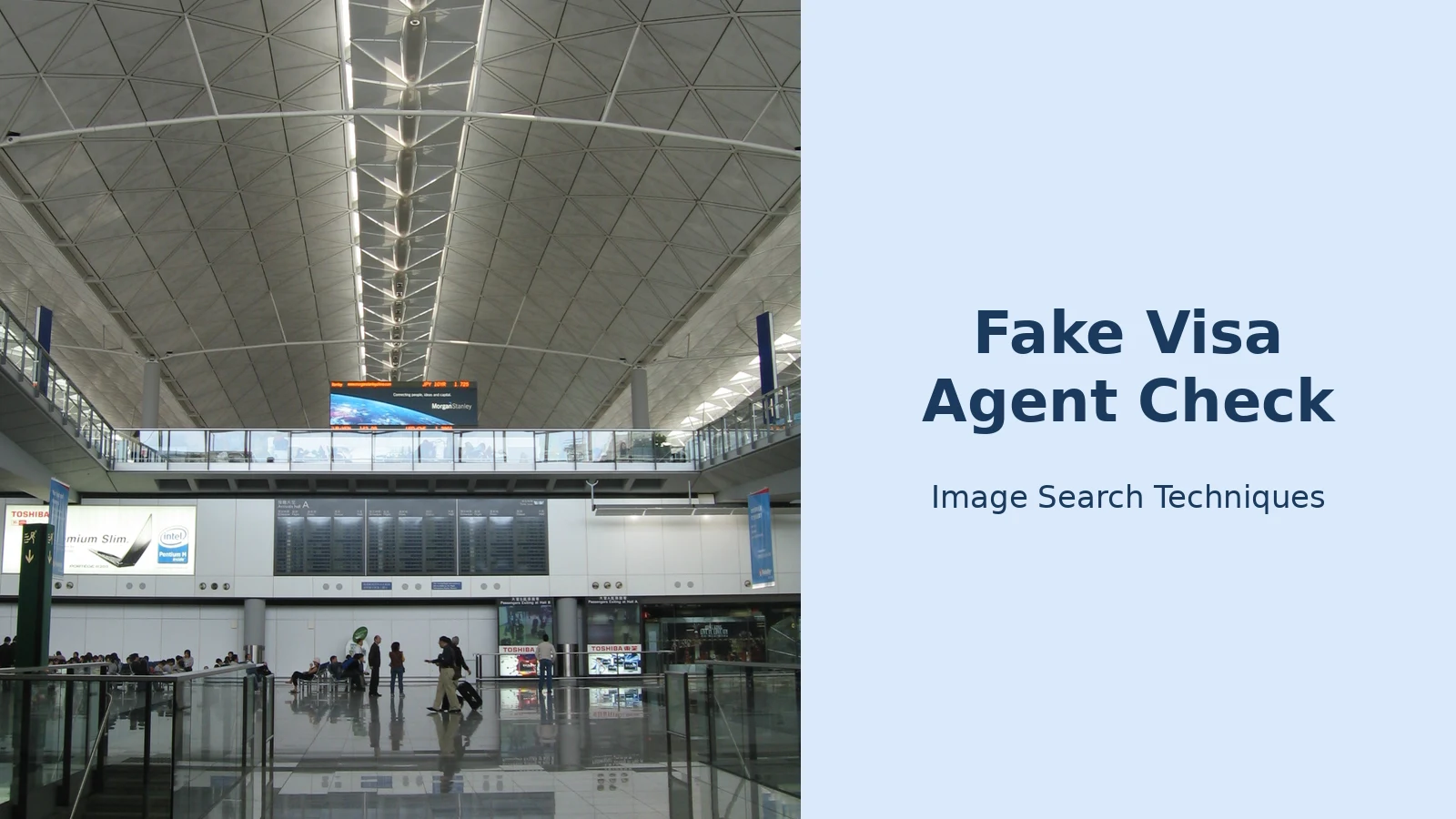
To keep this guide honest, I ran the test on a real photograph instead of describing it in the abstract: a public-domain photo of the Hong Kong International Airport arrival hall, taken in March 2006 and published on Wikimedia Commons. It is exactly the kind of image a fake agent reuses, a busy arrivals hall, travellers with luggage, no names, no dates, nothing tying it to any one person or agency. I treated it as an agent’s “success photo” and ran it through all three engines on 12 November 2026, signed out.
Google Lens never got to answer. Every attempt to open Lens by URL redirected to Google’s “unusual traffic” page, and the reCAPTCHA challenges that followed expired twice before any results loaded, several image-grid rounds were solved, two were rejected, and the sessions timed out. That is a result in itself, and one worth knowing: Lens is the best-known tool in this guide, and on some networks it simply will not run. If Lens blocks you, do not give up on the check, use the other two engines.
TinEye worked. It searched 86.7 billion images and returned two results for this photo, first indexed on 22 February 2015: the original Commons file itself, and a copy on a Swedish blog, biebertime.blogg.se, dated 11 January 2017. The Commons result even named the categories the file sits in. Two results, both naming the same 2006 photo, that is what a borrowed “success photo” looks like when it is caught: the same file, circulating under different captions, for years.
Yandex Images worked too, and it went further. It identified the photo as Hong Kong International Airport, tagged it “hong kong international airport terminal 1”, listed the sizes it exists in, and named the original Wikipedia and Commons file pages under “Sites with information about the image”. If an agent had sent you this photo as proof of a client’s arrival, Yandex would have told you within a minute that it is a twenty-year-old airport photograph, not a client’s success story.
The lesson is the one the battery table already states: run all three engines, because any one of them can be blocked on the day, and a single clean result proves nothing. Two engines agreed here, and that agreement is what turns suspicion into a fact.
How can I tell a visa approval screenshot is fake?
A visa approval letter is a formal document with a fixed format, and that rigidity is your friend: anything that breaks the format is a warning. Read the letter the agent sent you against these tells. This section teaches detection only, it does not explain how to make a convincing letter, and nothing here should be used to improve one.
It arrives as a chat screenshot, not from an official account. Real visa decisions are delivered through the official channel: your IRCC secure account in Canada, your UKVI account in the UK, or ImmiAccount in Australia. An approval that exists only as a photo in a WhatsApp chat, with no matching message in your own official account, is not an approval. Log in to your own account and look, if there is nothing there, there is no visa.
The same rule covers a UK ETA: apply through the official app or GOV.UK yourself. If the app rejects your face photo or the passport chip will not scan, our guide to UK ETA app photo and scan problems walks through the published fixes, including the online fallback. The passport photo itself can be rejected too: our guide to a passport photo rejected by the HMPO checker decodes the message and the fix.
The fonts or spacing change mid-letter. A genuine letter is generated from a template, so the typeface, size and spacing are consistent throughout. A doctored letter often betrays itself where text was pasted in: a name or date in a slightly different font, a line that sits a fraction higher than its neighbours, or a reference number in a different weight. Zoom in to full size and compare the letters, not the words.
The letterhead or logo is wrong. Compare the logo and letterhead against a genuine letter from the same authority, the issuing body’s own website publishes sample formats and guidance. A logo that is blurry while the rest of the letter is sharp, a coat of arms in the wrong colours, or a department name that does not exist are all signs the letterhead was assembled from images found online.
The letter promises what no letter promises. No immigration authority guarantees a visa before biometrics, medicals or security checks are complete, and no letter is issued before an application exists. A “pre-approval” or “guaranteed approval” letter, or a letter dated before you applied, contradicts how the process works.
The reference number does not fit. Application and receipt numbers follow a fixed pattern for each authority. If the number on the letter is the wrong length, mixes letters and digits in a way the authority never uses, or matches a number the agent has used for other clients, treat the letter as unproven. Do not share the number publicly to ask strangers to check it, check it yourself in your own official account.
One more check closes the loop: ask the agent to show you the same letter inside the official portal, on a screen you can watch, with your own application number typed in. A real agent with a real approval can do that in a minute. A scammer will change the subject, and that answer tells you everything. Our guide to the fake payment screenshot scam covers the same screenshot-forgery pattern in a different setting, and the tells rhyme: inconsistent fonts, a document that only exists as an image, and a refusal to show the original.
Which official register proves an agent is real?
This is the only check in the guide that can give you a yes. Every country in this article has one official register, kept by the regulator itself, and it is free to search. If the person charging you is not on it, and is not a lawyer or notary checked through their own regulator, they cannot legally charge you for immigration advice.
| Country | Who can charge for advice | Official register | What to check |
|---|---|---|---|
| Canada | Regulated Canadian Immigration Consultants (RCICs), lawyers and Quebec notaries, and Ontario paralegals | CICC Public Register | Search by name or College ID (an R followed by six digits). Status must be Active and “Entitled to Practise” must say Yes. |
| United Kingdom | Immigration Advice Authority (IAA) advisers, or solicitors and barristers through their own regulators | IAA Adviser Register | Search by organisation name, adviser name or the 10-character Organisation ID. Check the adviser’s level of practice too. |
| Australia | Registered migration agents, or Australian legal practitioners | OMARA Register of Migration Agents | Search by name or MARN (a seven-digit Migration Agents Registration Number). Registration must be current, and the name must match the person advising you. |
Canada: the CICC Public Register. The College of Immigration and Citizenship Consultants keeps the official record of every licensed RCIC and Regulated International Student Immigration Advisor. Search it yourself at the CICC Public Register: enter the consultant’s full name or College ID and open the profile. The College’s own guidance says to check the licence status, the licence history, the contact details and any discipline history, and then to contact the licensee directly using the contact details the register shows, never the phone number the agent gave you. The CICC replaced the former ICCRC as regulator in 2021, so anyone still advertising as an “ICCRC member” is out of date. Under section 91 of the Immigration and Refugee Protection Act, only an RCIC, a lawyer or Quebec notary, or a regulated Ontario paralegal may charge for Canadian immigration advice, and IRCC says it will not deal with a representative who charges a fee but is not authorised.
United Kingdom: the IAA Adviser Register. The Immigration Advice Authority is the UK regulator for immigration advisers who are not otherwise authorised by an approved legal regulator. It was previously known as the Office of the Immigration Services Commissioner (OISC); the OISC became the IAA on 16 January 2025. Search the IAA Adviser Register by organisation name, adviser name or the organisation’s 10-character IAA reference number. The register states plainly that it is illegal for an unregulated adviser to provide immigration advice or services, and warns the public not to seek advice from anyone not registered by the IAA or another recognised regulator. The IAA regulates more than 3,800 individual advisers and more than 2,000 organisations, according to Free Movement, and advisers are registered at Level 1, 2 or 3 depending on the work they may do, check the level matches the complexity of your case. In May 2026 the IAA launched its first nationwide awareness campaign warning the public to check advisers are authorised before trusting them.
Australia: the OMARA Register of Migration Agents. The Office of the Migration Agents Registration Authority keeps the Register of Migration Agents at portal.mara.gov.au. Search by the agent’s name or their MARN, a seven-digit Migration Agents Registration Number that a genuine agent displays openly on their website, emails and fee agreement. Only an individual can be registered, not a company, so check that the named person is the one actually advising you. Since March 2021, Australian lawyers no longer also register with OMARA, so a lawyer is verified through their state legal admission body instead. More than 5,400 registered agents are on the register, and OMARA also publishes a list of agents who have been sanctioned and formerly registered agents whose registration ceased in the last 12 months.
Three rules apply to all three registers. First, open the register yourself, never use a link the agent sends you, because fake register pages are a known trick, and never trust a screenshot of a register entry. Second, match the name, the licence number and the business name against your contract and your application form: in Canada, the same consultant’s name must appear on the Use of a Representative form (IMM 5476). Third, a clean photo result is never a substitute for this step. The registers are the answer; the photos were only ever the question.
What does a real agent’s process look like?
A legitimate agent’s process is boring, and that is the point. It runs on paper, in your name, with receipts, the opposite of a chat full of photos and promises.
You get a written agreement before you pay. It names the consultant, their licence number, the service, the fee and the refund terms. You get a receipt in the firm’s registered name, not a personal account, and you keep a copy of everything you sign.
Nobody guarantees the outcome. No consultant, lawyer or agent controls the officer who decides your file. A “guaranteed visa” is not confidence, it is the single clearest sign you are dealing with a fake visa agent scam. Real agents talk about eligibility, evidence and timelines, and they tell you when a case is weak.
You keep your own documents. A real agent never asks you to hand over your passport and disappear with it, and never offers to “arrange” a bank statement, a job letter or a degree for your file. Documents made for the file are misrepresentation, and the refusal, and any ban, lands on your record, not theirs. This is also where fake job offers enter the picture: many visa agents bundle a job that does not exist. Our job offer scam photo check shows how to test the photos in a job offer the same way you test an agent’s success photos.
You can verify everything independently. A real agent gives you their full legal name and licence number without hesitation, tells you which register to check, and expects you to check it. If an agent dodges the question, says “our partner in Canada handles the file” but will not name that partner, or rushes you to pay before you have checked anything, treat that as the answer.
I already paid a fake agent: what do I do now?
First, stop paying. Do not send a “final fee”, a “release fee” or a “government charge” to unlock a visa that is already supposedly approved, that is the same demand wearing a new label. Then save everything: every chat, every photo, every receipt, every bank transfer record and every document the agent gave you. Every complaint route below will ask for them.
Second, do not use any document the agent “arranged” for you. If a bank statement, job letter or qualification in your file is not genuine, submitting it can turn a bad loss into a misrepresentation finding. Get regulated advice before you file anything else, and check that adviser on the register first, using the table above.
Third, report them through the route that fits who they claimed to be. If they claimed to be a licensed Canadian consultant, complain to the CICC. If they claimed UK authorisation, report them to the IAA. If they claimed to be an Australian migration agent, complain to OMARA through mara.gov.au, the process is free. In the UK, report the fraud to Action Fraud through reportfraud.police.uk. In Canada, IRCC has a route to file a complaint against a representative, and the Canadian Anti-Fraud Centre takes reports from victims. If the agent operated in your own country, recruiting for jobs abroad without a licence is an offence in several countries, including Pakistan, report them to your local police as well.
Finally, be honest with yourself about recovery. Money sent to a scammer is rarely recovered, and reporting is about stopping the next victim as much as it is about your own case. What you can still protect is your immigration record: a refused application can be explained, but a file built on false documents follows you. The cheapest lesson in this guide is the one at the start, check the register before you pay, and it is worth repeating to anyone you know who is looking for an agent right now.
This guide is general information, not legal or immigration advice. Immigration rules change, and every case is different, for advice about your own application, speak to a licensed consultant or lawyer whose name you have verified on the official register yourself.
How can I check if an immigration consultant is real?
Search their full name and licence number on the official register before you pay: the CICC Public Register for Canada, the IAA Adviser Register for the UK, or the OMARA Register of Migration Agents for Australia. Open the register, match the name and number, and check the status is active. If they are not listed, they cannot legally charge you.
Can a visa agent guarantee my visa?
No. No agent, consultant or lawyer controls the immigration officer who decides your file, so a guaranteed visa is impossible. A promise of guaranteed approval is one of the clearest signs of a fake visa agent scam. A real agent talks about eligibility, evidence and timelines, and tells you honestly when a case is weak.
Are visa approval screenshots real?
A screenshot of an approval letter proves nothing on its own. Real visa decisions appear in your own official account, your IRCC secure account, UKVI account or ImmiAccount, not only as a photo in a chat. Check the letter for mismatched fonts, a wrong letterhead and promises no authority makes, then confirm the decision in your own account.
What should I do if a fake visa agent took my money?
Stop paying immediately, then save every chat, photo, receipt and bank transfer record. Do not submit any document the agent arranged for you. Report them to the regulator they claimed to belong to, CICC, IAA or OMARA, and to Action Fraud in the UK or the Canadian Anti-Fraud Centre, keeping copies of everything for your complaint.