🔎 Reverse Image Search
Image search techniques made simple: upload a photo or paste a URL and search 6 engines at once. 100% free, nothing stored.
🔒 Your image is never stored on our servers longer than 24 hours and is never shared.
You list a sofa on Facebook Marketplace. Within minutes a buyer agrees to your full price, says they are busy at work, and promises to send a FedEx driver to your home with the cash in an envelope to collect it. It sounds convenient, and it is a scam. A courier collection scam is a seller-side fraud in which a fake buyer uses a courier’s name to make you pay a bogus insurance or processing fee before any driver ever appears.
Direct answer: No courier will send a driver to a private seller’s home carrying a cash envelope from a buyer. FedEx, UPS and DPD offer no cash-envelope buyer service, and DPD states plainly that it will never ask for cash. If a “buyer” needs you to pay any fee before a courier collects your item, stop, that fee is the scam.
A courier collection scam is a fraud aimed at people selling items online: the “buyer” never intends to buy, and instead uses a trusted courier brand to trick the seller into paying a fake fee or handing over personal details.
How does the courier collection scam work?
The script follows the same five steps almost every time, and the photos and branding are the tells that give it away. Here is the annotated walk-through, the ranking asset for this guide.
| Step | What the scammer does | Photo / branding tell | What to do |
|---|---|---|---|
| 1. The too-eager buyer | Agrees to your full asking price within minutes, asks no questions about the item, and says they are busy at work or out of town. | The profile is often new, has few friends or photos, or is a hacked account belonging to a real person, reverse-search the profile photo before trusting it. | Slow down. A real buyer asks about condition, size or collection times. |
| 2. The courier promise | “I will send a FEDEX postman to your home to give you your cash and collect the item.” The courier name changes, FedEx, UPS, DPD and TNT all appear in reports, but the promise is always the same. | No courier offers a cash-envelope collection service for private sellers. DPD’s own fraud guidance names this exact trick and says it will never ask for cash. | Treat the courier’s name as a red flag, not a reassurance. No driver is coming. |
| 3. The fake courier email | You receive an email that looks as if it comes from the courier, asking you to confirm your details or pay a processing or insurance fee so the collection can be booked. | Check the sender address, not the logo: the mail comes from a free Gmail-style address or a lookalike domain such as fedx.com, never from the courier’s real domain. Logos are copied from the web and often slightly blurred or stretched. | Never click the link. Open the courier’s own site yourself and check the tracking number there, a fake one returns nothing. |
| 4. The fake payment proof | A screenshot arrives in Messenger showing a PayPal receipt, supposedly proving the buyer has paid, often for a round figure such as $500. | Screenshots are trivially faked. Reverse-search the receipt image and check the numbers: the amounts, dates and names rarely match the chat, and the same “receipt” image turns up in other scam reports. | Believe only your own bank or payment-app balance, opened by you. A screenshot is not payment. |
| 5. The fee demand | You are asked to pay an “insurance fee” or “processing fee”, sellers in forum reports quote around $200, by gift card, bank transfer or crypto, with the promise it will be refunded when the driver hands over the cash. | The payment method is the giveaway: gift cards, crypto and wire transfers cannot be reversed. The fee is the whole point of the scam. | Pay nothing. A real courier bills whoever booked it, and you never owe anyone money to sell your own item. |
After step five the pattern repeats: the “driver” never arrives, the buyer invents a new fee or vanishes, and the seller is out of pocket and still holding the item. In forum reports, sellers who gave a random address nearby and waited found that no courier from FedEx, UPS or TNT ever showed up at the time the scammer promised.
Why does the cash-envelope story sound believable?
The scam works because it borrows trust from two places at once. First, the courier’s brand: FedEx, UPS and DPD are names most people trust with parcels, so a message wrapped in their branding feels official. Second, the seller’s own wish: you want the item gone, the buyer is offering full price, and a courier collecting it sounds easier than meeting a stranger. The scammer’s job is to keep you thinking about the handover, the driver, the envelope, the doorstep, instead of the one question that matters: why would selling your item require you to pay anything?
There is also a second version of the same trick. Instead of a fee, the “buyer” overpays with a fake payment and asks you to return the difference through Western Union or a similar channel. The money you send is real and immediately withdrawn; the payment you received was fake, stolen or reversed. Both versions share the same structure: the buyer never meets you, the courier never comes, and the only real money that moves is yours, going out.
What are the photo and branding tells at each step?
Every step of the script leaves a visual clue, and checking the images is faster than arguing with the “buyer”. Use our reverse image search without a phone guide or our free reverse image search app guide to run the checks below in minutes.
- Reverse-search the buyer’s profile photo. Scam accounts often use a stolen photo. Run it through a reverse image search and see whether the same face appears under a different name, or on a stock-photo site. Our guide to how to reverse image search walks through the steps, and Google reverse image search is the fastest first check.
- Check the courier email’s branding, not just its logo. Open the courier’s real website yourself and compare. Real courier mail comes from the courier’s own domain, uses your name and a real tracking number, and never asks you to pay through a link in the message. A copied logo with a Gmail sender address is a fake.
- Reverse-search the “proof” photo. If the buyer sends a photo of the courier, a parcel or a receipt, search it. Stock images and photos lifted from other listings are the usual source, and a match elsewhere proves the image was not taken for you. The worked test below shows what the three main engines actually return on a real courier photo.
- Read the fake receipt like a document, not a promise. Check that the amount, date and names match the chat. Look for mismatched fonts, uneven spacing and cropped edges. Our fake payment screenshot guide shows the tells in detail, the same fake-receipt trick appears in several seller scams.
- Check the courier’s own fraud page. FedEx, UPS and DPD each publish fraud warnings. If the message you received contradicts what the courier itself says, the message is fake, and the courier’s own page is the authority to quote back to the “buyer”.
What did the reverse image engines say about a real FedEx photo?
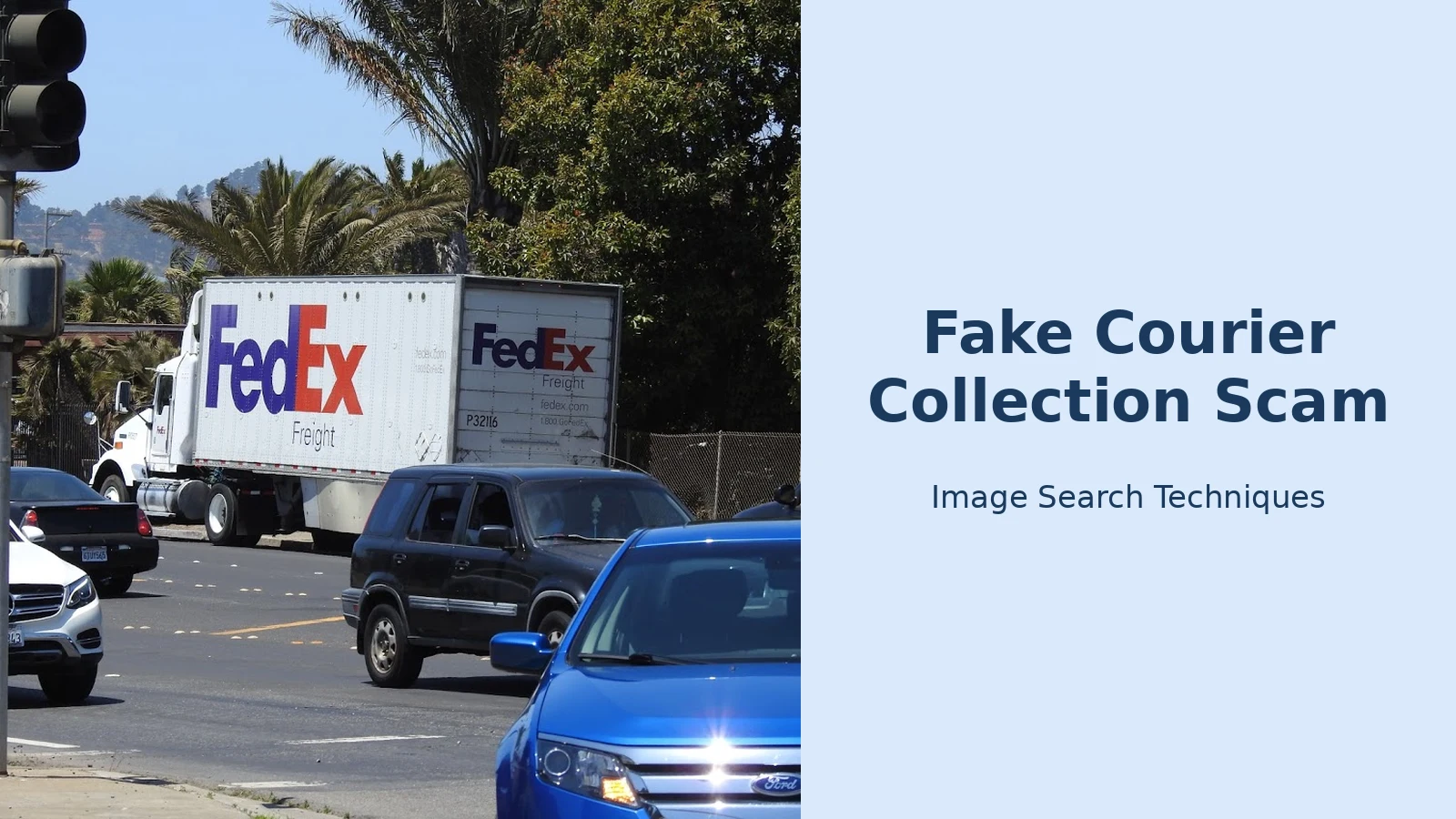
To show what the photo checks in this guide actually do, I ran a real courier photo through all three engines on 12 November 2026, signed out, with no account. The test image was the Wikimedia Commons file “FedEx Truck.jpg” (CC0, 1132×849 pixels, photographed 20 July 2019), a white FedEx Freight semi-truck at a traffic light. Here is what each engine returned:
| Engine | What happened | Did it find the original? |
|---|---|---|
| Google Lens | Blocked twice by Google’s unusual-traffic checks before it would load the image at all. Once in, Lens identified the truck correctly as a FedEx Freight semi-truck, its AI Overview described it as the less-than-truckload division of FedEx Corporation, and its exact matches were mostly other FedEx Freight truck photos from the FedEx newsroom, Trucking Dive and the Wall Street Journal. | No. Lens never surfaced the original Commons file page for this photo. |
| TinEye | Loaded without a block and searched over 86.7 billion images, and found nothing. It reported no matches and gave no identification label at all; the only thumbnails on the page were sponsored stock images. | No. TinEye had not crawled any page carrying this image. |
| Yandex Images | Loaded without a block and gave the clearest result. It tagged the photo “FedEx Ground” with tags including “fedex federal express” and “fedex worker”, listed the exact 1132×849 size under “In other sizes”, and named the original file page on Wikimedia Commons. | Yes, the original Commons page, at the exact size. (One honest caveat: Yandex’s label said “FedEx Ground” while the truck is actually FedEx Freight, the brand was right, the division was slightly off.) |
The lesson for a seller is the same one this guide repeats throughout: never trust a single engine’s “no match”. TinEye finding nothing proved nothing, the photo was genuine and freely available, TinEye simply had not crawled it. Lens confirmed the brand but not the source. Only Yandex traced the image back to its original page. When a “buyer” sends you a courier photo, a receipt or a logo, run it through at least two engines, and treat a match on a stock site or another listing as proof the image was not taken for you.
What do FedEx, UPS and DPD actually say?
The three couriers named most often in this scam all say the same thing in different words: they do not run a service like this, and they do not ask sellers for money or personal details out of the blue.
| Courier | What it says (verified 12 November 2026) | What it means for you |
|---|---|---|
| DPD | DPD’s fraud guidance describes this exact trick, a private seller told that DPD is coming to collect a package and that an envelope with cash must be handed over, and states that DPD will never ask for cash. A seller who wants to post an item buys a label and drops the parcel at a DPD parcel point. | Any message claiming DPD will bring you cash is fake by definition. DPD is the one courier that names this scam on its own help pages. |
| FedEx | FedEx states that it does not request, by unsolicited call, mail, text or email, payment or personal information in return for goods in transit or in FedEx custody. Unexpected requests for money in return for delivery of a package are listed among the warning signs of a scam. | A “FedEx” email demanding a fee before collection is not from FedEx. Report it and do not reply. |
| UPS | UPS states that it does not request payments, personal information, financial information, account numbers, IDs or passwords in an unsolicited manner, specifically in exchange for the transportation of goods or services. Its fraud guidance adds: never wire money, send money orders, gift cards or cash. | UPS does offer a collect-on-delivery service, but that is a shipper-arranged service for duties or delivery charges, it is not a driver carrying a cash envelope to a private seller on a buyer’s behalf. |
Put together, the position is clear: FedEx, UPS and DPD offer no cash-envelope buyer service. A driver will not arrive at your door with a buyer’s cash, because no such service exists to book. The only courier money that ever changes hands in a private sale is the postage you choose to pay yourself, through the courier’s own site or parcel point.
Police and postal services have warned about the same pattern. Dyfed-Powys Police in Wales describe the ploy plainly: criminals say they are sending a courier to pick up the goods and that the courier will bring the money, then a falsified invoice purporting to be from a well-known courier company arrives, and the seller is told the courier will bring the purchase price plus the extra money from the invoice. Australia Post warned in April 2026 that scammers were approaching Marketplace sellers with links and QR codes leading to fake courier-service sites designed to steal personal and financial information, and that more than 2,500 Australians had already reported being targeted. Australia Post states it does not handle payments for buyers and has no courier service associated with Facebook Marketplace.
What should you do if you have already paid or shared details?
Act quickly, and in this order:
- Contact your bank or payment provider immediately and tell them the payment was a scam. Ask about recalling a transfer or disputing a card payment. The sooner they hear, the more options they may have.
- Change passwords and switch on two-factor authentication on the email and Marketplace accounts you used, especially if you clicked a link or entered details on a fake courier page.
- Report the buyer on Facebook Marketplace using the Scam report option, then block the account. Screenshot the whole chat first, dates, the courier promise, the email and the fee demand, because the account may disappear.
- Report the fraud to the police. In the UK, report to the police via the Report Fraud service, which replaced Action Fraud’s website; in the US, report to the FTC at ReportFraud.ftc.gov. Keep the screenshots, the fake email with its headers, and any payment receipts.
- Do not pay a second fee to “release” the first one. Recovery-fee demands are a follow-on scam aimed at people who have already paid once.
If you only received the messages and paid nothing, you have lost nothing, report, block and move on. If you handed the item to someone who turned up, report that too: a genuine courier driver carries ID and a job on the courier’s own system, and the courier can confirm whether a collection was ever booked at your address.
How do you sell safely instead?
The safe way to sell is boring, and that is the point. Meet the buyer in person or use the platform’s own checkout, and only hand over the item once the money is showing in an account you opened yourself, not in a screenshot, not in an email, not in a promise. Never pay a fee, an insurance charge or a deposit to sell your own item, and never move the conversation to a link or a site the buyer sends you. If the buyer cannot collect in person, they can buy a courier label themselves and send it to you, or you can post the item after payment has cleared, the courier is never the one who pays you.
The buyer-side version of this problem is different: if you ordered something and the courier’s delivery photo shows the wrong house, our guide to challenging proof of delivery explains how to compare the photo with your own door and challenge the retailer.
If the photo itself is what looks wrong, our guide to how to check a proof of delivery photo shows how to reverse-search it and tell whether it is a reused image.
For the wider picture, our Facebook Marketplace scams guide covers the other seller-side tricks, and the complete photo scams guide is the hub for every check in this series. The rule that covers all of them is the same: if a buyer’s plan needs you to send money, share a code, sign in through a link, or release the item before the payment shows up in your own account, walk away.