🔎 Reverse Image Search
Image search techniques made simple: upload a photo or paste a URL and search 6 engines at once. 100% free, nothing stored.
🔒 Your image is never stored on our servers longer than 24 hours and is never shared.
A fine lands on your doormat for a parking offence in a town you have never visited, or a bus lane you have never driven down. The notice includes a photograph, and the car in it is not yours. Same registration number, different car. That is the moment most people discover their number plate has been cloned, and that they are holding a cloned number plate fine for somebody else’s driving.
Quick answer: If a fine photo shows a car that is not yours, your number plate has probably been cloned. Do not pay the fine. Report the cloning to the police, tell the DVLA, challenge each notice with the fine photo, a photo of your car and your reference number. Paying is treated as accepting the fine, so appeal before the deadline.
This guide shows you how to read the fine photo like evidence, build the comparison that proves the car is not yours, and challenge every notice that follows, without paying a fine for somebody else’s driving. It is part of our complete guide to photo scams. It covers real fines issued against the wrong car. If you have received a text about a fine that does not exist at all, that is a different scam, and this guide does not cover it.
First, a definition. A cloned number plate is a copy of your registration number displayed on another vehicle, usually one of the same make, model and colour as yours, so that fines, tolls and camera offences are traced back to you, the registered keeper. DVLA describes it in its guide INF104 as criminals finding “an exact make, model and colour of the car they have stolen, and us[ing] the same registration number on the stolen vehicle to make it look legal”. The plate on the other car is not your plate: it is a copy of your number.
How do you know your number plate has been cloned?
Most victims find out from the post. The signs are consistent, and one on its own is enough to act on:
- A penalty charge notice, speeding notice or toll charge for a place you have never been, on a date you can account for.
- Charges for a zone you never entered: a clean air zone, the London ULEZ or congestion charge, or a Dart Charge, especially if you have never driven there.
- A private parking company letter for a car park you have never used.
- A fine for a vehicle that does not match yours at all in the photograph: a different model, a different colour, a different body shape.
- More than one notice, from more than one issuer, in a short period, for places that have nothing to do with each other.
- Being stopped by the police about a vehicle with your registration, or hearing that a vehicle with your number has been seen somewhere you were not.
DVLA figures reported in 2026 show 11,394 reports in 2025 from drivers who received fines or penalties for a vehicle that was not theirs, the highest figure on record. That count also includes cases where a camera simply misread a plate, so it measures reports rather than confirmed cloning cases, but it shows how often keepers are now having to prove a car is not theirs. GOV.UK published fresh guidance on this on 7 October 2026: “What to do if your number plate is cloned”, and the process in this guide follows it.
Do not assume a single odd fine is a clerical error and wait for the next one. Every notice has its own deadline, and the deadlines are short. Report the cloning as soon as you suspect it, and challenge each notice separately.
How can a photo prove the car in the fine isn’t yours?
The fine photograph is the strongest evidence you have, because the cloning only works if the two cars look alike at a glance. Cameras read a registration number; they do not check the car. Your job is to make the adjudicator look at the car, not the plate. Work through the fine photo against a photo of your own car, taken from the same angle, and note every difference. One clear difference is often enough. Several together are decisive.
Ask the issuer for the full evidence pack if the notice only includes one small photograph. Council and private-operator evidence usually includes more than one frame, and the extra frames often show the difference the first one hides. Do this before you pay anything, and before the discount deadline passes: paying is treated as accepting the penalty, and it is very hard to undo.
| Check | What to look for in the fine photo | What proves it is not your car |
|---|---|---|
| 1. Make and model | Badge, grille shape, headlight shape, body shape | A different model, or the same model from a different generation |
| 2. Colour | Paint colour in daylight, allowing for camera colour shift | A different colour, not a shade difference, a different colour |
| 3. Body style | Three-door or five-door, hatchback or saloon, estate or SUV | A different number of doors or a different body shape |
| 4. Wheels and tyres | Alloy design, wheel size, steel wheels versus alloys | Different alloy pattern, or steel wheels where yours has alloys |
| 5. Trim and badging | Trim level badges, chrome strips, roof rails, spoiler | Roof rails, a spoiler or badging your car does not have, or the reverse |
| 6. Stickers and marks | Dealer sticker, parking permit, tax disc holder, window stickers | Stickers or a permit holder your car has never carried |
| 7. Damage and wear | Dents, scratches, a cracked light, a missing trim piece | Damage your car does not have, or the absence of damage your car does have |
| 8. Plate font and spacing | Character shapes, spacing between groups, plate backing | A different font, uneven spacing, or a plate that looks pressed rather than printed, signs of a cheap copy |
| 9. Plate surroundings | Plate surround, dealer frame, screws, plate size | A dealer frame or surround yours has never had |
| 10. Windows and glass | Tint level, a sunroof, a roof box, window chrome | Tinted rear glass, a sunroof or a roof box your car does not have |
| 11. Background and place | Street signs, shop fronts, road markings, the direction of travel | A place you can show you were not, matched with your own location evidence |
| 12. Date and time | The timestamp printed on the photo or in the notice | A time when you can prove your car was elsewhere: parked at home, at work, or in for service |
Photograph your own car the same day you receive the notice. Take the front, the rear, both sides, the wheels and the plate, in daylight, from the same angles as the fine photo. A dated photograph of your car is evidence; a description from memory is not. Keep the originals: do not crop out the background or edit the images, because the background and the metadata help show when and where the photograph was taken.
Be honest about what the photo cannot prove. A difference in one small detail, such as a missing sticker, may have an innocent explanation, stickers fall off. A different model, colour or body style does not. Lead with your strongest difference, and list the rest as supporting detail.
Worked example: what a reverse image search actually finds on a car photo
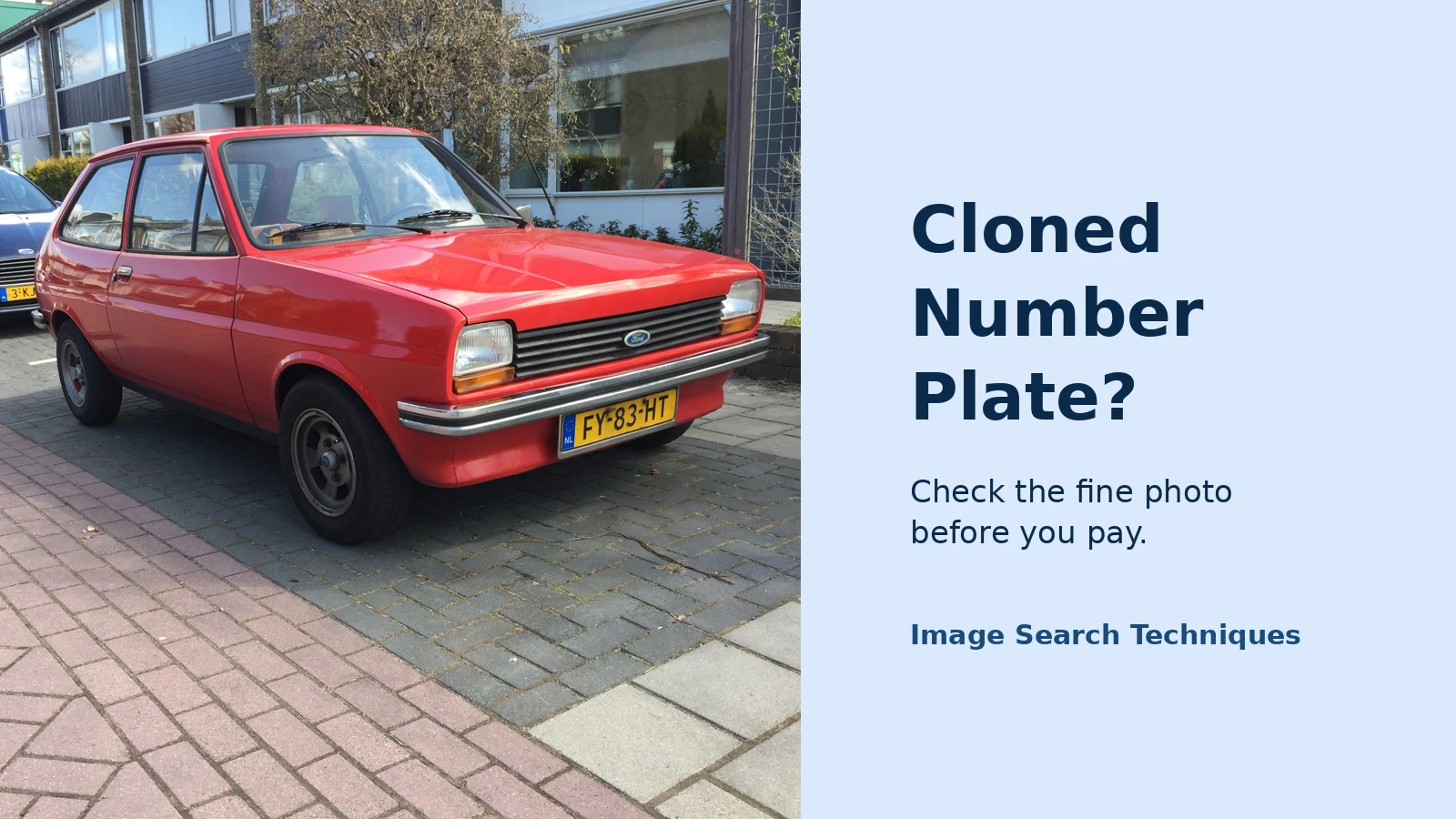
To show what a reverse image search can and cannot do with a car photograph, I ran a real photograph through the site’s own free reverse image search tool on 12 November 2026. The photograph was a public-domain picture of a red 1980 Ford Fiesta, taken in the Netherlands and published on Wikimedia Commons. One practical note first: the tool’s “Paste URL” option rejected the Commons redirect link, so I used the file’s direct link instead, and the tool loaded the image at its full 3,264 × 2,448 pixels. The tool’s “Search All” button opened only the Google tab in that browser, so each engine was run individually.
| Engine | What happened |
|---|---|
| Google Lens | Failed. The page loaded and showed the searched image, but both the “Exact matches” and “Visual matches” tabs returned “Something went wrong: No image at the URL”. I reproduced this four times, including a direct Lens search with the same image URL, so the failure was on Google’s side: its fetcher could not use this upload.wikimedia.org address. It did not identify the car and found no source page. |
| Bing Visual Search | Worked, in part. It correctly identified the car as a Ford Fiesta Mk1, deriving the query “Ford Fiesta Mk1 1980S” with 103,000 results, and showed 12 visual-match thumbnails, mostly other red Mk1 Fiestas. But its “Pages with this image” tab said “Unable to find pages with this image”, it did not find the Wikimedia Commons source page. |
| Yandex Images | Worked best. It identified the car (“ford fiesta 1976 1983, ford fiesta mk 1, ford fiesta 1977”, plus one wrong suggestion, a Volkswagen Jetta II), found the exact original size of 3,264 × 2,448, and showed 18 similar-image thumbnails, including a second photograph of the same car and plate. Its “Sites” tab listed the exact source first, the Wikimedia Commons file page, with a version dated 02:45, 5 August 2021. |
| TinEye | Ran, but found nothing: “0 matches: TinEye searched over 86.7 billion images but didn’t find any matches for your search image.” TinEye does not identify subjects, so it could not name the car either, and it did not find the Commons source. |
| Failed as a visual search. The button opened only a keyword search for the image’s domain, and after scrolling, 39 pin cards loaded, all unrelated, from the Chrysler Building to tennis. No Fiesta, no identification, no source page. |
The lesson from that test is the same one this whole guide rests on. A reverse image search can tell you where a photograph of a car has appeared before, and whether the car in a photograph matches the car you own. What it cannot do is prove, from the pixels alone, that a plate is cloned: that proof comes from the comparison between the fine photo and your car, plus your location evidence and your police report. Use the search to support your case, not to replace it.
What should you do first? Report it to the police and the DVLA
GOV.UK’s guidance, published on 7 October 2026, sets out three steps, in this order: report the cloned number plates to the police, tell the DVLA, and appeal the incorrect fines or charges. Do them in that order, because each later step depends on the reference numbers the earlier ones produce. GOV.UK’s guide to what to do if your number plate is cloned is the official source for the steps below.
- Report it to the police. You must be the registered keeper of the vehicle, or have the keeper’s permission. If you live in England or Wales, use the cloned number plates form on the police website, or call the police on 101. If you report using the form, the police will also tell the DVLA for you. If you live in Scotland or Northern Ireland, call the police on 101. You will be given a report reference number: keep it, because you will need it for every appeal and every time you speak to the police about the case. If more fines arrive from new places, make further reports; it is useful for the police to know about incidents in new locations.
- Tell the DVLA, by post, if you did not use the police form. Send a letter to DVLA, Swansea, SA99 1AR, with your vehicle registration number and copies of any fines or charges you received incorrectly. You must be the registered keeper or have the keeper’s permission. After DVLA receives your report, it sends a confirmation letter to the address on your vehicle log book (V5C). Keep that letter safe: issuers ask for it, and it is the document that shows the DVLA has a record of the cloning.
- Appeal every incorrect fine or charge. Contact the organisation that asked you to pay, tell it you have reported the cloned plates to the police and the DVLA, and include a copy of the DVLA confirmation letter. The organisation reviews your evidence and decides whether to cancel the fine. Cancellation is not automatic, and each issuer decides separately, a council cancelling one PCN does not cancel a private operator’s charge.
You can continue to drive your vehicle while this is going on. GOV.UK says the police may stop a vehicle carrying your number plate (including yours) and ask to see the report reference number, your vehicle log book (V5C) and your driving licence. Carry the reference number with you until the matter is closed. You can also report the cloning to Action Fraud on 0300 123 2040, which logs the fraud and gives you a further reference for your file.
A note on replacement registrations. In some cases the DVLA can issue a new registration number for a cloned vehicle, but it is not automatic and it is not the first step. Do not buy a private plate or apply for a new registration as a way of avoiding the appeals: the fines already issued still need to be challenged, and a new number does not cancel them.
How do you challenge a cloned number plate fine?
There is no single appeal route. The route depends on who issued the notice, and each one has its own deadline. Miss the deadline and the amount usually rises, a charge certificate adds 50% to a council PCN. Never ignore a notice because you know it is wrong: the system does not know it is wrong until you tell it, with evidence, inside the deadline.
| Notice type | Who issued it | Your route | Deadline |
|---|---|---|---|
| Council Penalty Charge Notice (PCN) | Council or Transport for London, on public land | Informal challenge, then formal representations to the council, then an independent tribunal | Informal challenge within 14 days (21 days for camera-issued notices); formal representations within 28 days of the Notice to Owner; tribunal appeal within 28 days of the Notice of Rejection |
| Private Parking Charge Notice | Private parking company, on private land | Appeal to the operator first, then to POPLA if it is a British Parking Association member or the Independent Appeals Service if it is an International Parking Community member | Follow the deadline printed on the notice, usually 28 days from issue for the operator appeal |
| Notice of Intended Prosecution (speeding, red light) | Police | Return the Section 172 notice naming the driver, with a written explanation that the vehicle was cloned, the crime reference number and your evidence | Section 172 notice must be returned within 28 days; the notice itself is usually sent within 14 days of the offence |
| ULEZ, congestion charge or clean air zone PCN | Transport for London or the local authority | Same council PCN route: representations to the issuer, then London Tribunals for London charges or the Traffic Penalty Tribunal elsewhere | As for a council PCN: representations within 28 days of the Notice to Owner |
| Toll or bridge charge | The toll operator | Challenge through the operator’s own appeals process with the same evidence pack | As printed on the notice |
The tribunal is the part people fear most, and it is the part that costs nothing. Outside London, council PCN appeals go to the Traffic Penalty Tribunal; in London they go to London Tribunals. Adjudicators are independent lawyers, and their decision is binding on the council. You can usually appeal in writing or by telephone hearing, and you do not need a solicitor. Citizens Advice puts the position plainly: you are not responsible for a ticket issued because your plate was copied, and once you have proven you were not driving, the notice against you must be cancelled. If a ticket is not cancelled after you have provided the evidence, Citizens Advice can help you get legal advice.
For private parking charges, the same principle applies but the process is different. The operator must be given the chance to cancel first, and only then can you go to POPLA or the Independent Appeals Service. Keep copies of everything you send, and send important letters by recorded delivery so you can prove they arrived.
Build your evidence pack before you write a word
Every appeal is decided on paper. The issuer and, if it goes that far, the adjudicator will never see your car: they will see the file you send. Build the pack once, then reuse it for every notice, adding only the notice-specific pages. Our guide to saving evidence before you report a stolen photo covers the same habits in more detail, and they apply here word for word. The same discipline applies to the council’s side of the file: our guide to checking your PCN photo evidence before you pay shows what the evidence pack must contain and which flaws in the photos weaken a ticket.
| Item | What to include | Why it matters |
|---|---|---|
| Police report reference number | The reference from your report to the police | Shows the cloning is already on record with the police |
| DVLA confirmation letter | A copy of the letter DVLA sent to your V5C address | Shows the DVLA has a record of the cloning |
| Fine photo versus your car | The issuer’s photograph next to your own dated photographs from the same angles, with the differences labelled | The core of the case: the car in the photo is not yours |
| Where-you-were proof | Work rota, fuel receipt, parking permit, dashcam file, phone location history or a witness statement for the date and time on the notice | Shows your car was elsewhere when the offence happened |
| Your car’s identity | A copy of your V5C and, if it helps, your insurance or service history showing your car’s make, model, colour and trim | Confirms what your car actually is, against the photo |
| The notice itself | A copy of every page of the notice, including the reference number and the deadline | Proves which notice you are challenging and that you are inside its deadline |
| Your correspondence log | Dates, names and reference numbers for every call and letter, with copies kept | Proves you acted promptly if a deadline is ever disputed |
Write the challenge letter in plain language. State that your number plate was cloned, give the police reference number, attach the DVLA letter, point to the specific differences between the photograph and your car, and state where your car was at the time. Do not write at length about how you feel about the fine, and do not accuse any named person: you do not know who cloned the plate, and the appeal is about the car, not the criminal. One page of facts with a labelled photo pair beats five pages of argument.
Mistakes that cost cloned-plate victims money
- Paying “just to make it go away”. Paying a PCN is treated as accepting it. Once paid, you generally cannot appeal, and the payment does not stop the next fine arriving. Challenge first, inside the discount window, so the reduced rate is preserved if the challenge fails.
- Ignoring a notice because it is obviously wrong. An unchallenged PCN grows: a charge certificate adds 50%, and the debt can be registered at court. The system only learns the car is not yours when you tell it.
- Challenging one fine and assuming the rest will follow. Each issuer decides separately. A council, a private operator, the police and a toll company do not talk to each other about your case. Every notice needs its own challenge, with the same evidence pack attached.
- Sending originals. Send copies. Keep the originals of your V5C, the DVLA letter and your photographs. If an issuer loses a copy, you can send another.
- Using a photo of the wrong car as your evidence. If you have changed cars, or the photographs are old, the comparison can work against you. Photograph the car you own now, on the day you receive the notice. If you need help telling one car from another in a photograph, our car part identification guide and reverse image search guide explain how to read a vehicle photograph properly.
- Waiting for the DVLA letter before challenging a fine. Challenge inside the notice deadline even if the DVLA letter has not arrived yet. Send the police reference number now and the DVLA letter when it comes.
One last check before you post anything: read the notice again and confirm which organisation issued it, what the deadline is, and whether the discount window is still open. Then send the challenge, keep a copy, and note the date. If the challenge is rejected, you still have the tribunal, and a clear photo comparison plus a police reference number is exactly the kind of case tribunals cancel.
This guide is general information about the process, not legal advice. If a fine has already escalated to court, or a bailiff is involved, get advice from Citizens Advice or a solicitor before you act. If you are buying or selling a car and want to check the vehicle behind the photographs first, our used-car listing photo check covers that from the buyer’s side. If you are wondering why a seller’s photos hide the plate in the first place, our guide to number plates in photos explains what a plate reveals, what it can never reveal, and how to blur one properly.
Can I be fined if someone else cloned my number plate?
No. You are not responsible for a fine issued because your plate was copied. Report the cloning to the police, get a reference number, and challenge the notice with that number, the fine photo and a photo of your own car. Once you have proven you were not driving, the notice must be cancelled.
How long do I have to appeal a cloned-plate PCN?
For a council PCN, challenge within 14 days, or 21 days if it was issued by camera. Make formal representations within 28 days of the Notice to Owner. If those are rejected, you have 28 days from the Notice of Rejection to appeal to the Traffic Penalty Tribunal, or London Tribunals. Private charges follow the deadline printed on the notice.
Will the DVLA give me a new number plate if mine is cloned?
Not automatically. The DVLA records the cloning and sends you a confirmation letter, and in some cases it can issue a new registration number, but that is not the first step, and it does not cancel fines already issued. Report to the police, tell the DVLA, and challenge every fine separately. A new number never replaces an appeal.
Can I still drive my car if my number plate has been cloned?
Yes. GOV.UK says you can continue to drive your vehicle after your number plate has been cloned. The police may stop a vehicle carrying your number (including yours) and ask to see your report reference number, your vehicle log book (V5C) and your driving licence. Carry the reference number with you until the matter is closed.