

🔎 Reverse Image Search
Image search techniques made simple: upload a photo or paste a URL and search 6 engines at once. 100% free, nothing stored.
🔒 Your image is never stored on our servers longer than 24 hours and is never shared.
Scroll through any car advert and you will see it: a shiny car, a careful angle, and a number plate hidden behind a blur, a sticker or a thumb. Number plates in photos are covered so often that a clear plate in a listing looks careless, yet the reason behind the habit is rarely explained properly. The question that started this guide came from Quora, where a reader asked why people cover their licence plates when taking pictures, especially when selling a vehicle, and whether everyone can see their plate every day anyway. It is a fair question, because both halves of it are true. Everyone can see your plate on the road, and sellers still cover it in photos. This guide explains why, what a plate actually gives away, and how to hide one properly.
Short answer: Sellers cover number plates in photos because a plate links a car to a real vehicle, and a clear photo can be copied into a fake listing or onto a cloned car. A plate alone cannot reveal your name or address, but it can reveal the car’s history, so sellers hide it in public and share it privately with buyers.
What a number plate is: a number plate, called a registration mark in the UK and a license plate in the US, is the unique set of letters and numbers a vehicle carries so it can be identified on the road. In the UK the plate belongs to the vehicle, not to a person, and it stays with the car when it changes hands. That one fact shapes everything in this guide: a plate identifies a car, not a person, and the rules around it are built on that split.
This is general information about how plates work in photos, not legal advice. The rules differ between the UK and the US, so the two are kept separate wherever they differ.
Why do sellers cover number plates in photos?
Sellers cover a plate for one simple reason: a photo on the internet is not the same as a plate seen on the road. A driver behind you on the motorway sees your plate for a few seconds and then it is gone. A photo in an advert can be saved, copied, searched and reused for years. That permanence is what sellers are guarding against, not the plate itself.
The first worry is cloning. A criminal who wants a duplicate plate for a stolen car needs a real plate from a car of the same make, model and colour. A clear listing photo hands them exactly that, with the colour and model attached. One Quora answerer, Dawn Murton, described a colleague whose car was cloned after criminals searched for the same model and colour, which is how the trick usually starts. Our guide to what to do when a cloned number plate brings a fine explains the signs that your plate has been copied, and the steps to take when fines arrive for a car you never drove.
The second worry is the fake listing. A scammer copies a genuine advert, plate and all, and posts it at a tempting price to collect deposits from buyers who never see a car. The plate makes the fake advert look real, because a buyer who runs a history check on it gets a clean result for a real car. A blurred plate does not stop this completely, but it takes away the easiest ingredient, which is a ready made set of photos with a matching plate.
The third worry is unwanted contact. A plate on its own gives no name or address, as the next sections explain, but it is still a starting point. Combined with the location in a photo, the seller’s profile and the timing of the advert, it can help someone narrow down where a car is parked. Sellers who post from home are rightly cautious about that, and hiding the plate is a cheap way to break the chain.
There is also a sceptical view worth hearing. The most upvoted answer on the Quora question, from Dash Riprock, calls covering a plate pointless, on the grounds that the US Driver’s Privacy Protection Act stops anyone getting a name from a plate. He has a point about names, as this guide confirms below, but he misses the cloning and fake listing risks, which have nothing to do with finding a name. The honest position sits in the middle: covering a plate is not about hiding your identity, it is about keeping your car’s details out of other people’s scams.
Finally, some sellers cover a plate because everyone else does. It has become the done thing in car adverts, and a clear plate in a listing now looks careless even to buyers who know it reveals little. That social habit is real, but it is not the reason to do it. The reasons above are.
Car forums were doing this long before selling sites caught on. On forums, members cover their plates partly because the forum rules ask for it and partly because a plate posted online is easy to copy, and cloning is the risk that follows.
What can someone actually find out from a number plate?
The short answer is: a lot about the car, and nothing about you. A plate is a key to vehicle records, not to personal records, and the two are kept apart on purpose. The table below is the honest version of what a plate reveals, with the route for each item, so you can see where the line sits.
| What someone can learn | What it takes | Risk |
|---|---|---|
| Tax and MOT status | Registration number only, free GOV.UK check | Low, public by design |
| Vehicle age, engine size, fuel type and CO2 | Same free GOV.UK check | Low, public by design |
| Full MOT history | Registration number, free GOV.UK MOT history service | Low, public by design |
| Outstanding finance, write-off category, stolen marker | Paid history check, using the plate | Medium, needs the plate and a fee |
| Keeper name and address | DVLA form V888, reasonable cause, £2.50, up to 5 weeks | Not available to casual searchers |
| Your name or home address from the plate alone | No public lookup exists | Not possible |
| A plate to copy onto another car | A clear photo of the plate | The real risk, see the cloning section |
The free check is the one most people meet first. The GOV.UK vehicle enquiry service asks for the registration number only, and it shows the tax rate and expiry date, whether the vehicle is off the road under a SORN, when the MOT runs out, the date the car was first registered, the date the last log book was issued, the year of manufacture, the type approval category, the weight, the engine size, the fuel type, the CO2 emissions and whether the car has been exported. It shows no name, no address and no keeper details of any kind. The page itself points anyone who wants keeper details to the written DVLA route, which is a different process entirely.
That split is deliberate. The free check exists so buyers can confirm the basics before they travel to see a car, and so anyone can check whether a car on their street is taxed. It was never meant to identify a person, and it does not. The paid history checks go a step further, because they can show whether a car has outstanding finance, whether it was written off and in which category, and whether it is recorded as stolen. Those checks need the plate, which is why a seller who shares it privately with a serious buyer is doing the buyer a favour, not taking a risk.
The gap in the middle is the part people get wrong. Some guides, and Google’s own AI Overview for this topic, say strangers can trace registration details, names or general locations through public or paid lookups. That is only half true. The registration details are public, as the table shows. The name and address are not, in the UK or in the US, and the next section explains why.
Can a number plate reveal your name or address?
No. In the UK and in the US, there is no public lookup that turns a number plate into a person’s name or home address, and that is true by law, not by accident. If someone tells you they found a name from a plate in a few clicks, they are either bluffing, describing a different country, or describing a route that needs a legal reason and a paper trail.
In the UK, keeper details are held by the DVLA, and the only way to ask for them is a written request with a reasonable cause. The current route is form V888 for individuals, and the GOV.UK guidance says it costs £2.50 for each enquiry and can take up to 5 weeks to process. There is no online service and no phone or email option. The request must state a reasonable cause, such as finding who was responsible for an accident, tracing the keeper of an abandoned vehicle or one parked on private land, issuing a parking ticket or a trespass charge notice, tracing someone who drove off without paying, or suspected insurance fraud. Private parking companies can only ask if they belong to the British Parking Association or the International Parking Community. Companies use different forms, V888/2A for a keeper name and address and V888/2B for other vehicle information, and parking and trespass companies use V888/3. Requests about your own vehicle are free, on form V888/4.
Two points matter here. First, £2.50 and five weeks is not a casual lookup, and a request without a real reason is refused. Second, even a successful request gives you the registered keeper, and the registered keeper is not necessarily the legal owner. The V5C log book itself says it is not proof of ownership, and the registered keeper may be a finance company, an employer or a leasing firm. So even the formal route does not hand over a simple answer to “who owns this car”.
In the US the protection is written into federal law. The Driver’s Privacy Protection Act of 1994, at 18 U.S.C. s.2721, says a state department of motor vehicles shall not knowingly disclose personal information from a motor vehicle record, except for the permitted uses the statute lists, such as government and law enforcement work, motor vehicle safety and theft, insurers and licensed investigators. You can read the statute in full on Cornell Law Institute’s page for 18 U.S.C. s.2721. That is why the sceptical Quora answers keep saying a name cannot be got from a plate: in the US, the law was written after a stalking case to stop exactly that.
None of this means a plate is harmless to share. It means the harm is specific, not general. A plate does not dox you, but it can be cloned, and it can be used to build a convincing fake advert. That is the honest line, and it is the one this guide sticks to throughout: cover the plate because of what can be done with the car’s identity, not because someone will find your house from it.
What is number plate cloning, and how does a photo help cloners?
Number plate cloning is when a criminal puts your plate on another car, usually a stolen car of the same make, model and colour, so that speed cameras, toll cameras and police checks see your car, not theirs. Fines, toll charges and penalty notices then arrive at your address for journeys you never made. It is the one risk in this guide that lands on real people in a concrete way, and it is the main reason sellers blur a plate.
A clear listing photo is the easiest source of a plate to clone. The criminal does not need to walk the streets looking for a matching car. They search adverts for the same model and colour, save the photo, and have the plate, the colour and the model in one place. Dawn Murton’s Quora answer describes exactly this happening to a colleague, and the top answer on the question, from OpenBlueprint, names cloning as the real risk and points out that an online photo is searchable and permanent, unlike a plate glimpsed on a motorway. That permanence is the difference the sceptics miss: a plate seen in traffic is forgotten in seconds, while a plate in a photo can be found months later by anyone searching for that model.
Cloning also feeds the fake listing scam. A scammer copies a genuine advert, keeps the real plate visible, and reposts the car at a low price. A buyer who checks the plate finds a real car with a clean history, which is what makes the advert convincing. The buyer pays a deposit and the car never existed. Our guide to cloned number plates and fines covers the signs that your plate has been copied and what to do when a fine arrives, so this guide does not repeat its checklist here.
Two cautions belong here. First, blurring a plate reduces the cloning risk, it does not remove it. A criminal can also read a plate on the road, and a determined one can find a plate another way. Blurring is a sensible habit, not a guarantee. Second, if you do get fines for a car you never drove, do not ignore them. Report it to the police and the DVLA, keep the evidence, and follow the routes in the cloned plate guide. A fine ignored becomes a bigger problem than a fine answered.
Is it legal to photograph a number plate?
Yes, in almost every ordinary situation. A number plate is designed to be seen in public, and photographing it is generally legal in both the UK and the US. Google’s AI Overview for this topic says the same thing, and it is right: plates are public data when a car is driven or parked in public, so taking or posting a photo of one is generally legal, except where the photo is used to harass, stalk or encourage unlawful behaviour.
The line is about use, not about the photo. Photographing a plate after an accident, for an insurance claim, or to report dangerous driving is legitimate, and it is often the sensible thing to do. Posting a plate alongside a person’s name, address or daily routine, or using it to threaten someone, is a different matter, and it can cross into harassment or stalking law. The same applies to using a plate to build a fake listing or to clone a car, which are fraud, not photography.
One common worry is whether taking a photo of a stranger’s plate in a car park or on the street could get you in trouble. In the UK there is no law against photographing a car in a public place, and the plate is part of the car. The same is broadly true in the US, where a plate in public view carries no expectation of privacy. What you cannot do is use that photo to pretend to be the keeper, to demand money, or to follow someone. The photo is fine. The misuse is not.
There is one related rule that people mix up with photos. Blurring a plate in a picture is not the same as covering a plate on a moving car. A physical cover on a car you are driving can be an offence in some places, because the plate must be readable on the road. That is a driving rule, not a photography rule, and it has nothing to do with an advert photo. Keep the two apart and you will not go wrong.
How do you blur a number plate properly before you post?
Blurring a plate is a small job, but most people do it badly, and a bad blur is barely better than no blur. A light smudge over the digits can often be read at full size, a sticker can slip, and a blur on one photo means little if a second photo in the same advert shows the plate clearly. The steps below take a few minutes and cover the whole set.
- Blur before the photo leaves your phone. Edit the image in your gallery before you upload it to the advert site, not after. Once a photo is live, anyone may have saved the original.
- Cover the whole plate, not just the digits. Blur the full rectangle, edge to edge. Covering only the last three characters still leaves enough for a history check, and a partial blur looks like an invitation to guess.
- Use a heavy blur or a solid block. A light blur can sometimes be partly read when the image is enlarged, especially if the original was high resolution. Pixelate heavily, or paint a solid rectangle over the plate. A sticker or emoji works if it covers the plate completely and cannot be peeled off in the image.
- Check every photo in the set. Go through all the pictures in the advert, including the front and rear three quarter shots, the interior shots that catch the plate through the window, and any photo where the car is reflected in a window or a puddle. One clear plate undoes the rest.
- Check the posted image at full size. Open the live advert on your phone, tap the photo to enlarge it, and read the plate area yourself. If you can make out any character, blur it again and re-upload.
- Keep the unblurred original off the listing. Do not attach the original file anywhere in the advert, and strip the location data from the photo file before you upload it, so the picture does not carry the place it was taken.
There are also tools that do the work for you. Google’s AI Overview for this topic names three: BlurMyPlates, which uploads photos and video and finds plates automatically; blur-face.com, which detects and blurs plates in the browser, with the processing done locally on your device; and Abraia, which handles batches of vehicle images at once. Any of them can save time if you have many photos, but check the result yourself afterwards, because automatic detection can miss a plate photographed at a sharp angle. A tool that misses one plate in ten is only useful if you catch the miss.
| Method | What it does | Watch out for |
|---|---|---|
| Physical cover before the photo | A cloth, paper or hand over the plate while you shoot | It can slip, and it looks untidy in a sales photo |
| Phone editor blur or pixelate | Built in editing tools blur the plate by hand | Easy to make the blur too light to work |
| Auto detect blur tools | Finds plates in the photo and blurs them for you | Can miss a plate at an angle, always check the result |
| Solid block or sticker | Paints a rectangle or places an emoji over the plate | Must cover the whole plate, edge to edge |
| Crop the plate out | Cuts the plate from the frame entirely | Often ruins the shot, and buyers want to see the rear of the car |
One more habit is worth building. When you photograph a car for sale, take the plate photos last, after the beauty shots, and keep them in a separate album. That way you cannot accidentally upload the wrong version, and you always have a clear plate photo ready to send privately to a buyer who asks for one.
Worked example: the Mercedes photo, searched live
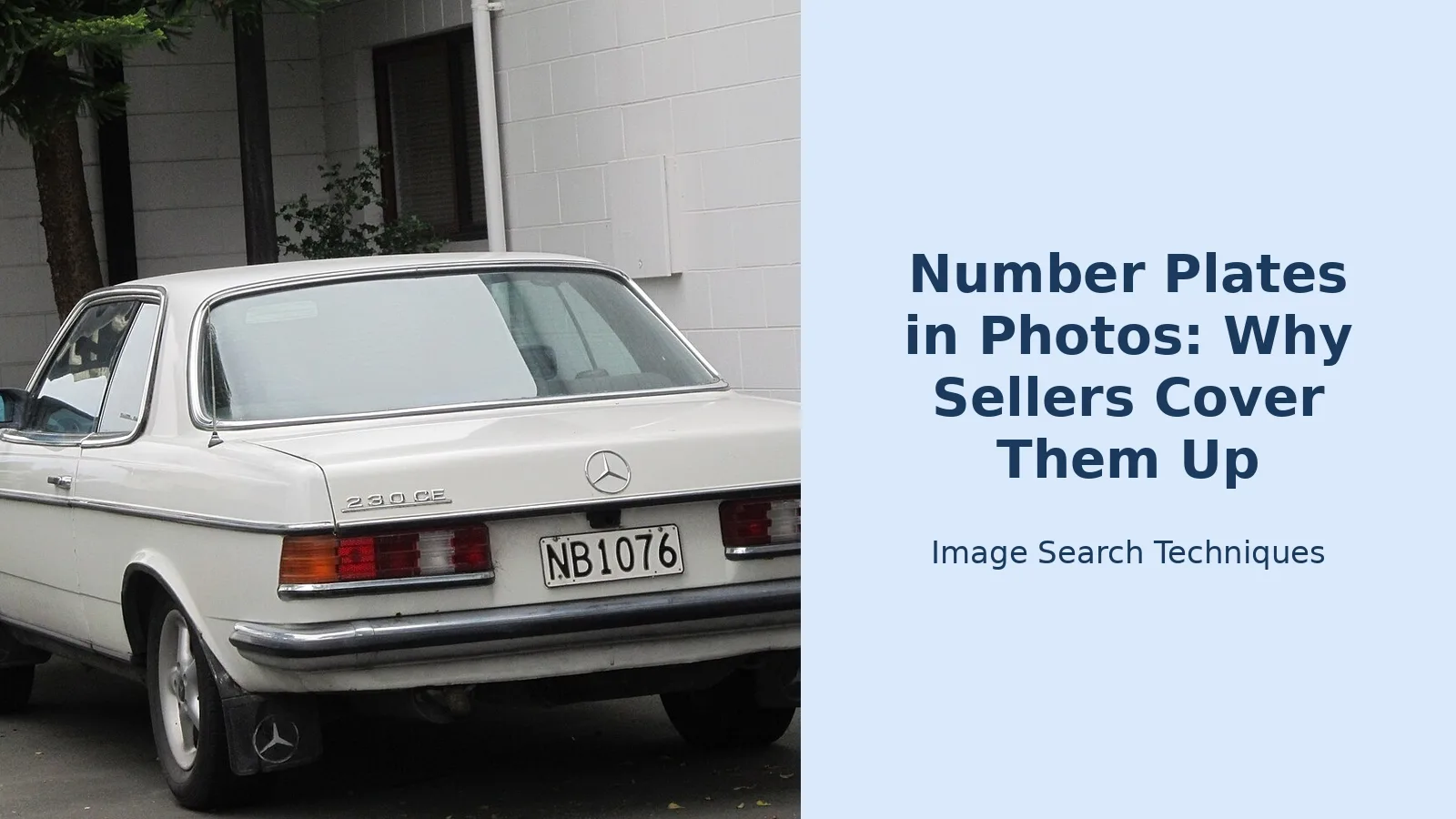
Every claim in this guide was checked against a real photo, so here is the test in full. The photo below is a white 1981 Mercedes-Benz 230 CE, photographed from the rear three quarter angle, with the plate NB1076 clearly readable. It was taken by Riley in Christchurch, New Zealand, on 4 February 2012, and it is published on Wikimedia Commons under a CC BY 2.0 licence. It is the kind of clear, honest listing photo a seller might post, plate and all.
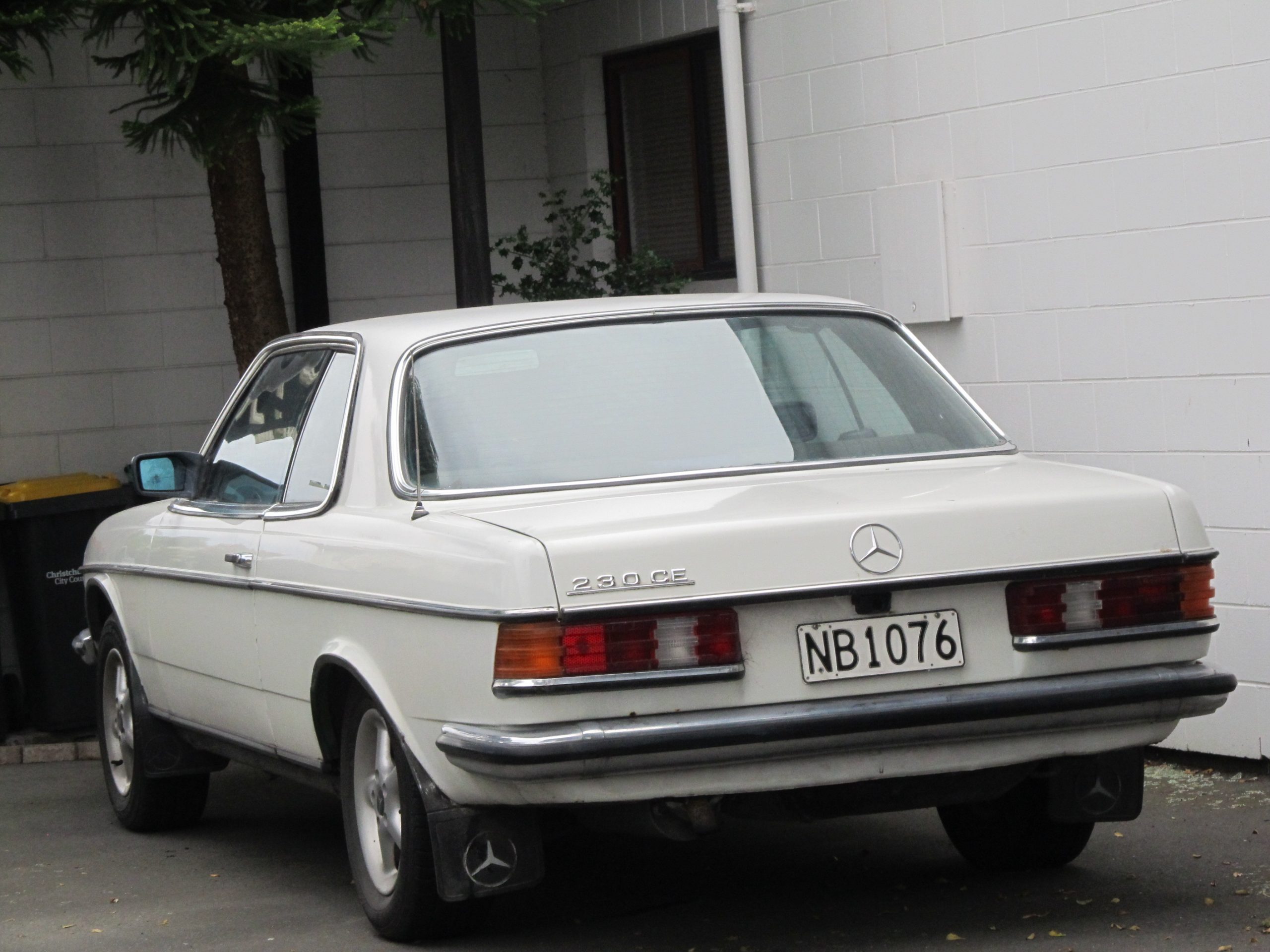
On 15 November 2026 I ran this photo through two reverse image searches, using the method in our guide to how to reverse image search. TinEye searched over 86.7 billion images and found 0 matches. The original Wikimedia Commons page was not among the matches, because there were none. That does not mean the photo is unused or safe. It means TinEye has not yet crawled a page carrying it, and TinEye says so itself on the results page. A zero result is never a clean bill of health, and this guide does not present it as one.
Google Lens failed outright, twice. Both attempts ended with an “Expired visual search” message and a “No image at the URL” error, with no results at all. I am reporting that failure honestly rather than guessing a count, because a failed search tells you nothing about the photo. It is also a useful reminder that these tools are not reliable on demand: a buyer who runs a Lens check on a listing photo and gets nothing has learned nothing, and should not treat silence as proof the photo is genuine.
What the test does show is the other half of the story. A photo like this one, clear, well lit and with the plate readable, is exactly the kind of image that can be copied into a fake listing. The car is identifiable from the photo alone: the model, the colour and the plate are all visible, and a buyer who wanted to check the car could identify a car from a photo before ever asking the seller a question. That is useful for an honest buyer and useful for a scammer in exactly the same way, which is why the seller’s choice to blur the plate matters. The photo stays useful with the plate hidden, because the car, the condition and the colour are still on show. Only the plate, the one detail a scammer needs, is gone.
Should you ask a seller to show the plate?
Yes, privately. A buyer has a good reason to want the plate: it is the key to the free GOV.UK tax and MOT check and to a paid history check, and those checks can catch outstanding finance, a write-off or a stolen marker before any money changes hands. The right way to ask is in a private message, not in a public comment under the advert, so the plate is shared with one person instead of the whole internet.
A seller who shares the plate on request is behaving normally, and a seller who refuses outright is a red flag. One Quora answerer, Robert Banet, put it bluntly: covering a plate stops buyers checking the car’s history, so a seller who will not share it at all is probably hiding something. That is not always true, a careful seller may simply want to know you are serious first, but a flat refusal, combined with pressure to pay quickly or to pay before seeing the car, is a pattern worth walking away from. Our guide to checking a used car listing with photos covers the other signs to look for in the same situation.
When the seller does share the plate, run the checks before you travel. The free GOV.UK enquiry takes a minute and confirms the tax, the MOT and the basics. A paid history check is worth the fee on any car that costs real money. If the plate the seller sends does not match the car in the photos, or the history shows a different model or colour, stop. That mismatch is the point of the check, and it is cheaper to find it at home than on a stranger’s driveway.
So the answer to the Quora question is both halves at once. Yes, everyone can see your plate every day, on the road, in traffic, in car parks. And yes, sellers still cover it in photos, because a photo is searchable and permanent in a way a passing glance is not. Cover the plate in the advert, share it privately with a serious buyer, and let the history check do its job. For the wider picture on photo based car scams, the complete guide to photo scams brings the car, rental and marketplace checks together in one place.
Can someone find my address from my number plate in a photo?
No. There is no lookup in the UK or the US that turns a plate into a name or home address. In the UK, keeper details need a DVLA request with a reasonable cause, a £2.50 fee and up to five weeks. In the US, the Driver’s Privacy Protection Act bars state departments from disclosing personal details from a plate.
Is it illegal to post a photo of someone else’s number plate?
Generally no. A plate is designed to be seen in public, and photographing one is legal in the UK and the US. It becomes a problem only when the photo is used to harass or stalk someone, or to commit fraud such as cloning the plate. The photo itself is fine, and the misuse is what the law punishes.
Should I blur the plate when I sell my car?
Yes, for the public advert. A blurred plate keeps it out of fake listings and makes cloning harder, while costing you nothing. Share the plate privately with a serious buyer who asks for it, so they can run a history check before they travel to see the car.
Can a blurred number plate be unblurred?
Sometimes, if the blur is light and the original photo was high resolution. A light smudge can often be partly read when the image is enlarged, which is why heavy pixelation or a solid block is safer than a gentle blur. Never post the unblurred original alongside the blurred copy, and check the posted image at full size.
Does covering the plate stop cloning?
It makes cloning harder, but it does not stop it. A criminal can also read a plate on the road, so blurring a photo is a sensible habit rather than a guarantee. If fines arrive for journeys you never made, report it to the police and the DVLA at once and keep every letter as evidence.
What should I do if my number plate appears in someone else’s photo?
Ask the person who posted it to blur the plate: a clear plate can be copied into a fake listing or onto a cloned car. If they refuse, report the photo to the platform and keep a screenshot of the post. Then watch for fines you did not cause, and check the plate on the free GOV.UK vehicle enquiry.