🔎 Reverse Image Search
Image search techniques made simple: upload a photo or paste a URL and search 6 engines at once. 100% free, nothing stored.
🔒 Your image is never stored on our servers longer than 24 hours and is never shared.
You took a good photo of a stranger on the street, or a friend agreed to pose for your portfolio, and now you want to use it. Can you sell it, put it in an ad, or upload it to a stock library? That question is what a model release answers, and the answer is rarely a simple yes or no. It depends on what you do with the photo next, not on where you took it. The same question comes up for buildings and landmarks, not just people: our guide to whether you need a property release for your photos covers the property side, with a decision table for a private home, a public building and a landmark.
Short answer: You need a model release if the photo will sell, advertise or promote something, including stock sales. You usually do not need one for personal use or for news, documentary and educational use. A photo taken legally in a public place can still need a signed release the moment it becomes an advert.
This guide explains the dividing line in plain language, then tests it against two real photos and the live contributor rules of Adobe Stock and Shutterstock. It is general information, not legal advice. Laws differ by country, and by state in the US, so for a specific case, talk to a lawyer who works in photography law.
What is a model release?
A model release is a short written agreement in which the person in a photo gives you permission to use their likeness for stated purposes. It usually names the model and the photographer, describes the photos, and sets out what the photos may be used for. The model signs and dates it, and the photographer keeps it on file.
Three points about it cause most of the confusion, so it helps to settle them first.
First, a release is permission from the person, not a transfer of copyright. The photographer still owns the copyright unless it is assigned separately in writing. Signing a release does not make the model the owner of the photo, and owning the copyright does not remove the need for a release.
Second, a model release and a property release are different documents. A property release covers a recognisable home, business or private place. A model release covers a person. A photo with both a person and a private property in it can need both.
Third, a release is about the use, not the shoot. The same photo can be fine in a news story and need a signed release in an advert. Keep that test in mind through the rest of this guide, because it answers nearly every question below.
Do I need a model release for my photos?
The answer capsule is simple: if the photo will be used to sell or promote something, get a signed release. If it stays personal, or it illustrates news, a documentary or teaching material, you usually do not need one. The table below turns that into a decision you can run on any photo.
| How will the photo be used? | Release needed? | Why |
|---|---|---|
| Advertising a product, service or brand | Yes, signed | Commercial use of a likeness is the core case a release exists for |
| Selling the photo through a stock library | Yes, signed | Stock libraries require a release for any recognisable person |
| Product packaging, merchandise or a book cover that sells something | Yes, signed | The person is being used to sell, even if the photo itself is not the product |
| Portfolio or social media posts meant to win bookings | Yes, get one | Marketing your own business is still commercial use |
| News, documentary or educational use | Usually no | Editorial use is the main exception in the US and the UK |
| Personal use, family album, private sharing | No | No public or commercial use is taking place |
| Fine art exhibition or a personal project with no sale attached | Usually no, but check the venue | Artistic expression is protected, yet galleries and buyers often ask for a release anyway |
| A crowd where nobody stands out | Usually no | No single person is recognisable, so there is no likeness to clear |
If you are unsure which row your plan falls into, that doubt is itself the answer. Photographers on the Reddit thread the AI Overview quotes put it the same way: some say a release is only needed for commercial use, while others say they get one every time as standard practice, even for personal projects. A signed release costs a minute at the shoot and removes the argument later. A missing one can cost a sale, a stock rejection, or a legal letter.
When do you need a model release?
Any use that connects a recognisable person to selling something needs a release. That covers the obvious cases, advertising, product packaging, sponsored posts, and it covers several that catch people out.
Selling the photo is commercial use. Uploading a street portrait to a stock library counts, even if you never meet the buyer and never see the advert it ends up in. Both Adobe Stock and Shutterstock demand a signed release for a recognisable person in commercial content, and the worked example below shows exactly how strict that rule is.
Marketing your own work counts too. A wedding photographer who posts a couple’s photos on Instagram to win the next booking is using those photos commercially, even though no money changed hands for the post itself. Narrative’s guide to model release forms makes this point directly, and then contradicts itself by listing portfolio use as not needing a release. The safer reading is the one its own template follows: if there is any chance the photo becomes an ad, get the release at the shoot.
Endorsement is the sharpest case. If a photo makes it look as though a person recommends a product, a clinic, a political cause or a service, the risk is highest. That is the use the US right of publicity laws were written for, and it is also where a UK claim for passing off or misuse of private information is most likely. A release that names the permitted uses protects both sides, because the model knows what they agreed to and the photographer can prove it.
One more case worth naming: a photo that was fine when first published can become a problem when its use changes. An editorial photo of a nurse in a hospital corridor, published with a news story, loses its editorial protection if it is later used in an advert for private healthcare. LegalClarity’s guide warns about exactly this. If the use changes, the release question starts again from the beginning.
When do you usually not need one?
News, documentary and educational uses are the main exception. A photo of a crowd at a protest, a player during a match, or a passer-by in a street scene used to illustrate a story does not usually need a release. The same applies to a photo used to teach, to comment, or to record an event. This is the editorial exception, and it is the reason press photographers can work without collecting signatures all day.
Personal use needs no release either. Photos you take for your own enjoyment, keep in a family album, or share privately with friends are not a commercial use of anyone’s likeness. Posting a holiday snap to a private group chat is personal use. Posting the same snap to a business page that sells holidays is not.
Photographing people in public places is also usually fine on its own. In the UK there is no general right to privacy in a public street, and in the US a person in a public place has no reasonable expectation of privacy in the ordinary sense. But that permission covers taking the photo and, in many cases, publishing it editorially. It does not cover turning the photo into an advert. The public place answers the question of whether you could take the photo. It does not answer the question of what you may do with it next.
Fine art is a grey area rather than a free pass. A print exhibited as art, or a photo book presented as artistic expression, is usually protected, and a New York court ruled that way for the street portraits in the di Corcia case. Even so, galleries, publishers and buyers often ask for a release before they will touch the work. Artistic protection is a defence in court, not a permission slip, and it is an expensive defence to rely on.
The two-photo test: what Adobe Stock and Shutterstock actually demand
Guides can disagree about the theory, so I tested the question against the rules that decide real sales. I took two real photos and read the live contributor guidance of Adobe Stock and Shutterstock on 20 November 2026, then applied each agency’s rules to each photo. I did not open contributor accounts and I did not upload either photo. The test is what the published rules demand, read word for word, and the table at the end of this section is the result.
Photo A: one recognisable person. The file is “Fishmonger smiling, Maracaibo street market, Venezuela.jpg” by Wilfredor, taken 16 March 2013 in Maracaibo, Venezuela, 3,522 by 2,345 pixels. It is a black-and-white street portrait of one smiling fishmonger at a market stall, and it is a Featured picture on Wikimedia Commons. Its licence is CC0, a public domain dedication, so the copyright side is as clear as it gets. But the file page also carries a personality rights warning, which says the person shown may have rights that restrict certain re-uses, and a note in which the uploader asserts that all identifiable persons shown specifically consented to publication. That is the whole lesson in one file page: a free copyright licence does not by itself clear the subject’s rights.
Adobe Stock’s rule for this photo is blunt. Its model release requirements page says that when you upload content showing someone who can be recognised, you must include a signed model release, and that a release may be required even if the person’s face is not visible, because people can be identified by other features or details. Its test is one question: would this person recognise themself in this content? For the fishmonger, the answer is plainly yes, so the verdict is a signed release, no exceptions.
Shutterstock reaches the same verdict by a different route. Its model release FAQ says it requires a valid model release for every recognisable person, even if the model is yourself, and that content will typically be rejected for a missing model release. A separate release is required for each recognisable person. The one escape route Shutterstock offers is editorial: model releases are not required for recognisable people depicted in editorial content. So for Photo A, the choice is a signed release for commercial sale, or an editorial submission, with no commercial sale attached.
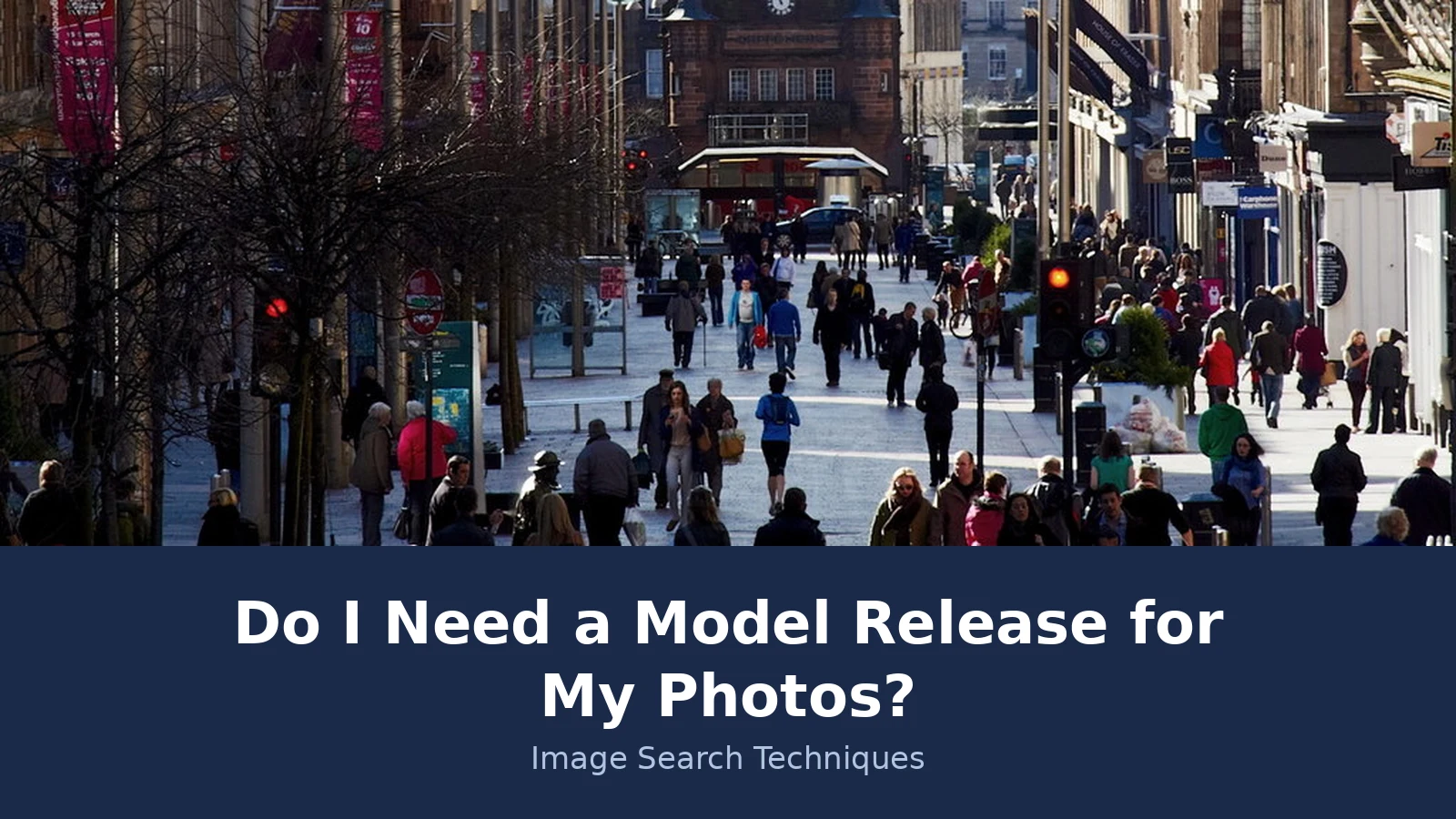
Photo B: a crowd where nobody stands out. The file is “Buchanan Street Glasgow crowds – geograph.org.uk – 3815215.jpg” by david cameron photographer, taken 18 March 2012 on Buchanan Street, Glasgow, Scotland, 1,280 by 883 pixels, licensed CC BY-SA 2.0. It shows a busy pedestrian shopping street full of people walking in both directions, with the St Enoch station building at the end of the street. No single person is singled out, posed, or in sharp focus in the foreground. It is the photo on this article’s banner, and it is the opposite end of the test from Photo A.
Adobe Stock’s rule for this photo is equally clear in the other direction. Its requirements page lists crowds where individual people are not identifiable as a case where contributors do not need a model release. The same list covers people far away in the background, blurry or out-of-focus figures, and bystanders who cannot be identified. Photo B fits that exemption exactly, so the verdict is no release needed.
Shutterstock gives no explicit crowd exemption on the two pages I read, but its rule is triggered by recognisability in commercial content, and Photo B has no recognisable person to trigger it. The warning to take from Shutterstock’s wording is narrower than a crowd exemption: one person in sharp focus in the foreground with others blurred behind still needs a release for each person, and even a partial silhouette can require one. A crowd only passes the test when nobody in it can be recognised, which is true of Photo B and false of a crowd shot built around one sharp face.
| Photo | Adobe Stock | Shutterstock |
|---|---|---|
| Photo A: one smiling fishmonger, Maracaibo street market | Signed release required for commercial sale | Signed release required for commercial sale, or submit as editorial only; without a release it is rejected |
| Photo B: Glasgow crowd, Buchanan Street, nobody singled out | No release needed | No release triggered, because nobody in the frame is recognisable |
The test also shows why the stock route is stricter than the law. Neither agency is stating the law of any country. Both are stating their own house rules, and their house rules demand more than the law does in many cases. A photo that is perfectly legal to publish editorially can still be rejected by a stock library for a missing release. If your plan is to sell photos, the agency’s rule is the one that decides, so read it before you shoot, not after.
How is the UK different from the US?
Nearly every popular guide to model releases is written for the US, including both of the top competitors for this topic. Narrative’s guide never mentions the UK at all, and LegalClarity’s guide is built entirely on US state law. That matters, because the US and the UK answer this question in different ways, and a photographer in Britain who follows a US guide can get the wrong answer twice over.
In the US, the main protection is the right of publicity, which exists in about half the states under statute, with no single federal statute. It gives a person control over the commercial use of their name and likeness. California’s version is the best known, and it is the law behind most of the big model release cases. The test is commercial use, and the remedy can include an injunction and damages.
In the UK, there is no US-style right of publicity. Nobody in Britain owns a general right to stop their face being used in an advert simply because it is their face. But that does not mean anything goes. Three other rules do the work instead. The Human Rights Act 1998 brings in Article 8, the right to respect for private life, and the courts have built a claim for misuse of private information on top of it. Data protection law, the UK GDPR, treats a photo that identifies a living person as personal data, which brings rules about lawful basis and fairness. And passing off can apply where a photo falsely suggests a person endorses a product or service.
For a photographer in Britain, the practical difference is small but real. Taking a photo of a stranger in a public street is generally lawful, and publishing it editorially is generally fine. Using it in an advert without permission is where the risk sits, and it sits under privacy and data protection rather than under a publicity statute. A signed release still does the same job in both countries: it proves the person agreed, it names the permitted uses, and it ends the argument before it starts. If your photos will be used commercially in both the US and the UK, get the release and write it to cover both.
What about children, crowds and recognisable body parts?
Children need more care than adults, not less. If a photo features a minor, the release must be signed by a parent or guardian, not by the child. Adobe Stock says a parent or guardian signs for a minor and that a witness is required in some cases. Contracts signed by children are voidable in several US states, which means a child’s signature may not protect you at all. School events, sports days and youth groups are the places this bites, because the photos are easy to take and the releases are easy to forget. Get the signature from the adult before the shoot, and keep it with the photo.
Crowds follow the recognisability test, not a head count. LegalClarity’s guide puts it well: the test is prominence, commercial significance, and how long a person is shown. A half-second appearance in a stadium wide shot is incidental. A person singled out, lingered on, or placed in sharp focus in the foreground is not incidental, even if a hundred other people are behind them. The Glasgow crowd photo passes because nobody is singled out. A crowd photo built around one sharp face in the front row fails, and it fails even if the other faces are blurred, because Shutterstock’s rule treats a partially visible face as still recognisable.
Body parts count too. A release can be needed even when the face is out of frame. Adobe Stock says a person can be identified by other features or details, and Shutterstock requires a release for a body part of an unrecognisable model when it carries a visible tattoo. A distinctive tattoo, a uniform with a name badge, a wedding ring in a recognisable setting, or hands and feet that someone would know as their own can all make a person identifiable. If the person in the photo would recognise themself, or someone who knows them would, treat them as recognisable.
One more warning belongs here. Never publish an unblurred photo of a private person as your example without their consent. The worked example in this guide uses a CC0 street portrait whose file page records that the people shown consented to publication, and a crowd photo in which nobody stands out. If your own example photo has no consent behind it, blur the face or pick a different photo.
What should a model release include?
A good release is short, specific, and signed before the photo is used. Templates from Narrative and others cover the same ground, and the checklist below is what to look for in any template you use.
Names and contact details for the model and the photographer come first, with the date, the place, and a description of the shoot. The description should be specific enough to identify the photos later, such as the date, the location, and the project name.
Scope of permitted use is the heart of the document. It should name the uses allowed, such as advertising, marketing, stock licensing, or editorial use, and the media they cover. A release that says “any use in any media forever” is common in stock photography, but a model may reasonably want limits, such as no use that suggests endorsement of a political cause, or no use in adult content. Write down the limits that were actually agreed.
Territory and duration matter more than most people think. A release for use in the UK only does not cover a worldwide stock sale. A release for one year does not cover use five years later. If you want worldwide use without a time limit, say so in plain words and make sure the model understands it.
Consideration, the payment or other benefit the model receives, should be recorded even when it is small. Many templates record a token sum or the prints the model received. The amount matters less than the fact that it is written down.
Signatures and dates close the document, with a witness where one is required. Some stock platforms require a witness for a minor’s release. Adobe Stock requires witnesses to be over 18 and not the model or the photographer. In 2026, one more clause is worth adding: whether the photos may be used to train AI models. Neither Narrative’s template nor most older templates mention AI training, and it is now a common source of dispute, so agree it in writing rather than assuming it.
Keep signed releases indefinitely, and keep them with the photos they cover. A release stored on a laptop you replaced three years ago is no use when a buyer asks for it. File the release under the shoot name, and note the file name of the photos it covers.
How do I check a photo before I use it?
Before you publish or sell a photo of a person, run three checks. Together they take a few minutes, and they catch the two separate problems that sink most photos: the copyright is not yours to use, and the person in the frame never agreed.
First, check where the photo came from. Run a reverse image search on it and find the earliest source and the licence attached to it. Our guide to how to check a photo’s licence before you use it walks through the full routine. A free licence such as CC0 clears the copyright, as the fishmonger photo shows, but it does not clear the person’s rights. Credit is not permission, and finding a photo on Google is not a licence.
Second, ask the recognisability question Adobe Stock uses: would the person in the photo recognise themself, or would someone who knows them? If the answer is yes, and the use is commercial, you need a signed release. If the answer is no, because it is a genuine crowd with nobody singled out, a release is usually not needed. If you hesitate over the answer, treat that hesitation as a yes and get the release.
Third, check the use against the release you hold, if you hold one. A release for a wedding album does not cover a billboard campaign. A release for editorial use does not cover an advert. If the use has changed since the shoot, get a fresh signature for the new use rather than stretching the old one.
If someone has already used your photo without permission, the route depends on who used it and how. Our guides explain what to do when an employer uses your photo without permission and when a company uses your photo in ads without permission, and the stock route is covered in our guide to a photo sold on stock sites without permission. All three start from the same place: gather the evidence, then act on the use, not on the photo alone.
The full picture is in our complete guide to protecting your photos online, which covers licences, releases, and the steps to take when a photo is misused. A model release is one document in that system, not the whole system, and it works best alongside a licence check and a reverse image search before every use.
FAQs
Do I need a model release for photos taken in a public place?
Taking the photo in a public place is usually fine, but using it commercially is a separate question. If the photo will sell, advertise or promote something, you need a signed release even though it was taken in public. Stock libraries demand one too. Personal and editorial uses usually do not need a release.
Do I need a model release to sell a photo on a stock site?
Yes. Adobe Stock requires a signed release for any recognisable person in commercial content, and Shutterstock rejects commercial content with a recognisable person and no release. A crowd where nobody can be recognised is the main exception. Check the agency’s own rules before you upload, because its house rules decide.
Do I need a model release for a photo of a child?
Yes, and it must be signed by a parent or guardian, not by the child. Some stock platforms also require a witness for a minor’s release. A child’s signature may not protect you, because contracts signed by children are voidable in several US states. Get the adult’s signature before the shoot.
Does a free licence like CC0 mean I do not need a model release?
No. A free licence clears the copyright only. The person in the photo keeps their own rights, and a commercial use can still need a signed release. The fishmonger photo in this guide is CC0, yet its file page still carries a personality rights warning and a note that the people shown consented to publication.
Do I need a model release for a crowd photo?
Usually not, if nobody in the crowd can be recognised. The test is recognisability, not head count. A person singled out, in sharp focus in the foreground, or lingered on is not incidental, even in a large crowd. A partially visible face or a distinctive tattoo can still make someone recognisable.
Is a model release needed in the UK?
There is no US-style right of publicity in the UK, so the risk works differently. Taking a photo in a public street is generally lawful, but commercial use can still raise privacy, misuse of private information, data protection and passing off issues. A signed release remains the simplest protection in both countries.