🔎 Reverse Image Search
Image search techniques made simple: upload a photo or paste a URL and search 6 engines at once. 100% free, nothing stored.
🔒 Your image is never stored on our servers longer than 24 hours and is never shared.
You took a photo of a house, a shop front or a famous landmark, and now you want to use it. Maybe it is going on your blog. Maybe a stock agency wants it. Maybe a client wants it in an advert. The question that stops most people is the same one: do I need a property release for my photos?
Short answer: you usually need a property release when a recognisable private property is the main subject of your photo and you plan to use it commercially, for advertising, marketing or a stock sale. You usually do not need one for personal use, for ordinary editorial use, or when the property is only a small part of a wider street scene. The answer turns on two things, what the photo shows and what you plan to do with it.
That short answer is also what Google’s AI Overview says for this exact question, and this guide goes further than it does. Below you get a decision table that covers a private home, a public building, a landmark, an interior and a trademarked building, for a blog, a stock sale and an advert, with the UK rule and the US rule kept separate. Then there is a real worked example: two Geograph photos, one of a private house and one of a public landmark, both reverse searched live so you can see how the source check works. For the wider picture, our complete guide to protecting your photos online covers licences, credit and removal in one place.
This is general information, not legal advice. Property rules vary by country, and a stock agency or a publisher can set stricter terms than the law does. If money or a dispute is involved, ask a solicitor.
What is a property release?
A property release is a signed document in which the owner of a property gives permission for a photo of that property to be used, usually for commercial purposes. It is the property version of a model release. A model release covers a recognisable person in a photo. A property release covers a recognisable property in a photo. The two are separate documents, and one does not cover the other.
Alamy’s help page puts the definition plainly: a release is a signed document stating that permission has been given for an image containing people or property to be used commercially. The property in question is not only buildings. It can be a work of art, a trademark, a brand, a logo, a pet, or a famous landmark. If it is recognisable and someone owns rights in it, a release may be needed before a commercial use.
Three words in that definition do most of the work. Recognisable means someone could identify the property from the photo. Commercial means the photo is used to sell something, promote something or raise money. Permission means the owner, or the owner’s agent, has agreed in writing. If any of those three is missing, the answer often changes, which is why a flat yes or no never works for this question.
Answer capsule: a property release is written permission from a property owner for commercial use of a photo of their recognisable property, and it is a separate document from a model release.
Do I need a property release for my photos?
Start with the use, not the building. The same photo can be fine on a blog and blocked from a stock sale, because the use changes the risk. Alamy’s help page makes this the first step: work out whether your use is commercial or editorial, then look at what the photo shows.
Commercial use means the photo helps sell or promote something. An advert, a product page, a brochure, a sponsored post and a stock photo sold for advertising all count. Editorial use means the photo illustrates a story, a news report, a review or an educational piece. A blog post about a place, a news article and a textbook illustration are usually editorial. Personal use means the photo is for you, your family and your friends, with no sale and no promotion attached. Posting a holiday snap on your own social media is personal use, as long as nothing is being sold through it.
For commercial use of a recognisable property, get a release. Stock agencies expect one, and without it they will usually list the photo as editorial only or refuse it. For editorial use, you do not normally need a release. For personal use, you do not need one either. That is the headline rule, and it matches both Alamy’s guidance and the AI Overview’s summary. The rest of this guide is about the cases where the headline rule bends.
The first bend is recognisability. If the property cannot be recognised, no release is needed. A blurred house at the end of a street, a building cropped to an anonymous wall, or a landmark shot so wide that no single building is the focus all fall on the safe side. Alamy says the same about cityscapes: where no particular building is the focus of the image, no property release is needed to license it commercially. The second bend is endorsement. A photo that suggests the owner endorses a product, a service or a cause is riskier than a plain photo of the same building. That is the point the Photography Stack Exchange consensus makes, and it is the reason a release is asked for even when the photo itself was taken lawfully from a public road.
Answer capsule: decide the use first, commercial, editorial or personal, then ask whether the property is recognisable and the main subject, because those two answers decide whether a release is needed.
The property release decision table
This table is the ranking asset for this guide. Read across from your property type to your planned use, then check the UK and US notes. The table assumes the property is recognisable and the main subject. If it is not recognisable, or it is only background, the answer is no release needed in every row.
| Property type | Blog or editorial use | Stock sale | Advertising use | UK note | US note |
|---|---|---|---|---|---|
| Private home, distinctive exterior | No release needed | Release needed, or editorial only | Release needed | Photographing from a public road is lawful, but the owner can object to commercial use that implies endorsement | No federal release law, but a stock agency will ask for one and an advert implying endorsement is the risk |
| Private home, interior | Release needed if shot inside without the owner’s say so | Release needed | Release needed | Interiors are private, and entry without permission can be trespass, so the owner’s permission matters twice over | Same position, plus a model release for any recognisable person in the room |
| Public building, permanently in a public place | No release needed | Usually no release, check the agency | Usually no release, check for trademarks | CDPA section 62 lets you photograph a building in a public place without infringing copyright | Photographing from a public place is generally fine, and a building itself has no right of publicity |
| Famous landmark, open to the public | No release needed | Usually no release, check the agency | Release or permission if the image implies endorsement | Section 62 covers the building, but a separate artwork or light display on it may still be protected | Same split, and some landmarks have their own photography rules on site, which are contract terms, not copyright |
| Trademarked building or branded storefront | No release needed for editorial | Release needed, or editorial only | Release needed | The trademark owner can object to use that suggests a connection with their brand | Trademark law bites on use that confuses buyers, not on a plain editorial photo |
| Interior of a business, shop or venue | Release needed if the venue asked for no photos | Release needed | Release needed | A venue can set entry terms, and breaking them is a contract matter even if the photo itself is lawful | Same position, and a recognisable brand or artwork inside adds a second permission question |
Two rows deserve a closer look. The private home row is the one most readers worry about, and the worked example below walks through it with a real photo. The landmark row hides a trap: the building itself may be free to photograph while something on it is not. The Eiffel Tower is the famous example. The tower itself is out of copyright, but its night lighting, installed in 1985, is treated as a separate copyrighted work in France, so a photo of the tower lit up at night can need permission for commercial use in a way a daytime photo does not. The AI Overview cites this exact example, and it is worth remembering whenever a landmark is lit, decorated or dressed for an event.
Answer capsule: a private home and a trademarked storefront usually need a release for commercial use, while a public building or landmark usually does not, and the table above is the quick way to check your own case.
Worked example: a private house and a public landmark
The brief for this guide asked for two real photos worked through the table: a Geograph photo of a distinctive private house and a Geograph photo of a public landmark. Both photos are on Wikimedia Commons under a Creative Commons Attribution Share Alike 2.0 licence, and both were reverse searched live on 21 November 2026 so their sources could be confirmed before anything was written about them.
The private house photo is “House by private crossing” by John Firth, taken on 29 October 2009 with a Nikon D50 and published on Geograph as photo 1560230. It shows a house beside a private railway crossing, shot from the roadside. The house is the whole subject of the frame, and its shape and setting make it identifiable. One point of care first: this guide does not print that photo. The angle lock for this article is that an unblurred photo of a private home is never published as a worked example without the owner’s consent, and no consent was sought. The photo is described here, and its Geograph number is given so a reader can look it up, but the image itself is not reproduced on this site. That restraint is part of the answer to the question this article asks.
Run through the table, the house photo lands in the first row. For a blog post about railway crossings or rural houses, no release is needed, because that is editorial use. For a stock sale, a release is needed, or the photo is listed as editorial only. For an advert, a release is needed, because the house is recognisable, it is the main subject, and an advert could suggest the owner endorses whatever is being sold. The photo being on Geograph under a Creative Commons licence does not change any of that. The licence covers the photographer’s copyright in the photo. It does not grant a property release, and it does not promise that the house owner has agreed to anything.
The reverse search results for the house photo were: Google Lens Google Lens failed, not a zero (the Lens search would not load the Wikimedia URL, and retries on two browsers ended the same way), TinEye TinEye found 1 result out of 86.8 billion images searched, first indexed on 20 March 2013, and the only copy is the Wikimedia Commons file page itself, Yandex Yandex showed 1 site carrying the image, the Wikimedia Commons file page, and it misidentified the photo as the House of Commons, which is wrong.
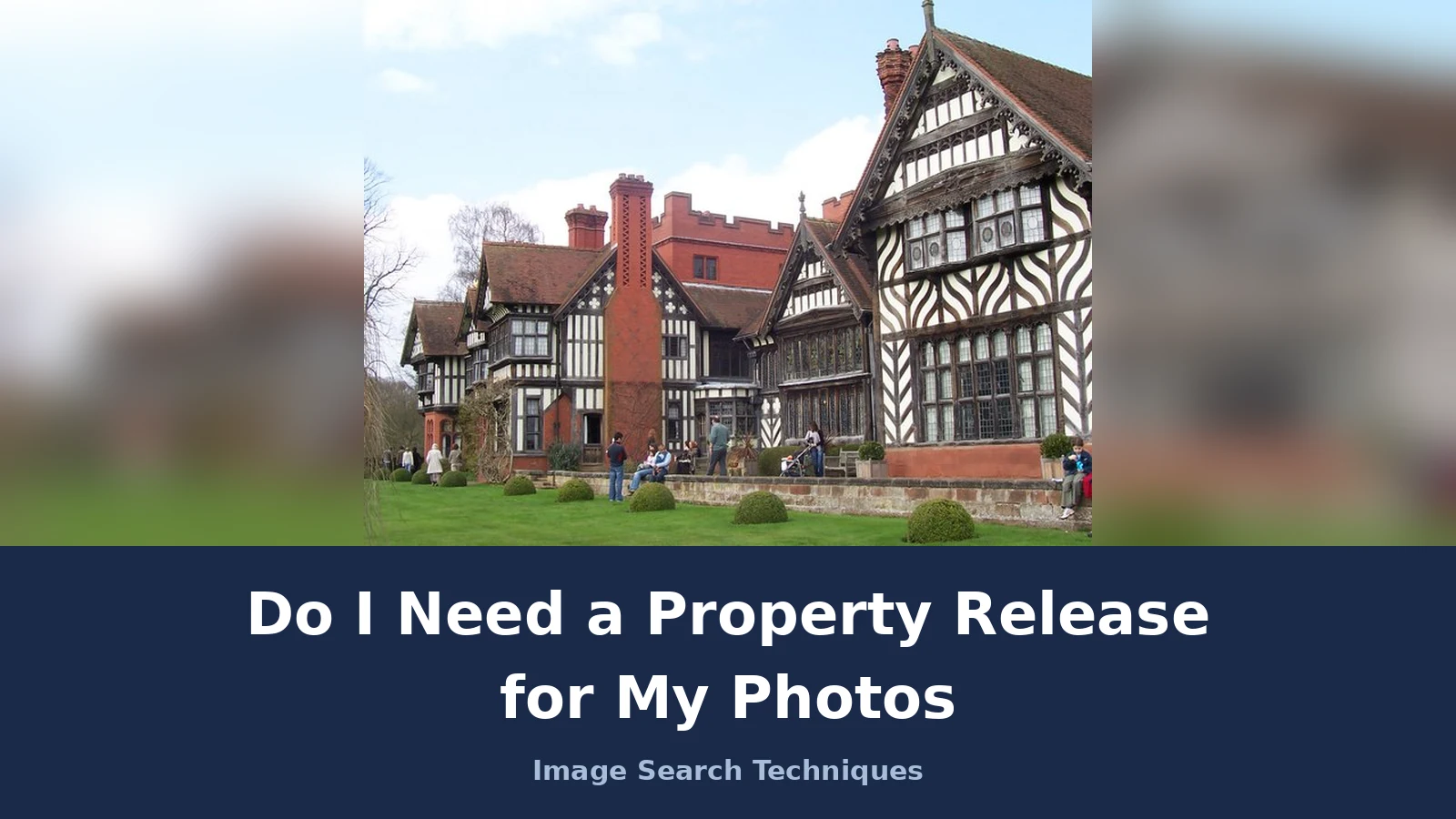
The public landmark photo is “Wightwick Manor” by Stephen Grice, taken on 28 March 2005 and published on Geograph as photo 673711. Wightwick Manor is a National Trust property open to the public. Sir Geoffrey and Lady Rosalind Mander gave the house and grounds to the National Trust in 1937, and the house is Grade I listed It is a large historic house with gardens, and the photo shows the manor from the grounds, with the building as the clear subject. The photo is reproduced below, with credit, because a public landmark photographed from publicly accessible grounds is the opposite end of the table from a private home.
Run through the table, the manor photo lands in the landmark row. For a blog post, no release is needed. For a stock sale, usually no release is needed, though an agency may still ask about it. For an advert, the honest answer is to check: the building itself is a public landmark, but an advert that uses it to imply an endorsement is the case where a release or a written permission is worth getting. The same photo, the same building, three different answers, decided by the use.
The reverse search results for the manor photo were: Google Lens Google Lens failed, not a zero (the Lens search would not load the Wikimedia URL, the same failure as the house photo), TinEye TinEye found 32 results out of 86.8 billion images searched, first indexed on 24 August 2010, led by the Wikipedia Wightwick Manor article, Yandex Yandex identified it correctly as Wightwick Manor, a Victorian house in Wightwick Bank, Wolverhampton, with 6 sizes and 12 site entries.
The contrast between the two photos is stark. The private house appears in only one place online, while the public landmark appears in 32 TinEye results and on 12 Yandex site entries. A photo that is barely indexed is not automatically a safe photo, and a widely shared photo is not automatically a free one, but the search tells you how public each image already is. The two photos also show why the reverse search matters before you use any photo of a building. The search confirms where the photo actually came from, who took it, and what licence it carries. In both cases the source was Geograph via Wikimedia Commons, and the licence was CC BY-SA 2.0, which means credit is required and any reuse must carry the same licence. Finding the source does not grant a property release. It only tells you who to credit and what the photographer’s terms are. The property question is separate, and it is answered by the table, not by the search.
Answer capsule: the same table gives different answers for a private house and a public landmark, and the reverse search confirms the source and licence of each photo without answering the property question itself.
What the UK rules actually say
There is no UK law called the property release law, and no statute that says every photo of a building needs a signed form. What the UK does have is a set of separate rules that add up to the table above, and it helps to know which rule is doing the work in each case.
The most useful rule is section 62 of the Copyright, Designs and Patents Act 1988. It says the copyright in a building, and in a sculpture or work of artistic craftsmanship permanently situated in a public place or in premises open to the public, is not infringed by making a photograph or film of it, or by issuing copies of that photograph to the public. In plain words, you can photograph a building you can see from a public place, and you can publish that photo, without infringing the architect’s or the sculptor’s copyright. That is the UK version of freedom of panorama, and it is the reason the public building and landmark rows of the table say no release is needed for editorial use.
Section 62 has limits, and they matter. It covers buildings and permanent sculptures, not paintings, murals or photographs on display. A mural on a building is not the building, so section 62 does not cover it. It also covers copyright only. It does not cover trademark, and it does not cover privacy. A photo of a trademarked shop front is fine under section 62 as far as copyright goes, but using it in an advert that suggests the shop endorses your product is a trademark question, not a copyright question. And a photo taken inside a private home, or on private land where the owner has set a no photography rule, is governed by trespass and by the entry terms, not by section 62.
Privacy is the other UK rule that readers ask about, usually in the form of whether a homeowner can stop a photo of their house being published. The short answer is that there is no general UK right to stop a photo of a house taken from a public road from being published. The longer answer is that the position changes if the photo is used in a way that harasses the owner, reveals private information, or is taken from a place where the owner had a reasonable expectation of privacy, such as through a window or over a high fence. That is why the table treats a distinctive exterior and an interior as different rows. An exterior seen from the road is one thing. An interior is another.
The UK side also has a fair dealing rule, and it is different from the US fair use rule. UK fair dealing is a narrow set of named exceptions, such as criticism, review and reporting current events, and it is not the same as the broad US fair use test. A blog post that reviews or reports on a place can fall inside fair dealing. An advert cannot. Keep the two doctrines separate, because an argument that works under US fair use may not work under UK fair dealing at all.
Answer capsule: UK section 62 lets you photograph buildings in public places, but it covers copyright only, so trademark, privacy and entry terms still need checking.
What the US rules actually say
The US position starts from a different place. There is no federal law that requires a property release for a photograph, and a building has no right of publicity, which is a right that belongs to people, not to property. A photo of a building taken from a public place in the US is generally lawful to take and to publish. That is why the US column of the table looks permissive for public buildings and landmarks.
The limits in the US come from other directions. The first is trademark. Photographing a branded storefront is fine, but using that photo in a way that confuses buyers about who sponsors or endorses a product can infringe the trademark. The second is trespass and contract. A property owner can set the terms for entry, and a photo taken after breaking those terms can be a problem even if the photo itself is lawful. The third is the stock agency. US agencies ask for property releases because their buyers want certainty, not because a statute demands it. An unreleased photo of a recognisable property is sold as editorial only, or not at all.
US fair use is also broader than UK fair dealing, and it is a four factor test rather than a list of named exceptions. A blog post that uses a photo of a building for commentary or criticism has a fair use argument in the US that it would not have in the UK. But fair use is a defence in court, not a permission slip. It does not stop an owner from complaining, and it does not help at all with an advert, where the use is commercial and the endorsement risk is highest.
The practical split, then, is simple to state and worth keeping. In the UK, section 62 answers the copyright question for public buildings, and the remaining questions are trademark, privacy and entry terms. In the US, there is no property release statute, and the remaining questions are trademark, trespass and the stock agency’s own rules. Both countries reach a similar place for the ordinary reader: editorial use of a public building is fine, commercial use of a recognisable private property needs a release.
Answer capsule: the US has no property release statute, so the real US risks are trademark, trespass and agency rules, while the UK adds section 62 for copyright and a narrower fair dealing rule.
How to get a property release when you need one
If the table says you need a release, the next step is a short written document, not a legal battle. A property release does not have to be long. It needs to say who the owner is, which property it covers, which photo or shoot it covers, what uses are allowed, and whether the permission lasts for a set time or indefinitely. It should be signed and dated by the owner, or by someone authorised to sign for the owner, such as an agent or an estate manager. Keep the signed copy with the photo file, so you can show it to a stock agency, a client or a publisher later.
Ask before you shoot if you can. A release is easiest to get when the owner is standing in front of you and the photo has not been taken yet. Explain the use in plain words: a blog, a stock listing, an advert. Owners agree far more often when they know what the photo is for than when they are asked to sign a blank permission after the event. If the owner is a business, ask for the person who can sign for the premises, not the first member of staff you meet.
If you cannot get a release, you still have options, and they are better than using the photo and hoping. Sell or publish it as editorial only, if the use genuinely is editorial. Crop or reshoot so the property is not recognisable, or so it is only background. Use a different photo, one where the property is a public building or landmark. Or go back to the owner with a narrower ask: permission for one use, on one site, for one year. A narrow permission is often easier to get than a wide one, and it is enough for most blog and stock uses.
One thing a release does not do is replace the other permissions a photo may need. A property release covers only the property owner’s rights. It does not cover a recognisable person in the frame, who needs a model release. It does not cover a trademark or a copyrighted artwork in the frame, which may need a separate permission. And it does not cover the photographer’s copyright, which is a separate question answered by the licence on the photo itself. Check each layer on its own, and keep the paperwork for each one.
Answer capsule: ask the owner in plain words before you shoot, keep the signed release with the photo file, and if you cannot get one, use the photo editorially only or pick a different shot.
Common mistakes that get photos into trouble
The first mistake is treating credit as permission. Giving credit to the owner, the architect or the photographer does not replace a release. Credit is a condition of some licences, and it is good practice, but it is not consent. The same is true of a link back to the source. A release is a signed agreement, and a credit line is not one.
The second mistake is assuming that finding a photo online means it is free to use. A photo of a building found on Google, Pinterest or a social media feed carries the rights of the photographer who took it, and the property in it carries its own questions. Finding a photo is not a licence, and a public post is not public domain. Check the licence on the source page, and check the property against the table, before you use it.
The third mistake is confusing a model release with a property release. A signed model release from a person in the photo does not cover the building behind them. A signed property release from the building owner does not cover the person in front of it. The site’s model release guide covers the people side in full, and this guide covers the property side. If your photo has both, you need both.
The fourth mistake is thinking a release is needed for every photo. It is not. A street scene where no building is the focus, a landmark photographed for a news story, and a holiday snap on your own feed do not need one. Over asking for releases wastes the owner’s time and yours. The table exists so you can tell the two cases apart quickly, and the worked example shows how the same table gives different answers for a private house and a public landmark.
Answer capsule: credit is not permission, a photo found online is not free, a model release is not a property release, and not every photo needs a release at all.
FAQs
Do I need a property release for a photo of my own house?
No, not for your own property. You own the rights in the property, so you can give permission to yourself. A release only matters when someone else owns the property in the photo. Keep a note of the address and the date if a stock agency asks, because they may still want confirmation that the house is yours.
Do I need a property release to post a photo of a house on social media?
Usually not. Posting a personal photo on your own social media account is personal use, and no release is needed for that. The answer changes if the post is an advert, a sponsored post, or a listing that sells something, because then the use is commercial and a recognisable private property may need a release.
Do I need a property release for a photo taken from a public road?
It depends on the use, not on where you stood. Taking the photo from a public road is lawful in the UK and the US, and section 62 of the UK Copyright, Designs and Patents Act 1988 covers photographing buildings in public places. But a commercial use of a recognisable private home can still need a release, because the risk is endorsement, not the taking.
Is a property release the same as a model release?
No. A model release covers a recognisable person in a photo, and a property release covers a recognisable property. They are separate documents, signed by different people, and one does not cover the other. A photo with a recognisable person in front of a recognisable building needs both releases for commercial use.
Can I sell a photo of a landmark without a property release?
Often yes, as editorial stock, but not always as commercial stock. A public landmark photographed from a public place usually needs no release for editorial use. For commercial use, check the agency, because some agencies ask for a release anyway, and a landmark with a trademarked or copyrighted feature, such as the Eiffel Tower lighting at night, is a separate case.
Does crediting the property owner replace a property release?
No. Credit is not permission. A credit line tells readers who owns the property, but it does not give you permission to use the photo commercially. A property release is a signed document in which the owner agrees to the use. If the table says you need a release, add the credit as well, but do not treat it as a substitute.