


🔎 Reverse Image Search
Image search techniques made simple: upload a photo or paste a URL and search 6 engines at once. 100% free, nothing stored.
🔒 Your image is never stored on our servers longer than 24 hours and is never shared.
A photo of an insurance card proves nothing on its own. Check the policy dates against the crash date, then match the named insured, the vehicle and the VIN to the driver and car in front of you. If any field fails, call the insurer on a number you found yourself and ask whether the policy was in force.
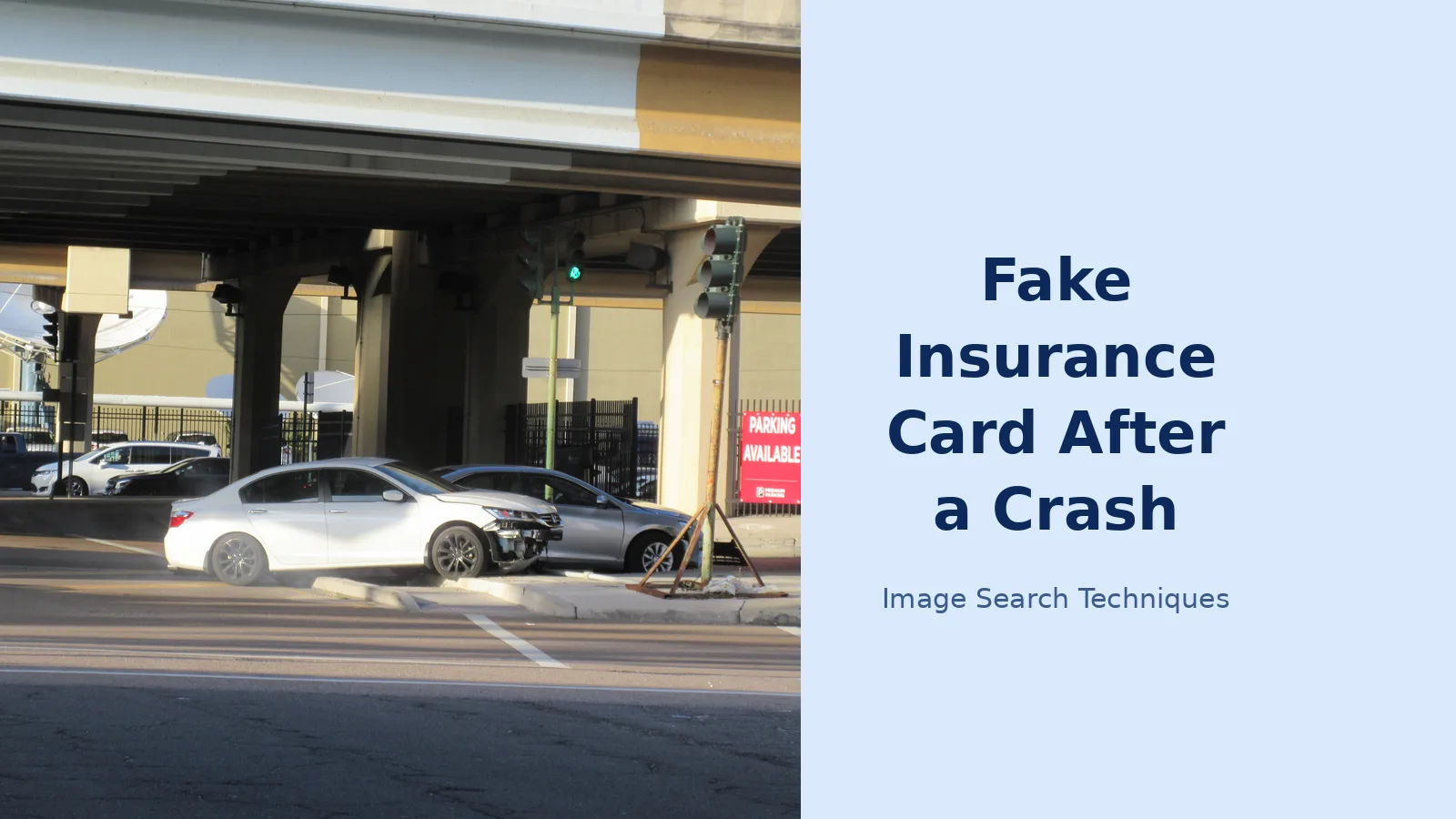
In November 2026 a driver wrote to the insurance site The Zebra about a fake insurance card after an accident, with a problem that will sound familiar to anyone who has stood in a car park after a bump. Someone had hit their car, the damage looked small, and no police were called. The two drivers swapped details. Days later the driver looked at the insurance card photo and saw the policy did not start for five days. The crash had happened before the cover began. That one date changes everything, and it is the first thing to check on any card photo you are handed.
This guide is for the driver who received the card, not the one who handed it over. Every step is tied to the crash and the photo in your hand. If you are submitting your own claim photos instead, our guide to verifying insurance claim photos covers that side. This article is general information, not legal advice, and insurance rules vary by state, so treat the steps as checks to run, not as a verdict on your claim.
What is an insurance ID card, and what does it prove?
An insurance ID card is a small document that summarises a motor policy. It is not the policy itself. In most US states it follows a standard form, the ACORD 50, and it carries the same short list of fields: the insurer name, the policy number, the effective date, the expiration date, the named insured, and the year, make and model or VIN of the covered vehicle. Washington state law lists those fields as the minimum a card must carry, and other states follow the same pattern.
The card proves that a policy existed on the day it was printed. It does not prove the policy was still in force on the day of your crash. A policy can be cancelled the week after the card was issued, and the card stays in the glovebox looking perfectly valid. A renewal card can also be printed before its start date, which is exactly what happened in the Zebra case: the driver was handed a card for a policy that had not started yet. So the card is a starting point for checks, never the check itself.
Most US states now accept a photo or digital copy of the card as proof of insurance at the roadside. That is convenient, and it is also why a photo is so easy to fake. Blank card templates for every state are a search away, and a home printer can fill one in. A tidy-looking card photo tells you nothing until its fields are checked against the crash.
What should you photograph at the scene?
The best checks happen at the scene, while the other driver and car are still in front of you. Photograph the card front and back, the number plate, the VIN plate on the dashboard or door frame, and the damage on both cars. Photograph the card straight on, not at an angle, and make sure every line of text is readable before you let the driver leave. A blurry photo of a card is useless later, and you cannot ask for a second one once the driver has gone.
Also note the time, the place, and the name the driver gives you, and ask any witness for a name and number. If anyone is hurt, or the cars cannot be moved, call the police. If the other driver will not give details, or drives off, note the plate, the make, model and colour, and the direction they went. Our guide to checking a car damage photo covers what to photograph when the damage itself looks wrong.
Do not accept a cash offer at the scene. Repair costs and injuries both have a habit of appearing days later, and a cash deal leaves you with no paper trail. Keep every photo, message and repair estimate. If you did not call the police at the scene, check whether your state allows a delayed report, because a police report filed now creates a record while memories are fresh.
How do you check a fake insurance card after an accident, field by field?
Work through the card photo in this order. Each field either matches the crash or it does not, and one failure is enough to stop and verify before you believe the card.
| Field on the card | What to check | What fails the check |
|---|---|---|
| Effective date | The policy must have started on or before the crash date. | A start date after the crash. This was the Zebra case: the policy began five days later. |
| Expiration date | The policy must still have been running on the crash date. | An expiry date before the crash. An old card in a glovebox is the most common failure. |
| Named insured | The name on the card should match the driver or the owner of the car. | A different person’s name with no link to the driver or the car. |
| Year, make and model | The car described on the card should be the car in front of you. | A different make or model, or a blank field where the car should be named. |
| VIN | The 17-character VIN should match the plate on the car. | A VIN that does not match, a short or made-up number, or no VIN at all. |
| Insurer name | The company should be a real, licensed insurer. | A name you cannot find, a misspelled company, or a logo that looks pasted on. |
| Policy number | Note the full number exactly as printed, for the insurer call. | A number that is partly blank, smudged, or in a different font from the rest. |
The dates come first because they settle the most cases the fastest. In the Zebra scenario the policy started five days after the crash, so nothing else on the card mattered. The driver may have handed over a renewal card by mistake, or may have been uninsured at the time. Either way, a policy that had not started cannot cover a crash that already happened.
The VIN matters because it ties the card to one specific car. A card that names a different vehicle, or no vehicle at all, does not cover the car that hit you. Fleet cards are the exception: a commercial fleet card covers a whole fleet and often lists no single VIN, so the VIN check cannot be done from the card alone. The worked example below shows exactly that case.
What are the edited-card tells inside the photo?
A fake card is usually a real card with something changed, or a blank template filled in. Look at the photo itself before you trust the words on it.
First, look for mixed fonts. The insurer name, the dates and the policy number on a genuine card are printed in the same typeface at the same size. If the dates sit in a different font, or one line looks bolder or sharper than the rest, that line may have been edited. Second, look at the edges of the text. A date pasted over an old one often leaves a faint rectangle, a slight shadow, or a change in the background colour around the digits. Zoom in on the photo and check the effective and expiration dates closely, because those are the two fields a faker changes most.
Third, check the card against the car. A photo of a card taken at the scene should show the same card the driver is holding, with the same creases and wear. If the photo looks like a screenshot of a screen, or a printout photographed at an angle, ask yourself why the driver did not show you the card itself. Fourth, look for missing pieces. A genuine card carries the insurer name, policy number, dates, insured name and vehicle details together. A card with a blank vehicle field, no insurer address, or no issuing agency is either a fleet card, which is legitimate, or an incomplete fake. The difference is whether the rest of the card makes sense, which is what the field check above settles.
Reverse image search can help here, but only in a limited way. A card photo that has been copied from a website will sometimes turn up as an exact match, which proves the photo is not the driver’s own card. But a blank result proves nothing: a card printed at home and photographed once has never been online, so no search engine has seen it. Our reverse image search guide explains the method, and the worked example below shows what a real search on a real card actually returns.
How do you verify the policy was in force on the crash date?
The card photo cannot answer the one question that matters: was this policy in force on the day of the crash? Only the insurer can answer that, so the insurer call is the endpoint of every check in this article. Call the company named on the card, on a number you found yourself, and ask whether the policy was in force on the crash date. Never use a phone number printed on the card, in a text from the driver, or in an email that arrived after the crash. Look the number up on the insurer’s own website, or in a directory you trust.
Expect some friction. Insurers do not hand out policy details to strangers, and US federal law limits what a state motor vehicle department can share about someone else’s records. The Driver’s Privacy Protection Act, 18 USC 2721, bars a DMV from releasing personal information from motor vehicle records except for a short list of uses, and that list is why an insurer handling a claim, a court, or law enforcement can get answers where a private person cannot. Your own insurer can verify the other driver’s coverage as part of your claim, which is the practical route for most readers. Report the accident to your own insurer as soon as you can, hand over the photos and the card, and let them run the check.
There is no public database where you can type in a plate number and see whether a car is insured. Some states run electronic verification systems, such as TexasSure in Texas, but those are built for state agencies, not for the public. Websites that promise an instant insurance lookup by plate should be treated with care: many cannot access real-time insurance status at all.
One free check is worth running while you wait. The National Insurance Crime Bureau runs VINCheck, a free tool that checks a VIN against theft and salvage records from participating insurers. It tells you whether the car was reported stolen and not recovered, or declared a total loss, and it covers insurers representing 92.49 percent of US earned insurance premium as of August 2026, with a limit of five searches per IP address in 24 hours. It does not tell you whether the car has active liability insurance, so a clean result is not proof of cover. Run it at the NICB VINCheck page with the 17-digit VIN from the car, not from the card.
In the UK the equivalent check is simpler. The Motor Insurers’ Bureau runs askMID, a free check where you enter a registration number and it tells you whether the vehicle is insured. It answers the question a US driver cannot answer directly, so UK readers should run it before they ring anyone.
What did the worked example show?
For the worked example I used a real insurance ID card published on a trucking company’s own website: a Missouri auto insurance identification card on the standard ACORD 50 form, issued by Great West Casualty Company for Buchheit Trucking Service, Inc. of Scott City, Missouri. It is a commercial fleet card, which makes it a useful test because fleet cards break the usual field check in a specific way. The policy number is redacted in this article, but the card itself is public, and the audit below reads it exactly as printed.
| Field | What the card says | Verdict |
|---|---|---|
| Insurer | Great West Casualty Company, a real commercial insurer | Pass: the company exists and is a known commercial carrier. |
| Policy period | Effective 10/01/2023, expiration 10/01/2024 | Fail for any crash after 1 October 2024. In November 2026 this card is more than two years out of date. |
| Named insured | Buchheit Trucking Service, Inc., a company | Check: the name is a business, so the driver must be connected to that business or the card does not belong to them. |
| Vehicle | Year and make/model fields are blank | Fail as a match: no car is named, so the card cannot be tied to any single vehicle. |
| VIN | The VIN field reads “Commercial Fleet” | Expected on a fleet card: the card covers a fleet, so no single VIN is listed. The VIN check has to move to the insurer call. |
| Card type | Commercial box ticked, personal box empty | Consistent: a commercial fleet card for a trucking company. |
If a driver handed you a photo of this card after a crash in November 2026, the dates alone would settle it. The policy expired on 1 October 2024, so it cannot cover a crash two years later. The card is genuine, but it is old, and an old genuine card is just as useless as a fake one. That is the first lesson of the example: real does not mean current.
I then ran the card photo through reverse image search on 13 November 2026, using the site’s own tool, to see whether the image could be traced back to its source.
| Engine | Result |
|---|---|
| Google Lens | 0 exact matches, on two separate runs. The AI Overview read the card text correctly, naming the insurer, the policy dates, the fleet status and the insured company. Visual matches were only similar Missouri card templates. |
| TinEye | 0 matches of 86.7 billion images searched. |
| Bing | 0 pages with this image. Bing separately reported 3,070 text results for the phrase “Missouri Auto Insurance Identification Card”, which are not image matches. |
| Yandex | 20 sites listed, none of them the source page, and none an exact copy. The top results were blank template sites, including one offering free fake and real insurance card templates. |
| No visual search at all. The tool’s Pinterest link opens a keyword search for the site’s own domain, returning unrelated domain-name pins. |
Two findings matter. First, no engine found the source page, even though the card is a public PDF on the company’s own site. A blank reverse search proves nothing about a card, because a card photo that has never been shared widely is invisible to every engine. Second, the search surfaced how easy it is to get a blank card: template sites offering free Missouri insurance card forms appeared in the top results on Lens, Bing and Yandex. A tidy card photo is cheap to produce, which is why the dates and the insurer call carry the weight, not the photo itself. The tool also has two quirks worth knowing: its Google and Lens buttons lead to the same Lens search, and its Pinterest button is a domain keyword search, not a reverse search.
What do you do if the card fails the check?
Do not argue with the other driver at the roadside, and do not try to prove the card is fake in person. Your job at the scene is to collect evidence, not to win the argument. Photograph everything, note the time and place, and leave. Then report the accident to your own insurer the same day, with the photos, the card, the plate and the VIN. Your insurer can check whether the policy was in force and can pursue the other driver or their insurer on your behalf.
If the other driver was uninsured, you may still have routes to recover the cost. Depending on the cover you carry, your own collision cover may pay for the repair, and in some states uninsured motorist property damage cover exists for exactly this situation. If you have neither, the other driver may be personally responsible for paying out of pocket, which usually means a small claim rather than a quick settlement. Ask your insurer which of these applies to your policy before you spend anything on repairs.
File a police report if your state allows delayed reporting. That creates a paper trail while the details are fresh, and it matters if the other driver stops responding. Save every message, photo and repair estimate. If the driver gave you a card you believe was deliberately faked, report it to the FTC at Report Fraud, and keep the report reference with your claim file. Do not post the other driver’s details or the card photo on social media: a public accusation can backfire, and it does not help your claim.
The same field-by-field method works on other documents a seller or driver shows you. Our ghost MOT certificate check uses the same idea: take the numbers off the photographed certificate and check them against the official record, because the document alone proves nothing.
Common mistakes when checking a card photo
The most common mistake is stopping at the expiry date. A card that has not expired can still belong to a cancelled policy, a different car, or a different person, so the dates are the first check, not the only one. The second mistake is trusting the phone number on the card. A faker prints their own number on the card, so a call to that number reaches the faker, not the insurer. Always look the number up independently.
The third mistake is treating a blank reverse search as proof the card is genuine. As the worked example shows, a real card photo can return zero matches on every engine, and a fake one printed at home will return zero matches too. A blank search tells you the image is not widely shared, nothing more. The fourth mistake is paying privately to make the problem go away. A driver who offers cash at the scene may be trying to avoid a claim, and the cost of a repair often grows once a garage looks at the car properly. Report it, document it, and let your insurer handle it.
Finally, do not assume a card that looks official is real. Blank templates for every state are easy to find, as the worked example’s search results showed, and a home printer can produce a card that looks right at a glance. What makes a card trustworthy is not how it looks, but whether its dates cover the crash, its vehicle matches the car, and the insurer confirms the policy was in force. If any of those three fails, the card has failed. For the full set of photo-based scam checks, see our complete guide to photo scams.
FAQs
How can I tell if an insurance card is fake after a crash?
Read the card photo field by field. Check the policy dates against the crash date, then match the named insured, the vehicle and the VIN to the driver and car. Look for mixed fonts or edited dates. Then call the insurer on a number you found yourself and ask if the policy was in force on the crash date.
What if the policy on the card starts after the crash?
A policy that starts after the crash cannot cover it, even if the card looks genuine. The driver may have handed you a renewal card by mistake, or may have been uninsured at the time. Report the accident to your own insurer with the photos and the card, and let them verify the cover and advise on your options.
Can I check someone else’s car insurance online?
In the US there is no public database that shows whether a specific car is insured right now. State verification systems exist, but they are built for agencies, not the public. Your own insurer can check the other driver’s cover as part of your claim. In the UK, the free askMID check works by registration number.
Does a blank reverse image search mean the card is real?
No. A blank search only means the image has not been widely shared online. A real card photo can return zero matches on every engine, and a fake card printed at home will too. The dates, the vehicle match and the insurer call are the checks that matter, not the search result.
What should I do if the other driver has no insurance?
Report the accident to your own insurer the same day and hand over your photos, the card, the plate and the VIN. Your collision cover may pay for the repair, and some states offer uninsured motorist property damage cover. File a police report if your state allows delayed reporting, and keep every message and estimate.
Should I accept cash from the other driver at the scene?
No. Repair costs and injuries often appear days after a crash, and a cash deal leaves no paper trail. Photograph the card, the plates, the VIN and the damage, note the time and place, and report the accident to your insurer. A private payment can leave you with no claim if the damage is worse than it looked.






