🔎 Reverse Image Search
Image search techniques made simple: upload a photo or paste a URL and search 6 engines at once. 100% free, nothing stored.
🔒 Your image is never stored on our servers longer than 24 hours and is never shared.
A bulb has blown, the fitting is empty, and the only record of what was in it is a photo on your phone. This guide shows you how to identify light bulb from photo details alone: read the base code, the shape code and the size in millimetres, and you can usually pin down the exact replacement without taking the bulb to a shop. The trick is knowing which of the three codes on a bulb actually matters, and photographing the right end of it.
Short answer: To identify a light bulb from a photo, read the base code (E27, B22, GU10 and similar), the shape code (A60, C35, G45 and similar) and the size in millimetres. Photograph the base end-on and the printed text, then match the codes against a base chart, the printed codes beat any search engine.
A light bulb is identified by three separate things, and people mix them up constantly. The base is the metal or plastic fitting that connects to the socket. The shape is the glass envelope, pear, candle, golf ball, reflector. The size is a number in millimetres that belongs to one of the other two. A bulb code such as E27 tells you the base only; A60 tells you the shape only. You need both, plus the wattage or lumens, before you buy a replacement.
What can a photo of a light bulb actually tell you?
A good photo can tell you almost everything you need. A poor photo tells you nothing at all, and the difference is usually which end of the bulb was photographed. The base is the part that decides whether a bulb fits, so a photo of the glass alone, however clear, cannot identify a bulb on its own. A photo of the base, taken end-on, usually can.
The same idea applies beyond bulbs. A photo of a key can name its blank from the stamp and the grooves, as our guide to how to identify a key from a photo shows.
Here is what to look for in a bulb photo, in order of usefulness:
- The base, end-on. A screw thread, two side pins (bayonet) or two bottom pins (capsule/spot) each point to a different family of codes.
- Printed text on the glass or base. Modern bulbs print the base code, wattage, lumens and colour temperature on the bulb itself, often in small grey print on the glass.
- The shape and proportions. A pear shape, a candle flame, a golf ball or a flat reflector face each narrow the shape code.
- Something for scale. A coin or a ruler in the frame turns a guess about size into a measurement. Batteries work the same way: our guide to identifying a battery type from a photo shows how a coin beside the cell, plus the printed code, names the exact replacement.
- The original box, if you still have it. The box prints every code at once and is the single best photo you can take.
If your photo shows only the glowing bulb in a ceiling fitting, it will not identify anything. Take the bulb out, with the power off, as the safety section below explains, and photograph it on a plain surface, base towards the camera, with the printed text in frame. If the object in your photo turns out not to be a bulb at all, start with our guide on how to work out what is in a picture before you narrow it down.
How do you read the base code in a photo?
The base code is a letter followed by a number, and the number is always a measurement in millimetres. Philips Hue’s official bulb size guide explains the system plainly: the first letter tells you the base type, bayonet cap or Edison screw, for example, and the number tells you the diameter of the base, or the distance between the pins, in millimetres. Once you know that, you can decode almost any bulb from a photo.
There are three base families in homes. Screw bases start with E, for Edison. Bayonet bases start with B. Pin bases start with G. The table below is the article’s ranking asset: the seven bases that cover nearly every household bulb in the UK and the US, with the measurement you can check from a photo.
| Base code | What the number measures | Size | Voltage | Where you find it |
|---|---|---|---|---|
| E27 | Screw thread diameter | 27 mm | 230 V | Standard lamps and pendants, UK and Europe |
| E14 | Screw thread diameter | 14 mm | 230 V | Chandeliers, small shades, fridge bulbs |
| B22 | Bayonet cap diameter | 22 mm | 230 V | Ceiling lights and table lamps, UK default |
| E26 | Screw thread diameter | 26 mm | 120 V | Standard lamps and pendants, US and Canada |
| GU10 | Distance between pins | 10 mm | 230 V mains | Kitchen and bathroom spotlights |
| G9 | Distance between pins | 9 mm | 230 V mains | Chandeliers, under-cabinet lights |
| G4 | Distance between pins | 4 mm | 12 V low voltage | Cabinet and display lights, needs a transformer |
How to tell them apart in a photo:
- Screw thread, no pins. It is an Edison base. Measure the thread diameter across the widest point: about 27 mm is E27, about 14 mm is E14. In the US, the standard screw base is E26 at 26 mm, one millimetre smaller, which is why the two are so often confused.
- Two small lugs sticking out of the sides, and a push-and-twist fit. It is a bayonet cap. At 22 mm across the cap it is a B22, the standard bayonet in UK homes. The smaller B15 (15 mm) appears in some appliances and night lights.
- Two thick, blunt pins underneath, and a push-and-twist fit. It is a GU10. The pins are 10 mm apart and the bulb runs directly on mains voltage, so there is no transformer to worry about.
- Two thin looped pins underneath, and a simple push fit. It is a G9 if the pins are 9 mm apart. G9 capsules run on mains voltage and are common in decorative chandeliers and under-cabinet fittings.
- Two needle-thin pins, 4 mm apart, on a tiny capsule. It is a G4. G4 capsules are low voltage, usually 12 V, and need a transformer or LED driver. Never assume a capsule is mains voltage from its size alone.
The G4/G9 pair is the one that catches people out. The two capsules look almost identical in a photo, and the difference is invisible unless you measure the pin spacing or read the printed voltage. A G9 pushed into a 12 V G4 fitting will not work; a G4 pushed into a mains G9 fitting is dangerous. If the photo does not show the pin spacing or the voltage, do not guess. Measure the pins or read the print.
What do the shape letters and numbers mean?
The shape code is a letter for the shape and a number for the diameter in millimetres, or, on older US bulbs, in eighths of an inch. The common household shapes are:
- A60 (A19 in the US). The classic pear-shaped bulb, 60 mm across. A19 is the same 60 mm bulb named in the US system, where 19 means 19 eighths of an inch.
- C35. A candle or flame shape, 35 mm across, used in chandeliers and decorative fittings, usually on an E14 base.
- G45. A golf ball, 45 mm across, used in small shades and bathroom fittings, usually on an E14 or B22 base.
- R63 and R80. Reflector bulbs, 63 mm and 80 mm across, with a mirrored coating that throws light forwards, common in older downlights.
- MR16. A small reflector spotlight, 50 mm across (16 eighths of an inch), on a GU5.3 low-voltage base or a GU10 mains base. The two look identical from the front, so check the base.
- PAR38. A larger reflector flood, 121 mm across, used outdoors and in high ceilings.
- Capsule. The small glass tube of a G4 or G9, with no shape letter at all, the base code is the whole identification.
Shape and base are independent. An E27 base can carry an A60 pear, a G95 globe or a C35 candle, and a B22 base can carry exactly the same shapes. That is why a photo of the glass alone cannot identify a bulb: the shape tells you what it looks like, and only the base tells you whether it will fit.
How do you measure a bulb from a photo?
Photos lie about size. A close-up of a G9 capsule can look identical to a close-up of an E27 bulb, because the camera gives you no scale. Three measurements settle almost every identification, and all three can be done from a photo if the photo was taken properly:
- Photograph the base end-on, next to a ruler or a coin. A UK 10p coin is 24.5 mm across, close enough to a B22 cap to compare against, and a useful scale for an E27 thread. Lay the bulb on its side with the ruler beside the base, not the glass.
- Measure the thread or cap diameter. For a screw base, measure across the widest point of the thread. For a bayonet cap, measure across the metal cap. For a pin base, measure from the centre of one pin to the centre of the other, not from edge to edge.
- Measure the glass diameter at its widest point. That number is the shape code: 60 mm is an A60, 35 mm is a C35, 45 mm is a G45. Measure the glass, not the base, for this one.
If the photo has no scale object, you can still estimate by comparing the base with the glass. On a standard A60 bulb the glass is a little over twice the width of an E27 base (60 mm against 27 mm). On a candle bulb the glass is about two and a half times the width of an E14 base (35 mm against 14 mm). These ratios are rough, but they are enough to separate an E27 from an E14 when no ruler is in the frame.
When a photo cannot be measured at all, a single shot of a bulb in a fitting, no scale, no print visible, a reverse image search is the fallback. It works best on distinctive bulbs (a filament bulb, an unusual reflector) and worst on plain white pear bulbs, which all look alike. The worked example below shows exactly how far it gets.
Which base do you need in the UK and the US?
The UK and the US use different default bases, and this is the single most useful table in the article for anyone who has moved house, bought a lamp abroad, or ordered a bulb online. The UK standard is the B22 bayonet for ceiling lights and the E27 screw for most lamps; the US standard is the E26 screw almost everywhere. A bulb bought in one country will usually not fit a fitting from the other, even when it looks identical.
| Fitting | UK / Europe | US / Canada |
|---|---|---|
| Standard ceiling light | B22 bayonet | E26 screw |
| Table and floor lamp | E27 or B22 | E26 |
| Chandelier / small shade | E14 | E12 |
| Kitchen spotlight | GU10 | GU10 |
| Under-cabinet capsule | G9 (mains) or G4 (12 V) | G9 (mains) or G4 (12 V) |
| Mains voltage | 230 V | 120 V |
Two warnings follow from that table. First, E26 and E27 look almost identical and an E27 bulb will often screw into an E26 holder, but a European 230 V bulb in a 120 V US fitting will glow dimly, and a US 120 V bulb in a 230 V European fitting can fail dangerously, so the voltage printed on the bulb matters as much as the thread. Second, GU10, G9 and G4 are the same codes on both sides of the Atlantic, but G4’s 12 V transformer and G9’s mains voltage are not interchangeable, the code alone does not tell you the voltage, the print on the bulb does.
How do you match the brightness when the old bulb’s watts are gone?
Old bulbs were sold by watts, and most people still remember “a 60-watt bulb” rather than a lumen figure. LED bulbs use so much less power that watts no longer describe brightness at all: watts now measure the electricity a bulb uses, while lumens measure the light it gives out. The Energy Saving Trust’s lighting advice makes the same point: choose by lumens, not watts, and gives the replacement brightness for the familiar old wattages.
| Old incandescent | Brightness to match | Typical LED |
|---|---|---|
| 25 W | About 250 lumens | About 2–4 W |
| 40 W | About 470 lumens | About 4–6 W |
| 60 W | About 800 lumens | About 7–9 W |
| 75 W | About 1,100 lumens | About 9–12 W |
| 100 W | About 1,500 lumens | About 13–16 W |
Those lumen figures are the anchors used by ENERGY STAR and the EU energy-labelling rules (25 W ≈ 250 lumens, 40 W ≈ 470, 60 W ≈ 800, 75 W ≈ 1,100, 100 W ≈ 1,600), and the LED wattages are typical ranges, not exact figures, always check the lumen figure printed on the box, because it varies between products. The word “equivalent” on a box means the same brightness in lumens, not the same power draw, so a bulb labelled “60 W equivalent” should give about 800 lumens while drawing roughly 8 watts.
Two more numbers on the box matter. Colour temperature, in kelvin, describes whether the light looks warm or cool: 2700–3000 K is warm white, the colour of old incandescent bulbs; 4000 K is neutral or cool white; 6500 K is daylight. Beam angle matters for spotlights: a GU10 with a narrow 36° beam suits a picture light, while a 60° beam suits general kitchen lighting. Both are printed on the bulb or the box, and both are worth photographing before you throw the old bulb away.
Worked example: identifying a real E27 bulb from a photo
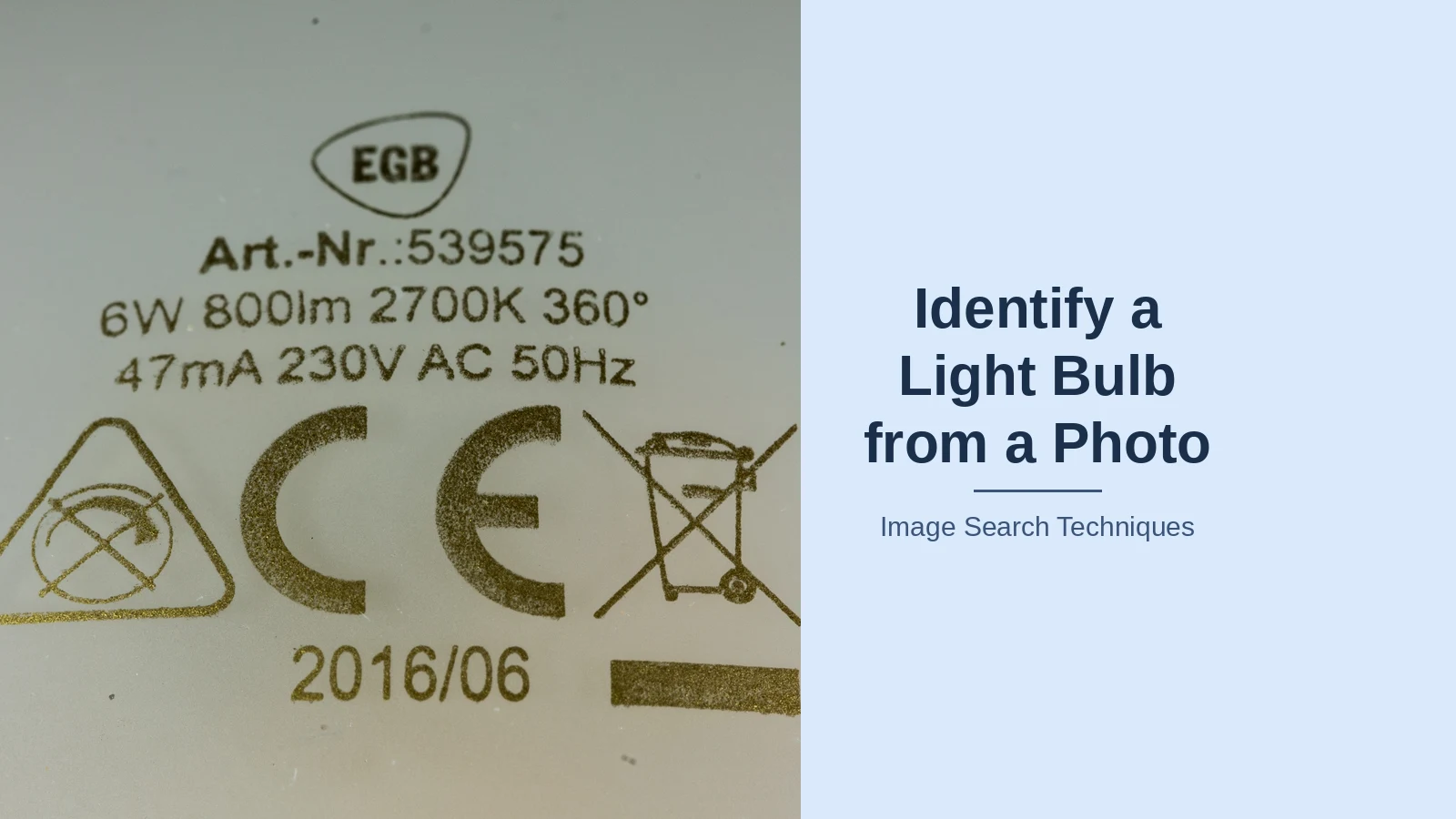
To test how far a photo alone can take you, I ran a real photograph through the reverse image search tool on this site on 12 November 2026. The photo is a Wikimedia Commons image by Raimond Spekking (CC BY-SA 4.0) showing the printed markings on an LED filament bulb: “6W 800lm 2700K 360° 47mA 230V AC 50Hz”. The file name adds two more facts the print does not show, E27 and 810 lumens, and the small mismatch between the printed 800 lumens and the file name’s 810 lumens is itself a useful warning: treat printed figures as approximate, and trust the base code over the brightness claim.
The tool accepted the image URL and showed a preview (3968 × 2976 pixels) with all six search engines selected, and no CAPTCHA appeared on any engine. Here is what each engine actually returned:
- Google Search by Image: failed. The results page stayed stuck on “Thinking” and “Generating” for about 30 seconds, then both the Exact matches and Visual matches sections reported “Something went wrong / No image at the URL”. Zero matches, no identification, no source named.
- Google Lens: failed the same way. Lens opens the same Google search page, and it returned the same “No image at the URL” error. Zero matches. One possible factor is that the tool’s engine links double-encode the commas in this file’s URL, but that is a guess, not a proven cause, Yandex, TinEye, Bing and Pinterest all ran with the same encoding.
- Bing Visual Search: ran, but misidentified the photo. Bing read the printed label correctly, “Led Ceiling Light 6W 800Lm 2700K 360°”, and described it as the product label of an LED ceiling light, with 3,930 results for that keyword query. But its “Pages with this image” section found nothing at all, and the one similar product it surfaced was a different bulb from a lighting retailer, not the photo itself.
- Yandex Images: the only engine that found the original. Yandex identified the photo in Russian as an LED lamp and a filament lamp, and its first similar image was exactly the Wikimedia Commons file at 3968 × 2976. Its Sites tab listed exactly two sites carrying the image: the Wikimedia Commons file page itself, and a Russian filament-lamp article on ixbt.com at 1280 × 960.
- TinEye: ran, but found only partial matches. TinEye searched 86.7 billion images and returned just 2 results, first indexed on 12 May 2019, a battery product photo and a manual illustration that share the label’s CE symbols, not the bulb photo itself. The Commons original was not among them.
- Pinterest: not a visual search at all. The tool’s Pinterest button redirected to a keyword search for the image’s host domain, and the results were unrelated Wikimedia-hosted pins, the Taj Mahal, the Empire State Building, Audrey Hepburn, with no LED bulb anywhere in them.
Two honest conclusions follow. First, the photo’s printed label identified the bulb better than any search engine did: 6 W, 800 lumens, 2700 K, 230 V, printed on the glass. The search engines added only one thing, Yandex confirming where the photo came from. Second, the photo itself had a blind spot: it is a close-up of the print, not of the base, so the E27 base is known only from the file name, not from the image. A complete identification needs two photos, one of the base, end-on, and one of the print. Take both before you throw the old bulb away.
One more tool note: the site’s “Search All” button opened only the Google tab, even with all six engines selected. If you use the tool, open the engines one at a time rather than trusting the bulk button.
What should you never do with an unidentified bulb?
Identifying a bulb is a safe job as long as it stays a reading job. It becomes dangerous the moment you start fitting things by trial and error, so these rules are not optional:
- Isolate the power before handling any bulb. Switch the light off at the switch and, for a fitting you are unsure about, at the fuse box or circuit breaker as well. Never remove a bulb from a live fitting, and never touch a broken bulb’s exposed base with bare hands.
- Never guess the voltage of an unmarked capsule bulb from a photo. A G4 capsule is 12 V and a G9 capsule is 230 V mains, and the two look almost identical. If the photo shows neither the pin spacing nor a printed voltage, measure the pins or read the print. Do not fit it and see what happens.
- Never exceed the fitting’s maximum wattage. The maximum is printed on the fitting itself, usually near the socket. With LEDs this is rarely a problem, because an 800-lumen LED draws about 8 watts, but a halogen replacement must stay under the limit.
- Check the transformer before replacing a low-voltage bulb. A G4 or GU5.3 bulb needs a transformer or driver, and an LED replacement must suit it: older transformers can make LEDs flicker or buzz. If the fitting has a transformer, buy a bulb rated for it.
- Check dimmer compatibility. An LED is not dimmable unless the box says so, and a dimmable LED still needs a compatible dimmer switch. The Energy Saving Trust advises checking LED dimmer compatibility before buying a full set, and testing one bulb in the room first.
If the bulb is broken, hot, or stuck in the fitting, stop and call an electrician rather than forcing it. A shattered bulb leaves sharp glass and a live base in the socket, and no identification is worth that risk.
How to identify light bulb from photo, step by step
- Switch the power off and let the bulb cool, then remove it from the fitting.
- Photograph the base end-on, with a ruler or a coin beside it for scale.
- Photograph any printed text on the glass or the base, wattage, lumens, kelvin and voltage.
- Photograph the original box as well, if you still have it; it prints every code at once.
- Read the base code from the photo: screw thread (E27, E14, E26), bayonet lugs (B22) or pins (GU10, G9, G4), and measure the diameter or pin spacing in millimetres.
- Read the shape code from the glass diameter: 60 mm is an A60, 35 mm is a C35, 45 mm is a G45.
- Match the brightness in lumens, not watts, about 800 lumens replaces a 60 W incandescent, and check the colour temperature in kelvin.
- If the photo alone cannot settle it, run it through a reverse image search, checking Yandex as well as Google, and remember that a photo of the print beats any search result.
- Buy the replacement by base code first, shape second, lumens third, and check the fitting’s maximum wattage and dimmer before you fit it.
Most bulb identifications take two minutes once you know the code system: base first, shape second, brightness in lumens third. The photo that makes it easy is not a clever one. It is a plain, well-lit shot of the base and the print, with something in the frame for scale. Take that photo before the old bulb goes in the bin, and the replacement is a five-minute job instead of a second trip to the shop. The same code-reading method works for other household objects too: see how to identify a tool from a photo, or a cable or connector from a photo, with the same base-first approach. The same idea works for remotes: our guide to how to identify a remote control from a photo reads the button layout the way this guide reads a base code.
FAQs
Can Google Lens identify a light bulb from a photo?
Sometimes, but not reliably. In our test on a real E27 filament bulb photo, Google Lens failed to load the image at all, Bing misread the label as a ceiling light, and only Yandex traced the photo to its source. A photo of the printed base code and wattage identifies a bulb far more reliably than any search engine.
What is the difference between E27 and B22?
E27 is a screw base with a 27 mm thread; you twist the bulb into the socket. B22 is a bayonet cap, 22 mm across, with two side lugs; you push it in and twist a quarter turn to lock it. Both are standard in UK homes, but they are not interchangeable.
Can I use an E26 bulb in an E27 fitting?
Usually it screws in, because the threads differ by only one millimetre, but you should not rely on it. E26 is the North American standard for 120 V, while E27 is the European standard for 230 V. A 120 V bulb in a 230 V fitting can fail, so match the voltage printed on the bulb, not just the thread.
How do I identify a small capsule bulb, G4 or G9?
Measure the distance between the centres of the two pins: 4 mm means G4, 9 mm means G9. Then read the voltage printed on the bulb. G4 capsules are 12 V and need a transformer; G9 capsules run on 230 V mains. Never guess from size alone. A wrong-voltage capsule is a safety risk.