🔎 Reverse Image Search
Image search techniques made simple: upload a photo or paste a URL and search 6 engines at once. 100% free, nothing stored.
🔒 Your image is never stored on our servers longer than 24 hours and is never shared.
Yes: you can identify animal tracks from a photo. Photograph one clear print with a coin or ruler beside it, photograph the whole trail, then count the toes, check for claw marks and read the animal’s gait from the pattern. A single print only narrows the list; the trail is what names the animal.
Animal tracks are the footprints an animal leaves in snow, mud, sand or soft soil. The Old Farmer’s Almanac, whose animal-track identification guide is one of the best-known pages on the subject, notes that tracks are easiest to find in mud, soft garden soil, sand and snow, and that a photo of a track can be identified later, at home, if it was taken properly. That is the whole premise of this guide: a good photo preserves the evidence; a bad one throws it away.
This guide covers the photo method the Almanac’s chart-only page does not teach: how to photograph a trackway, how to read a single print, how to read the trail, and how snow and mud distort what you see. It works for the animals most people actually find: fox, dog, cat, badger, deer, rabbit and squirrel in the UK, plus coyote, bobcat and raccoon in North America. It does not cover scat identification in depth, and it never promises a certain identification from one blurry print.
What can a photo of animal tracks actually tell you?
A photo can tell you a surprising amount, but only within limits. From one clear print you can usually tell whether the maker was a paw animal or a hoofed animal, how many toes showed, whether claws registered, and roughly how big the foot was. From the trail, the line of prints, you can tell how the animal moved: walking, trotting, bounding or hopping. Put the two together with the habitat and the season, and you can usually narrow a track to one or two likely animals, the same approach our what is this picture guide uses for any mystery photograph.
What a photo cannot do is give you a certain identification. The lock on this article is the one every honest tracking guide states: tracks are indicative, never certain. A fox print and a small dog print overlap. A print in soft snow can look half as large again as the foot that made it. Two animals of the same species leave different-sized prints. So the honest answer to “what animal made these tracks?” is usually “most likely a fox”, with the reasons stated, not “definitely a fox”.
That uncertainty is not a failure of the method. It is the method. The sections below give you the checks that separate a likely match from a guess, and the worked example at the end shows the method applied to a real photograph, including where the search engines helped and where they did not.
How do I photograph tracks so they can be identified?
The single most common reason a track photo cannot be identified is that it shows one print, from directly above, with nothing for scale. The ranking asset of this guide is the trackway photo routine: three photographs that together preserve everything an identification needs.
Take the photographs in this order, before you touch anything:
- The single print, from directly above. Crouch low and hold the camera straight down over the clearest print. Get close enough that the print fills most of the frame. If the light is flat, hold a hand or a piece of card to one side to cast a low shadow across the print. The Almanac’s guide recommends tracking early in the morning or late in the day precisely because low shadows make prints easier to read, and you can fake that light with a shadow.
- The same print with scale. Put a coin, a ruler, a pen or your hand flat beside the print, not on top of it, and take the same shot again. A print with no scale is a shape; a print with a coin beside it is a measurement. A UK 50p coin is 27.5 mm across; a US quarter is 24.26 mm. State which coin you used when you ask anyone to identify the photo.
- The whole trail. Stand back and photograph at least six to ten prints in a line, showing how they are spaced and whether they fall in a straight line, in pairs or in a zigzag. The trail pattern is often more diagnostic than any single print: a fox trots in a neat straight line, a rabbit bounds in groups of four, a squirrel’s hind feet land ahead of its front feet.
Take a fourth photograph if you can: the surroundings. A track beside a river, a hedge, a compost heap or a bird feeder tells the identifier where the animal was going, and habitat is a legitimate clue: a badger track on a well-worn path through a wood is a different proposition from the same print on a city pavement.
Do not clean the print, pour water on it or press anything into it. Do not follow the trail. If your first shots come out soft or shaky, our guide to reverse image search on a blurry photo explains how to get a usable result from a poor photograph. If the tracks are fresh and the animal may still be nearby, note the direction of travel from a distance and leave it alone: the section at the end of this guide explains why.
How do I read a single print: toes, claws and pads?
Start with three questions, in this order. They sort almost every track you will find into a small group before you ever think about species.
1. How many toes show? Count the toe pads in front of the main pad. Four toes means a dog-like or cat-like animal (canid or felid) or a rabbit or hare. Five toes means a mustelid (badger, otter, stoat, weasel), a raccoon, a squirrel’s hind foot, or a bear. Two long slots instead of toes means a hoofed animal: deer, sheep, goat or pig. Three toes forward and one back means a bird. The Wildlife Trusts’ mammal detective guidance puts it plainly: foxes have four toes, badgers have five, and deer leave two pointed toe prints with no claws or pads at all.
2. Do claw marks show? Dogs, foxes, coyotes and badgers cannot retract their claws, so their prints usually show small claw dots ahead of the toes. Cats, bobcats and lynx retract theirs, so their prints show no claw marks at all: the single most reliable way to separate a cat print from a small dog print of the same size. A fox print often shows two neat claw marks at the front, sometimes called “buddy claws” in UK tracking guides.
3. What shape is the main pad? The pad behind the toes is the fingerprint of the family. A fox has a triangular pad with a raised chevron-shaped ridge across it that no dog or coyote leaves. A cat has a three-lobed pad, wider than it is tall, with a distinctive “M” shape along its back edge. A badger has a wide, kidney-bean-shaped pad with five toes in front of it and long digging claws. A deer’s print has no pad at all, just two cloven hoof slots.
The table below is the second part of this guide’s ranking asset. It covers the animals most readers actually photograph, with the measurements that published guides agree on. Sizes are for the front foot unless stated, and all of them assume a clear print on a firm surface. Snow and mud change them, as the next-but-one section explains.
| Animal | Toes | Claw marks | Typical print size | Tell-tale sign |
|---|---|---|---|---|
| Red fox | 4 | Yes, two neat front claws | 5–6.5 cm long, 4–5 cm wide | Narrow diamond shape; chevron ridge on the pad; furry winter feet leave a gap between toes and pad |
| Domestic dog | 4 | Yes, usually blunt | 4–8 cm, varies by breed | Rounder and wider than a fox print; toes splay; no chevron ridge |
| Domestic cat | 4 | No | 3–4 cm | Round print; three-lobed pad; no claw marks; an “X” cannot be drawn between toes and pad |
| Badger | 5 | Yes, long digging claws | Up to 8 cm wide | Five toes in a row; wide kidney-bean pad; hind foot often treads over the forefoot print |
| Roe deer | 2 (cloven hoof) | No | 3–4 cm long | Two narrow pointed slots; may splay when running; dew claws sometimes show behind on soft ground |
| Red deer / white-tailed deer | 2 (cloven hoof) | No | 6–9 cm long | Heart-shaped split print; much larger than roe deer; deeper in soft ground |
| Rabbit / hare | 4 | Rarely clear | Hind feet up to 10–15 cm in hares | Read the trail, not the print: hind feet land ahead of the front feet in a bounding pattern |
| Grey / red squirrel | 4 front, 5 hind | Yes, fine | 2.5–4 cm | Bounding pairs; hind feet land ahead of and outside the front feet |
| Raccoon (North America) | 5 | Yes, small | Front 5–7.6 cm; hind 6–9.7 cm | Long finger-like toes like a small hand; hind print longer and narrower than the front |
| Bird (most species) | 3 forward, 1 back | Yes, fine | 2–8 cm by species | Three toes forward like a peace sign; hopping birds leave paired prints side by side |
Two quick tests settle the commonest confusions. The fox-versus-dog test: a fox print is a neat diamond, narrower than a dog’s, with the two front toe pads sitting further forward than a dog’s and a triangular pad roughly the same size as the toe pads. The Wildlife Trusts note that you can usually draw a horizontal line between the two forward toe pads and the second two on a fox track. The cat-versus-dog test: draw an “X” through the print between the toes and the pad. On a dog or fox print the X fits in the gaps; on a cat print the large three-lobed pad blocks it. If you cannot draw the X, think cat.
What does the whole trail tell you that one print cannot?
A single print names a family. The trail names the animal, or at least rules most of the family out. Four things matter: the pattern of the prints, the stride, the straddle (the width of the trail) and whether the animal registered its feet directly on top of each other.
Walkers and trotters (fox, dog, coyote, cat, deer and badger) leave prints in a regular alternating left-right line. A fox trotting is famously neat: the hind foot lands almost exactly in the print of the front foot, a pattern trackers call a direct register, and the trail runs in a straight, economical line. A dog’s trail wanders and meanders by comparison; a fox’s trail goes somewhere. Carleton College’s tracking guide makes the same point from the other direction: look at the size of the tracks and the distance between individual prints first, because that alone gives you a sense of the animal’s size.
Bounders (weasels, stoats, otters and martens) travel in a loping 2×2 pattern, two prints side by side, then a gap, then two more. The prints appear in pairs because the hind feet land in or beside the front prints as the animal bounds.
Hoppers (rabbits, hares, squirrels and mice) leave groups of four: two small front prints behind, two larger hind prints ahead of them. A rabbit’s hind feet point forward and sit parallel; a squirrel’s hind feet angle outwards. In deep snow the four prints of a squirrel can merge into two diamond shapes pointing at each other, and a hare’s hind feet can be 17 cm long, longer than most people’s hands.
Why the trail matters for identification: a fox print and a small dog print can look identical in isolation, but a fox trail is a straight direct-register line and a dog trail wanders. A rabbit print and a squirrel print can look alike, but a rabbit’s hind feet are parallel and a squirrel’s are angled. The Canadian Wildlife Federation’s winter tracking guide gives the practical version of this rule: measure the length and width of the print, count the toes, check for claw marks, and then read the straddle and stride, because those give you a rough estimate of the size of the animal that made them.
If you lose the trail, the Almanac’s advice is to widen your search in a circle around the last print you found rather than walking straight on. Tracks often resume a few metres away where the animal changed direction or crossed a harder patch of ground.
How do snow and mud change what a track looks like?
Snow and mud are the two surfaces where tracks are easiest to find, and the two surfaces that lie to you most. This is the third part of the ranking asset, and it is the part the chart-only guides skip.
Snow enlarges prints. A print in fresh snow looks larger than the foot that made it, and it keeps growing: sun and wind melt and collapse the edges through the day, so a fox print photographed at noon can look half as large again as the same print photographed at dawn. Measure prints in the morning, in shade, or as soon as you find them. Deep powder is worse. A fox pushing through 15 cm of powder drags its feet and leaves connected drag marks between prints that can look like a single trough with regular punch holes.
Snow hides detail. Red foxes grow dense fur between their toes from November to March, so a winter fox print often looks fuzzy at the edges, with the pad detail blurred and the toe pads further from the main pad than they would be on mud. The chevron ridge that identifies a fox may not show at all in powder. If the print looks soft and the animal’s fur is the reason, say so. Do not force an identification from a print that has lost its detail.
Mud gives the sharpest detail, and the most splaying. Soft mud records toe pads, claw marks and pad shape better than any other surface, which is why a muddy garden after rain is the best place to practise. But wet mud also lets toes splay wider than they would on firm ground, so a print in wet mud can look a size larger than the same foot on dry soil. A print in mud that has dried and cracked can also look deeper and sharper than it was when it was made.
Crust and thaw erase evidence. A print in snow that has frozen overnight, thawed and refrozen again is a mould of a mould, bigger, rounder and emptier than the original. If the edges are rounded and the pad detail is gone, the print is old. The Almanac’s scat tip applies here too: fresh signs mean a recent animal; dry, crumbled signs mean an old one.
The practical rule: never identify from size alone in snow, and never identify from a single melted print. Size plus toe count plus claw marks plus the trail pattern is the minimum for a likely identification. Anything less is a guess, and the article should say so.
Which animal made these tracks? A quick guide to the common ones
Work through the table above, then check the shortlist below. These are the animals whose tracks turn up most often in gardens, parks and woodland edges in the UK and North America, and the look-alikes that cause the most confusion.
Fox. The commonest wild track in a UK garden. Small oval four-toed print, 5–6.5 cm long, narrow and diamond-shaped, with a chevron ridge on the pad and two neat claw marks. The trail is a straight direct-register line, often along a hedge, a fence or a wall. In winter the print looks furry and soft-edged. Confused with: small dog (rounder, splaying, wandering trail) and coyote in North America (larger, 6–7.5 cm, longer stride).
Badger. Five toes, a wide kidney-bean pad and long digging claws that leave deep gouges ahead of the toes. The print can be as wide as a medium dog’s, up to 8 cm. Badgers follow the same routes every night, so look for a well-worn path through the undergrowth and a line of four or five prints where the hind foot has trodden over the forefoot print, a habit the WWT’s mammal tracking guide from its Caerlaverock reserve records in photographs. Confused with: dog (four toes, no kidney pad) and otter (five toes too, but webbing sometimes shows and the habitat is water).
Deer. Two pointed slots, no toes, no claws, no pad. Roe deer prints are 3–4 cm long and narrow; fallow deer are broader and heart-shaped at up to 7 cm; red deer reach 8–9 cm. A walking deer places its back foot almost exactly in the print of its front foot. Confused with: sheep and goats (similar cloven prints, but usually found with other signs of livestock) and pigs (rounder, wider slots).
Rabbit and hare. Read the trail: two small front prints behind, two long hind prints ahead, in a bounding group. Hare hind feet can reach 17 cm in snow. The prints themselves are oval with four toes that come to a point. Confused with: squirrel (hind feet angled outwards, not parallel) and, in snow, small deer (which leave two slots, not four paws).
Squirrel. Dainty prints, 2.5–4 cm, with four toes on the front foot and five on the hind. The hind feet land ahead of the front feet and angle outwards, and in deep snow the four prints can merge into two diamonds. Look under a favoured feeding tree for chewed nuts and droppings as well as prints. Confused with: rat (smaller, narrower trail, usually along walls) and rabbit (parallel hind feet, toes pointed).
Cat. Small round four-toed print, 3–4 cm, no claw marks, three-lobed pad. The trail is a neat alternating line with a direct register, like a fox’s, but smaller and rounder. Confused with: small dog (claw marks, X test passes) and, in North America, bobcat (same shape, but 5–7.5 cm and a longer stride).
Raccoon (North America). Five long finger-like toes that look like a small hand, front prints 5–7.6 cm and hind prints 6–9.7 cm, the hind print longer and narrower than the front. Trails often lead to trees, water or bins. Confused with: opossum (hind foot has an opposable thumb that sticks out sideways, and a tail drag mark often shows behind the prints) and badger (wider pad, digging claws, no finger-like toes).
Birds. Three toes forward and one back, like a peace sign. Hopping birds (blackbirds, robins, crows) leave paired prints side by side; walking birds (pheasants, herons, ducks) leave an alternating trail. Webbed feet show as a fan shape between the toes. A heron print can be 15 cm across and is easy to mistake for something larger until you count the toes.
Worked example: identify animal tracks from a photo using three search engines
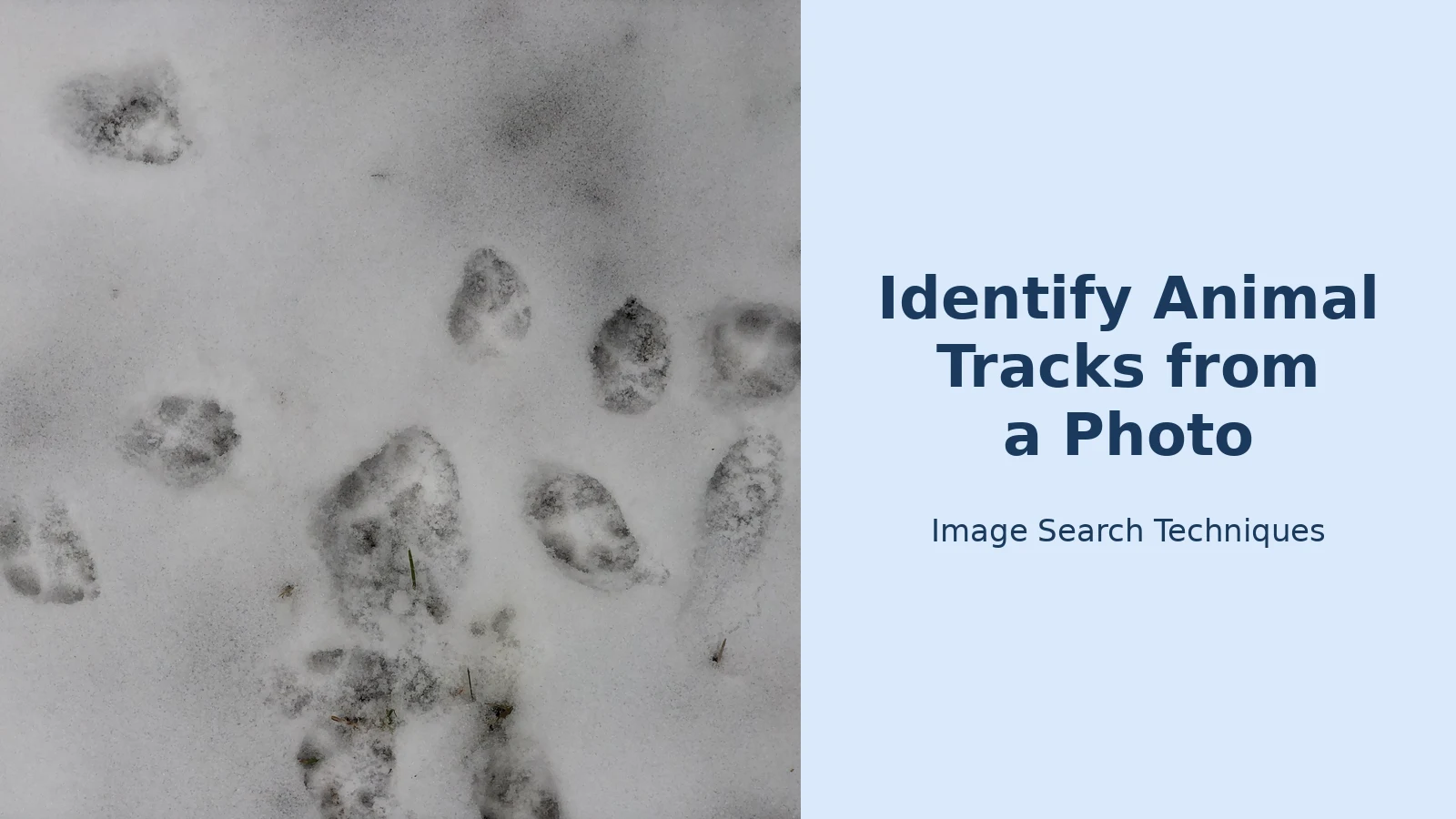
The photograph used for this test is a real one: fresh red fox tracks in snow photographed on Christmas morning, 25 December 2024, along Aquetong Lane in Ewing Township, New Jersey, by Wikimedia Commons contributor Famartin and released under a CC BY-SA 4.0 licence. It shows a line of small oval prints crossing fresh snow, exactly the kind of photograph a reader would take in their own garden and want identified.
Running the photo through a reverse image search first is worth doing before you identify it yourself, because the search may find the same photograph already captioned, or a matching field-guide image with the animal named. Our how to reverse image search guide explains the upload steps, and Google reverse image search by URL is the fastest route for a photograph already on the web. You can also ask an AI assistant to describe the print, see our guide to identify a photo with ChatGPT and Gemini, but treat an AI description as a suggestion to check, not an identification. The worked test below ran the same image URL through Google Lens, TinEye and Yandex Images, signed out, on 12 November 2026, and reports what each engine actually returned.
Google Lens failed outright. It accepted the URL and showed the thumbnail, but its AI overview stayed stuck on “Thinking” and never produced an answer, and both the “Exact matches” and “Visual matches” tabs returned the same error: “Something went wrong: No image at the URL.” A retry in a fresh tab gave the identical error. Lens named neither the animal, the location nor the source page. No CAPTCHA appeared; the failure was Lens’s own.
TinEye searched and found nothing. It reported that it had searched over 86.7 billion images and found no matches, adding that it had “yet to crawl any pages where this image appears”. It did not name the source page; the only other images shown were sponsored stock photographs of snow. The photograph is barely two years old and sits on one of the most-crawled sites on the web, yet TinEye had never seen it.
Yandex Images returned results, and got the animal wrong. Under “The image appears to contain” it offered five tags: squirrel tracks in snow, animal tracks in snow (twice, in different Russian wording), wolf tracks in snow, and tracks in snow. It did not name the red fox, the Ewing Township location or the Wikimedia Commons source page, and its list of sites was headed by squirrel-track pages. A reader who trusted Yandex’s first tag would have gone home believing a fox trail belonged to a squirrel.
What the test shows is the same lesson as the rest of this guide: a reverse image search is a lead, not a verdict. The photograph’s own caption said “red fox tracks”, and the trail in the image, a neat straight line of small oval prints, is consistent with a fox’s direct-register trot. But the identification rests on the print itself: four toes, a narrow oval shape, a straight trail. If the engines had returned nothing, the photo routine in the earlier sections would still give the same likely answer, and that is the point. Learn the method, and you do not need the search engine to agree with you.
What should I do after identifying the tracks?
First, enjoy it, and write down what you found. Note the date, the place, the surface, the measurements and the trail pattern. A dated record turns a one-off sighting into evidence you can compare with the next time tracks appear, and it is exactly what a local wildlife group or a neighbour will ask for if you report the sighting.
Second, do not approach or follow the animal. This is the binding safety rule of this guide: tracks are a sign that an animal passed through, and following them leads you towards an animal that may be feeding, resting, denning or protecting young. Never follow a trail into dense cover, never approach a den, sett or burrow you find by following tracks, and never use a torch or a flashlight to look for the animal at night. If the tracks are large (bear, moose, wild boar) or if they lead towards a building where people or pets are, give them a wide berth and report them to your local wildlife authority or council rather than investigating yourself.
Third, if the tracks are in your garden and you are worried about damage, identify first and act second. Foxes and badgers are protected in the UK, and deterring them is a matter of removing the attraction (securing bins, clearing fallen fruit, blocking access under sheds) not of trapping or harming the animal. The Almanac’s own advice on garden visitors is to deter, not to harm, and the same applies here. If a pet has been threatened or livestock is involved, contact your local wildlife trust or council for advice rather than acting on a photo identification alone.
Finally, keep the photograph. A clear track photo with a coin for scale is useful evidence for a wildlife group, a neighbour dispute about a garden visitor, or your own records, and it is the photograph that lets someone else check your identification. That is the real value of learning to identify animal tracks from a photo: not the answer, but the evidence trail that lets the answer be checked. The same evidence-trail idea applies to the animal itself: our guide to identify a frog from a photo shows the same routine on a garden frog.
The same evidence trail works for the animal itself: our guide to identify a lizard from a photo shows the routine on a basking wall lizard.Can you identify animal tracks from just one photo?
Sometimes, but not reliably. One clear print with a coin or ruler for scale can narrow the maker to a family: four toes and claw marks points to a dog-like animal, five toes to a mustelid. A certain identification needs the whole trail as well, because the gait pattern separates look-alikes such as fox and small dog.
What animal made these tracks in snow?
Start with the print, not a guess. Count the toes, check for claw marks, measure the print against a coin, then photograph the trail. In the UK a small oval four-toed print in a straight line is most often a fox; in North America the same print may be a coyote. Snow enlarges prints, so treat size as approximate.
How can I tell fox tracks from dog tracks in a photo?
A fox print is a neat diamond, 5 to 6.5 cm long, with the two front toe pads further forward than a dog’s and a chevron-shaped ridge on the pad. A dog print is rounder and wider, the toes splay, and the trail wanders. A fox trots in a straight line, placing its hind foot in its front print.
Should I follow animal tracks to find the animal?
No. Tracks show where an animal has been, not where it is safe to go. Never follow a trail into dense cover, approach a den or sett, or use a torch to search at night. Note the direction from a distance, photograph the prints, and report large or worrying tracks to your local wildlife authority.