🔎 Reverse Image Search
Image search techniques made simple: upload a photo or paste a URL and search 6 engines at once. 100% free, nothing stored.
🔒 Your image is never stored on our servers longer than 24 hours and is never shared.
Short answer
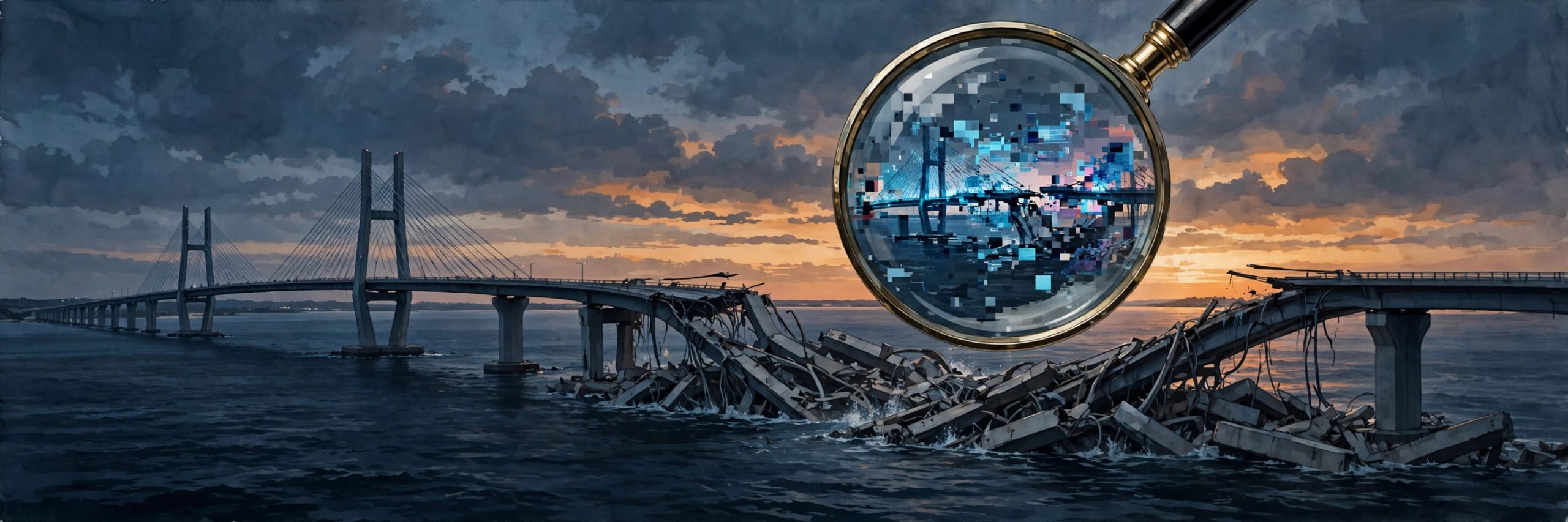
No. Full Fact checked it on 24 November 2026 and found it was AI-generated. The clip was first shared by an Instagram account on 16 November 2026, claiming it showed damage from the first attack. Two checks give it away. First, the fake shows two road bridges, but the real crossing is one road bridge and one rail bridge, and the rail arch has a criss-cross pattern missing from the fake. Second, Google’s SynthID detector found an invisible watermark, which means it was made or edited with Google AI tools. Official photographs of the real damage do not match the clip.What the viral video claims
The clip shows a bridge that looks badly damaged, with the posts around it saying this is the Crimean Bridge after Ukraine attacked it in November 2026. It first appeared on Instagram on 16 November, the same day as the first real attack, and spread from there to other platforms. Full Fact says it has been liked thousands of times.The timing is the whole trick. A fake that appears on the same day as a real event is hard to question, because the event itself is true. People searching for pictures of the damaged bridge find this clip first, and most have no reason to check whether the bridge in the video matches the bridge on the map. It is the same pattern behind the fake AI video of a Mumbai bookseller and the fake video of a rebuilt Howrah bus station: a believable scene, a real news hook, and no source.The clip is not the only fake attached to this story. Every real strike creates demand for pictures, and AI tools can produce those pictures in minutes. Our complete guide to photo scams explains how these waves work and why they spread faster than the corrections.What really happened to the Crimean Bridge
To see why the fake fails, it helps to know the real bridge. The Crimean Bridge, also called the Kerch Bridge, is a pair of parallel bridges across the Kerch Strait, linking the Taman Peninsula in Russia with the Kerch Peninsula in Crimea: one carries a four-lane road, the other a double-track railway. At 19 kilometres long, it is the longest bridge in Europe, with the road section opened in 2018. It is the only direct land link between mainland Russia and Crimea. Ukraine damaged it in October 2022, July 2023 and June 2025, but never took it out of service until now.The November 2026 attacks were different. The first strike came at around 2 a.m. Moscow time on 16 November, when Ukrainian drones hit the bridge. Russian media reported the arch over the road section had shifted by about 15 degrees. Road traffic partly resumed later that day, and rail traffic resumed after a few hours.The second strike came around midnight on 17 November. The road bridge arch and the main span below it collapsed into the Kerch Strait. The 227-metre steel arch, weighing more than 5,000 tonnes, fell into the water. Road traffic was cut off, and rail traffic was suspended before resuming later the same day. President Volodymyr Zelenskyy described it as the seventh phase of an operation prepared over several weeks. A third attack on 19 November reportedly damaged the rail bridge too.The damage is severe. BBC Verify confirmed the road section was destroyed, while the railway arch remains standing, although damaged. Bridge specialist David MacKenzie told the BBC the attack struck the most critical part of the bridge, and restoring full road traffic could take more than a year. The Kremlin has said the bridge will be restored.None of this is in doubt. What is false is the viral video that claims to show it. The real damage is documented in official photographs. The fake clip shows a bridge that was never built.How Full Fact proved the video is AI-generated
Full Fact published its check on 24 November 2026. The evidence comes in three parts, each one a check anyone can repeat using public sources and free tools.1. The bridge in the video is wrong
The most direct evidence is the structure itself. The fake video shows two road bridges side by side, but the real crossing is one road bridge and one rail bridge. That alone fails the clip. Full Fact found a second detail: the real rail bridge arch has a distinct criss-cross pattern on the lowest rung near the track, and that pattern is missing from the fake.Big structures are the easiest to check this way: a bridge has a fixed shape, and an AI tool that has never seen the real thing will invent the details. Compare a still frame from any viral clip against a known photograph of the same place, and the differences usually appear within seconds. Our guide on how to tell if an image is AI-generated walks through this kind of comparison, and our guide on identifying a picture helps when you do not know what you are looking at.2. Google’s SynthID detector found a watermark
Full Fact ran the video through Google’s SynthID detector, which found an invisible SynthID watermark. SynthID is a watermarking technology from Google DeepMind, launched in 2023, that embeds an invisible signal into content made with Google’s AI tools. Finding that signal means the video was made or edited with Google AI.The public SynthID Detector is available in English at synthid.com, opened to everyone in October 2026. You upload a file and it reports whether it found a watermark. One limit matters: the detector only finds content that was watermarked. No watermark found does not prove the media is real. A positive result, like the one Full Fact got, is strong evidence. A negative result is not. Reports say users are limited to around 10 checks a day, and a sign-in is required.Watermarks are one of the most useful checks for viral video, because they do not depend on opinion. A detector score is a judgement call. A watermark is a fact about how the file was made. Our guide on how to check if a video is AI-generated explains the other checks to use alongside it, and our roundup of the best deepfake video detector tools explains which tools are free and what their scores mean.3. Official photographs do not match the clip
The third check is the simplest. Official photographs of the damage from the later strikes on 17 and 19 November do not match the fake video. The real damage is a collapsed arch and a missing road span, with debris in the water below. The fake shows a different bridge, damaged in a different way.When a real event has real photographs, compare the viral clip against them. If the clip shows damage that no official photograph shows, that is a warning sign. A reverse image search on a clear frame is the fastest way to run this comparison, and a cross search across several image search engines finds the original fastest.Why a fake like this spreads after a real attack
This fake worked because the event was real, the demand for pictures was instant, and the real pictures were scarce. In the first hours after an attack, official photographs are few and newsrooms are still verifying what happened. That gap is where AI fakes live.The same gap produced another fake this week: Lead Stories checked a video on 24 November 2026 claiming to show powerful waves hitting Gordon’s Bay in South Africa. Its TikTok version carried an AI-generated media label, no news outlet reported such waves, and the footage showed vehicles sitting on top of buildings. Two different stories, two different continents, the same pattern: a dramatic scene, a real place, and no news trail.War makes the problem worse. People follow a conflict closely and share what they find. A fake bridge video does not need to fool an expert. It only needs to look right for three seconds on a phone screen. Full Fact’s own note makes the point plainly: it can be hard to tell real and AI-generated videos apart, particularly when they circulate after real events.A short message saying this video is AI-generated, with a link to a fact check, does more good than a repost of the fake. The same discipline applies to the fake Trump stockpile screenshot, the fake Elon Musk crypto livestream, and the 4D cinema AI videos.How to check a viral war video in 5 steps
You do not need professional tools to catch a fake like this one. Full Fact used public sources and a free detector, and you can follow the same steps in a few minutes.Step 1: Search the news first. A real event leaves a news trail. Search the claim in plain words and see whether a credible outlet published the same footage. In this case, BBC Verify published real photographs of the bridge damage, and none matched the viral clip. If the only sources for dramatic footage are social media posts, treat it as unproven.Step 2: Compare the structure against a known photograph. Pause on a clear frame and open a trusted photograph of the same place. Count the spans and check the arches. Here, the fake showed two road bridges where the real crossing has one road bridge and one rail bridge. One structural error is enough.Step 3: Reverse image search a keyframe. Screenshot a clear frame and run it through Google Lens and another image search engine. If the same scene appears only in social media posts, never in a news report, that is a warning sign. If it appears in an older context, the video is built on that older image. Our deepfake video detector tools guide explains how to read the scores.Step 4: Run it through the SynthID detector. If you can download the video, upload it at synthid.com and check for a watermark. A watermark found means the clip was made or edited with Google AI tools. Remember the limit: no watermark found does not prove the video is real. Use it as one check among several, not the only check.Step 5: Watch the video like a fact-checker. Play it twice. First, watch the background: does water behave normally, do structures hold their shape? Second, watch hands, text and faces. The Gordon’s Bay fake failed this step with cars on rooftops and flood water that damaged nothing. One impossible detail is a warning sign. Two or more is a strong signal.If the checks disagree, do not share the video as fact. Share the check instead. The full method is in our master guide to image search techniques.Is the viral Crimean Bridge damage video real?
No. The video is AI-generated. Full Fact checked it on 24 November 2026 and found it does not match the real bridge. The clip shows two road bridges, but the real crossing is one road bridge and one rail bridge, and Google’s SynthID detector found an invisible watermark in the footage.
Where did the fake Crimean Bridge video come from?
The clip was first shared by an Instagram account on 16 November 2026, the day of the first real attack on the bridge. It claimed to show damage from that drone attack, and it has been liked thousands of times online. The account that posted it is the source, not a news outlet.
How did Full Fact prove the Crimean Bridge video is AI-generated?
Three checks. The bridge in the video is wrong: it shows two road bridges, while the real crossing has one road bridge and one rail bridge. Google’s SynthID detector found an invisible watermark. Official photographs of the real damage do not match the clip.
Was the Crimean Bridge really damaged in November 2026?
Yes. Ukrainian forces attacked the bridge on 16, 17 and 19 November 2026. The road bridge arch and main span collapsed into the Kerch Strait on 17 November. The railway arch remains standing but was damaged. A bridge specialist told the BBC that restoring full road traffic could take more than a year.
How can I check a viral war video before sharing it?
Search the news first, then compare a clear frame against a trusted photograph of the same place. Reverse image search a keyframe, run the video through the SynthID detector at synthid.com, and watch for impossible details. If the checks disagree, do not share the video as fact.