🔎 Reverse Image Search
Image search techniques made simple: upload a photo or paste a URL and search 6 engines at once. 100% free, nothing stored.
🔒 Your image is never stored on our servers longer than 24 hours and is never shared.
You found a small brown bug in or near your bed, and now you need to know what it is. The question “is this a bed bug” is one of the most searched insect questions online, because the answer decides whether you need a pest controller or just a closer look at a harmless beetle. This guide shows you how to identify a bed bug from a picture, step by step, and how to rule out the insects most often mistaken for one. If the insect turns out not to be a bed bug at all, our guide to identifying an insect from a photo shows how to narrow any insect to its group.
Yes, often: an adult bed bug is a flat, oval, reddish-brown insect about the size of an apple seed (5–7 mm), with six legs, short antennae and no wings. A photo is a starting point, not proof of an infestation: check the signs below and get a professional inspection before spending on treatment.
What is a bed bug? A bed bug is a small, wingless, blood-feeding insect, the common bed bug is Cimex lectularius, that hides close to where people sleep and feeds at night. This guide is about identifying the insect from a photo. It does not diagnose bites or skin reactions: skin reactions vary from person to person and cannot identify any insect, so this article never uses them as evidence.
If you are starting from a photo you already have, the method in this guide works the same way whether the picture came from your phone, a hotel room or a second-hand mattress listing. The same photo skills apply to almost any small creature, and our guide to identifying anything from a photo covers the general method in full. They also work outdoors: our guide to identify animal tracks from a photo applies the same routine: scale, close-up, whole trail, to footprints in snow and mud.
What does a bed bug look like close up?
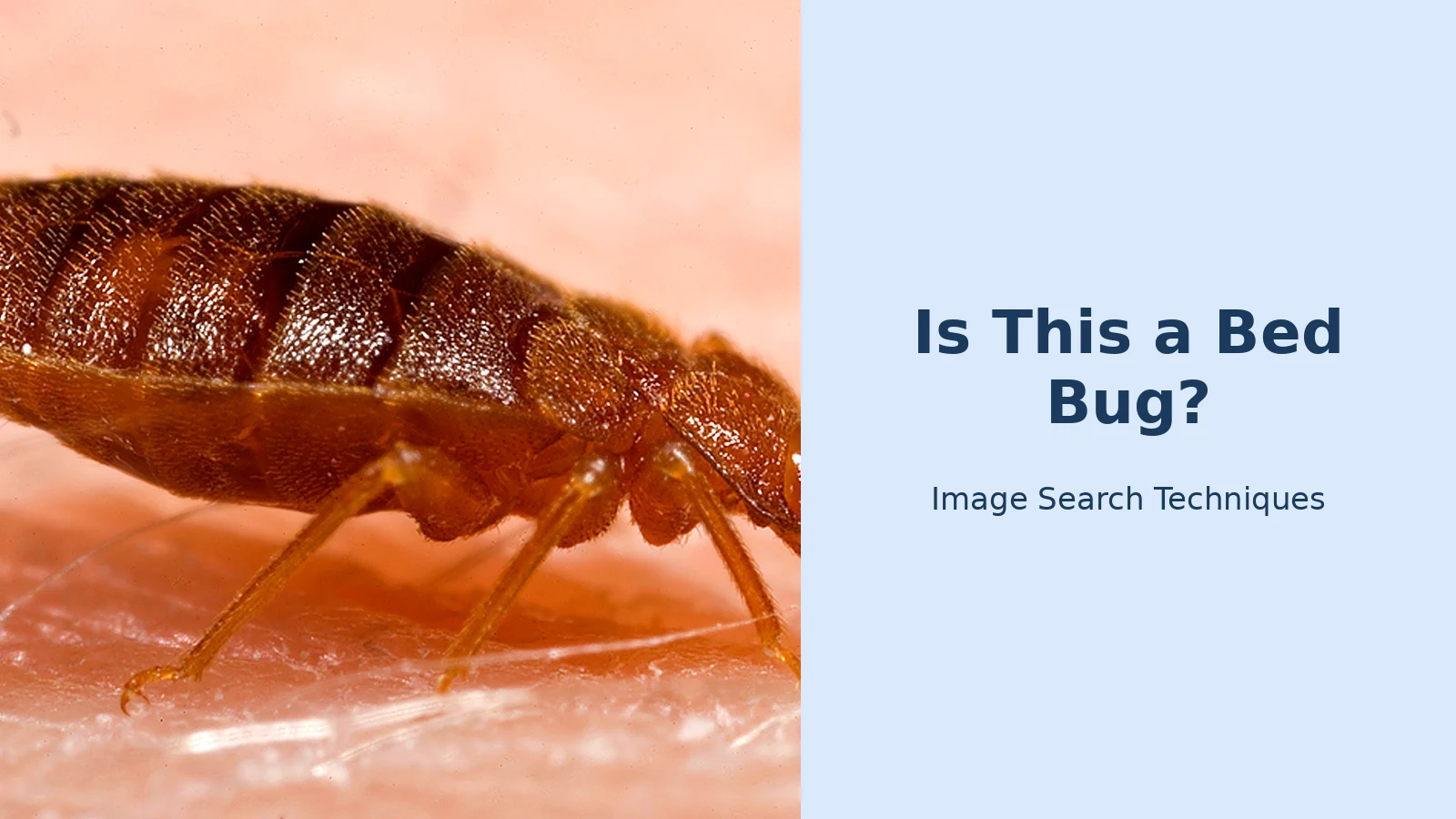
Start with the real thing. An adult bed bug, as the US Environmental Protection Agency (EPA) describes it, is about the size of an apple seed: 5 to 7 mm, or 3/16 to 1/4 inch, long, brown and flat when it has not fed, and swollen, longer and redder after a blood meal. The NHS gives the same picture in plainer terms: bedbugs are dark yellow, red or brown, and adults are around 5 mm long. The body is broadly oval, like an apple seed, with a head that is narrower than the body, six legs, short antennae with four segments, and small wing pads behind the head that never become wings. Bed bugs cannot fly, and they cannot jump.
That flatness matters more than most people expect. An unfed adult is flat enough to slip into a gap about as thin as a credit card, which is why they hide in mattress seams, screw holes and bed-frame joints. After feeding, the abdomen fills and stretches into a longer, cigar-like shape, and the red of the blood meal fades to a dark patch as it is digested. The same bug can therefore look quite different from one day to the next, so do not rule a photo out just because the bug in it looks fatter or paler than the textbook picture.
Young bed bugs, called nymphs, look like smaller, paler versions of the adults. The EPA says nymphs are translucent or whitish-yellow, and an unfed nymph can be nearly invisible to the naked eye because of its colouring and size. They pass through five stages before becoming adults, and each stage needs a blood meal before it can moult. A nymph that has just fed shows a bright red belly through its see-through body, which makes it much easier to spot. The EPA’s life-cycle sizes are:
| Life stage | Length | Colour | Compare it to |
|---|---|---|---|
| Egg | 1 mm | Pearl-white | A pinhead |
| 1st stage nymph | 1.5 mm | Clear to straw-coloured | A poppy seed |
| 2nd stage nymph | 2 mm | Pale tan, bright red when fed | Half a sesame seed |
| 3rd stage nymph | 2.5 mm | Light tan | A sesame seed |
| 4th stage nymph | 3 mm | Tan to light brown | A grain of rice, end on |
| 5th stage nymph | 4.5 mm | Light brown | A small lentil |
| Adult, unfed | 5–7 mm | Brown to reddish-brown, flat | An apple seed |
| Adult, just fed | Up to about 9 mm | Deep red, swollen and longer | A swollen apple seed |
Bed bug eggs are about 1 mm long, pearl-white and shaped like a tiny barrel or grain of rice. The EPA notes that eggs more than five days old show a dark red eye spot. Females glue them into cracks, seams and screw holes, often in small groups, and they hatch in roughly six to ten days. Finding eggs is strong evidence, because eggs do not move, but they are so small that most people find the droppings or shed skins first, which are covered below.
Three quick eliminations save most readers the rest of the guide. If the insect in your photo has hard, shiny wing covers, it is a beetle, not a bed bug. If it jumps, it is most likely a flea. If its antennae are longer than its head, or thread-like and sweeping, it is almost certainly something else: a bed bug’s antennae are short and stubby. Check those three things before anything else.
How do I photograph a bug so it can be identified?
A photo without a size reference is the main reason people cannot match a specimen online. Bed bugs are small, and a close-up with no scale makes a 2 mm nymph look identical to a 7 mm adult. Take five minutes and photograph the bug properly before you search the picture: it changes the quality of every answer you get afterwards.
- Add scale. Lay a ruler, a coin or the edge of a credit card next to the bug before you take the photo. A 10p coin is about 24.5 mm across, so a bug that spans a quarter of it is around 6 mm, adult bed bug size.
- Shoot from directly above. A top-down view shows the body shape, the plate behind the head and the banded abdomen. A side view hides the shape that matters most.
- Get the head in frame. Zoom in until the antennae are visible. Short, four-segmented antennae support a bed bug identification; long, thread-like antennae rule it out.
- Use bright, even light. A phone torch held to the side shows colour and texture better than direct flash, which washes a small brown insect out to pale grey.
- Photograph the hiding spot too. Droppings, eggs and shed skins near the bug help confirm the identification, and they photograph far more easily than a moving insect.
If the bug is already dead, photograph it on white paper with the scale beside it, the pale background makes the outline and legs easy to see. If it is alive, catch it first with clear tape or in a sealed jar; a photo of a bug under a glass is better than a blurry photo of one running away. And if your close-up still comes out soft, our guide to reverse image searching a blurry photo explains how to sharpen and search it anyway.
How do I search the photo to identify it?
Once you have a clear photo with scale, run it through a reverse image search. The aim is not to get a search engine to name the insect for you, it is to find labelled photos of the same insect, so you can compare the shape, antennae and size yourself. Our step-by-step guide to reverse image search covers the full method; the short version for a bug photo is below.
- Google Lens. Open Google Lens, upload your photo, and look at the visually similar images rather than the first text result. Lens is strongest when the photo is sharp and the bug fills the frame; crop tight around the insect before uploading.
- Yandex Images. Upload the same photo to Yandex Images, which is often better than Lens at matching small, ordinary insects, because its index is strong on reference and stock photos of common species.
- TinEye. Use TinEye to check whether your exact photo, or a near-identical one, already exists online with a label. If your “mystery bug” turns out to be a stock photo of a carpet beetle, TinEye will usually show you the original.
- Compare, do not accept. Whatever any tool suggests, check the match yourself against the three eliminations above: wing covers, jumping, and antennae length. A tool’s label is a lead, not a verdict.
Worked example: what actually happened when we tested this. On 12 November 2026 we took a public-domain photograph of an adult bed bug (Cimex lectularius, from Wikimedia Commons) and ran it through all three engines by image URL, exactly as a reader would. Google Lens returned a visual-search results page, but from a signed-out request it gave no readable identification text, so we could not rely on it. TinEye refused the request outright with a 403 bot-block, returning no result at all. Yandex Images worked: it labelled the photo as a bed bug (Cimex) and returned similar bed bug images. Two lessons follow from that honest result. First, no single engine is reliable for this job, so always try at least two. Second, the engines are at their best when the photo is a clean, well-lit reference shot, a blurry phone photo of a bug on a dark mattress is the hardest case, and that is when the scale photo and the comparison table below matter more than any search result.
Bed bug or something else? The look-alike table
Most “bed bug” photos people share turn out to be another insect. The table below is the heart of this guide: it compares a bed bug with the four look-alikes named in our research: carpet beetle (adult and larva), German cockroach nymph and booklouse, using only features you can check by eye or with a hand lens. Work across the row for what you found, and check the one feature that rules each look-alike in or out.
| Insect | Size | Shape and key tells | Antennae and legs | Where you find it |
|---|---|---|---|---|
| Bed bug (Cimex lectularius) | 5–7 mm adult | Flat, broadly oval, apple-seed shape; reddish-brown; banded abdomen; no wings | Short, four-segmented antennae; six legs | Mattress seams, bed frames, headboards |
| Carpet beetle, adult (Anthrenus) | 2–5 mm | Rounded, dome-shaped; hard wing covers with a centre line; often mottled white, brown and yellow | Short, clubbed antennae; six legs; can fly | Windowsills, wool clothing, light fittings |
| Carpet beetle, larva | 3–5 mm | Hairy, elongated, carrot-shaped body, often banded; looks like a tiny caterpillar | Short bristles all over; six legs; does not jump | Wool rugs, lint, cupboards, under furniture |
| German cockroach nymph (Blattella germanica) | 3–10 mm | Elongated, cylindrical body; long legs; fast-moving; two short tail parts (cerci) at the rear | Very long, thread-like antennae; six spiny legs | Kitchens, behind appliances, bathrooms |
| Booklouse (order Psocodea) | 1–2 mm | Pale, soft-bodied; wide head nearly as wide as the body; narrow “neck” | Long antennae; six legs; very small | Damp spots, old paper, stored grain, mouldy corners |
Carpet beetle or bed bug? This is the most common confusion, and it is also the easiest to settle. An adult carpet beetle has a hard, rounded shell with a visible centre line where the wing covers meet, and it is often mottled in white, brown and yellow. A bed bug is flat, smooth and unmottled, with no wing covers at all. The larva is even easier: it is hairy and elongated, like a tiny caterpillar, while a bed bug is smooth. If the insect in your photo is fuzzy, it is not a bed bug.
Cockroach nymph or bed bug? A young German cockroach is dark and small enough to be confused with a bed bug at a glance, but it gives itself away in three ways: its antennae are very long and thread-like, its body is elongated rather than broadly oval, and it runs fast. Bed bugs move slowly and deliberately. If the bug in your photo has antennae longer than its head, or you watched it sprint across the mattress, it is not a bed bug.
Booklouse or bed bug? Booklice are far smaller, 1 to 2 mm, pale and soft, with a wide head that is nearly as wide as the body and long antennae. They live in damp places where mould grows, such as old paper and stored grain. If what you found is barely visible without magnification and was in a damp corner rather than a bed, a booklouse is the more likely answer.
A note on bat bugs. Bat bugs are close relatives that look almost identical to bed bugs and can bite people when bats leave an attic roost. Telling them apart needs strong magnification: the fringe of hairs on the plate behind the head is shorter than the width of the eye in a bed bug, but as long as or longer than the eye in a bat bug. If bats or bird nests are near the room, send a specimen to an expert rather than deciding from a photo. The same caution applies to swallow bugs, which live in bird nests on buildings.
For comparison, the same photo skills work on other small creatures too: our guide to identifying a butterfly from a photo uses the same routine of scale, top-down shots and look-alike checks, and it is a useful next read if the insect you found has wings.
What signs around the bed back up a photo match?
A single photo is a lead. The signs around the bed are what turn a lead into a confident identification, because bed bugs leave traces even when the insects themselves are hiding. The US Centers for Disease Control and Prevention (CDC) lists the signs to look for as shed skins, rusty-coloured blood spots on mattresses or nearby furniture, and a sweet, musty odour. Check for all of them before you decide.
- Faecal spots. Bed bug droppings are digested blood. They look like dots from a fine black or dark-brown marker, about 1 mm across, and they soak into fabric like ink. The University of Tennessee describes a simple check: wipe a spot with a damp cloth, and bed bug faeces smear and run reddish-brown, while cockroach droppings do not run red. Look for clusters of these spots along mattress seams, where eggs and shed skins also collect.
- Shed skins. Every moult leaves behind an empty, pale tan skin shaped like the bug. Finding several shed skins of different sizes is a strong sign that bed bugs are breeding where you are looking, because it shows more than one life stage is present.
- Eggs and eggshells. Tiny pearl-white grains, about 1 mm, glued into cracks and seams, often in groups. Hatched eggs look like empty, slightly crumpled white shells with an open cap.
- Blood spots. Small rusty or red smears on sheets, often from a bug crushed after feeding. The CDC lists these among the signs of an infestation.
- Odour. A sweet, musty smell in a heavily infested room, also noted by the CDC. One bug will not produce it; a smell means numbers.
Where to look matters as much as what to look for. The CDC says bed bugs can travel over 100 feet in a night but tend to live within 8 feet of where people sleep. Start with the piping, seams and tags of the mattress and box spring, then the bed-frame joints, screw holes and the back of the headboard, then nightstands, drawers and the seams of nearby sofas and chairs. The NHS adds that bedbugs can hide on bed frames, mattresses, clothing and furniture, behind pictures and under loose wallpaper. Check luggage seams and straps after travel, before bags come into the bedroom.
Why a photo match is not proof of an infestation
This is the part most guides skip, and it is the part that saves readers money. A photo that matches a bed bug proves that the insect in the photo looks like a bed bug. It does not prove that bed bugs are living in your home.
First, one bug is not an infestation. A single bed bug can arrive on luggage, second-hand furniture or a visitor’s coat, and never establish itself. The CDC notes that bed bugs spread by getting into the seams and folds of luggage, overnight bags, folded clothes and bedding, and most people do not realise they are transporting them. Finding one insect, with no eggs, skins or faecal spots nearby, is a reason to inspect carefully, not a reason to book a treatment.
Second, a photo cannot rule out the close relatives. As noted above, bat bugs and swallow bugs are nearly identical to bed bugs in a photograph, and only an expert with magnification can separate them. If the room is near a bat roost or a bird nest, the identification is genuinely uncertain until a specimen is examined.
Third, the stakes of a wrong answer are high in both directions. Treating for bed bugs when the insect is a carpet beetle wastes money and exposes your home to chemicals for no reason. Ignoring a real bed bug match lets a small problem grow: the CDC notes that early detection and eradication make infestations easier to control. So treat a photo match as the trigger for a proper inspection, not as the final word. Do not spend on sprays, foggers or a treatment contract until a professional, or your local extension service, has confirmed the identification from a specimen or the signs above.
What to do next if your photo matches
If your photo matches a bed bug and the signs around the bed agree, act calmly and in this order. Do not move furniture or bedding to other rooms, which spreads the bugs. Wash affected bedding and clothing on a hot wash, the NHS advises 60°C with a tumble dry on a hot setting for at least 30 minutes, and put items that cannot be washed in a sealed plastic bag in the freezer for two to three weeks. Vacuum seams and cracks thoroughly, then seal and discard the vacuum bag outside. Fit zippered bed bug encasements on the mattress and box spring, and place interceptor cups under the bed legs if you use them.
Then get a professional in. The CDC’s advice is direct: if you think you have a bed bug infestation, contact a professional pest control company experienced with treating bed bugs. In the UK, the NHS advises contacting your local council or pest control service, and notes that bedbugs are very difficult to get rid of yourself because they can be hard to find and may be resistant to some insecticides. The EPA points readers in the United States to their state cooperative extension service, which can confirm an identification from a specimen. Keep the specimen you photographed, in a sealed jar or on clear tape, because a professional identification is faster and more certain with the insect in hand than with a photo alone.
Keep a record as you go: dated photos of the insect with a scale, photos of the signs, and notes of where each was found. If you are renting, that record is what your landlord or letting agent needs to act. If you found the bug in a hotel or a holiday let, the same record supports a report to the property, and the photos you took are the evidence.
A photo is the fastest way to start identifying a bed bug, and for most people it is enough to separate a real bed bug from a carpet beetle, a cockroach nymph or a booklouse. But the photo is the beginning of the identification, not the end of it. Match the shape, the antennae and the size; check the signs around the bed; and let a professional confirm it before you spend anything on treatment. That sequence: photo, signs, professional, is what turns a worrying picture into a certain answer. For the full method, the EPA’s bed bug appearance and life cycle guide is the reference this article is built on, and the NHS bedbugs page is the best starting point for UK readers deciding what to do next.
Can you tell from a photo whether something is a bed bug?
Often, yes, if the photo is clear and has a size reference. An adult bed bug is flat, oval and reddish-brown, 5 to 7 mm long, with six legs, short antennae and no wings. But a photo is a starting point, not proof of an infestation, confirm it with the signs around the bed and a professional inspection first.
What bug looks like a bed bug but is not?
The usual mix-ups are carpet beetles, German cockroach nymphs and booklice. A carpet beetle has a hard, domed shell and is often mottled; its larva is hairy. A cockroach nymph is elongated, fast-moving and has very long antennae. A booklouse is pale, soft and only 1 to 2 mm long. Use the comparison table above to check each one.
How big is a bed bug in a photo with no scale?
Without a scale, size is easy to misjudge, because a close-up makes a 2 mm nymph look like a 7 mm adult. Compare the bug with something in the frame, such as a mattress seam, a screw head or the weave of the fabric. If nothing gives scale, re-photograph the insect next to a coin or ruler before deciding.
I found a bug in my bed: should I spray it straight away?
No. Do not spray, fog or buy a treatment contract until the identification is confirmed. A photo match is the trigger for a careful inspection, not a diagnosis. Check for faecal spots, shed skins and eggs around the bed, keep the specimen, and contact a licensed pest professional or your local council first.