🔎 Reverse Image Search
Image search techniques made simple: upload a photo or paste a URL and search 6 engines at once. 100% free, nothing stored.
🔒 Your image is never stored on our servers longer than 24 hours and is never shared.
Every Blue Badge application needs a photo of the badge holder, and it is the part of the form most likely to cause a delay. The photo goes on the back of the badge itself, so the council checks it against a national standard. This guide explains the blue badge photo requirements in full: the national rule, what councils actually ask for, and how to take a photo that passes first time.
The short answer: a Blue Badge photo must be a recent, colour, head-and-shoulders photo, 45mm high by 35mm wide, taken against a light grey or cream background, with your head visible and nobody else in the frame. The national law says within the month before you apply, but many councils accept older photos, so check your council’s page. A phone photo is fine.
A Blue Badge is a parking permit for people with a disability or health condition that affects mobility. The photo on it proves the badge belongs to the person showing it. That is why the rules are strict about likeness, and why a photo that looks fine to you can still be sent back. The same face-photo checks apply across official documents, and our face search and photo privacy guide explains how a photo of your face can be traced online.
What are the blue badge photo requirements?
The standard is written into law, not just guidance. The Disabled Persons (Badges for Motor Vehicles) (England) (Amendment) (No.2) Regulations 2011 set out what the photo on an individual badge must be. It must be a close-up digital photograph of the head and shoulders of the badge holder, with a strong definition between face and background. It must be in colour, 45 millimetres high and 35 millimetres wide, taken within the month before the application, against a light grey or cream background, undamaged, and free from redeye, shadows, reflection or glare from spectacles.
GOV.UK keeps it simpler on the application page. It asks for “a recent digital photo showing your head and shoulders” and lists it alongside proof of identity, proof of address and proof of benefits. The same page states the fees: a Blue Badge costs up to £10 in England and £20 in Scotland, and it is free in Wales. Badges usually last up to three years, and councils usually decide within 12 weeks.
The scale of the scheme explains why the photo rules matter so much. According to the Department for Transport’s Blue Badge Scheme Statistics, 3.07 million valid Blue Badges were held in England as of 31 March 2025, up 8 percent on the year before. That is about one in twenty people in England. Every one of those badges carries a photo, and every renewal needs a fresh decision about whether the old photo still looks like the holder.
Why do councils disagree about how recent the photo must be?
This is the question that causes the most confusion, and it has a simple cause. The national law says within the month. Councils then write their own application pages, and many of them soften that rule or leave it out. Nobody is breaking the law by accepting a six-month-old photo. The council is the body that issues the badge, and it decides what it will accept. Bus passes work the same way: our guide to bus pass photo rules compares what eight English councils actually publish, side by side.
We re-checked a sample of council pages on 13 November 2026. The differences are real, and they are all live right now.
| Council | How recent must the photo be? | Background | Anything else worth knowing |
|---|---|---|---|
| Southend-on-Sea | Within the month before the application | Plain light grey or cream | Follows the national wording exactly, including neutral expression and mouth closed |
| Hillingdon | Taken some time over the last 6 months | Plain, light, such as a white wall | Must be different from the photo on your previous badge |
| East Sussex | Taken in the last 3 months | Same as a passport photo | Minimum 16-week wait at the time of writing; pay £10 only after approval |
| North Northamptonshire | Taken within the last 6 months | Plain, light background | £10 charge; you can photograph documents with a phone |
| Knowsley | No recency stated | Plain light-coloured background | No filters allowed; free digital photo service at Knowsley libraries |
| Nottinghamshire | Must be a true likeness | Plain, well-lit background | A previous photo can be reused on up to three badges |
| Medway | Recent photo for new applications | Not specified on the page | For renewals, the council can reuse the photo on your current badge; £10 fee |
| Camden | A recent photo, a true likeness of you as you are now | Light grey or cream | Full guidance notes; photo must be in daylight or bright white light |
| East Ayrshire (Scotland) | Not stated on the page | Not specified on the page | £20 fee in Scotland; name written on the back of a printed photo |
The pattern is clear. Councils that copy the national wording ask for a photo from the last month. Councils that write their own pages usually say three or six months, or just say “recent”. None of them is wrong. They are all applying the same scheme with different local wording.
The practical rule follows from the table. Take a new photo for every application. If your council says six months, a new photo still passes. If your council says one month, only a new photo passes. A fresh photo is the one choice that works everywhere, and it costs nothing when you take it on a phone. Other official photos work the same way. Each railcard has its own photo rules, and the pattern of one national idea with local variations repeats there too.
What does a passing Blue Badge photo look like?
Put the national standard and the council pages together and a passing photo has the same features everywhere. Check yours against this list before you upload it.
- Colour, not black and white. Every council says this. A black-and-white print or a photo converted to greyscale will be rejected.
- Head and shoulders only. Frame from the top of your head to just below your shoulders. A full-body photo or a tight crop that cuts off your chin will not do.
- Your full head in the frame. Nothing missing at the top, the chin or the ears. If you cover your head for religious or medical reasons, the covering is fine, but your face must still be fully visible.
- Facing the camera, looking straight at it. No side profiles, no looking down, no looking over your shoulder.
- Eyes open and clearly visible. No sunglasses, no tinted lenses, no hair across your eyes. Clear glasses are usually fine as long as there is no glare and the frames do not cover your eyes.
- Neutral expression, mouth closed. Southend and Camden both state this plainly. A broad smile is the most common reason a photo that looks friendly fails the rules.
- Plain, light background. The law says light grey or cream. Councils accept a plain white wall. What matters is a strong definition between your face and what is behind you, with no pattern, no doorway and no people.
- Sharp, in focus, evenly lit. No blur, no shadows on your face, no redeye, no reflection. Daylight or bright white light works best.
- Only you in the photo. Nobody holding you up, nobody standing beside you, no hands visible. This is the rule that causes the most trouble for people who need support to sit upright, and the alternatives section below covers it.
- Unaltered. No filters, no beauty mode, no retouching. Knowsley states this directly: filtered digital photos are not allowed and will be rejected.
If you are applying by post with a printed photo, write your name clearly on the back. Southend, East Ayrshire and Slough all ask for this. It sounds old fashioned, but a loose print with no name on it can be separated from its form.
How to take a Blue Badge photo at home
You do not need a photo booth. A phone camera is enough, and most councils say so on their pages. The file rules are similar to other official photo uploads, including the UK eVisa photo rules. A UK visa photo upload has its own file rules too, covered in our guide to fixing a failed UK visa photo upload. The method below takes about five minutes.
- Pick your spot. Stand or sit about a metre in front of a plain light wall. A pale painted wall, a closed light-coloured door or a plain sheet hung flat all work. Avoid a window behind you, which turns your face into a silhouette.
- Face the light. Turn so the main light source, ideally a window, is in front of you or slightly to one side. The light should fall evenly on your face with no shadow on the wall behind you.
- Ask someone else to take it. A photo taken by another person at your eye height, about 1.5 metres away, looks far better than a selfie at arm’s length. Selfies distort the shape of the face and often cut off the shoulders.
- Frame head and shoulders. Leave a small gap above your head and include your shoulders. Do not zoom in so tight that your ears or chin are cropped.
- Look straight at the camera, mouth closed, eyes open. Take several shots and pick the most neutral one. A relaxed face beats a forced smile here.
- Check it on a big screen. Open the photo on a tablet or computer before you upload it. Check the focus, the background and whether anything else has crept into the frame. A phone screen hides blur that a council officer will spot.
- Upload the original file. Do not screenshot the photo, do not crop it inside a messaging app, and do not apply a filter. Upload the file the camera made, or a clean crop of it.
If you are renewing and your appearance has not changed much, some councils will reuse your old photo. Nottinghamshire says a previous photo can be used on up to three badges. Medway says it can reuse the photo on your current badge for a renewal. Do not assume this. If your appearance has changed, send a new photo even if your council offers reuse.
What if a standard photo is hard to take?
Many Blue Badge applicants cannot easily stand against a wall or sit in a photo booth. The scheme recognises this. The government’s guidance to councils says that people who cannot use photo booths, for example wheelchair users, should be asked for a suitable photograph taken by other means, and that councils may offer webcam facilities for taking one.
Southend’s page repeats this in plain terms: if you are unable to access a photo booth, you may provide a suitable clear photo taken by other means that can be cut down to the right size, and no other person should be visible in the photo. That one sentence covers most situations.
Practical alternatives that work:
- Sit where you are. Nothing in the rules requires you to stand. Sit in your chair or wheelchair in front of a plain light wall or a pale sheet hung behind you. Keep any headrest or supporting hand out of the frame.
- Ask your council to take it. Some councils offer to take the photo themselves, or have a library or customer service point that can. Knowsley runs a free digital photograph service for Blue Badge applicants at its libraries.
- Use a webcam appointment. The guidance allows councils to offer webcam facilities. Ask your council whether this is available before you struggle with a home setup.
- Explain what cannot be changed. If a condition affects your expression, the position of your head or your eyes, say so when you apply. Councils apply the photo rules with judgement, and a short note with the application helps the person checking it.
- Take the photo lying down if you must. If you cannot sit upright, a photo taken from above against a plain sheet still meets the standard, as long as your face is straight to the camera and the framing is head and shoulders.
Do not let a helper’s hands or arms appear in the shot. If someone needs to steady your head, take the photo, then crop tightly enough to remove them while keeping your full head and shoulders in the frame.
Worked example: testing a real photo against the rules
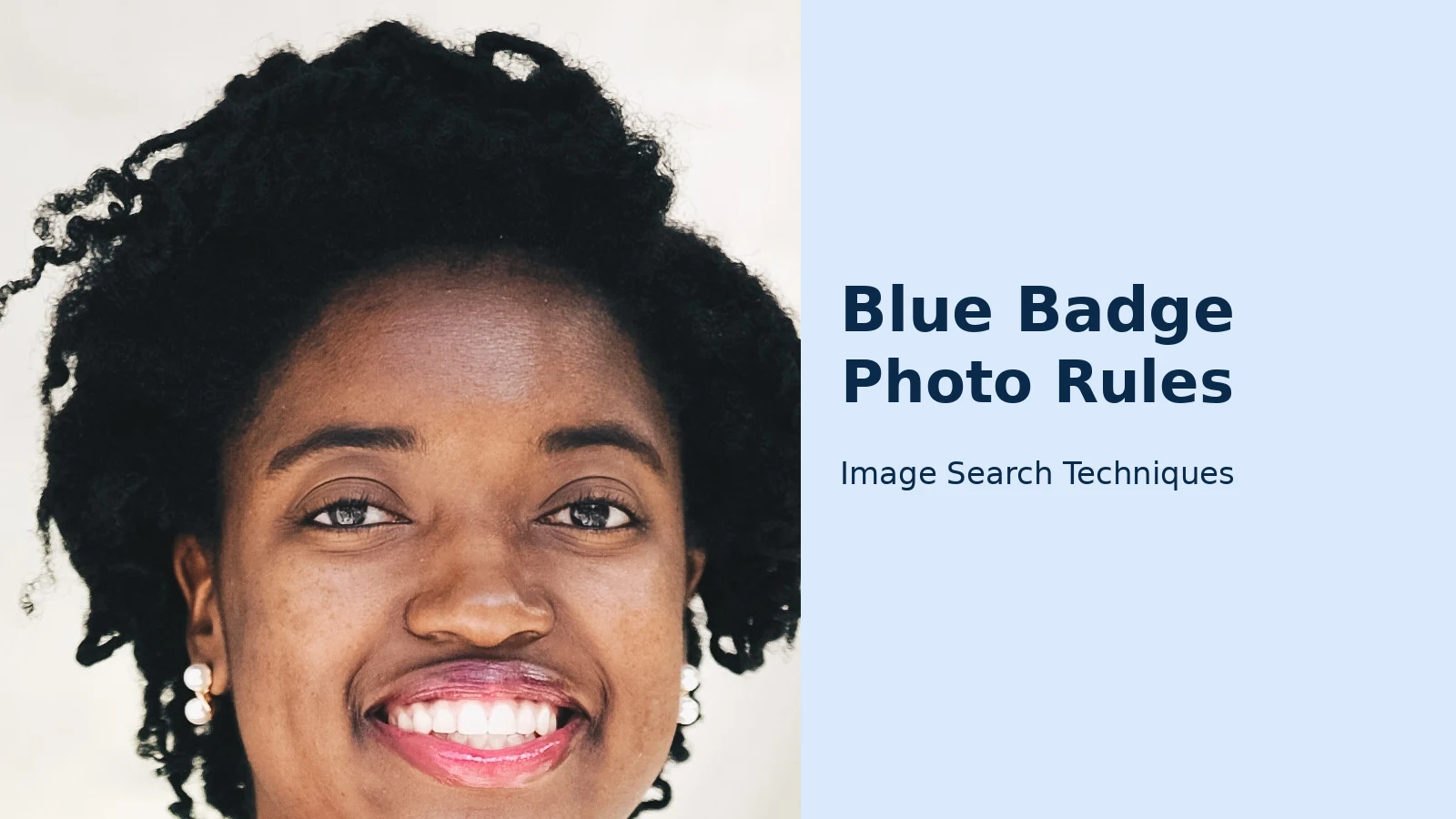
To show how the checks work in practice, we took a real portrait photo and judged it against the Blue Badge rules, then ran it through our own reverse image search tool to see where else that photo appears online. The photo is a CC0 portrait from Wikimedia Commons, “Woman smiling pink shirt2.jpg”, a colour head-and-shoulders style shot of a smiling woman in a pink top.
Judged against the rules, this photo would fail as a Blue Badge photo for three reasons. First, the expression: she is smiling broadly with teeth showing, and the rules ask for a neutral expression with the mouth closed. Second, the background: she is standing on a porch with pillars, greenery and a bright sky behind her, not a plain light grey or cream wall. Third, the framing: the shot runs to her waist, not head and shoulders, so it would need cropping. On the plus side, it is in colour, sharp, evenly lit, and shows her full head facing the camera with her eyes open. The lesson is that a good portrait and a passing badge photo are different things, and the differences are exactly the items on the checklist above.
We ran the photo through the four search engines on our own reverse image search tool on 13 November 2026, using the photo’s Wikimedia Commons URL. Here is what each engine actually did.
| Engine | What happened | Did it find the source? |
|---|---|---|
| Google Lens | Ran with no error and no CAPTCHA. It listed 10 exact matches, all from pexels.com, two distinct Pexels photos from 6 to 7 June 2018 in several language versions. It gave no subject name and no total count. | No. No Wikimedia Commons result appeared. |
| TinEye | Ran after a short Cloudflare check cleared by waiting. It reported 15 results from 86.7 billion images searched, first indexed 31 August 2018. Page one was all Pexels results. Page two included the Commons file page, 2304 by 3456 pixels, 648.1 kB, dated 8 November 2023. | Yes, on page two. |
| Bing Visual Search | Ran with no error. It read the photo as “Pink Off-Shoulder Top With Black Skirt Outfit” and reported 3,840 results for that query. “Pages with this image” listed only two pages, on pay.hotmart.com and prep-1st.com. The first visual match tile showed the same photo on kaschristian.com. | No. No Commons result appeared, and Bing did not identify the subject. |
| Yandex Images | Ran with no error. It described the photo only in general terms, listed 14 sizes from 2304 by 3456 down to 120 by 180, and 40 similar images. Its sites list was headed by the Wikipedia file page for this exact photo. | Yes, as the top result. |
Two engines traced the photo to its Wikimedia file page and two did not. That split is the point. A single engine can miss the source entirely, and the engine that misses it is often the one people try first. If you are checking a photo before you upload it anywhere, run it through more than one engine. And note what none of the engines did: none of them named the woman in the photo. A reverse search finds copies of a picture. It does not identify the person in it, and it should never be treated as proof of who someone is.
The privacy check matters too. A photo you upload to a council form is a personal image, and it is worth knowing whether that same photo is already public online before you send it anywhere. If a reverse search finds the photo on stock sites or social media, that tells you the file has travelled, and you may prefer a fresh photo taken for the application instead of reusing one from the internet.
Renewals, children and applying for someone else
A Blue Badge usually lasts up to three years, and you must reapply before the current one expires. Renewal is not automatic. Your council reviews eligibility again, and in some cases asks for a mobility assessment. For the photo, the same rules apply, with one difference: some councils will reuse the photo from your current badge if your appearance has not changed. Medway does this, and Nottinghamshire allows a previous photo to be used on up to three badges. If your appearance has changed, send a new photo. East Sussex asks for a photo taken in the last three months with a renewal, and applies the same requirements as a passport photo.
You can apply on behalf of someone else, such as a parent or a child. The photo must be of the badge holder, not the person filling in the form. For a child, the plain expression and eye contact rules are harder to meet, so take several photos and choose the most neutral one. Our guide to baby and child passport photo rules covers the same situations in detail. Children under three can qualify where a medical condition means they must always be accompanied by bulky medical equipment, or need to be kept near a vehicle at all times for treatment. The same head-and-shoulders, plain-background standard applies to their photo too.
Organisational badges are different. They carry the organisation’s stamp or logo in the space where an individual’s photo would go, so no photo of a person is needed. Southend states this on its page, and it is set out in the same 2011 Regulations.
What happens if your photo is rejected?
A rejected photo does not mean a rejected application. It means a delay. Your council will ask for a new photo, and the application waits until one arrives. That is why the photo is worth getting right before you submit. East Sussex currently warns of a minimum 16-week wait for a completed application, and further delays if documents are wrong or an assessment is needed. Other councils quote around 12 weeks. A photo sent back for a retake adds weeks to either figure. A CSCS card photo works the same way: if it fails, CSCS asks for a new one and approval waits, as our CSCS card photo requirements guide explains.
The same applies to other government photo checks: if your GOV.UK One Login identity check failed, the photo ID scan and the face scan are where the fix sits, not in a new document. The same pattern holds for security licences: our guide to SIA licence photo requirements covers the Security Industry Authority’s six rules, including the white-or-cream background rule and the three routes your photo can take.
If your application itself is refused, the council should tell you why. You can ask it to reconsider if you do not think all the important information you provided was taken into account, and you can reapply if your mobility problems become more serious. GOV.UK states both of these routes on the application page. A photo problem is the easiest refusal to fix, because the fix is a new photo taken to the checklist above. The same rejection reasons apply to passport photos, and our guide to fixing a rejected passport photo walks through them.
One last check before you send anything. Open your council’s Blue Badge page and read its photo section, not a summary of it. Council pages change without warning, and this article’s table is a snapshot from 13 November 2026. The blue badge photo requirements are simple once you separate the national standard from the local wording, but the local wording is what your council applies. If your council’s page and this guide ever disagree, follow your council’s page, because it is your council that issues the badge.
How much does a Blue Badge cost, and how long does it last?
The fee depends on where you live. GOV.UK states that a Blue Badge costs up to £10 in England and £20 in Scotland, and is free in Wales. Some councils charge less than the maximum, and some charge nothing at all for a replacement, so the figure on your council’s page is the one that applies to you. East Ayrshire in Scotland charges the full £20, while most English councils in our sample charge £10. Badges usually last up to three years from the date of issue, and the photo on the badge is printed at the same time, which is why a photo that no longer looks like you can cause problems at renewal.
Can I take my Blue Badge photo on my phone?
Yes. GOV.UK asks for a digital photo, and most councils say a phone photo is fine. Have someone else take it at your eye height against a plain light wall, about 1.5 metres away. Check the focus and background on a bigger screen before you upload the original file, with no filter applied.
How recent does my Blue Badge photo need to be?
The national law says within the month before you apply, but councils differ. Southend follows the one-month rule, East Sussex asks for the last three months, and Hillingdon and North Northamptonshire accept six months. Take a new photo for every application, because a fresh photo passes under every council’s wording.
Can I wear glasses in my Blue Badge photo?
Yes, if you normally wear them, as long as your eyes are open and clearly visible. The lenses must not be sunglasses or tinted, and there must be no glare, reflection or shadow hiding your eyes. If the frames cover your eyes or catch the light, take the photo without them or move the light source.
What happens if my council rejects my Blue Badge photo?
Your application is delayed, not refused. The council will ask for a new photo and the application waits until one arrives. Check the photo against the national standard, take a fresh one on a plain light background, and send it promptly. A photo sent back for a retake can add weeks to a wait that is already around twelve weeks.