🔎 Reverse Image Search
Image search techniques made simple: upload a photo or paste a URL and search 6 engines at once. 100% free, nothing stored.
🔒 Your image is never stored on our servers longer than 24 hours and is never shared.
Short answer: Check fake tenant documents by looking for inconsistencies inside the photos, then verifying the income at its source. A payslip or bank statement photo is only a claim. The checks that matter are whether the figures reconcile, whether the employer and previous landlord can be reached through independently found contact details, and whether the salary actually lands in the bank account.
A fake tenant document is a payslip, bank statement, employment letter or reference that has been altered, or created from scratch, to make an applicant look as though they earn more than they do, or to hide a history a landlord would want to know about. This guide is for landlords checking an application. It covers detection signs only, at the level legitimate referencing agencies publish. It contains no instruction, tool or template for creating or editing documents, in any section, including the FAQs. If the checks below leave you in doubt, the safe route is professional referencing and Open Banking verification, not a do-it-yourself verdict.
Tenant referencing fraud has grown sharply. Goodlord, analysing more than 300,000 tenancy applications, found that fraud rates rose by 140% between 2022 and 2023, from 1.2 to 2.9 cases per 1,000 applications, and that 58% of all fraudulent applications detected in 2023 involved fake or doctored payslips, according to PropertyGoose’s summary of that research. Homeppl’s 2024 report found that 94% of the fraud cases it caught involved fake documents, with doctored bank statements the single most common type, in 81% of cases. Homeppl also estimates the average cost of a fraudulent tenancy to a landlord, once eviction and legal fees are factored in, at around £64,000. Those figures explain why a careful photo check is worth an hour of your time, and why it must be followed by verification at source.
What is a fake tenant document?
A fake tenant document is any application document that misrepresents the applicant’s income, employment or rental history. The most common types are doctored payslips, altered bank statements, invented or embellished employment references, and references from a previous landlord who does not exist or cannot be reached. Tax records and identity documents are faked too, though less often than payslips and bank statements. Less often, the whole identity is assembled from real and invented details, a pattern referencing firms call a synthetic identity. The document usually looks professional. Modern editing software can make an altered statement, payslip or letter appear convincing at first glance, which is why a quick look at the photo is never enough on its own.
Understanding the motive helps you know where to look. Affordability checks are the keystone of most referencing: if an applicant meets the income threshold, the other checks tend to follow. So the forgery usually targets the income figure. A payslip is edited to show a higher salary, a bank statement is altered so the salary credits match the edited payslip, and an employer letter is produced to back both up. Each document supports the others, which is why you should check them against each other, not one at a time. A single document can be made to look perfect; a set of documents that all have to agree with each other is much harder to keep consistent.
There is also a difference between a document that is fake and a document that is merely messy. A genuine payslip from a small employer can look rough, use an unusual layout, or carry a handwritten correction. A genuine bank statement can be a scanned printout with a coffee stain. Do not treat unfamiliar formatting as proof of fraud. The signs below are reasons to dig further, not verdicts. A clean document is not proof of honesty either: as Vorensys notes in its rental-fraud guide, some forgeries now start from a genuine PDF, so the formatting is perfect because the original was real and only the figures were changed.
Finally, keep the two sides of the rental market separate. This article is about an applicant’s documents. The mirror problem, a tenant checking a landlord’s listing photos before paying a deposit, is covered in our guide to rental listing scams and how to check the property photos. The photo skills overlap, but the checks, the evidence and the reporting routes are different. And once the tenancy starts, the tenant’s own photos matter just as much: move-in photos that win deposit disputes are the dated record that answers a deduction at check-out. The other mirror problem is a notice arriving on a tenant’s own door: our fake eviction notice check covers the tenant-side checks, starting with the court case number.
What are the signs in a payslip photo?
Start with the payslip, because it is the document most often doctored. Work through it slowly, zoomed in, and compare it with the other documents rather than judging it alone. The checks below are the ones referencing agencies publish as detection signs. None of them proves a document is fake on its own. Two or three together should stop the application until the income is verified at source.
Do the figures reconcile? On a real payslip, the maths works: gross pay, minus income tax, minus employee National Insurance, equals net pay. Check the year-to-date figures too: they should grow steadily month by month, and the current month’s gross should be consistent with the year-to-date total for the number of months worked. A payslip where the tax does not match the gross, or where the year-to-date total jumps by an amount that does not match the monthly figure, is a strong reason to pause. PropertyGoose’s tenant-fraud guide makes the same point: on a real payslip, the maths works, and the figures that do not reconcile are the ones that give a forgery away.
Does the tax code look right? The standard PAYE tax code for 2024/25 was 1257L, reflecting the £12,570 personal allowance, according to PropertyGoose. A code that does not match the applicant’s circumstances, or a code that changes from month to month without explanation, deserves a question. Do not treat an unusual code as proof of fraud, codes change for legitimate reasons, such as a second job or a benefits adjustment, but do ask the applicant to explain it, and check the explanation against the employer’s confirmation.
Is the National Insurance number in the right format? A valid National Insurance number follows the format of two letters, six digits and one letter, with the final letter being A, B, C or D, for example, AB123456C. A number that breaks that pattern, or a number that differs between the payslip, the bank statement and the application form, is a detection sign. Never share an applicant’s National Insurance number with anyone outside the referencing process, and never store it longer than you need it.
Look at the fonts, spacing and alignment. Real payslips are machine-generated, so their layout is boringly uniform: the same font throughout, even spacing, aligned columns. A forgery assembled from pieces often betrays itself here. Look for mixed fonts within one document, a line of text in a slightly different weight from the rest, figures that sit a few pixels off the column, or a logo that is sharper or blurrier than the text around it. The same visual discipline applies to any photo of a document: our guide to checking whether a screenshot is real explains how to read fonts, spacing and alignment in a captured image, and the same habits work on a photographed payslip. AI-made fakes are harder to catch this way: the layout, logo and figures can all look clean and plausible, so a tidy document is not proof it is genuine.
Check the dates and the pay pattern. Monthly pay should land on the same date, or the same working day, each month. A payslip dated on a Sunday for a company that pays on the last working day, or three payslips with pay dates that drift without pattern, should prompt a question. Compare the pay date on the payslip with the salary credit date on the bank statement: the two should match, or sit within a day or two of each other. If they do not, one of the documents is wrong.
Check the employer details on the document. Does the company name, address and payroll reference match the employer’s public presence? A payslip naming a company that has no website, no Companies House record and no traceable address is a warning sign, not a verdict, small employers can be hard to find online, but it is a reason to verify the employer independently, as the next-but-one section explains. A logo that looks stretched, low-resolution or pasted over the background is worth a closer look: reverse-search the logo image itself to see whether it was lifted from a different company’s website. Our step-by-step guide to how to reverse image search shows how to run that check from a photo.
| Detection sign | What it may mean | What to do next |
|---|---|---|
| Gross, tax and net pay do not reconcile | Figures were changed after the payslip was generated | Ask for the next two months and check the year-to-date figures |
| Tax code does not fit the applicant’s circumstances | Code copied from another person’s payslip | Ask for an explanation and confirm it with the employer |
| Mixed fonts or misaligned columns | Text was typed over the original document | Request the original file and compare it with the photo |
| Pay dates drift without pattern | Dates were edited to fit a story | Match each pay date against the bank statement credits |
| Employer has no public trace | Employer may not exist as claimed | Verify the company independently before proceeding |
| Salary on the payslip never lands in the bank | Income figure is not real | Verify income at source through Open Banking or HMRC records |
One caution runs through all of this. A single oddity is usually innocent: payroll software changes, employers rebrand, tax codes move. It is the pattern that matters. One unexplained inconsistency is a question. Three is a reason to stop and verify at source before you hand over keys.
How do you check a bank statement photo?
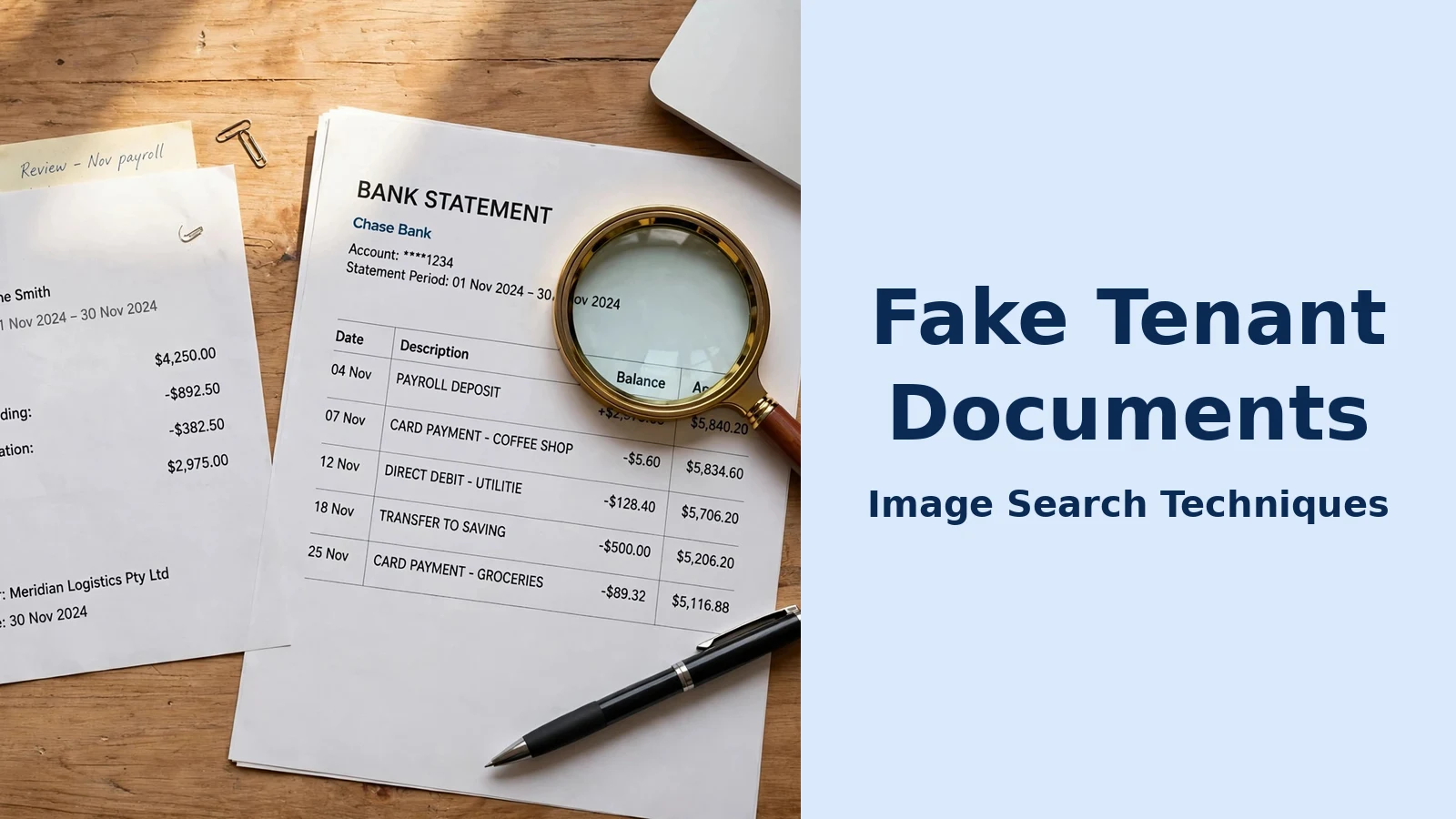
Bank statements are the hardest document to fake well and the easiest to check badly, because most landlords only glance at the balance. The balance is the least informative number on the page. What matters is the pattern of money moving in and out over three months, and whether that pattern matches the story the payslips tell.
Trace the salary credits. Ask for three months of statements and follow the salary line. Genuine payroll credits are consistent: the same amount, on the same date or working day, from the same originator reference, month after month. The reference usually names the employer or the payroll provider. If the salary credit changes amount without explanation, arrives from a personal account rather than a business payroll, or appears under a different reference each month, ask why. Homeppl’s 2024 report found that doctored bank statements were the single most common type of fake document it caught, in 81% of its fraud cases, and the most common alteration is exactly this: a real statement with the salary deposits inflated, or regular loan repayments removed. That is why the credit line, not the balance, is the check that counts.
Look for the mundane noise of real life. A genuine three-month statement is messy. It shows direct debits, utility bills, groceries, transport, the occasional takeaway, and a balance that rises and falls. A statement showing only tidy salary credits and nothing else warrants scrutiny, as PropertyGoose notes: real life leaves a trail, and a statement without one has usually been cleaned up. Equally, look for what has been removed rather than what has been added. Regular loan repayments, gambling transactions or payments to another landlord that vanish between months are worth a question, because they change the affordability picture the statement is supposed to show.
Reconcile the statement against the payslip. The net pay on each payslip should appear as a credit on the statement within a day or two of the pay date, for the same amount. Do this month by month, not just once. A payslip claiming £2,800 net pay with a statement showing a £2,100 credit is not a rounding error; it is a contradiction. The worked example later in this guide walks through exactly this mismatch on a staged application, so you can see how the cross-check works in practice.
Check the statement as a file, not just as a picture. Ask for the original PDF or the downloaded statement from the applicant’s banking app, rather than a photograph of a printout, wherever possible. A photograph hides the file’s properties; an original file lets you see whether the document opens as a genuine bank download, whether the pages are consistent, and whether the statement’s formatting matches the bank’s current layout. If the applicant can only supply photographs, zoom in on the same details as the payslip: mixed fonts, figures that do not align, a balance column whose running total does not add up. A running balance that does not reconcile from one line to the next is a strong detection sign, because it means individual lines were changed after the statement was produced.
Do not ask for more than you need. A landlord checking affordability needs the salary credits, the regular outgoings and the running balance. You do not need the applicant’s full transaction history, account numbers or sort codes, and you should not ask the applicant to share their online banking login, no legitimate referencing process needs it. Ask the applicant to redact account numbers and sort codes before sending statements, keep the files in a password-protected folder, and delete them once the tenancy decision is made if the application fails. The data-handling section near the end of this guide covers the UK GDPR care this requires.
How do you check the employer and the previous landlord?
Documents can be forged; independent verification is much harder to fake. The rule that runs through every referencing guide is the same: never verify an employer or a landlord using contact details supplied by the applicant. Look the organisation up yourself, and contact it through the details you find.
Verify the employer exists. Search the company name on Companies House, the UK’s official register of companies, where you can check whether the company is active, when it was incorporated, and who its officers are. The free Find and update company information service lets anyone search the register by company name or number without an account. A company that was incorporated last month, or one whose registered office is a residential address with no trading history, is not proof of fraud, new companies are legitimate, but it changes how much weight you should put on an employer reference from that company, and it is a reason to ask for more evidence.
Contact the employer through its own channels. Find the employer’s official website and call the main switchboard number, not the direct line or mobile number printed on the reference letter. Ask to be put through to HR or payroll, and confirm the applicant’s job title, start date and salary band. Vorensys makes the same point in its rental-fraud guide: fake employer reference letters often carry HR contact details that ring through to the applicant or an accomplice, so the call only counts if you dialled a number you found yourself. If the employer is a large organisation, check whether the reference letter’s email domain matches the employer’s real domain, a reference sent from a free webmail address for a company that issues its own staff email addresses is a warning sign. Goodlord’s research, reported by Simply Business in September 2026, found that fake employment references were the fastest-growing type of tenant fraud, up 226%, with scammers using real company email addresses and authentic-looking payslips to make the reference seem legitimate.
Reverse-search the letterhead and logo. An employer letter is a photo of a document, and the same image-search skills that catch a stolen listing photo work here. Save the letterhead logo, crop to the logo alone, and run a reverse image search to see where else that logo appears. If the logo belongs to a different company, or appears on a template site, the letter was assembled rather than issued. A reverse image search works best with the crop-first method, which matters here because a full-page search will match the text layout rather than the logo.
Verify the previous landlord the same way. Do not call the number on the reference. Search for the landlord or the letting agent independently, confirm they manage the property the applicant claims to have rented, and ask whether the rent was paid on time and whether the tenancy ended cleanly. Goodlord’s research also found false landlord references up 146%, according to the same Simply Business report, so the previous-landlord check deserves the same independence as the employer check. If the applicant claims to have rented from a private landlord, ask for the tenancy agreement and cross-check the landlord’s name against the Land Registry or the deposit protection certificate, both are documents a genuine previous tenancy produces. A reference from an individual rather than a professional landlord or managing agent, with no supporting paperwork, should carry less weight than a verifiable one.
Watch for pressure and reluctance. The behaviour around the documents is evidence too. Warning signs that referencing guides consistently list include pressure to move in urgently, reluctance to provide original documents, and payslips or employer letters that do not match the company’s publicly available contact details. An applicant who is happy to send photographs but refuses Open Banking verification, or who cannot produce an original file for a document they photographed, is telling you something. None of these behaviours proves fraud, a genuine applicant can be disorganised or private about their banking, but together with a document inconsistency they should move the application from “proceed” to “verify at source”.
How do you check fake tenant documents on a staged application?
The checks above are easier to use on a real file than on a list, so here is a worked example. It is built from a staged, illustrative application assembled for this guide, invented names, a made-up employer and figures chosen to show the checks, not a real applicant’s documents. No real person’s payslip, statement or reference is reproduced anywhere in this article. Walk through it as you would a real application, and notice how each check on its own looks minor, while together they tell a clear story.
The staged application. An applicant called “J. Smith” applies for a two-bedroom flat at £1,400 a month. The application claims employment as a warehouse supervisor at “Northgate Logistics Ltd”, with a gross salary of £3,800 a month. Three monthly payslips and three months of bank statements are supplied as photographs, plus an employer reference letter on company letterhead. On the surface, the file is tidy: the payslips look professional, the salary clears the affordability threshold comfortably, and the reference letter praises the applicant’s reliability.
Step 1: reconcile the payslip. The first payslip shows gross pay of £3,800, income tax of £420, National Insurance of £310, and net pay of £3,070. The maths checks out. The tax code is 1257L, which fits a standard personal allowance. The year-to-date gross after three months is £11,400, which matches three months at £3,800. So far, nothing is wrong, and that is the point. A careful forgery can pass the maths check, which is why the check does not stop here.
Step 2: trace the salary on the statement. The bank statement for the same month shows a credit labelled “NORTHGATE LOGISTICS” of £2,100, not £3,070. The next month shows £2,100 again, and the third month shows no salary credit at all, only a transfer from a personal account labelled “wages”. The payslip and the statement disagree by £970 a month, every month. That contradiction is the strongest finding in the file. It does not prove how the documents were produced, and this guide does not speculate about that; it proves the income figure on the payslip is not the income landing in the account.
Step 3: look at the fonts and the file. Zoomed in, the payslip’s net-pay figure sits in a slightly different weight from the rest of the table, and the “£3,070” line is a touch sharper than the surrounding text. The bank statement, meanwhile, is a photograph of a printout, and its running balance does not reconcile: one month’s closing balance is £140 higher than the next month’s opening balance, with no transaction to explain the gap. Either finding alone could be a scanning artefact. Together with the salary mismatch, they point the same way.
Step 4: verify the employer independently. A search of the company name on Companies House finds no active company called “Northgate Logistics Ltd”, the closest match is a dissolved company of a similar name in a different city. The reference letter gives a phone number and an email address; the email domain is a free webmail address, and the number, when searched, appears in no business listing. A reverse image search of the letterhead logo finds the same logo on the website of a real logistics firm with a different name, in a different part of the country. The employer, as claimed, cannot be verified through any independent channel.
Step 5: check the previous landlord. The reference from the previous landlord is a short letter with no letting-agent details, no tenancy dates and no deposit protection reference. A search of the property address the applicant claims to have rented finds it listed for sale, not for rent, through an estate agent who has no record of the applicant. The reference cannot be corroborated, and the address does not support the story.
The verdict on the staged file. No single check settles it. The payslip maths passes. But the salary never lands in the bank, the statement’s running balance does not reconcile, the employer cannot be found on the public register, the letterhead logo belongs to another company, and the previous tenancy cannot be corroborated. Five independent checks point the same way. The correct response is not to accuse the applicant or to try to prove how the documents were made. It is to stop the application, ask for source-verified evidence, and, if that is not provided, decline and report. That is the decision the next section covers.
What should you do when the documents do not add up?
Pause the application and ask for source-verified evidence. Do not hand over keys while a material inconsistency is unresolved. Tell the applicant, in writing, which figures do not match, the payslip net pay against the bank credit, for example, and ask for evidence that comes from the source rather than from a photograph: Open Banking access, HMRC payroll records, or a fresh reference sent directly by the employer to you. A genuine applicant can usually supply one of these. An applicant who cannot supply any of them, and who instead offers another photograph, has answered your question.
Use Open Banking and payroll checks where you can. Under the UK’s Open Banking framework, an applicant can grant a referencing provider read-only, revocable access to their bank transaction history, typically the last 90 days, through their own banking login. That pulls salary deposits directly from the bank, with no document involved and nothing to forge, as PropertyGoose explains. A growing number of referencing providers also verify income directly against HMRC PAYE records or payroll data with the applicant’s consent. These are the checks that settle an affordability question, because they do not depend on any document the applicant could have altered. If you let property yourself and do not use a referencing provider, a professional referencing service can run these checks for you, and for most small landlords, that is the right call once a document inconsistency appears.
Route the decision to professional referencing. This is the conclusion this guide is built around: do not make a DIY verdict on a suspicious file. A professional referencing provider checks income at source, runs credit and fraud-database screening, and verifies employers and previous landlords through its own channels. It also produces a written report you can rely on, which matters if the applicant disputes your decision. The cost of a reference is small next to the cost of a fraudulent tenancy, Homeppl’s estimate of around £64,000, once eviction and legal fees are factored in, is the figure to keep in mind. If the professional reference fails, decline the application in writing, keep your notes, and move on. Do not offer a guarantor route as a workaround for a failed fraud check: as PropertyGoose notes in its failed-referencing guide, a guarantor scheme requires honest information about the tenant’s position, and it does not cure a dishonest application.
Save your evidence before you report anything. Before you contact anyone about the application, save everything you have: the photographs as received, the messages in which they were sent, the dates they arrived, and your notes of each check and its result. Do not tell the applicant you suspect fraud before you have saved it all, once tipped off, an applicant can delete messages and withdraw the application, taking the evidence with them. Our guide to saving evidence before you report a stolen photo is written about images, but the same discipline applies here: capture the whole page, keep the original files untouched, and keep a written log with dates. If you later report the matter, that folder is what the report is built on.
Report suspected fraud. If you believe an application contains forged documents, report it to Action Fraud, the UK’s national reporting centre for fraud and cybercrime, using its online fraud reporting tool or by calling 0300 123 2040. You will receive a crime reference number, and your report helps the police build a picture of tenancy fraud even if it is not investigated individually. Reporting also protects other landlords: the same documents are often reused across several applications. For the wider picture of how photo-based scams work and how to check them, our complete guide to photo scams sets out the same verify-at-source discipline across dating profiles, marketplaces and fake listings.
Handle applicant documents with UK GDPR care. From the moment you receive an application, you are handling personal data, and UK GDPR and the Data Protection Act 2018 apply. Only collect the documents you need for the referencing decision. Store them securely, do not share them with anyone outside the referencing process, and delete them once the decision is made if the application fails, do not keep a rejected applicant’s payslips and bank statements “just in case”. If you store tenant data electronically, you almost certainly need to register with the Information Commissioner’s Office and pay the annual data protection fee, and you should give applicants a short privacy notice explaining what you collect and why. Never publish an applicant’s documents, or details from them, on social media or in a landlord forum to “warn others”: that would breach data protection law and could expose you to a claim, even if your suspicion was well founded. If you are unsure about your obligations, take professional advice rather than improvising.
What not to do. Do not accuse the applicant of forgery in writing or in person: you have detection signs, not proof, and an accusation you cannot substantiate can become a dispute of its own. Do not try to “prove” how a document was made, and do not go looking for tools or templates that produce documents, that is not part of a landlord’s job, and this guide deliberately contains none of that material. Do not accept a replacement set of photographs as a cure for a failed source check. And do not let urgency override the checks: pressure to move in quickly is itself one of the warning signs referencing guides list, and a good tenant will wait for a proper reference.
FAQs
Can a landlord tell if a payslip is fake from a photo alone?
Not reliably. A photo can reveal detection signs, such as figures that do not reconcile, mixed fonts, a tax code that does not fit, or a salary that never appears on the bank statement. But a careful forgery can pass a visual check, and a genuine payslip can look rough. Treat the photo check as a screen, and verify income at source through Open Banking or HMRC records before deciding.
What is the strongest check for fake tenant documents?
Verifying income at its source. Open Banking pulls salary deposits directly from the applicant’s bank, and HMRC payroll checks confirm the income against official records. Neither depends on a document the applicant supplied. Combine that with an employer check made through independently found contact details, and a forged file has very little room left to hide.
Should a landlord ask for original bank statements or accept photos?
Ask for the original PDF or the downloaded statement from the banking app wherever possible, covering three months. Photographs hide file properties and make the running balance harder to check. If only photos are available, zoom in on the salary credits, the running balance and the fonts, and reconcile every month against the payslips.
What should a landlord do if a tenant’s documents look fake?
Pause the application, put the mismatch to the applicant in writing, and ask for source-verified evidence such as Open Banking access or a professional reference. If that is not provided, route the decision to a professional referencing provider and decline if it fails. Save all evidence first, then report suspected fraud to Action Fraud.