🔎 Reverse Image Search
Image search techniques made simple: upload a photo or paste a URL and search 6 engines at once. 100% free, nothing stored.
🔒 Your image is never stored on our servers longer than 24 hours and is never shared.
Most lost plush toys are identified from two things: the small fabric label sewn into a seam, and a reverse image search of a clear photo. If the label is still there, it usually names the maker. If it is gone, the eyes, the fabric, the filling and the shape of the feet still narrow the field a long way. This guide works through both routes in order, with a real worked example, so you can put a brand name to a toy that has lost its tag.
Short answer: To identify a plush toy brand from a photo, photograph the tush tag first, then run the photo through Google Lens and TinEye, then match the eyes, nose, fabric and footpads against the brands the search returns. A clear tag settles the question in minutes. Without one, two search engines agreeing on the same listing is the next best answer.
A tush tag is the small fabric label sewn into a seam at the back or base of a soft toy. It is different from the paper hang tag that dangles from an ear or a paw. The hang tag is the first thing a child pulls off, so it is usually long gone. The tush tag is stitched into the toy itself, which is why it often survives years of washing and cuddling even when the hang tag does not.
What is a tush tag and where do you find it?
The tush tag is the single most useful clue on a plush toy, because it is the one label the maker sews into the toy rather than tying on. Turn the toy over and look at the seam across its back, its bottom, or the inside of a leg. The tag is a small rectangle of fabric, usually white or cream, folded into the seam so that half of it sticks out. On some toys it sits in the seam at the back of the head or behind an ear, so check those spots too if the body seams are bare.
What the tag says depends on the brand and the age of the toy. Most carry the brand name or logo, the country where the toy was made, the materials, and the care symbols. Some carry a style number or a product code. A few carry a copyright year. Read every line, even the small print, because the brand name is sometimes the smallest text on the tag while the washing instructions take up most of the space. Photograph the tag with your phone before you do anything else, and photograph both sides. The back often carries the maker while the front carries the care symbols.
If the tag is faded, try a raking light. Hold the toy so a lamp or a window shines across the tag from the side rather than straight on. Faded print often shows up in the shadows this way. A phone camera with the flash on can also lift print that the eye misses. Do not iron the tag or scrub it. Heat and rubbing are the two fastest ways to destroy the last readable words on an old label.
How do you read a tush tag to name the brand?
Start with the name on the tag, then check it against the toy in your hands. A tag that says TY, Jellycat or GUND is a direct answer, but it still needs a quick check, because counterfeit plush toys copy tags too. The check is simple: does the toy match what that brand actually makes? A TY Beanie Baby is small, deliberately under-stuffed, and filled with plastic pellets that shift when you squeeze it. A Jellycat is usually larger, very soft, and carries a sewn fabric label that reads Jellycat London. A Steiff toy carries a small metal button in its left ear, a trademark the company has used since 1904. If the tag and the toy disagree, trust the toy and keep looking.
The best-known tag system in plush collecting belongs to TY. Every Beanie Baby carries two tags, a heart-shaped swing tag at the top and a fabric tush tag at the bottom, and both have been redesigned several times since the line launched in 1993. The swing tag names the animal, gives it a birthday, and from early 1996 carries a short four-line poem. The tush tag carries the manufacturing location, the contents, the company mark and a date. That date is the year the design was copyrighted, not the birthday on the swing tag, so the two dates are supposed to differ. Collectors use the tag design to place a Beanie in a generation: the earliest tags have no star, while the fourth and fifth generation tags carry a yellow star. Most Beanie Babies people actually own carry a fourth or fifth generation tag, which is the common kind.
Other brands have their own signatures. Jellycat, a London company founded in 1999, uses a cream paper hang tag with a silver logo and a sewn fabric label reading Jellycat London on a side seam, with the style name and a barcode on the hang tag. Steiff, the German company founded in 1880, marks its toys with a metal button in the left ear. The earliest buttons carried an elephant, then came blank buttons, and from 1906 most carried the Steiff name, so the button itself can date an old bear. GUND and Build-A-Bear use sewn fabric labels in a side or bottom seam, with the brand name, the country of manufacture and the care symbols. When you know these signatures, a tag that only shows half a word can still point to the right maker.
| Brand | What to look for | Where it sits |
|---|---|---|
| TY Beanie Babies | Heart-shaped swing tag, fabric tush tag, name plus birthday plus poem | Ear or paw for the swing tag, bottom seam for the tush tag |
| Jellycat | Cream hang tag with silver logo, sewn label reading Jellycat London | Side seam, hang tag on the ear or paw |
| Steiff | Small metal button in the ear, often with the Steiff name | Left ear |
| GUND | Sewn fabric label with the GUND name and care symbols | Side or bottom seam |
| Build-A-Bear | Sewn label with the Build-A-Bear Workshop name | Side or bottom seam |
If the tag is cut off or chewed, look for the stub. A tag is usually cut flush with the seam, and the folded edge often leaves a tiny ridge of fabric you can feel with a fingertip. Photograph that spot in close-up anyway, because a collector who sees the stub will know at once whether a tag was ever there, and the stitching pattern can hint at the maker. If the tag shows only a logo and no readable name, our guide to working out what brand a photo shows explains how to read a logo from a photo.
What if the tag is missing or unreadable?
When there is no tag to read, the toy itself has to do the talking. Work through the features in order, from the most distinctive to the most general, and write down what you see before you start searching. Guessing from memory is how people end up convinced a toy is a rare TY when it is a supermarket own-brand bear.
Start with the eyes and the nose, because brands are consistent about them. TY Beanie Babies use hard black plastic safety eyes and a stitched or plastic nose. Jellycat toys often have embroidered eyes, which is a safety choice for baby toys, and many have a stitched nose. Steiff animals traditionally have glass or hard plastic eyes and a stitched or embroidered nose. Flat felt eyes and a felt nose point towards a cheaper or handmade toy. A nose made of leatherette or moulded plastic is a different clue again. Photograph the face straight on and in close-up, because the eyes and nose are the details a reverse image search locks onto.
Next, feel the fabric and the filling. Jellycat is known for an exceptionally soft, velvety fabric that resists matting. TY Beanie Babies feel floppy, because they are deliberately under-stuffed and filled with plastic pellets that move. Older mohair toys feel curly and coarse, and a toy stuffed with kapok or straw feels lumpy and firm. A bean filling, the little plastic pellets, points strongly towards TY or a TY-style toy, while a soft polyester fibre filling is used by almost every modern brand and proves little on its own. Note the texture in plain words, curly mohair, ultra-soft minky, velvet or corduroy, because those are the words that work in a text search later.
Then look at the distinctive anatomy. Shaped footpads, a particular inner ear pattern, a tail of a certain shape, or a piece of clothing sewn onto the body are the details that separate one brand from another. A bear with a red ribbon around its neck and a heart on its chest is a different toy from a bear with a checked bow tie, even if both are brown and both are about the same size. Measure the toy from head to foot and note the colour of the footpads, the ears and the nose, because a collector answering your question will ask for the measurements and the colours before anything else.
How do you reverse search a plush toy photo?
A reverse image search is the fastest way to put a name to a tagless toy, and it works best when the photo is taken for the search rather than pulled from an old album. Photograph the toy on a plain background in daylight, filling the frame, straight on from the front. Then take the same shot from the back and from the side, and a close-up of the face. Four photos give the search engines four chances, and a tight crop around the toy, with no clutter behind it, is the single biggest factor in getting a useful result.
Run the front photo through Google Lens first. Upload it, or paste the image address if the photo is already online, and crop tightly around the toy. Lens will show exact matches and visually similar listings. If it names the toy, do not stop there. Run the same photo through TinEye, which searches by the image itself and shows where else that exact photo has appeared online, and then through Bing Visual Search as a third check. If two independent engines point to the same listing, you have an identification you can trust. If they disagree, the tag and the physical tells decide. If you are not sure what kind of object you are looking at at all, our guide to identifying any picture from a photo walks through the same method for any object.
Read the results with care. A match on a shop listing is a lead, not a verdict. Check that the listing shows the same eyes, the same nose, the same footpads and the same proportions as your toy. A listing that shows a similar bear in a different colour is not your toy. A listing that shows your exact toy, down to the colour of the stitching, is. When a search returns nothing at all, that proves nothing either. It may mean the photo is new, the toy is rare, or the search engine has simply not indexed the page that holds it.
How do you date a plush toy by its tag format?
The tag format can narrow a toy to a span of years, which narrows the maker too, because brands changed their tags on a schedule. TY is the clearest example. The earliest Beanie Babies, from 1993 to 1994, carried first generation swing tags with no star and no birthday. The second and third generation tags, from 1994 to 1995, added a “To” and “From” space for gift giving. The fourth generation, from early 1996, added the birthday and the poem and the yellow star. The fifth generation kept the star and the poem. So a tag with a star and a poem cannot be older than early 1996, and a tag with no star and no birthday is from the first two or three years of the line. That is a useful check when a seller claims a toy is a rare early Beanie, because the tag gives the claim away.
Steiff dates the same way, through the ear button. The first buttons, from 1904, carried an elephant. Blank buttons followed in 1904 and 1905, and buttons carrying the Steiff name appeared from 1906 onwards, with the lettering changing over the decades. A bear with a blank metal button in its left ear was made in 1904 or 1905, a fact the Victoria and Albert Museum confirms for the bears in its own collection. Jellycat is younger, so the dating is simpler: the company was founded in London in 1999, so no genuine Jellycat is older than that, and the holographic authentication tag on newer toys dates from 2018.
For other brands, the care label is the dating clue. The symbols, the wording and the country of manufacture change over time, and a label that names a country that no longer exists, or a safety standard that was replaced, sets a latest possible date. Photograph the whole label, front and back, and search for the exact wording on it. A phrase from a label, in quotation marks, in a search engine, often finds the exact product page faster than a photo does.
What do you do when the search finds nothing?
When the search engines come back empty, the collector communities are the next step, and they are good at this precisely because they have seen thousands of toys. Post clear, well-lit photos from several angles: front, back, side, face close-up, and the tag or the place where the tag was. Add the measurements, the colours, the eye and nose type, the fabric, the filling, and the decade you think the toy comes from. The more of this you give, the faster the answer comes.
The best places to ask are the Reddit communities r/plushies, r/HelpMeFind and r/ToyIdentification, and the Facebook groups for lost plush toys and vintage toy hunting. The Facebook group Plush Memories and the site LostMyLovey both exist for exactly this problem, and the Ghost of the Doll forum has a board for plush identification. Join the group first, read its rules, and post once with all the photos together rather than one photo at a time. A single post with four good photos and the measurements will get a faster and better answer than four separate posts.
Resale platforms are the other place to look. Search eBay, Poshmark and Etsy with descriptive keywords rather than a brand name you do not yet know. A search for “1990s brown dog plush blue romper” or “vintage Gund puppy white lace” will find listings that a search for a brand name never would. Check the sold listings as well as the live ones, because a sold listing shows what an identical toy actually looked like and what it was listed as. When you find a match, compare the eyes, the nose, the footpads and the stitching before you accept it. A listing title can be wrong, but the photo in the listing does not lie about the shape of the toy.
How do I know the identification is right?
An identification is only as good as the evidence behind it, so check the answer against three independent points before you act on it. First, the tag or the physical tells should agree with the brand the search returned. Second, two search engines should point to the same toy, or one search engine plus a collector community should agree. Third, the listing or catalogue entry you matched against should show the same eyes, nose, footpads, colours and proportions as the toy in your hands. If three of those agree, you have an identification you can use.
Be careful with two common mistakes. The first is trusting a single Lens result. Lens is good at recognising a popular toy, but it will also return lookalikes, and a toy that is rare, handmade or heavily worn will often be matched to the nearest common toy instead of the right one. The second is trusting a price. A listing that asks a high price for a toy does not make the toy rare, and a toy that looks like a valuable one is not valuable until the tag, the generation and the condition all match. Check sold listings, not asking prices, and never pay for a “certificate” or an appraisal from a stranger who found you through a forum post.
If the toy matters to you because it is a lost childhood favourite, the identification is only the first half of the job. Once you know the brand and the character name, search for that exact name plus the colour and the size. A replacement is usually found through a resale listing, a collector group or a charity shop search, and the exact name is what turns a hopeless search into a findable one. This guide covers soft toys only. If the toy is a hard plastic figure, our guide to identifying a toy or action figure from a photo covers the scanner apps and the foot-stamp checks that work for those.
Worked example: identifying the brand in a real photo
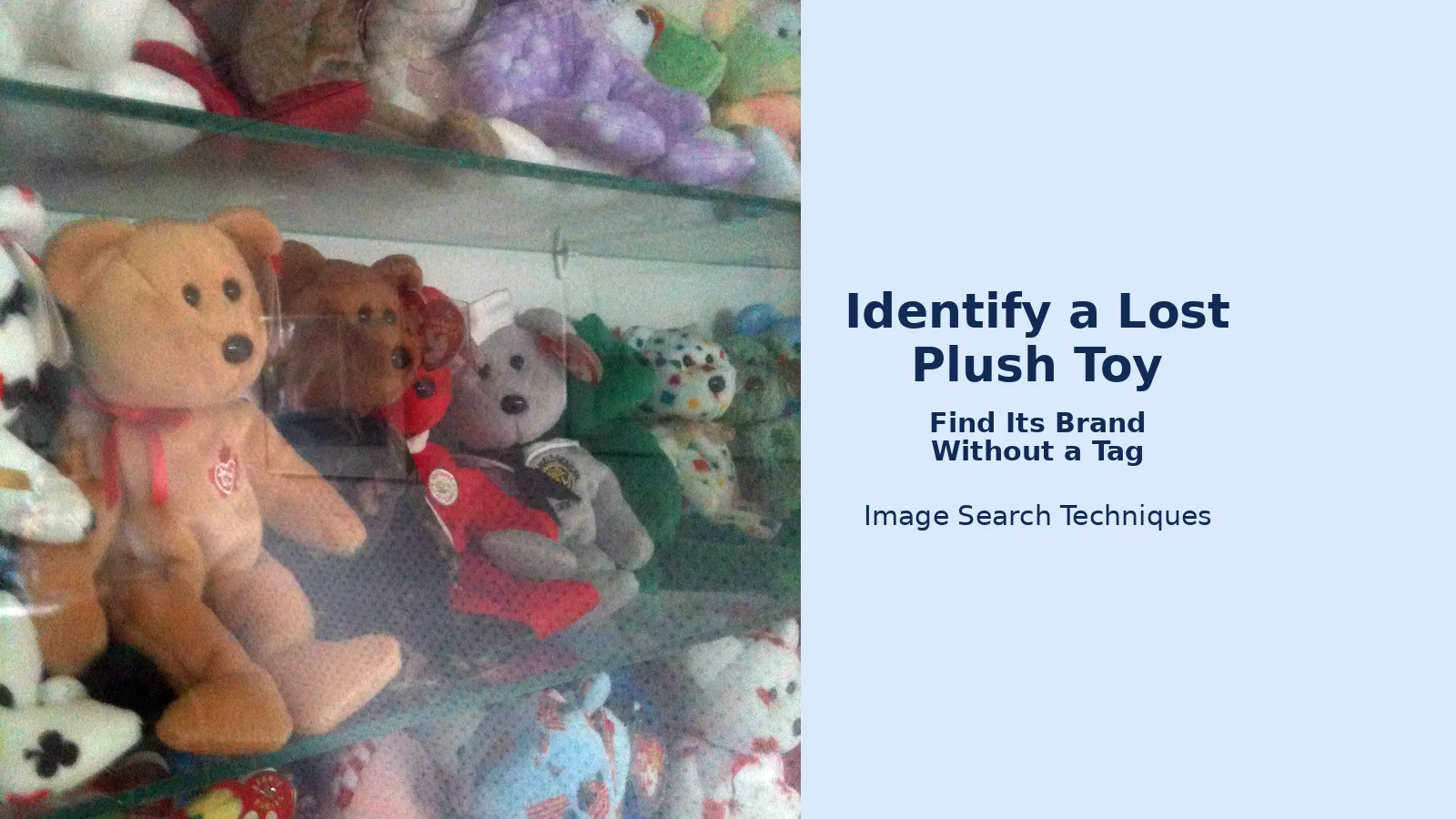
To show the method working, I ran it on a real photo. The photo is “Mom’s Beanies”, taken by Daryl Mitchell in Regina, Saskatchewan, in June 2013 and published under a Creative Commons licence. It shows more than sixty TY Beanie Baby bears arranged in a display case. The bears are the test, because the photo was taken thirteen years ago and the toys in it are the classic TY line, with the heart-shaped swing tags and the fabric tush tags the article describes.
Step one was the tag read, done from the photo itself. Several bears in the case show the small red heart tag at the ear, which is the TY swing tag, and the tan bear at the front left shows the tag clearly enough to read its shape. The bears are small, floppy and bean-filled, which is the TY build. Step two was the reverse search. I ran the photo through TinEye and Google Lens on 15 November 2026 and recorded what each engine actually returned, without guessing any number either engine did not show.
TinEye returned 11 results from 86.7 billion images searched, the earliest indexed on 10 September 2021. Every result was the photo itself: the Wikimedia Commons file page in several sizes, and the Wikipedia Beanie Babies article, which uses the photo at 250 pixels wide. No other site, no shop listing and no copy turned up. Google Lens failed four times in the same session, answering “No image at the URL” each time, even though the image address loads fine in a browser, so no Lens count is reported here. That failure is worth noting, because Lens is usually the first tool people try, and on this day it could not read a perfectly good image address at all.
The result is a clean identification. The tag read and the reverse search agree, and they agree on the same brand: TY, and the same line: Beanie Babies. The photo is the original, published on Flickr in 2013 and carried on Wikimedia Commons since 2019, and the search results point back to those two pages. That is the pattern to look for with your own toy. A tag you can read, plus a search that returns the same toy from its original source, is an identification you can trust. A search that returns nothing, or returns only lookalikes, means you go to the communities with good photos and the measurements, not that the toy has no name.
One warning belongs here. A zero from a reverse image search never clears a toy. The search engines only know the photos they have indexed, and a photo that is new, rare or simply never posted online will return nothing. The same goes for a toy that has been photographed only once, by you, on your phone. In that case the tag, the eyes, the fabric and the collector communities are the route, and the search is only one tool among several.
FAQs
Can you identify a plush toy with no tag at all?
Yes, but it takes more steps. Photograph the toy from the front, back and side, then run the photo through Google Lens and TinEye. Match the eyes, nose, fabric and footpads against the results. If two search engines agree on the same toy, that is an identification. If they do not, ask a collector community with the photos and measurements.
What does the TY heart tag tell you about a Beanie Baby?
The heart-shaped swing tag names the animal, gives it a birthday, and from early 1996 carries a short poem. The fabric tush tag carries the manufacturing location, the contents and a copyright date. The tag design places the toy in a generation, since the earliest tags have no star and the fourth and fifth generation tags carry a yellow star.
Is a reverse image search enough to name a plush toy?
Often, but not always. A search works best on a popular toy photographed clearly on a plain background, and it works better when two engines agree on the same listing. It struggles with rare, handmade or heavily worn toys, and a search that returns nothing proves nothing, since the engines only know the photos they have indexed.
How should I photograph a plush toy for identification?
Photograph it in daylight on a plain background, filling the frame, straight on from the front. Take the same shot from the back and the side, plus close-ups of the face and the tag. Crop tightly around the toy, since background clutter is the biggest reason a reverse image search returns poor matches.
Where can I ask collectors to identify a stuffed animal?
The Reddit communities r/plushies, r/HelpMeFind and r/ToyIdentification are good places to start, as are the Facebook groups for lost plush toys and vintage toy hunting. Post clear photos from several angles together with the measurements, colours, eye and nose type, fabric and filling. One post with four good photos gets a faster answer than four separate posts.
How do I find a replacement for a lost childhood plush toy?
Identify the brand and the character name first, then search for that exact name plus the colour and size. Resale listings on eBay, Poshmark and Etsy are the most likely source, and collector groups and charity shops are worth trying. The exact name is what turns a hopeless search into a findable one, so confirm it before you start buying.