


🔎 Reverse Image Search
Image search techniques made simple: upload a photo or paste a URL and search 6 engines at once. 100% free, nothing stored.
🔒 Your image is never stored on our servers longer than 24 hours and is never shared.
Walkers, gardeners and pond owners all meet the same problem when they try to identify a turtle species from a photo. A turtle appears on a path, on a log or at the edge of a pond, and nobody nearby knows which species it is. A photo is usually all you have, and a photo can do more than most people expect, as long as it shows the right parts of the animal.
Short answer: Photograph the turtle from the side, with the shell, head and feet visible, and note where you saw it. Read the shell shape and pattern first, then the head markings, then the feet. Run the photo through Google Lens, TinEye and Yandex, check the result against a field key. A photo can suggest a species, but it cannot prove one.
Google’s own answer to this question asks for the same things: a photo, or a description of what you can see, plus the place it was seen. It points readers to a step by step field key and to the Olive Ridley Project for sea turtle photo identification, and it lists the same four features this article works through: shell shape and texture, shell markings, head and neck patterns, and feet with habitat. The difference is that this article does the work on a real photo, with real search results, instead of listing the features and stopping there.
The method below works for pond turtles, tortoises and sea turtles alike, and it works whether the animal is a pet that has escaped, a wild native or a released exotic. The steps are the same in every case: photograph it properly, read the shell, read the head, read the feet, then check the photo with a reverse image search and a field key.
What should your photo show before you start?
Answer capsule: One clear side view showing the shell, the head and at least one foot, plus a close up of the head, is enough to identify most pond turtles and tortoises.
Most failed identifications start with a bad photo, not a hard species. A turtle seen from directly above hides its head markings. A turtle half under water hides its feet. A distant turtle on a log shows a shell and nothing else. Before you search, take the photo the identification needs.
Stand or crouch at the animal’s level and take a side view that shows the whole shell, the head and at least one foot in a single frame. Then take a second photo, a close up of the head and neck, because the markings there often decide the species. If the animal is basking, wait for it to lift its head. If it is swimming, wait until it surfaces near the edge. A short video clip works too, and a still taken from it is often sharper than a rushed photo.
Write down where you saw it while you are still there: the place, the date, and the habitat. A pond, a river bank, a garden, a beach and a dry grass field all point in different directions, and the place is often what separates two species that look alike. Note the size roughly, against something in the frame if you can, but never pick the animal up to measure it.
Photograph the turtle where it is, from a distance, and leave it alone. Never flip a turtle over to see its underside, never move it to a better spot, and never put a land turtle in water to see whether it swims. A tortoise or a box turtle can drown, and a stressed turtle may bite. The underside of the shell, the plastron, is useful for a field key, but it is not worth harming the animal to see it. If the plastron is not visible, say so and work with what the photo shows.
Is it a turtle or a tortoise?
Answer capsule: Tortoises are land turtles with high domed shells and thick, column like legs with no webbing. If the animal has flippers it is a sea turtle, and if it has webbed toes it is a pond or river turtle.
The turtle versus tortoise split. All tortoises are turtles, but not all turtles are tortoises. Tortoises are the land adapted branch of the turtle family. They live on dry land, they have high domed shells, and they walk on thick, column like legs with stumpy toes and no webbing between them. Pond and river turtles have flatter shells and webbed toes with claws, because they swim. Sea turtles have flippers instead of feet, because they live in the sea. Box turtles sit in between: they are domed land dwellers with a hinged lower shell, but they are not tortoises.
This split is the first question a field key asks, and it is the one that saves the most time. The Virginia Herpetological Society key, which this article uses as its reference, starts the same way: front limbs shaped like flippers, or front limbs not shaped like flippers. Flippers mean a sea turtle, and only seven sea turtle species exist, so the field narrows at once. Anything else goes down the freshwater and land route, where the shell and the head do the work.
People mix up box turtles and tortoises more than any other pair. Both live on land, both have domed shells, and both walk rather than swim. The difference is in the feet and the shell: a box turtle has a hinged plastron that lets it close its shell, and its feet are smaller and less column like than a tortoise’s. If the animal is on dry land with a high dome, check the feet before you call it a tortoise. Stumpy, elephant like feet with no webbing point to a tortoise. Smaller feet with claws point to a box turtle.
Habitat is supporting evidence, never proof on its own. A turtle basking on a log over a pond is almost certainly a pond turtle. A turtle crossing a road after rain could be a pond turtle heading for a new pond or a tortoise out foraging. A turtle grazing in a dry pen is almost certainly a tortoise. Use the place to support what the shell and feet already say, not to replace them.
How do you read the shell?
Answer capsule: Read the shell in three passes: the shape, then the pattern, then the surface. Shape separates the big groups, pattern separates the species inside each group.
Two words help here. The carapace is the top shell, the part you see from above. The plastron is the bottom shell, the part you almost never see in a photo. A scute is one of the large plates that cover the carapace, and the seams between the scutes, plus the pattern on them, are where most of the identification lives.
Start with the shape. A high domed shell points to a land animal, a tortoise or a box turtle. A low, streamlined shell points to a swimmer, a pond or river turtle. A very flat shell with a leathery surface and no scutes at all points to a softshell turtle, a different family entirely. A shell with a raised ridge, a keel, running down the middle points to species such as map turtles, which carry that ridge as adults. A shell with a jagged rear edge points to snapping turtles and their relatives.
Then read the pattern on the scutes. Look for stripes, spots, rings and the colour of the seams. Painted turtles carry red and yellow markings on a dark shell. Map turtles carry fine pale lines that look like a contour map. Sliders carry yellow swirls on a dark green shell. Some species lose their pattern as they age, and older adults can look almost plain dark, which is why the head markings matter as a second check. Juveniles are often brighter and more clearly marked than adults of the same species, so a bright young turtle and a dull old one can be the same species.
Finally, read the surface. A smooth shell with clear scutes is the usual pond turtle. A rough, ridged shell is common in snapping turtles. A leathery shell with no scutes is a softshell, and the long pointed snout that goes with it confirms the match. Overlapping scutes, where each plate overlaps the one behind it like roof tiles, point to sea turtles such as the hawksbill.
Do not try to age a turtle from its shell. Growth rings on the scutes look like tree rings, and people often read them as years, but they are not reliable. Rings grow faster in good years and slower in bad ones, they wear smooth with age, and in many species they vanish altogether. The identification guides that mention shell rings treat them as a rough hint at most, never as an age in years.
The Virginia Herpetological Society publishes a turtle identification guide that works through these choices one at a time, as a key: flippers or not, scutes or not, plastron shape, head stripes, and so on. Its species are Virginian, so it will not name a turtle seen in Britain or Malaysia, but the method is the same everywhere, and the order it asks the questions in is the order this article follows.
What do the head and neck tell you?
Answer capsule: The head decides what the shell leaves open. A coloured patch behind the eye, stripes along the neck, or a plain dark head each point to a different group.
The head is where the quickest identifications happen, and it is also where the closest look alikes separate. Three things matter: the patch behind the eye, the stripes on the neck, and the shape of the snout.
The patch behind the eye is the single most useful head mark. A red patch means a red eared slider. A yellow patch means a yellow bellied slider. A yellow stripe that runs from the eye to the tip of the snout, with two more stripes on the head, points to a striped mud turtle. No patch at all, a plain dark head, points to species such as the snapping turtle or the common cooter. Photograph the head from the side, in good light, because a red patch can look orange in shade and a yellow patch can look white in bright sun.
Neck stripes are the second check. Sliders and cooters carry fine yellow lines down the neck. Painted turtles carry red and yellow lines. Map turtles carry a small pale spot behind the eye and fine lines on the neck. Softshell turtles have almost no neck pattern at all, which fits with their plain leathery shell. If the neck stripes are bold and clear, note their colour. If they are faint, say so, because faint markings are a real feature, not a bad photo.
The snout matters most for two groups. A long, pointed snout with the nostrils at the tip belongs to a softshell turtle. A short, blunt snout belongs to most pond turtles. A hooked beak belongs to a snapping turtle. None of these need a close measurement. A side photo of the head shows all three at a glance.
Watch for the age trap. Young sliders have bright red patches and vivid neck stripes. Older males often darken until the patch is barely visible and the shell looks almost black. If the photo shows a dark, plain looking turtle with a faint red smudge behind the eye, it may still be a red eared slider, just an old one. The feet and the shell shape will back you up: webbed toes and a low shell with yellow swirls still say slider even when the red has faded.
What do the feet and the habitat tell you?
Answer capsule: Flippers mean the sea, webbed toes with long claws mean a pond or river, and stumpy elephant like feet mean dry land. Habitat backs the feet up, it never replaces them.
Feet are the most underused clue in turtle photos, because people photograph the shell and forget the legs. Four shapes cover almost every turtle you will meet.
Flippers are flat, paddle shaped front limbs with no separate toes visible. They belong to sea turtles only. If the photo shows flippers, the animal is one of the seven sea turtle species, and the head scales and the shell scutes narrow it from there. The Olive Ridley Project identifies individual sea turtles from the unique pattern of scales on the face, which stays the same over time like a fingerprint, and its photo identification method asks for a clear image of each side of the face.
Webbed toes with long claws belong to pond and river turtles. The webbing is easy to see when the animal is basking with a foot stretched out, and the claws are longer on the front feet of males in some species. Sliders, cooters, painted turtles and map turtles all have this foot shape, which is why the feet confirm the group but the head and shell have to name the species.
Stumpy, elephant like feet with thick scales and no webbing belong to tortoises. The front legs often look shovel like, built for walking on dry ground and digging. If the feet look like little columns and the shell is high and domed, you are looking at a tortoise, and the head pattern and the shell colour narrow it from there.
Small feet with claws and no webbing, on a domed land animal, belong to box turtles. They walk on land like tortoises, but their feet are smaller and their shell has a hinge underneath. This is the pair that catches people out, so when the animal is on land, look at the feet before you decide.
| Trait | What to look for | What it suggests |
|---|---|---|
| Shell shape | High dome, low and streamlined, very flat, or ridged down the middle | High dome means land, low and streamlined means swimmer, flat and leathery means softshell |
| Shell pattern | Stripes, spots, rings, yellow swirls, or a plain dark shell | Swirls point to sliders, fine pale lines point to map turtles, red and yellow marks point to painted turtles |
| Scutes | Clear large plates, overlapping plates, or no plates at all | Overlapping scutes point to sea turtles such as the hawksbill, no scutes means a softshell |
| Head markings | Red or yellow patch behind the eye, neck stripes, spots, or a plain dark head | Red patch means red eared slider, yellow patch means yellow bellied slider, plain dark head means snapping turtle or cooter |
| Feet | Flippers, webbed toes with claws, or stumpy elephant like feet | Flippers mean sea turtle, webbed toes mean pond or river turtle, stumpy feet mean tortoise |
| Habitat | Basking on a log, floating in a pond, crossing a road, grazing in a dry pen | Supports the feet and shell, never replaces them; a log over water means a pond turtle, a dry pen means a tortoise |
Habitat deserves a warning. It is tempting to name a turtle from where it was found, and the place does narrow the field, but released pets break the rule. Pet sliders turn up in ponds, lakes, canals and slow rivers across Britain, far from their native range, because owners release them when they grow too big. A turtle in a British pond is not automatically a native species. The shell, the head and the feet have to agree with the place before the identification holds.
How do you identify a turtle species from a photo with a reverse image search?
Answer capsule: Crop the photo to the turtle, then run it through Google Lens, TinEye and Yandex. Lens names the species, TinEye finds exact copies, and Yandex finds similar photos with tags.
Reverse image search is the fastest way to check a hunch. It does not replace the shell, head and feet checks, but it tells you whether anyone else has already identified the same photo, and it often names the species outright. Use all three engines, because they disagree usefully: one names the animal, one finds the exact file, and one finds similar photos.
Crop the photo to the turtle before you upload it. A wide shot of a pond gives the engines water and reeds to match, and the results fill up with other ponds. A tight crop on the animal, with the shell and head in the frame, gives the engines the markings to work with. Save the crop as a new file and keep the original untouched.
Start with Google Lens. Upload the photo at lens.google.com or through the Lens button in Google Images. Lens gives two things: an identification, often with a short description of the species, and a list of exact and visual matches. The identification is a good first guess, not a verdict, so read it and then check it against the shell and head marks yourself.
Then try TinEye. TinEye does not name species. It finds exact copies of the same image across the web, and it tells you where the image was first indexed and how many copies exist. That matters when the photo is not yours: if TinEye finds the same photo on a field guide or a zoo page, you have a source to check the identification against. If it finds nothing, that is a genuine zero, not a failure, and it means the photo has not been published before.
Then try Yandex Images. Yandex is often the strongest of the three on animals, because its tags name the species in plain words and its similar images page shows dozens of look alikes. Read the tags first, then the similar images. If Yandex names a species and Lens names the same one, the match is worth trusting. If they disagree, trust the shell, head and feet checks, not the engines.
If the photo shows something else entirely, a lost object rather than an animal, our guide to finding an item by its photo covers the same routine for objects, and our general guide to reverse image search explains each engine in full.
Worked example: a red eared slider in Penang
Answer capsule: A basking turtle photographed in a temple pond in Penang was identified as a red eared slider by two of the three engines, and the shell, head and feet all agreed.
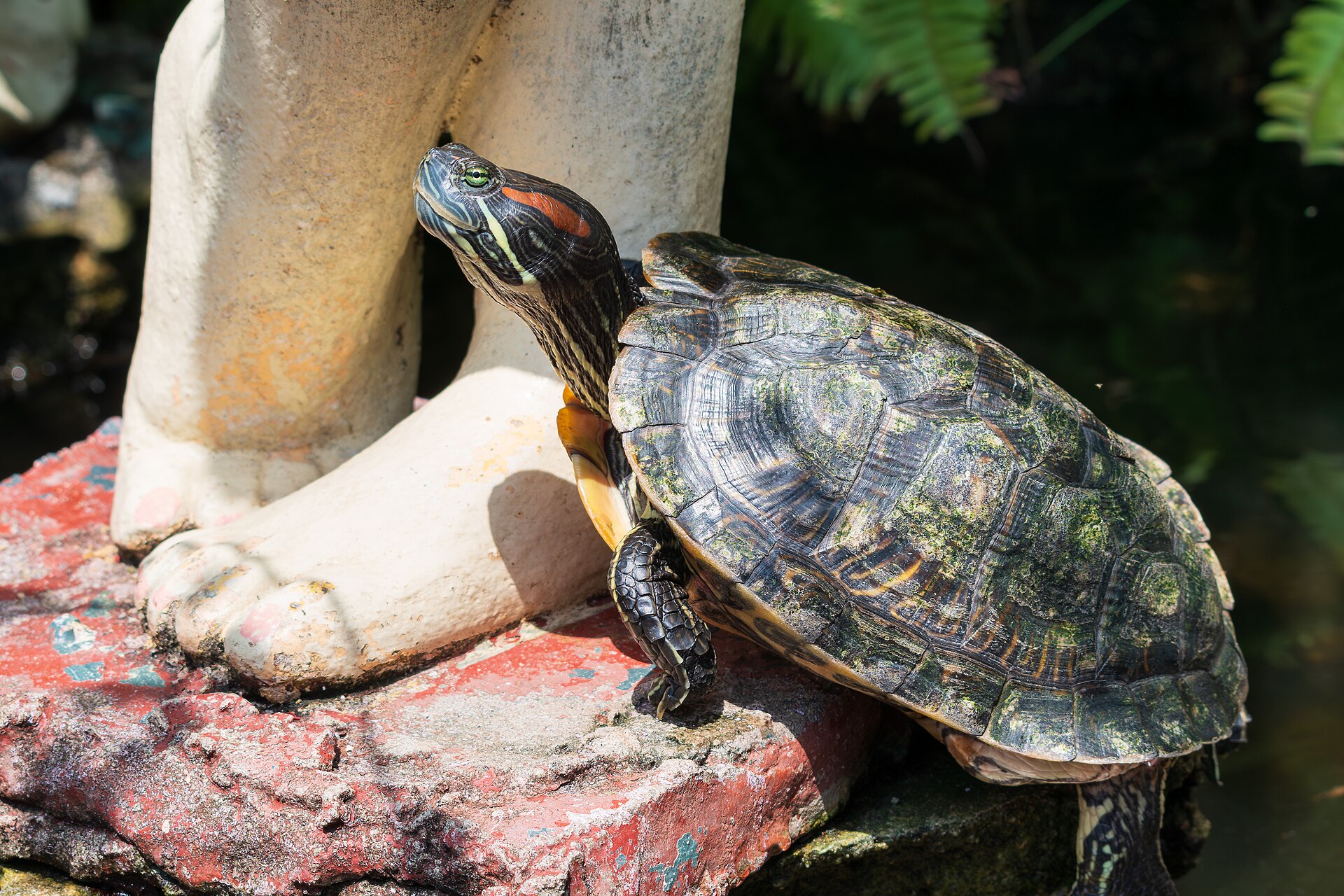
The photo above is a real one, taken on 27 May 2024 at the Dhammikarama Burmese Buddhist Temple on Penang Island, Malaysia. The pond there houses dozens of turtles and fish, cared for by the resident monks. The turtle is basking at the base of a statue, out of the water, which is why the photo is so useful: the shell, the head and a front foot are all visible in a single side view, exactly what the photo routine in this article asks for.
Read it with the checklist. The shell is low and streamlined, not high domed, which says swimmer, not tortoise. The scutes are clear and covered with yellow swirls on dark green, which says slider. The head carries a bright red patch behind the eye and fine yellow stripes down the neck, which says red eared slider rather than its yellow bellied cousin. The front foot is webbed with visible claws, and the edge of the yellow plastron shows under the shell rim. Every trait points the same way, which is what a good identification looks like.
| Engine | What it returned on 21 November 2026 |
|---|---|
| Google Lens | Named it a red eared slider, Trachemys scripta elegans, and pointed to the red stripe behind the eye and the yellow and dark striped neck. 3 exact matches, including the Wikimedia Commons file page itself. |
| TinEye | 1 result out of 86.8 billion images searched, first indexed 4 March 2026. The only match was the Wikimedia Commons file page. TinEye does not name species, it only matches the image. |
| Yandex Images | Tags in Russian naming the red eared turtle, with similar image captions in English naming the red eared slider, Trachemys scripta elegans. About 80 similar images on the first screen and 20 sites listed, though the exact Commons file page was not among the top sites. |
Two of the three engines named the species, and the third confirmed the photo’s source, which is a strong result. Lens gave the identification and the exact file. Yandex gave the same identification through its tags and similar images. TinEye gave only one result, the Commons page, which tells you the photo has not been reused widely, and that is useful in itself: a photo with one TinEye result is almost certainly the original, not a copy passed around the web.
The verdict is a likely red eared slider, not a proven one. A photo can suggest a species, and this one suggests it strongly, because the red patch, the shell pattern, the webbed foot and the pond habitat all agree, and two engines agree with them. The setting fits too: temple ponds in Malaysia hold many released pet sliders, and this pond is known to house dozens of turtles. If the red patch had been missing, or the feet had been stumpy instead of webbed, the verdict would have been different, and the article would have said so.
Which species do people mix up most?
Answer capsule: Sliders mix with cooters, painted turtles mix with map turtles, and box turtles mix with tortoises. In each pair, one mark settles it: the patch behind the eye, the neck lines, or the feet.
The red eared slider and the yellow bellied slider are the same species group, and the patch behind the eye is the only mark that separates them reliably. Red means red eared, yellow means yellow bellied. Older males darken and the patch fades, so an old male red eared slider can look like a yellow bellied slider at a glance. Check the shell swirls and the webbed feet as well, and if the patch is gone entirely, say the photo shows a slider and leave the subspecies open.
Sliders and cooters are the next pair. Cooters are larger, plainer turtles with less marked shells and plainer heads. A cooter’s head often looks dark with faint stripes, where a slider’s head is busy with yellow lines. If the turtle is large, plain and sitting in a river rather than a pond, think cooter first and check the head stripes before you settle it.
Painted turtles and map turtles mix because both are small, bright pond turtles. The painted turtle carries red and yellow marks on the shell edge and the neck. The map turtle carries fine pale lines on the shell that look like a contour map, and a small pale spot behind the eye. The shell pattern decides this pair, so photograph the top of the shell as well as the side if you can.
Juveniles and adults of the same species are a quieter trap. Young turtles are bright, clearly marked and small. Adults are larger, duller and sometimes almost plain. A bright young slider and a dark old slider can look like two species in two photos. If the photo shows a small, vivid turtle, consider that it may be young, and check the feet and the shell shape, which change less with age than the colours do.
Finally, the box turtle and the tortoise. Both live on land, both have domed shells, and both turn up on garden paths. The feet settle it: stumpy, elephant like feet with no webbing mean a tortoise, smaller feet with claws mean a box turtle. The shell hinge helps too, if you can see the underside without handling the animal, but the feet are usually enough.
What should you do once you have a likely species?
Answer capsule: Record the identification as likely, not certain, note the place and date, and leave the animal alone. If it looks like a released pet or it is injured, tell a local wildlife rescue instead of handling it yourself.
Write the identification down as a likely species, with the reasons: the red patch, the shell swirls, the webbed feet, the pond. A record that says “likely red eared slider, red patch behind the eye, yellow swirls on the shell, webbed front foot, basking in a temple pond” is useful to anyone who reads it later. A record that says only “red eared slider” is not, because nobody can check it.
Do not handle the animal, and do not move it. Wild turtles bite, and snapping turtles in particular can cause a serious injury. Wash your hands after any contact with a turtle, because reptiles can carry salmonella. If the turtle is on a road, and you are sure it is safe to help, the usual advice from wildlife groups is to move it in the direction it was already heading, not back the way it came, and never to pick it up by the tail.
If the turtle looks like a released pet, the right step is to tell a local wildlife rescue or recording group, not to take it home. Released pet terrapins are a real issue in Britain. A citizen science survey, Turtle Tally UK, collected reports between 2019 and 2023 and recorded 1,387 turtles seen in the wild, of which 98 were verified as red eared sliders from photographs. Most were single animals in ponds, lakes and canals in London and the urban north west. Releasing a non native turtle in Britain is illegal under section 14 of the Wildlife and Countryside Act 1981, and a released pet rarely survives a cold winter, so a rescue group is the best outcome for the animal and the pond.
Sea turtles are a different job. Identifying the species is only the first step, and researchers also identify individual animals, because counting individuals is how populations are tracked. The Olive Ridley Project photo identification method uses the unique pattern of scales on a sea turtle’s face, which stays the same over time like a fingerprint, and it asks citizen scientists for a clear image of each side of the face, plus the place and the date. If your photo is of a sea turtle, that page is where it belongs, and the species key in this article is only the start.
The same photo routine works for the other animals you meet around a pond. Our guide to identifying a frog from a photo, our guide to identifying a lizard from a photo and our guide to identifying a fish from a photo all use the same discipline: photograph the animal where it is, read one feature at a time, and check the result with a reverse image search before you record it.
FAQs
Can you identify a turtle species from a single photo?
Often yes, to a likely species, if the photo shows the shell, the head and the feet in a side view. The shell shape and pattern narrow the field, then the head markings and the feet settle it. A photo can suggest a species, but it cannot prove one, so check the result against a field key before recording it.
What is the difference between a turtle and a tortoise?
Tortoises are land turtles with high domed shells and thick, column like legs with no webbing between the toes. Pond and river turtles have flatter shells and webbed toes with claws, and sea turtles have flippers. Box turtles live on land with domed shells, but they are not tortoises, and their feet are smaller with claws.
How can I tell a red eared slider from a yellow bellied slider?
Look at the patch behind the eye. A red patch means a red eared slider, and a yellow patch means a yellow bellied slider. Older males darken with age and the patch can fade, so check the shell swirls and the webbed feet as well. If the patch is gone, record it as a slider and leave the subspecies open.
Can Google Lens identify a turtle species from a photo?
Yes, Lens named our test photo a red eared slider and gave three exact matches, including the original file page. It is a good first guess, not a verdict, so check its answer against the shell, head and feet marks. Run TinEye and Yandex too, because the three engines disagree usefully and two matching answers are worth more than one.
Can you tell a turtle’s age from its shell?
No, not reliably. Growth rings on the shell scutes look like tree rings, but they grow faster in good years and slower in bad ones, and they wear smooth with age. In many species they vanish altogether. Treat rings as a rough hint at most, and never state an age in years from a photo of a shell.
What should I do if I find a turtle in the wild in the UK?
Photograph it from a distance and leave it alone. Do not handle it, flip it, move it or put it in water. If it looks like a released pet or is injured, tell a wildlife rescue instead of taking it home. Releasing a non native turtle is illegal in Britain, and a rescue group gives the animal its best chance.