🔎 Reverse Image Search
Image search techniques made simple: upload a photo or paste a URL and search 6 engines at once. 100% free, nothing stored.
🔒 Your image is never stored on our servers longer than 24 hours and is never shared.
A fake wedding photographer scam starts with a portfolio that looks too good to question and ends with a missing photographer, missing photos, or both. The check that catches most of them takes about twenty minutes: reverse-search the portfolio photos, demand one full wedding gallery, and pay in a way you can reverse. This guide walks through each step, with the exact tests to run before any deposit leaves your account.
Direct answer: Reverse-search a wedding photographer’s portfolio photos before paying a deposit. If the same photos appear under another photographer’s name, on a stock library, or on an unrelated business, walk away. Then ask for one complete wedding gallery, a phone call, and a written contract, and pay by credit card, never by a payment app with no buyer protection.
How does a fake wedding photographer scam work?
A fake wedding photographer is not one single trick. The Better Business Bureau (BBB) describes three versions of the same scam in its April 2025 scam alert, and all three start the same way: you find a photographer on social media or a wedding-vendor site, you like the portfolio, you discuss the date by email or message, you sign a digital contract, and you send a deposit through a peer-to-peer payment app.
In the first version, the photographer cancels a few days before the wedding, after the final payment has already been taken, and then stops answering. In the second, nobody turns up on the day at all. In the third, the photographer does turn up and takes the photos, and then never delivers them. One bride told the BBB’s Scam Tracker that after she paid, the photographer “stopped contacting me and all of her contact information went out of service”, and that digging afterwards showed “she had done the same if not worse to 30+ other brides”. That bride lost $1,700. Another couple paid in full the week before the wedding, were cancelled on two days before the event, and lost $5,300. A third report describes a photographer who shot the wedding, never delivered a single photo, and stopped all contact, a $2,400 loss.
The scale is not a handful of isolated cases. In 2025 the BBB issued a specific warning about a North Texas photographer after receiving 18 complaints, and CBS News Texas spoke to 18 brides who had hired her, 14 of whom said she did not show up on their wedding day; she later pleaded guilty to felony theft. In October 2026, a North Carolina court ordered Holly Christina Photography to pay nearly $1.7 million after the state’s Attorney General received hundreds of complaints and reported losses of about $1 million, with some couples receiving only “sneak peek” images and never the full gallery. The pattern in every case is the same: the portfolio looked real, the deposit was paid through a channel with no buyer protection, and by the time the couple checked, the money and the photographer were gone.
The reason the portfolio is the right place to start is that it is the one thing a scammer cannot fake cheaply without leaving traces. A real photographer has years of consistent work, real clients, and full galleries. A fake one has a handful of beautiful images pulled from somewhere else, or generated by AI, and nothing behind them. The tests below are designed to find that gap before you pay. The same portfolio trick is used by rogue builders, our rogue builder check applies the same tests to a tradesperson’s work photos and certificate numbers.
What is the portfolio test battery?
No single check proves a photographer is genuine, that is the most important limit of this whole guide, and it is worth stating plainly. A clean reverse image search is not proof of legitimacy, because an AI-generated portfolio leaves no trace to find. The battery works because it stacks four independent checks, and a genuine photographer passes all four without effort while a fake one usually fails at least one.
| Test | What you do | Pass | Fail, walk away |
|---|---|---|---|
| 1. Reverse-search the portfolio | Search 6–8 portfolio photos on Google Lens, TinEye and Yandex Images | Photos appear only on this photographer’s own site and social pages | Same photo under another name, on a stock site, or on an unrelated business |
| 2. Full-gallery request | Ask for one complete wedding, start to finish, as the client received it | A full gallery arrives: getting ready, ceremony, portraits, reception, 300+ images | Only highlight reels, excuses, or a gallery of mixed styles and venues that do not match |
| 3. AI-portfolio tells | Look for the visual signs listed in the next sections | Consistent people, hands, jewellery and backgrounds across the whole gallery | Hands with extra fingers, melting jewellery, faces that change between shots of the “same” couple |
| 4. Contract and payment check | Written contract plus a reversible payment method | Named business, address, cancellation and delivery terms, credit-card or bank payment | Payment app only, no contract, no business address, pressure to pay today |
Run the tests in that order. The reverse search is first because it is fast and it is the only test that can end the process in five minutes: a stolen portfolio is a definite fail, whatever the photographer says afterwards. The same check works from the other side too: if you are the photographer whose work was taken, our guide to stolen wedding photos explains how to find every copy and prove the photos are yours. The full gallery is second because it is the test a scammer finds hardest to fake, anyone can steal ten beautiful photos, but nobody can steal a coherent 400-photo wedding day. The AI tells and the contract check then cover the cases the reverse search cannot reach.
How do you reverse-search a portfolio photo?
Reverse image search works by matching the pixels of a photo against an index of images already on the web. If a portfolio photo was stolen from another photographer’s site, a stock library, or a real wedding blog, the search engines will usually show you where it came from. If it was generated by AI, it will not appear anywhere, which is why this test is a way to catch stolen work, not a way to prove a portfolio is genuine.
Save or screenshot six to eight photos from the portfolio, pick the strongest ones, the ones that sold you on this photographer, and include at least one full-length portrait and one wide venue shot. Right-clicking may be disabled on some portfolio sites; a screenshot of the photo on its own works, though a clean saved file gives the engines more to match. Then run each photo through at least two engines, because no single engine indexes the same web. Our guide to reverse image search covers the full method, and Google reverse image search is the usual starting point because Lens indexes the widest range of wedding blogs and vendor sites.
What counts as a fail is specific. A match on the photographer’s own website, their own Instagram or Facebook page, or a wedding blog crediting them by name is a pass. A match on another photographer’s portfolio, a stock-photo library, a different business in a different city, or a “free wedding photos” download site is a fail, stop there and do not book. A match on a site in another language, or on a page that has nothing to do with weddings, is also a fail; stolen photos travel widely and often surface far from where they were taken.
Do the test yourself rather than asking the photographer to explain a match away. A common excuse is that the photo was “featured” on another site. That can be true, real photographers are featured on blogs, but a feature credits the photographer by name and links back to them. If the other site presents the photo as its own work, or credits a different name, the explanation does not hold.
Worked example: testing a real wedding photo
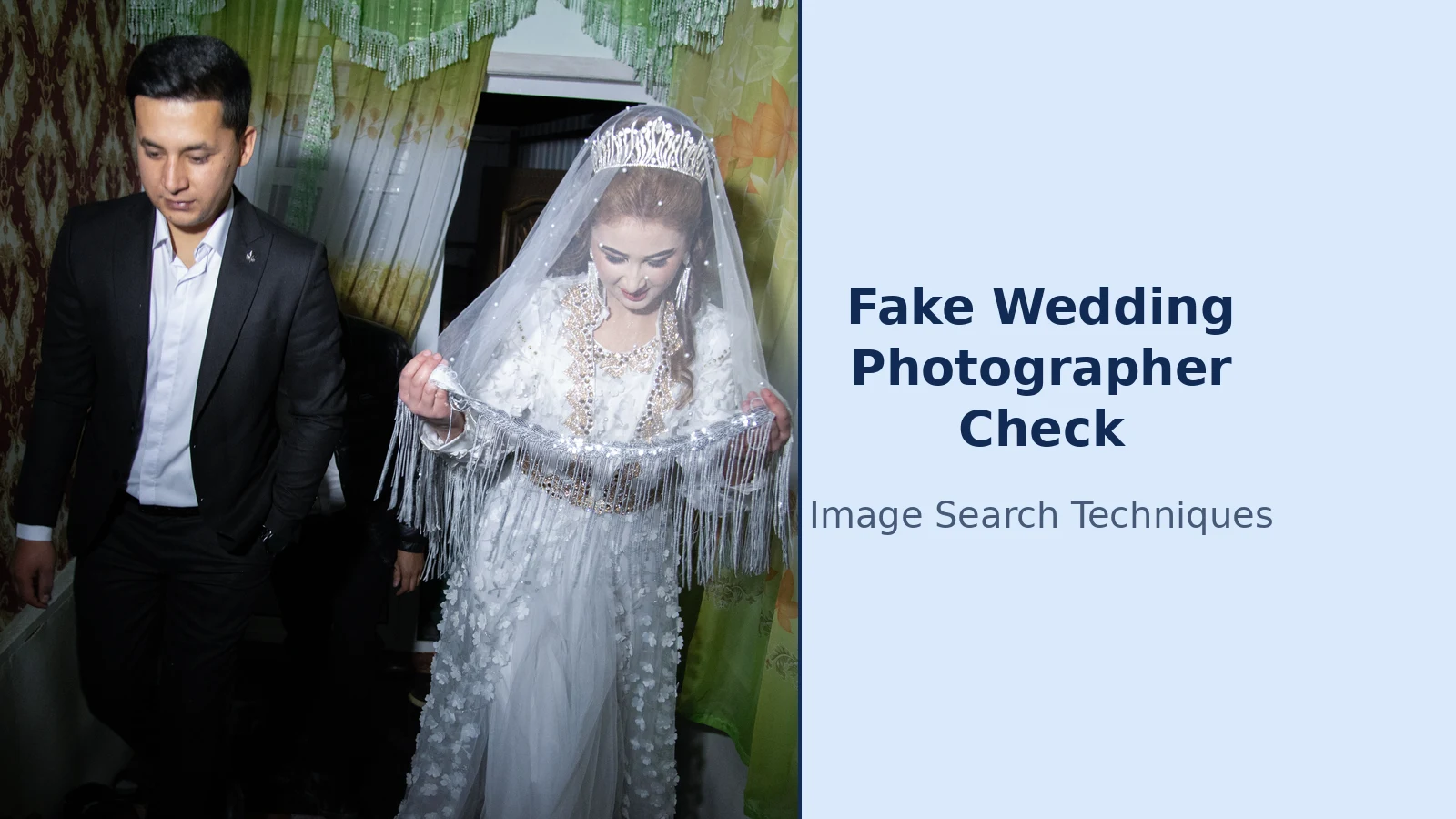
To show what the test actually looks like in practice, I ran a real wedding photograph through the three engines on 12 November 2026, signed out, exactly as a couple would. The photo was “Bride and groom at wedding party”, a CC BY-SA 4.0 image from Wikimedia Commons, a genuine, publicly available wedding photograph, the kind of image a portfolio thief could lift without anyone noticing.
Google Lens, tested first, could not fetch the image at all: in two fresh signed-out sessions it returned “Something went wrong / No image at the URL”, and its AI Overview stayed empty. TinEye did load the image and searched its index of over 86.7 billion images, and returned 0 matches, explaining that it had “yet to crawl any pages where this image appears”. Yandex Images did best: it recognised the photo as a wedding, tagging it (in Russian) as a wedding, bride, groom, wedding outfit and bride’s dress, and returned similar wedding images, but no exact match and no link back to the Wikimedia Commons source page.
Read that result the right way round. This is a genuine, publicly available photograph, and two of the three engines could not trace it to its source while the third could not even load it. A “no match” result does not mean a photo is original, any more than a match means it is stolen, it often just means the engine has not indexed the page where the photo lives. That is exactly why the lock on this guide exists: a clean reverse image search is never, on its own, proof that a photographer is genuine.
The honest lesson from that test is that the engines are uneven, and the unevenness matters. When an engine is blocked or returns nothing readable, that is not a pass, it is an inconclusive result, and you should try another engine rather than treating silence as a clean bill of health. When an engine does work, a single match on an unexpected site is enough to end the booking. You do not need all three engines to agree; you need one of them to show you something the photographer cannot explain.
How do you spot a stolen or AI-generated portfolio?
A stolen portfolio and an AI-generated portfolio fail in different ways, and you need different eyes for each. Stolen work is caught by the reverse search above. AI work is caught by looking closely at the images themselves, because an AI portfolio has no original to find.
Start with consistency across the gallery. A real photographer shoots the same couple, in the same venue, in the same light, all day. Faces stay the same face. The bride’s dress, the groom’s suit, the bridesmaids’ dresses and the venue details do not change between shots. In an AI portfolio, the “same” couple drifts: a face changes shape between the ceremony and the reception, a dress changes neckline, a venue’s windows move. Look at three or four photos that claim to be from one wedding and ask whether they could plausibly be the same day. If the light, the people and the place keep shifting, they are probably not.
Then look at the small details AI still gets wrong. Hands are the classic tell: extra fingers, fingers that merge, a hand holding a bouquet with the wrong number of digits. Jewellery melts, a necklace that dissolves into skin, earrings that do not match. Text in the background garbles: a venue sign, a menu card, a car number plate that reads as nonsense letters. Rings, watches and glasses change shape between shots. None of these on its own proves anything, a real photo can have a motion-blurred hand, but three or four of them across a portfolio is a pattern, and a pattern is enough to ask for the full gallery.
Also check the portfolio against itself. A genuine photographer’s style is recognisable: similar editing, similar colour, similar framing, similar venues in one area. A stolen or AI portfolio often jumps between styles, one photo looks like a bright editorial shoot, the next like a dark moody film set, the next like a phone snapshot, because the images came from different sources. The same applies to venues and seasons: a photographer based in Manchester whose portfolio shows a beach wedding in Bali, a vineyard in Tuscany and a castle in Scotland, with no travel story to match, is worth a closer look. Our guide to telling whether an image is AI-generated covers the full set of tells in detail.
What should a full gallery and a phone call prove?
Ask for one complete wedding gallery, delivered the way a client would receive it, and ask for it before you pay anything. A real photographer has this ready: a link to an online gallery, or a set of files, showing one wedding from the first getting-ready shots to the last dance. You are not judging whether the photos are beautiful, the portfolio already told you that. You are checking four things.
First, completeness. A full day produces hundreds of images. If the “full gallery” is forty highlights, that is not a full gallery. Second, consistency: the same couple, the same venue, the same light, all the way through. Third, the unglamorous middle, the group shots, the speeches, the dancing, the details. Scammers steal highlights; they rarely steal a blurry first dance or a table-setting close-up, because those are not the photos that sell a booking. Fourth, the boring proof: the same photographer’s name, watermark or site on the gallery, matching the portfolio site you already checked.
If the photographer refuses, or offers a second highlight reel instead, treat that as a fail. Genuine photographers are proud of full galleries and share them routinely; a refusal is one of the strongest warning signs there is, and the BBB’s own advice makes the same point from the other side, look for a long history of happy clients on the photographer’s own pages, and be wary of anyone who only operates through social media with nothing else to show.
Then get the photographer on the phone, or meet in person. The BBB lists this explicitly: ask to speak on the phone or meet before booking, and treat a refusal as a warning sign. A call does three things a message thread cannot. It confirms there is a real person behind the account. It lets you ask the questions that are hard to fake, which venues they have shot, what happens if they are ill on the day, who their second shooter is, and hear whether the answers are specific or vague. And it gives you a voice and a number you can use later if anything goes wrong. Ask for two recent clients as references, and actually call them. A genuine photographer expects this; a scammer hopes you will not bother.
How do you pay safely, and what must the contract say?
Payment method is where most of the money is lost. The BBB’s warning is blunt: businesses that only accept payments through peer-to-peer payment apps are a red flag, and if you are asked to send a large amount through one of these apps, ask to pay by credit card, cash, or cashier’s cheque instead. Payment apps and bank transfers to a personal account are effectively irreversible, once the money is sent, it is gone. A credit card, by contrast, gives you a chargeback route through your card provider, and a bank transfer to a named business account leaves a paper trail. If a photographer insists on a payment app and will not take a card, that alone is reason to walk away, however good the portfolio looks.
On deposits, the usual structure is a booking deposit to hold the date, with the balance due closer to the wedding, often a few weeks before, never in full months ahead, and never in cash with no receipt. Get a receipt for every payment, keep every message, and never pay the full balance before the day. The BBB cases show why: one couple paid in full the week before the wedding and were cancelled on two days before it, losing $5,300 with no way to get it back.
The contract matters as much as the payment. Before you sign, check that it names the business and the photographer, gives a real address and phone number, states the date, hours and venue, and spells out the cancellation and refund terms, the delivery deadline for edited photos, how many images you will receive, and what happens if the photographer cannot attend. Ask for a copy signed and dated by both of you, and keep it. If there is no contract at all, do not book, a genuine professional works with one, and a scammer prefers the booking to exist only in messages that can be deleted. For the payment side in more depth, including how scammers fake proof of payment, see our guide to fake payment screenshots.
What to do if you have already paid a fake photographer
If the photographer has vanished, cancelled at the last minute, or never delivered your photos, act in the first hour, while the trail is warm. First, save everything: screenshots of the portfolio, the listing, every message, the contract, and the payment receipts, with dates. Scammers delete accounts quickly, and a screenshot you take today is evidence you may not be able to get tomorrow.
Second, try to reverse the payment. If you paid by credit card, contact your card provider and ask about a chargeback, explaining that the service was not delivered. If you paid by bank transfer, contact your bank immediately and ask what recovery options exist; the sooner you report it, the better the chance, though recovery is not guaranteed. If you paid through a payment app, report the transaction inside the app and ask the app’s support team, but be aware that these payments are the hardest to recover, which is exactly why the payment section above matters.
Third, report it. In the UK, report to Report Fraud (reportfraud.police.uk), the national fraud and cybercrime reporting service that has replaced Action Fraud’s website. In the US, file a report with the BBB’s Scam Tracker and the FTC, the BBB’s scam alert itself points readers to its Scam Tracker to search for reports against a business before booking, and the same tool takes new reports. Reporting matters twice over: it creates the record that helps the next couple who searches that photographer’s name, and it is the evidence your bank or card provider will ask for.
Finally, do not name and shame the photographer publicly while you are still trying to recover your money. Stick to the facts in any review or report, keep the language to what you can prove, dates, amounts, what was promised and what happened, and let the reporting bodies and your bank do the rest. A public post that overstates the case can work against you; a precise, factual report helps everyone, including you.
The twenty minutes of checks in this guide will not catch every fake photographer, no check can, and an AI-generated portfolio leaves no trace for a reverse search to find. But they will catch the common ones: the stolen portfolio, the highlight-only gallery, the payment-app-only booking, the photographer who will not take a call. Run them before the deposit, not after it. A wedding happens once, and the photos are the only part of the day you keep. This check is one of the routines in our complete guide to photo scams.