🔎 Reverse Image Search
Image search techniques made simple: upload a photo or paste a URL and search 6 engines at once. 100% free, nothing stored.
🔒 Your image is never stored on our servers longer than 24 hours and is never shared.
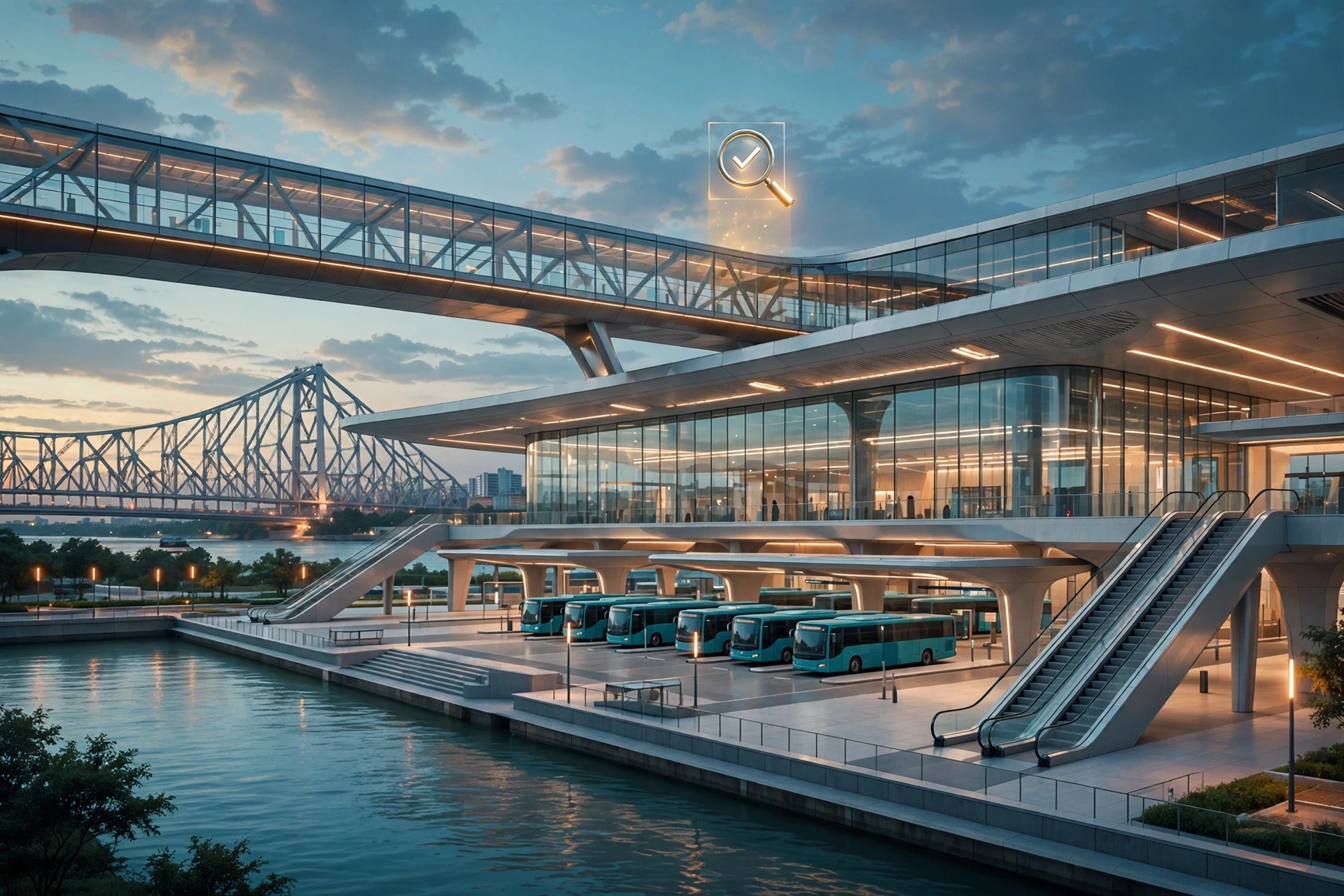
A shiny new bus station appears on your feed. Glass walls, wide walkways, escalators, a skywalk linking the platforms, and the famous Howrah Bridge in the background. The caption says the transformation is already happening, that Howrah bus station in Kolkata is being rebuilt as a modern transport hub. Thousands are sharing it as proof that change has arrived. None of it is real. The video is AI-generated, made as a concept by an Instagram account called Reforge India, and fact-checkers proved it on 23 November 2026. The station has not been rebuilt. The gleaming hub in the clip exists only inside an AI tool. This guide explains what the video really is, how fact-checkers caught it, and how you can check any viral revamp video in five steps.
Short answer
No, the viral video does not show a real revamp of Howrah bus station. Newschecker reported on 23 November 2026 that the 50-second clip is AI-generated. A reverse image search on keyframes from the video traced it back to an Instagram post by Reforge India, whose caption says plainly that it is an AI-generated concept of how the station could look after redevelopment, and that the project has neither been officially approved nor executed. Three detection tools agreed. Hive Moderation flagged a high probability of AI-generated or deepfake content, NVIDIA’s Synthetic Video Detector classified the clip as a synthetic video with a 77.5 percent synthetic score, and Sightengine labelled it likely AI-generated with a 99 percent GenAI score. AFP Fact Check reached the same conclusion on 19 November. A real redevelopment discussion exists, but this video is not evidence of it.
What the viral video claims
The clip shows Howrah bus station, next to Howrah Bridge in Kolkata, transformed into a spotless modern transport hub. Clean floors, bright lighting, orderly queues and a futuristic design replace the crowded bus stand that commuters know. The video spread on X and Facebook claiming the transformation is taking place under the BJP government in West Bengal. Some versions credited the West Bengal chief minister instead.
That is why the clip travelled so far. A before and after story about a famous, crowded place is easy to believe, and a video feels harder to doubt than a text post, because it feels like seeing the place with your own eyes. But a video can be generated just as easily as a text post can be written. The Howrah case shows how to check if a video is AI-generated, step by step.
What the fact-checkers found
Newschecker published its check on 23 November 2026. Here is how a viral video falls apart under basic checks.
First, the fact-checkers searched for news about the supposed transformation, trying keywords such as Howrah Station, Howrah bus stand and transformation. No credible news report said the bus station near Howrah Bridge was being transformed into a modern transport hub. A project of that size, at one of India’s busiest stations, would be covered by every major newspaper. Silence in the news is not proof on its own, but it is the first warning sign.
Second, they looked closely at the video itself, and spotted the words Reforge India appearing in the footage. A reverse image search on keyframes from the viral video led straight to an Instagram post by Reforge India featuring the same footage. The caption says clearly that the video is an AI-generated concept showing how Howrah Bus Station could be transformed into a modern transit hub, and that the project has neither been officially approved nor executed. The creator said it was AI from the start. The label was lost when other accounts reposted the clip with a new caption.
Third, they checked the creator’s profile. Reforge India describes itself as an account dedicated to reimagining Indian urban spaces through creative visualisations, and it regularly posts AI-generated videos of hypothetical transformations of Indian cities and public infrastructure, under the theme of turning Filth into Future. The Howrah clip is one of many in the same style. It was never presented as news by its maker.
Fourth, the footage was tested with AI detection tools, and all three pointed the same way. Hive Moderation indicated a high probability of AI-generated or deepfake content. NVIDIA’s Synthetic Video Detector classified the 50-second clip as a synthetic video and gave it a 77.5 percent synthetic score. Sightengine labelled it likely AI-generated, with a 99 percent GenAI score and only 1 percent face manipulation. No single detector is proof by itself, but three independent tools agreeing with the original creator’s own caption leaves little room for doubt. AFP Fact Check had already reached the same verdict on 19 November.
Why the video fooled so many people
Four things made the Howrah video believable.
The first is that a real redevelopment discussion exists. Newschecker found a Facebook post by Ei Samay carrying a statement from Shri Rahul Ranjan, Senior Divisional Commercial Manager of the Howrah Division under the Eastern Railway zone, about the proposed redevelopment of Howrah station. Ranjan discusses plans for multi-storey bus terminals and a skywalk-like structure connecting passengers to railway platforms, potentially up to Platform 8. The idea of a rebuilt station is a real proposal from a real railway official. The fake video simply showed that proposal as if it were already built.
The second is the quality of the video. A 50-second clip of a building is easier to fake than a close-up of a face. There are no hands to count, no lips to sync and no familiar voice to judge. A station is mostly straight lines, glass and crowds, and AI handles straight lines and glass well. Our guide to how to tell if an image is AI-generated covers the visual tells to look for, and many apply to video frames too.
The third is political sharing. The clip was shared both as proof of the BJP government’s work in West Bengal and as praise for the West Bengal chief minister. When a post flatters the side you support, the urge to share it arrives before the urge to check it. That is why the most shared fake videos confirm what people already want to believe.
The fourth is the missing label. The original Reforge India post says the video is AI-generated. The reposts did not. A caption is easy to change and a watermark is easy to crop, and once the clip leaves its creator’s page, nothing travels with it except the pictures. This is the same pattern behind the viral 4D cinema AI videos and the fake Elon Musk deepfake crypto livestream. The version you see is rarely the original, so check the original before you believe the copy.
How to check a viral revamp video in 5 steps
No special software is needed. The whole check takes about ten minutes.
Step 1: Search the news for the project
Search the name of the place plus words like redevelopment, revamp or renovation. A real transformation of a major station is big news, with newspaper reports and a press release from the authority in charge. If the only results are social media posts repeating the same clip, that is a red flag.
Step 2: Look for the creator’s name inside the video
Watch the clip slowly and look for a watermark, a logo or a name in a corner. AI concept videos often carry the creator’s name, because the creator wants credit, not deception. In the Howrah video, the words Reforge India were visible, and that name led directly to the original post. If you find a name, search it. A creator’s profile usually shows whether they make AI concepts or real news. Our identify anything guide explains the same habit for photos.
Step 3: Reverse image search a keyframe
Screenshot a clear frame and run a reverse image search with Google Lens. This is the step that cracked the Howrah case. Keyframes from the viral video matched the original Reforge India Instagram post, where the caption explained everything. The same step works for reverse image search for landmarks: if the earliest result is an AI art account or a concept page, the clip is a concept, not a news report.
Step 4: Run the clip through an AI detector
Upload a frame or the video to a detection tool and see what it says. The best deepfake video detector tools we have tested include free options you can use in a browser. Treat a detector result as one clue, not a verdict. A high AI score plus no news coverage plus a concept creator is a strong case. A high score on its own is not, because detectors can be wrong, especially on short clips. If the video shows a person speaking, our deepfake video call check guide covers the extra tells, such as lip movement that does not match the words.
Step 5: Check the official source
Find the authority that would actually build the project. For a station, that is the railway division or the transport department. Check their website and their verified social media accounts for an announcement. In the Howrah case, the Eastern Railway zone had discussed redevelopment plans, but it had never announced the gleaming hub in the video, and no construction was under way. If you cannot find any official mention, do not share the video as fact.
What this means beyond Howrah
The Howrah clip is not a one-off. Accounts that reimagine cities with AI are popular, and their work is genuinely creative. The problem starts when a repost removes the AI label and adds a political caption. The same pattern has appeared with other places, and it will appear again, because a beautiful fake of a familiar place spreads faster than a true story about a planning meeting. Keep the label attached when you share them, and run the five checks above when a clip claims something is real.
A fake screenshot of an official post, like the fake Trump stockpile screenshot we checked earlier, and a fake video of a real place both work the same way: they borrow trust from something real, a real account or a real plan, and use it to sell something false. If a video or image misuses your own photo, our guide on how to report an AI-generated image of you explains what to do next, and our complete photo scams guide covers the wider family of tricks.
The Howrah bus station of the viral video does not exist yet. What does exist is a real proposal to improve the station, and real commuters who deserve to know the difference between a plan and a picture. Share the concept if you like it, but share it as a concept. Next time a gleaming new version of a familiar place appears on your feed, run the five checks first.
Is the Howrah bus station video real?
No. The video is AI-generated. Newschecker confirmed on 23 November 2026 that the 50-second clip is an AI concept made by the Instagram account Reforge India, and AFP Fact Check reached the same conclusion on 19 November. The station has not been rebuilt and the project shown in the video has not been approved or executed.
Who made the Howrah bus station AI video?
The video was made by Reforge India, an Instagram account that reimagines Indian urban spaces through AI-generated visualisations under the theme of turning Filth into Future. Its original post says plainly that the Howrah clip is an AI-generated concept of how the station could look after redevelopment. The video only became misleading when other accounts reposted it without that label.
How did fact-checkers prove the video is AI-generated?
They used four checks. A news search found no credible report of any such transformation. The words Reforge India in the video led to the original Instagram post, where the caption says it is an AI concept. Three detection tools agreed: Hive Moderation flagged a high probability of AI content, NVIDIA’s Synthetic Video Detector gave a 77.5 percent synthetic score, and Sightengine rated it likely AI-generated with a 99 percent GenAI score.
Is Howrah station actually being redeveloped?
Redevelopment has been discussed, but the video does not show it. Shri Rahul Ranjan, Senior Divisional Commercial Manager of the Howrah Division under the Eastern Railway zone, has spoken about plans for multi-storey bus terminals and a skywalk-like structure connecting passengers to railway platforms, potentially up to Platform 8. Those are proposals, not a finished project, and no construction matching the video is under way.
How can I check a viral video of a place before sharing it?
Search the news for the project first, because a real rebuild of a major station would be widely reported. Look for the creator’s name or watermark inside the video, then reverse image search a clear keyframe to find the original post. Run the clip through an AI detector such as Hive Moderation or Sightengine, and check the official authority’s website for an announcement. If the news, the creator and the official source all point away from the claim, do not share it as fact.